



| Browse Archives | Browse Archives(New) | Author's Guidelines | Submission Manuscript |
KFTRJ
- KCI(Korea Citation Index)
- DOI(CrossRef)
- DOI(CrossCheck)
The Korean Fashion and Textile Research Journal
ISSN : 1229-2060 (Print) / 2287-5743 (Online)
KFTRJ
- KCI(Korea Citation Index)
- DOI(CrossRef)
- DOI(CrossCheck)
The Korean Fashion and Textile Research Journal
ISSN : 1229-2060 (Print) / 2287-5743 (Online)
Tables & Figures
Tables
1. The title and content of a table are to be written in English. If there is certainly necessary to use original languages (including Korean language) please note an original term after the English translation in [ ].
2. Referring to table in the main text: ex) “Table 1 represents – ”or “– has been increased (Table 1).”
3. Title of a table: Only the first letter in a sentence is capitalized; however, a period is not put at the end.
4. Format of a table: The top and bottom edge lines of a table are thicker lines and the vertical lines are not included.
5. For a table that includes statistical results:
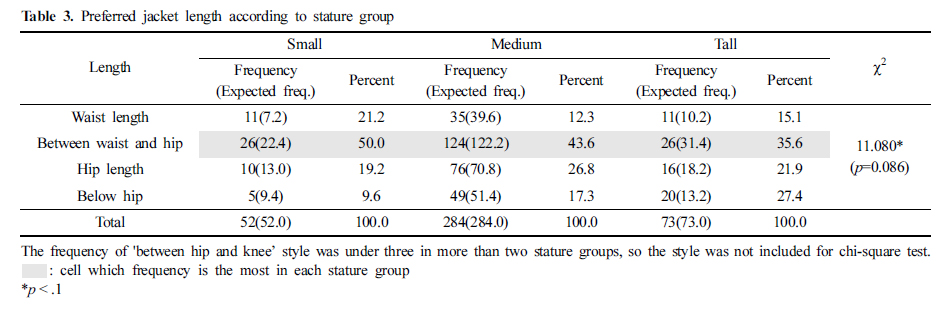
Place survey numbers and common units directly above the table to the right. Notes below the table are in the order of general notes, specific description notes, statistical notes, and source. Statistical notes should include a mark of the significance level first in the order of *p<.05, **p<.01, ***p<.001. Post-test content are described as indicated and with small letters such as a, b, c, etc. When a statistical table is cited, the source should be presented below the table in exactly the same method as quoting the source in the main text.
6. A table that includes images, illustrations or pictures should be marked as images, illustrations or pictures, and not indicated as a Fig. The source should be presented in the same manner as that for a Fig.
Ex 1) Statistical Table
Ex 2) Table with images
| Related photo |
|---|
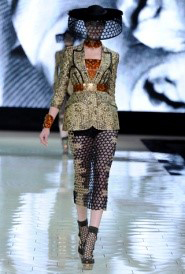 |
| Image 3. Ready-to-wear Alexander McQueen 2013 S/S. www.style.co.kr |
Figures
1. The title and content of a figure are to be written in English. If there is certainly necessary to use original languages (including Korean language) please note an original term after the English translation in [ ].
2. Referring to a figure in the main text: ex) “Fig. 1 represents –” or “– increased (Fig. 1).”
3. Figure format: It is recommended to use a box type graph composed of X, Y axis that does not include a double box. A data line or bar should be differentiated by different line types or patterns (and not with different colors). The description in a legend is principally indicated inside a graph and may be put as a description in the end of a caption when the description is long.
4. Items within all figures are required to be submitted with a Photoshop or Illustrator file (.tif, .psd, .eps, .ai, .pdf, or .jpg format) as a graphic file with high resolution of a print quality. When the width of a figure is reduced to 5.5 to 6cm, the size of the inserted letters (or sign) needs to be 2–3; in addition, a resolution of more than 300dpi is recommended.
5. Fig. caption and source: Only the first letter of a Fig. title is capitalized except for proper nouns.
In the case of several figures, it is suggested to place (a), (b), (c)... under each figure and write the description for each (a), (b), (c) at the end of the figure caption. The source of Fig. should be presented after a Fig. caption in italic type, and a period is put at the end of the caption.
In case of figure in costume history or an aesthetic field: After presenting a picture or illustration, the source should be briefly presented in the following form. The detailed source content should be presented in the reference section according to the Bibliography and Citation Guidelines. The page number must be noted in the case of a book quotation. The date that was prepared or captured should be recorded in the case of a performance for a picture or image that was taken directly. There is no need to include the source for an experimental result.
- Book : Fig. 1. Tulip line suit. Icons of Fashion in the 20th Century (1999), p. 70.
- Website : Fig. 2. Ready-to-wear Alexander McQueen 2013 S/S. http://www.style.co.kr.
- Media Content : Fig. 3. Costumes in ‘Cats’ that behave like a Human. 2006 Musical ‘Cats’ official DVD (October 1st 2012).
- Picture by Author : Fig. 4. Fantastical atmosphere presented by the harmony of stage lighting with blue
color and costume. Mask theatre ‘The story about Sora’s star’ (October 1st 2012).
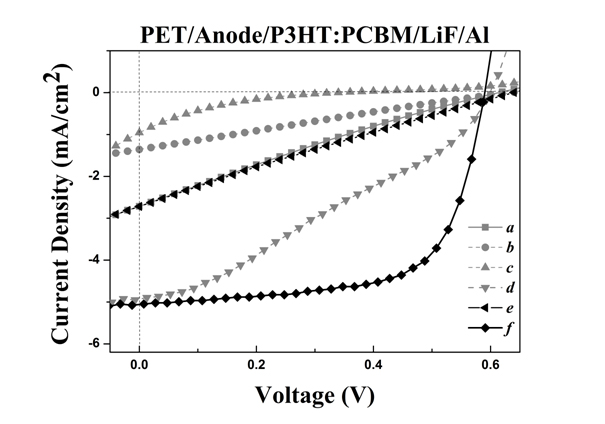 Fig. 1. J-V curves under AM 1.5G(100mW/cm2) of organic solar cells with various anode materials; a: PANI:CSA/SAS10, b: PANI:CSA/SAS20, c: PANI:CSA, d: PANI:CSA/SAS18, e: PANI:CSA with HTL, and f: PANI:CSA/SAS18 with HTL.
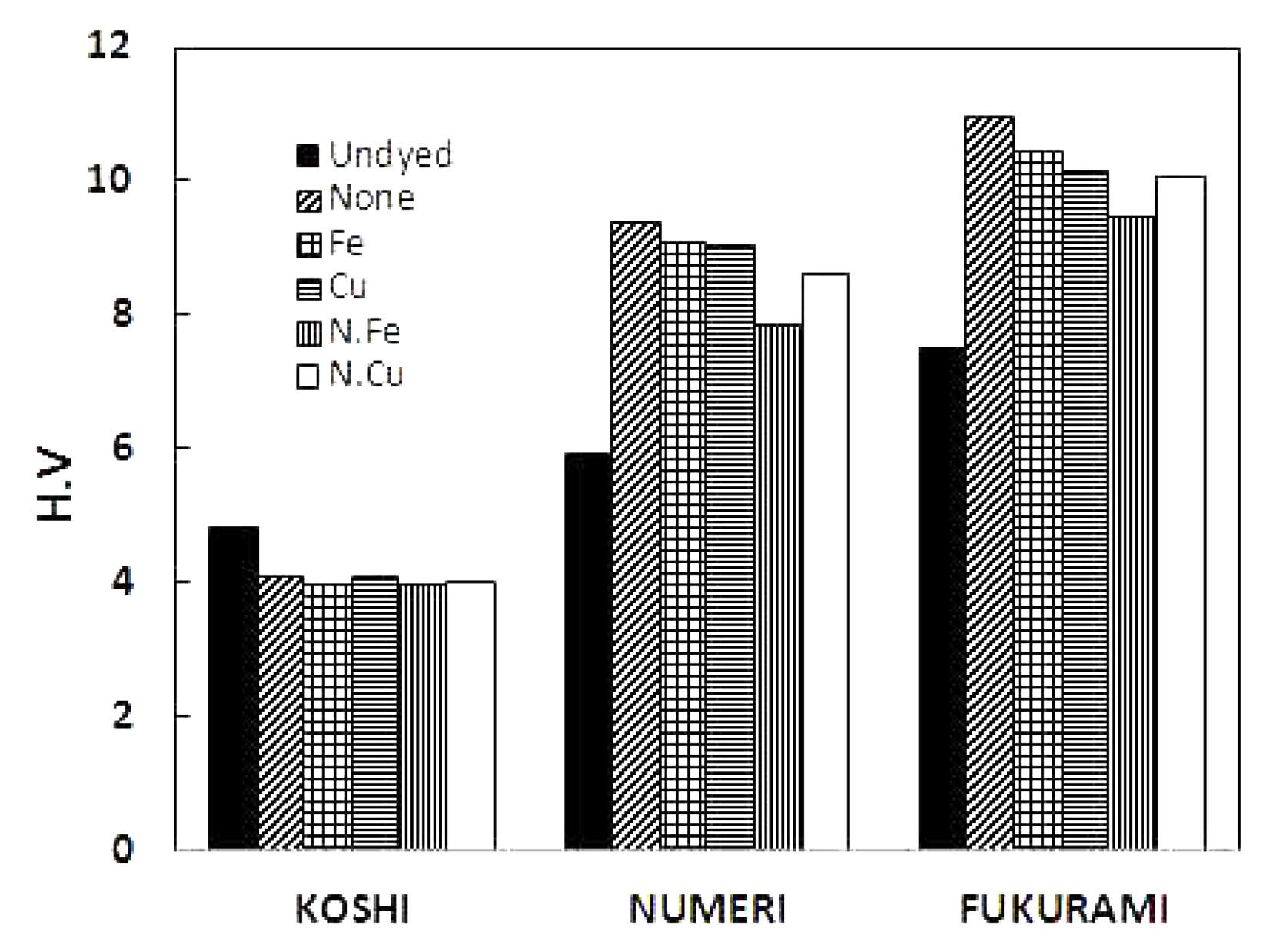 Fig. 2. Primary hand value of silk fabrics dyed with pine needles extract.
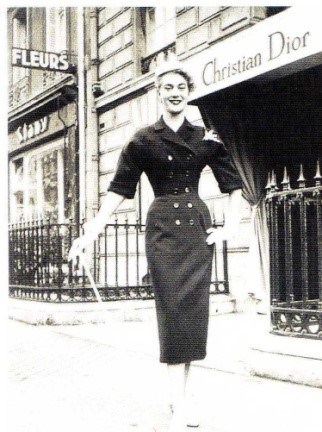 Fig. 3. Tulip line suit. Icons of Fashion in the 20th Century (1999), p. 70.
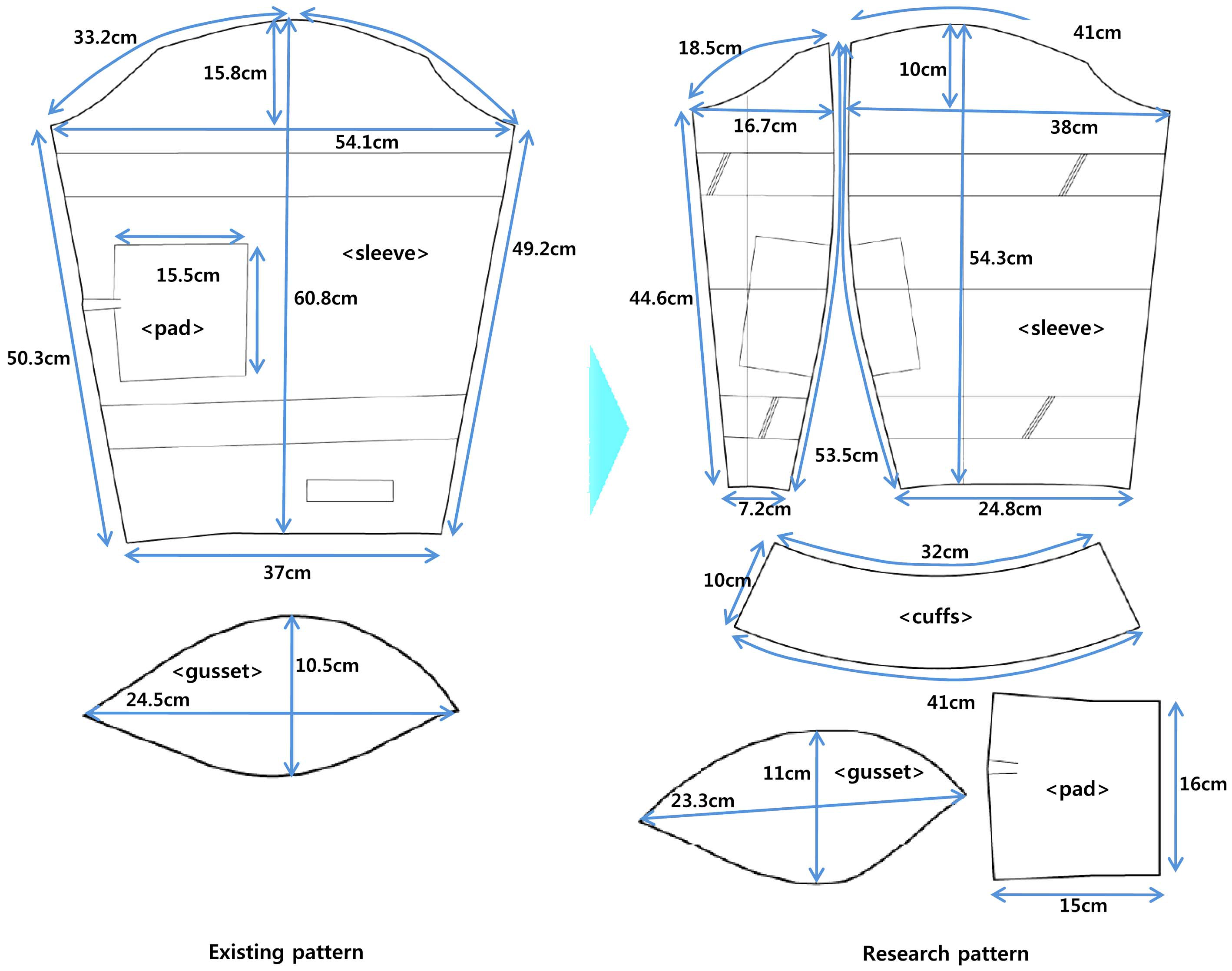 Fig. 4. Existing and developed sleeve patterns; (a)existing pattern, (b)research pattern.
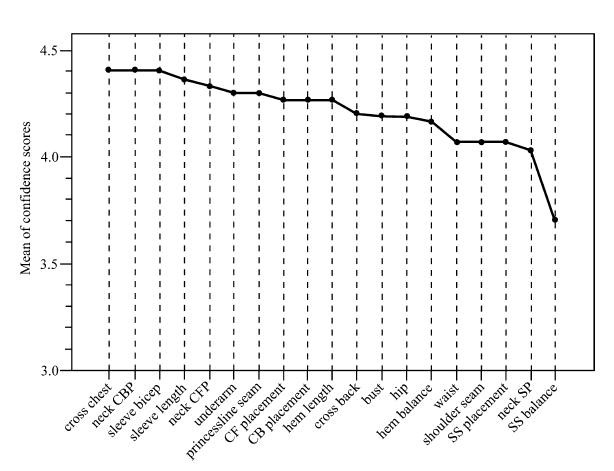 Fig. 5. Mean of confidence scores in rating misfit by body location: CB: center back, CBP: center back point, CF: center front, CFP: center front point, SS balance: side seam balance, neck SP: neck side point.
The Journal of Korean Association of Computer Education
Most Read

Copyrightⓒ2008 The Society of Fashion & Textile Industry. All rights reserved.
The Society of Fashion & Textile Industry / Editorial Office
5F, 234, Dasan-ro, Jung-gu, Seoul, Republic of Korea
E-mail:
kftrj@sfti.or.kr