
A Study on Improvement of Horseback Riding Pants I
© 2016 (by) the authors. This article is an open access article distributed under the terms and conditions of the Creative Commons Attribution license (http://creativecommons.org/licenses/by/3.0/), which permits unrestricted use, distribution, and reproduction in any medium, provided the original work is properly cited.
Abstract
This study has investigated improvement points of existing products by analyzing problems of horseback riding pants sold in market and by investigating wearing feeling of horseback riders. The purpose of this study is to suggest horseback riding pants which fit to body types of Korean adult women and also have improved functionality by reflecting findings of the study. The contents of this study is believed to suggest useful results on improvement of horseback riding pants sold in market; (1) By visiting hands-on experiencing horseback riding facilities, questionnaire investigation was carried out and we find problems of existing horseback riding pants. (2) Materials, designs and patterns of products sold in market are analyzed for improvement of horse-riding pants appropriate for Korean adult women body types. (3) Based on the results of previous analysis, this study was investigated wearing satisfaction after manufacturing improved horseback riding pants. As results of investigating wearing feeling for products manufactured with pattern designs reflecting the analysis result of existing horseback riding clothes as well as wearing feeling of horseback riders, it was possible to prevent wounds of bodies after horseback riding and the riders expressed high satisfaction for the products manufactured based on the research results.
Keywords:
horseback riding pants, wounds of bodies, wearing satisfaction, improvement1. Introduction
Korean domestic horse-riding industry was grown slowly because management of horseback riding facilities was poor and Korean people also considered horseback riding as an aristocratic sport but since the enactment of ‘Horse Industry Promotion Act’ in 2006, horse-riding industry now faces a decisive opportunity for a quantum-leap growth. It is investigated that Korean horseback riding population has grown to 45,000 people in 2012 which is an increase of 20,000 people within two years from 25,000 in 2010 (Ha, 2012). As Korean government recently announced plans to boost horse-riding industry, various positive effects such as growth of leisure industry, job creation, invigoration of agricultural economy and nurturing of human personality, etc are expected through boost of horseback riding (Kim, 2011). In particular, as Jeju Province is designated as a horse industry special zone recently, it is planned to carry out horse industry promotion plan by receiving government supports until 2017. According to the promotion plan, horseback riding tourism paths per each theme, Jeju horse history and culture exhibition hall and horseback riding foothold center, etc are included. In addition, it is planned to promote horse industry related manufacturing businesses such as harnesses and leather products, etc. Like this, as horseback riding facilities and horseback riding clubs are growing rapidly recently, horse-riding wear is appearing as a new rising star in domestic leisure and sport wear market and it is being watched with keen interest (Kim, 2015). Except for horse racing competition or in special occasions, any horse-riding wear is acceptable if there is no flapping parts in case of top clothes and in case of pants, beginners often wear blue jeans when they learn horseback riding for the first time. In particular, horseback riding pants shall be made with good materials which have high durability for contacting parts with saddles and prevent slipping for possible improvement of function and movement of horseback riding posture. In addition, it has the characteristics of being designed flexible and solid so that horseback riders can feel comforts and good touch feel despite violent movements.
However, at present, as preceding researches (Ha, 2012; Lee & Kwon, 2013) related to horseback riding, researches mainly related to horse-riding industry or sport and therapeutic horseback riding is the main stream. As researches related to horse-riding clothes, it is very limited to only few areas such as current status of horse-riding goods business and analysis of horse-riding clothes products, analysis and development of horse-riding clothes design, etc. Owing to this atmosphere, as horse-riding wear is rapidly appearing as a new rising star of domestic leisure and sport wear market, it is being watched with keen interest. Among them, horseback riding pants have the characteristics as being designed possible to help horse-riding postures and to improve functionality as the most core clothes during horse- riding.
This study has investigated improvement points of existing products by analyzing size and design of horse-riding pants sold in market and by investigating wearing feeling of horseback riders. The purpose of this study is to suggest horseback riding pants which fit to body types of Korean adult women and also have improved functionality by reflecting findings of the study.
First, by visiting hands-on experiencing horseback riding facilities, questionnaire investigation is carried out and we find problems of existing horseback riding pants. Second, materials, designs and patterns of products sold in market are analyzed for improvement of horseback riding pants appropriate for Korean adult women body types. In investigation of Korean human body size, horse-riding pants related to Korean adult women body types is examined by considering standardized clothes products sizes. Third, based on the results of previous analysis, we investigate wearing satisfaction after manufacturing improved horseback riding pants.
2. Method
2.1. Field investigation of horse-riding courses within Jeju city
For horse-riding hands-on experience of students and horse-riders survey, we have visited H horse-riding course with two students of graduate school. We have visited five times regularly from May 2013 to August 2013 and had actual horse-riding hands-on experiences and also investigated wearing status of horseback riding pants of horse-riders. We have limited subjects of the survey to those with over three years of horse-riding career among members of horse-riding club. Surveyed subjects of the questionnaire were 28 persons and five of them told us that they have horseback riding pants but at times they ride without wearing the horseback riding pants.
2.2. Lower body measurement analysis and election of examinees
In an investigation of Korean body sizes (Size Korea, 2011), we have selected body sizes related to general pants of adult women in consideration of standardized clothes products sizes (KS standards, Table 1).

Standardized clothes products dimension (unit: cm)
We have selected five women in their 20s~50s having body shape conditions of standardized clothes M size and also having horseback riding experiences in usual time as examinees. Each body sizes of 5 examinees are like Table 2.
Body sizes of examinees (unit: cm)
2.3. Selection of experiment clothes materials
As experiment clothes materials for developing horseback riding pants, we have selected denim with excellent appearance, wearing sensation and flexibility among those sold in market (Kim & Lee, 2013). Also we have selected 100% of denim dyed parts of friction generated between horse riders and horses with persimmon juice. Reasons for selecting them are for excellent durability and good-looking design due to persimmon juice dyeing.
2.4. Development and production of horseback riding pants design
The production team composed of graduate school students taking relevant classes have discussed the contents of the questionnaires and have developed design and patterns of horseback riding pants to be produced for the purpose of supplementing improvements after field survey of the horse-riding course. As a result of the field survey of the horse-riding course, we have limited subjects of the survey to professional horse-riders with over three years of horse-riding experiences and with experiences of wearing horseback riding pants and have investigated biggest issues of horseback riding pants they wear now through a method of interviews. They were concerned of having wounds of knee and buttocks the most and pointed out inconvenience by indicating issues of patch line, size and materials, etc. We have considered for padding line of existing designs so that seam does not cause troubles when contacting the skin and have attempted to reduce weight by selecting light materials for padding materials.
2.5. Wearing evaluation
We have analyzed five kinds of pants designs which were selected in investigation of horseback riding pants sold in market and after manufacturing pants for the examinees belonging to size M, we have evaluated wearing sensation of the manufactured experiment clothes. We have asked to carry out horseback riding actions per each examinee and questioned about wearing sensation. We have analyzed five types of pants design selected among the survey of horseback riding pants sold in market and after producing pants for those subjects belonging to size M of Table 1, we have asked three horse-riders to wear testing horseback riding pants produced for evaluation. We have asked each subject to make horse-riding motions wearing the horseback riding pants for a certain period in order to make wearing evaluation. We asked them what is overall wearing feel as a wearer and also asked to tell us wearing feels of padding part and patch line. Flat sketch of design development and productions (distinguishing back view of horseback riding pants) are like Fig. 1.
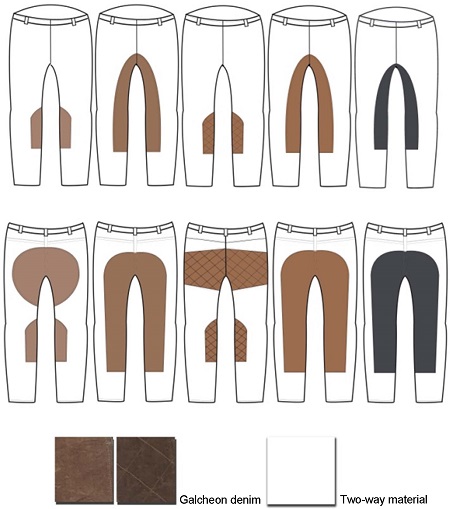
Flat sketch of design development and productions (back view).
3. Results and Discussion
3.1. Survey of horse-riders of horse-riding courses within Jeju city
The survey was implemented at horse-riding course. We have targeted horse-riders who have over three years of horse-riding career and those who have experiences of wearing professional horseback riding pants were about 82% (23 people among 28 subjects of the survey) of the subject of the survey. When we asked why some people do not wear professional horseback riding pants, they answered that they simply wear narrow casual trouser because it does not flutter during horse-riding and avoids inconvenience of changing into horseback riding pants. Since current trend of a trouser is in a narrow shape, it is believed that it was easy to replace breeches if it was not sever horse-riding activity. The serious problem of existing horseback riding pants was surveyed to have wounds in buttocks and shin part below the knee which are parts with the most friction during horse-riding. Wearing satisfactions of participants are like Table 3.
Wearing satisfaction of participants
3.2. Patterns of horseback riding pants and design development and productions
Materials of horseback riding pants sold currently in market were blended fabrics of cotton, polyamide, polyester, viscose, spandex, awatex and lycra. Their durability looked good. In general, about three materials were blended and it was possible to confirm that the majority contained various functionality (flexibility: bi-stretch) so that wearers can have comfortable horseback riding. In addition, in case of winter materials, warmth keeping was increased by attaching fluff on lining and it was possible to wear lightly and warmly because the fabrics were neither heavy nor thick. Photo 1 is horseback riding pants design and in case of front side, buckle type locking equipments were adopted to increase convenience of the wearers and ankle parts opening was velcro type to make it possible that each individual can wear in compliance to each one’s ankle. But materials and buckle type locking of horseback riding pants sold in market were limited. And as the design has pockets on both sides, it was possible to put simple stuffs. Fitting feel was also excellent with the use of functionality fabrics. Since design of pants with vertical cutting line was popular and common, we have manufactured by matching harmoniously each different material by selecting three kinds of designs with vertical sewing line and two kinds of designs on parts of hip and knee for experiment horseback riding pants manufactured in this study.
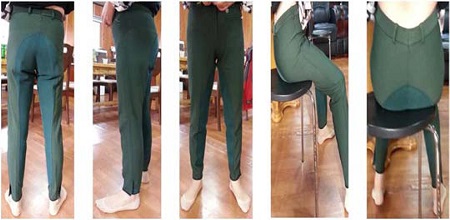
Buckle type locking equipments of horseback riding pants design.
We have applied by referring to precedent study (Ha & Seong, 2013; Kweon, 2012; Kwon & Hong, 2013; Oh & Suh, 2013) for horseback riding pants patterns. We have established and developed lines appropriate for horseback riding pants by analyzing existing products. Based on the results of previous analysis, pattern design of horseback riding pants was contemplated. We have considered for padding line of existing designs so that seam does not cause troubles when contacting the skin and have attempted to reduce weight by selecting light materials for padding materials. Horseback riding pants patterns developed after the discussions are like Fig. 2.
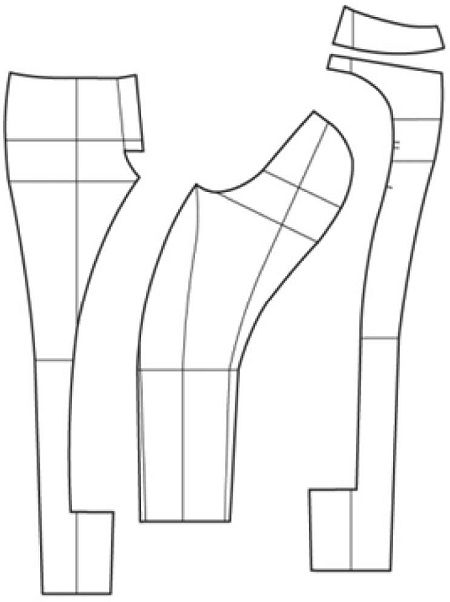
Patterns of horseback riding pants.
We have asked each subject to make horse-riding motions wearing the horseback riding pants for a certain period in order to make wearing evaluation. Front and back view of produced horseback riding pants are like Photo 2.
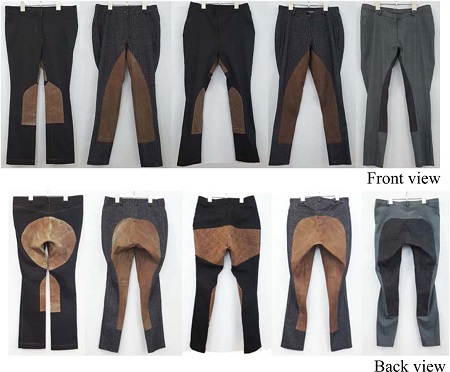
Design development and productions.
3.3. Improvements of horseback riding pants
Points of improvement discussed based on results of manufacturing and wearing horseback riding pants sold in market with various designs are as follows. Primary responses on wearing evaluation are like Table 4.
Responses on wearing evaluation
First, due to sitting motion during riding a horse, it tends that inseam is twisted toward the front side of knee. Since wounds are generated by irritating knee by sewing line due to slim margin between patch part, which is inside reinforcement plate, and outside plate, irritation of knee by slim margin of cutting line can be avoided if cutting line of patch part shall be composed of diagonal line from crotch to the middle of front knee. It can reduce irritation to skin by processing slim margin toward outside with flat fell seam instead of simple over lock process or doing stitching one more time by pushing slim margin to the maximum. Second, since lower knee part of pants enters into boots, it can minimize ankle irritation by processing with velcro or bending. Third, since majority of horseback riding pants tend to prefer both directional stretch materials, it is a trend to wear it very tight by purchasing one or two size smaller when selecting them and as riders wear smaller size, waist and abdomen pressure is severe when riding a horse. Therefore, it is judged that the problem can be solved if small bending structure is made on flank side or rear side of waist. Fourth, for hip patch, leather (chamois an, deer skin, etc) is preferred and recently, horseback riding pants are designed by using jean and hip cutting line is not processed separately but products with functionality together with pocket ornament by attaching leather patch on rear side pockets are being developed. Therefore, it is necessary to develop designs possible for wearing as an everyday dress. Fifth, since horseback riding is done for a long time, sweat are built and air is not penetrated, it must increase wearing sensation by considering design of openings of ankle or by using moisture and dryness absorption materials. Sixth, for pants materials, since 100% cotton materials provide too much pressure to horseback riding motions, two-way stretch materials are used and in fact, purchases of pants made of stretch materials are much larger and for hip patch, leather is preferred. For knee patch, materials, which are soft and have cushion, are preferred instead of hard materials which provide severe friction. In addition, fabrics with materials, which horse hairs are not well adhered, are preferred. Seventh, because flank side of knee and rear side thigh is prone to have wounds, it is necessary to consider wound prevention of the corresponding parts. As materials with durability are used for sturdiness, it becomes reasons for causing wounds from contacts with skin by wrinkles generated during bending knee.
4. Conclusion
This study is a preliminary study conducted through classes of department of clothing at graduate school for exploring improvement of horseback riding pants with the target of horse-riders in neighboring horse-riding courses together with invigoration of horse-riding industry in Jeju. Riding breeches are clothes with the most ratios among horse-riding clothes and are important clothes items that horse-riders must furnish together with horse-riding vests. Studies were implemented regarding preference of horseback riding pants designs or design analyses but in reality, studies on analyses of improvements of existing products are very poor. Main purpose of the study was to diagnose improvements by analyzing existing products and by applying analyzed results to horseback riding pants actually with the students, who will become customers of horse-riding in Jeju in the future, to be the center of the study. For overcoming problems of horseback riding pants sold in market, we have surveyed actual status of horse-riding clothes by visiting horse-riding courses within Jeju city for actual hands-on experiences of horse-riding and after interviewing with horse-riders. They expressed satisfaction for the following matters after wearing horseback riding pants produced by reflecting their obstacles.
Subject of the survey expressed convenience from improvement of sewing method together with consideration of cutting line while previous horseback riding pants had a trend that inseam moved to the front of the knee due to sitting action during horse-riding. Because lower part of knee of horseback riding pants is inserted into a boots, it was processed with velcro or banding and size of the velcro was reduced to be smaller and bias material was improved by substituting with materials without sticking of horse hairs. We have used two-way stretch materials for producing horseback riding pants materials and they responded that their wearing feels were good and also responded that they felt less pressure in waist and abdomen during horse-riding as a small banding structure was made in frank or rear of the waist. Buttocks and knee patch were completed in horseback riding pants design using jean. It was believed necessary to develop designs possible to wear as casual clothes without separately processing cutting line of buttocks. Because riders have sweat and air does not ventilate for long-time horse-riding, we have considered design of opening part of the ankle and also improved wearing feels by using moisture absorption and dryness absorption materials. We have used cotton and polyurethane mixed yarn material for trousers and have selected soft material with cushion for buttocks patch and knee patch instead of hard materials with much friction. In addition, it is believed that we need to have more consideration on surface processing as horse hairs shall not be attached easily. As we have considered materials for preventing wounds at parts with easy hurt, it is expected that the targets have less fears for wounds and feel more comfort. However, since parts with padding have feels of weight, we need to be careful in selecting materials during producing products.
This study was implemented in a method to draw out result through actual wearing tests for the students majoring in composition of clothes by diagnosing and directly producing parts of horseback riding pants with problems during horse-riding with the targets of horse-riders of horse-riding courses in Jeju region. We have referenced to existing products for overall designs and have improved knee and buttocks parts with problems by considering padding and padding line, etc. We believe that this study is very meaningful at the time when it is now time desirable to develop products for horse-riders who buy and wear imported horse-riding pad in market or who think the parts are inconvenient in usual time. In examination results, parts of inconvenience by actual horse-riders were applied a lot in production of horseback riding pants and these improvements must be considered in production of horseback riding pants sold in market in the future. Production localization will be implemented through cooperation between industry and school through follow-up studies which will apply and supplement the result of this study. Limits of this study are limited numbers of subjects of the study even though they are actual horse-riders and more professional analysis and application related to materials must be accomplished.
Acknowledgments
The research was supported by the 2015 scientific promotion program funded by Jeju National University.
References
- Ha, H. J., (2012), A design analysis of ladies’equestrian breeches in the Korean clothing market, Korea Society of Design Trend, 37(6), p479-494.
-
Ha, H. J., & Seong, O. J., (2013), Developing a prototype of bi-stretch pants for women in their 20s and 30s with overweight lower bodies, The Research Journal of the Costume Culture, 21(2), p246-260.
[https://doi.org/10.7741/rjcc.2013.21.2.246]

-
Kim, A. R., & Lee, Y. J., (2013), A study on the introduction of men's items in women's equestrian clothing, The Research Journal of the Costume Culture, 21(1), p31-41.
[https://doi.org/10.7741/rjcc.2013.21.1.031]
- Kim, D. S., (2011), A study on the Jeju`s horse & the related materials, Research of Jejudo, 28(2), p37-60.
- Kim, H. J., (2015, June), Promotion of horse industry, Horse Magazin, p11-21.
- Korean Agency for Technology & Standards, (2010), The report of national anthropometric survey of Korea 2010, Size Korea, Retrieved December 1, 2011, from http://sizekorea.kats.go.kr/.
-
Kweon, S. A., (2012), The effect of the skinny pants on the physiological responses and subjective pressure, Korean Journal of Human Ecology, 21(3), p567-576.
[https://doi.org/10.5934/KJHE.2012.21.3.567]
-
Kwon, S. H., & Hong, J. U., (2013), Evaluation of appearance and optimal for motion according to the back waist point of slacks pattern, Journal of the Korean Society of Clothing and Textiles, 37(6), p750-763.
[https://doi.org/10.5850/JKSCT.2013.37.6.750]
-
Lee, J. E., & Kwon, Y. A., (2013), Lower body type classification of women aged 20-30 for the development of riding breeches, The Journal of the Society of Clothing and Textiles, 37(8), p1075-1094.
[https://doi.org/10.5850/jksct.2013.37.8.1075]
-
Oh, S. Y., & Suh, D. A., (2013), Characteristics study of women's skinny jeans patterns by brand, The Research Journal of the Costume Culture, 21(5), p708-725.
[https://doi.org/10.7741/rjcc.2013.21.5.708]