
How Beauty Filters in AR Jewelry Try-on Affects Purchase Intention: Focusing on the Roles of Self-product Fit, Product Attitude, and Body Image

©2025 The Korean Fashion and Textile Research Journal(KFTRJ). This is an open access journal. Articles are distributed under the terms of the Creative 52 Commons Attribution Non-Commercial License (http://creativecommons.org/licenses/by-nc/4.0), which permits unrestricted use, distribution, and reproduction in any medium, provided the original work is properly cited.
Abstract
This study explores how beauty filters in augmented reality (AR) virtual try-on (VTO) systems affect consumers’ jewelry shopping decisions. It examines the influence of beauty filters on perceived self–product fit, product attitude, and purchase intention, and further investigates the moderating role of body image. An experiment was conducted with 108 female participants using existing AR try-on applications on Taobao. A confirmatory factor analysis (CFA) was conducted using AMOS to assess the validity of the measurement model. Following this, moderated serial mediation analysis was performed using the PROCESS macro in SPSS with body image included as the moderator. The results showed that unfiltered try-ons enhanced self–product fit, which, in turn, improved attitudes and boosted purchase intentions. This indirect effect was stronger for participants reporting higher body image satisfaction. These findings suggest that brands should exercise caution when applying beauty filters in virtual try-on systems, as they may weaken the sense of product fit, especially for users with a positive body image. Allowing users to adjust or disable filter intensity may improve user comfort and decision quality. This study demonstrates the psychological downsides of beauty filters in AR try-on and identified body image as a key moderating factor. This shifts attention from system-oriented technical features to user-centered psychological mechanisms, underscoring personalized design as a more effective solution. Methodologically, it enhances external validity through testing on an existing commercial AR try-on platform. These findings highlight the need for a user-centered design in AR retail, contributing to both consumer research and digital retail practices.
Keywords:
augmented reality, virtual jewelry try-on, beauty filters, self-product fit, body image1. Introduction
The global virtual try-on (VTO) market is experiencing rapid growth, with its market size projected to grow at a compound annual growth rate (CAGR) of 26.4% from 2024 to 2030, driven by increasing demand for immersive shopping experiences across sectors such as apparel, eyewear, and jewelry (Grand View Research, 2025). Notably, the Chinese VTO market is expected to expand at a similar CAGR of around 26%, owing to its tech-savvy consumer base and the dominance of major e-commerce platforms like Alibaba (Grand View Research, 2025). In parallel, the global jewelry market is forecasted to reach $374.8 billion by 2025, with the largest market share concentrated in China (Statista, 2025).
In the jewelry industry, brands are increasingly using virtual technology to enhance customer experience, allowing users to virtually try on jewelry as if they were in a physical store. İmre and Özseven (2024) reviewed several emerging virtual jewelry try-on applications and noted that jewelry is a category in which consumers are especially cautious and demanding in e-commerce, due to the difficulty of evaluating product details without physical inspection. Given the visual and tactile nature of jewelry, consumers require comprehensive product representations before making online purchases. Virtual try-on systems fulfill this need by simulating physical try-on experiences, thereby enhancing decision confidence (İmre & Özseven, 2024).
For instance, Tiffany & Co. has leveraged AR technologies through mobile collaborations with Snapchat and Taobao, enabling users to preview products like engagement rings and the Lock bracelet using high-fidelity visualization, including Snap’s ray tracing. The brand also integrated AR into its London archival exhibition, offering virtual try-on of the yellow Tiffany diamond and an immersive diamond wall experience (Snap Inc., 2023; Soper, 2023). Similarly, Graff introduced AR-based 3D previews on Tmall, providing realistic texture rendering and precise hand alignment for rings and bracelets (Kivisense, 2024). These examples reflect the luxury jewelry sector’s growing adoption of AR try-on to enhance product experience and consumer engagement in digital retail environments.
Despite the increasing popularity of AR-based virtual try-on technologies, most studies have primarily explored their technological attributes, such as interactivity (Poushneh & Vasquez-Parraga, 2017), perceived realism (Javornik, et al., 2016), and visual immersion (Hilken et al., 2017), and how these features enhance hedonic experience, product satisfaction, and purchase intentions (Yim et al., 2017; Wang et al., 2022). And with the increasing integration of beautifying filters into AR-VTO systems, other recent research has begun to explore the technology’s psychological implications, with some studies suggesting that filters can enhance perceived attractiveness and support idealized self-presentation (Chen et al., 2025). However, VTO technologies can also have unintended consequences, such as reduced realism, increased body awareness, and discomfort, especially when users become aware of the difference between their real and filtered appearance (Vendemia & DeAndrea, 2021; Wang et al., 2022). These findings highlight the dual-edged nature of beautifying filters in shaping user experience.
Self-product fit, defined as the perceived congruence between a consumer’s self-concept and a product’s attributes or image (Sirgy, 1986), plays a key role in shaping consumer reactions to virtual try-on. Research shows that consumers are more likely to form positive attitudes and stronger purchase intentions toward products that align with their actual or ideal self-image (Park & Lin, 2020; Sirgy et al., 2008). In virtual settings where visual cues dominate, this fit becomes even more salient (Hong & Pavlou, 2014). However, when beautifying filters alter users’ appearance, the perceived match between self and product may be disrupted, potentially weakening psychological engagement. Body image also plays an important role in how people react to virtual try-on experiences with beauty filters. Yim and Park (2019) found that people who are less satisfied with their bodies usually react more positively to filtered AR images, while people with a more positive body image may feel a mismatch when they see idealized virtual images. Although existing studies have explained the individual effects of body image and beauty filters, few have looked at how these two factors work together to influence consumers’ views on product fit or their willingness to buy, especially in luxury retail settings.
Given the above research gaps, this study aims to explore the psychological mechanisms of consumers in AR virtual jewelry try-on scenarios, particularly how consistent sensuality with the product affects their product reviews and purchasing intentions. Beyond product fit, the study highlights how beauty filters shape consumers’ self-perception and shopping responses, advancing theoretical understanding of consumer behavior in virtual try-on experiences. Specifically, the study addresses the following research questions:
- RQ1: “Does beauty filter usage reduce perceived self–product fit compared to unfiltered try-on?”
- RQ2: “Does self–product fit mediate the effect of filters on product attitude and purchase intention?”
- RQ3: “Does body image moderate this mediated relationship?”
Accordingly, the goals of this study are:
- (1) to examine the impact of filter usage (beauty filter vs. no filter) on consumers’ perceived self–product fit and their subsequent product evaluation and purchase intention;
- (2) to test the serial mediation effect of product fit and product attitude in the relationship between filter condition and purchase intention;
- (3) to investigate the moderating role of body image in the mediation pathway, identifying whether these effects differ depending on the consumer’s body image perception.
In this study we adopted an experimental survey design to investigate how beauty filters embedded in AR-based virtual try-on systems influence consumers’ psychological responses in the context of online jewelry shopping. Participants were randomly assigned to one of two simulated try-on conditions: a virtual interface with a beauty filter or one without. They interacted with the system to virtually try on rings or bracelets, then completed a structured questionnaire measuring perceived self–product fit, product attitude, purchase intention, and body image. Data were analyzed using PROCESS macro (Model 83) in SPSS to test both a serial mediation model and a moderated mediation effect. Specifically, the study examined whether the effect of filter usage on purchase intention was mediated sequentially by perceived self-product fit and product attitude, and whether this pathway was moderated by participants’ body image. The results supported all hypotheses, confirming that beauty filters can negatively influence perceived self–product fit, product attitude, and purchase intention—especially among consumers with more favorable body image. Our results show that the use of beauty filters in a virtual jewelry try-on environment will reduce consumers’ perception of self-product fit and product attitude, and this effect is only significant among consumers with high body image satisfaction, which will ultimately reduce their willingness to purchase.
This study has certain theoretical and practical value. On the theoretical level, this paper focuses on the impact of the use of beauty filters in the virtual jewelry try-on scene, emphasizing the role of two psychological factors: “self-product fit” and “body image.” Previous studies on virtual jewelry try-on have not fully explored these two variables. In addition, this study constructs a dual mediation path to illustrate how product self-fit and product attitude work together in the relationship between beauty filters and purchase intention. On the practical level, the research results provide a reference for the virtual try-on design of jewelry brands and digital platforms. The results show that beauty filters should not be used in general, because they may weaken the self-product fit and product evaluation of some consumers, thereby reducing purchase intention. On the contrary, the filter usage strategy should consider the differences in individual body image and self-cognition to create a more personalized and comfortable virtual shopping experience.
2. Conceptual Background and Hypotheses Development
2.1. VTO technology in online retailing
Online shopping platforms often present certain limitations—such as the inability to touch, feel, or accurately visualize products—which pose particular challenges in the fashion and beauty industries where sensory and visual assessment is critical (Kim & Forsythe, 2008). To address these limitations, augmented reality technologies have been introduced to enhance the digital shopping experience; by allowing virtual features to be integrated into real-world scenes, the mental gap between consumers and products is reduced (Poushneh, 2021). Among these AR applications, virtual try-on technologies have recently emerged as a key innovation, enabling users to overlay virtual items—such as makeup, accessories, or apparel—onto their real-time images using motion capture and facial or body tracking systems (Javornik et al., 2016).
By mirroring the user’s body or specific features, such as the face or hand, while simultaneously displaying virtual products like glasses, cosmetics, or jewelry, VTO systems create highly immersive and interactive shopping experiences (Shi et al., 2020). This approach has been widely adopted by major brands across the fashion and beauty sectors, highlighting its effectiveness in enhancing customer engagement and product visualization (Shi et al., 2020). Furthermore, VTO technologies may offer higher levels of enjoyment and interactivity compared to traditional offline shopping, contributing to their increasing popularity in digital retail environments (Lee & Chung, 2008).
In the context of high-value and complex products such as jewelry, online consumers often struggle to assess size, material, and overall appearance, which can hinder trust and drive preference for offline purchases (Shi et al., 2020). To overcome these barriers, AR-based VTO solutions are becoming increasingly prevalent in the jewelry industry. These technologies simulate the in-store experience by allowing users to virtually try on products, thereby improving customer satisfaction and aiding purchase decisions through clearer visualization of design features (Imre & Özseven, 2024; Prajapat et al., 2022). Kumar and Ambeesh (2022) found that the jewelry trying-on system based on AR technology can not only enhance the user experience but also enable more informed decision-making and personalized marketing strategies.
İmre and Özseven (2024) comprehensively summarize the technological innovations of virtual try-on systems in the jewelry industry. For example, Prajapat et al. (2022) developed a hand-tracking virtual try-on system using Mediapipe, OpenCV, and Unity, which can accurately locate jewelry such as rings and bracelets. Similarly, Cheng et al. (2019) proposed a mixed reality virtual jewelry try-on (MRVJF) system that integrates face and hand recognition capabilities but still has technical limitations in terms of comprehensive face detection and spatial superposition accuracy. These developments reflect the increasing application and technical maturity of VTO systems in the online jewelry industry.
2.2. The influence of beauty filters on self–product fit and purchase intention
“Beauty filters” are algorithmically driven tools that detect facial features and automatically adjust visual attributes to enhance users’ appearance (Andrada, 2025). Recent studies have shown that beautified photos can enhance users’ perception of the attractiveness of their appearance and improve their emotional state (Tiggemann et al., 2020), while making users feel more confident and attractive (Appel et al., 2023). Chen et al. (2025) further pointed out that beauty selfies enhance users’ preference for hedonic products. In addition, Javornik et al. (2021) found that beauty filters not only improve users’ experience satisfaction by presenting a more idealized self-image but also enhance their perception of the attractiveness of the product.
However, some scholars have also raised concerns about the negative consequences of filter use. Javornik et al. (2021) found that repeated engagement with digitally augmented versions of oneself can distort one’s sense of self, leading to psychological discomfort and reduced authenticity. From a marketing perspective, overuse of beautifying filters may result in consumer distrust. Yang et al. (2021) and Lv et al. (2022) showed that overly modified model images undermine perceived authenticity and reduce purchase intention. This “misrepresentation” effect also extends to influencer marketing, where perceived deception due to heavy filter use negatively affects followers’ attitudes (Taheran et al., 2024).
In virtual try-on contexts, the distortion created by beauty filters may impair perceived self–product fit—the degree to which a product aligns with the user’s authentic self-image. Isakowitsch (2023) found that AR beauty filters can lower self-acceptance and generate dissonance, especially when the digitally rendered self feels inconsistent with reality. This aligns with self-discrepancy theory put forward by Higgins (1987), which posits that inconsistencies between the actual and ideal selves can result in anxiety and dissatisfaction. On the other hand, self-congruity theory (Sirgy, 1986) suggests that when product images align with one’s self-concept—particularly the ideal self—they foster greater identification and positive evaluation.
Given the above research findings, we propose that not using beauty filters may lead to a more realistic and consistent virtual try-on experience, ultimately improving consumers’ perceived fit between themselves and the product and stimulating purchase intention. This view is supported by the research of Chen et al. (2025), who found that unbeautified product images were more effective in increasing consumers’ preference for functional products, suggesting that visual realism can have a positive impact on consumers’ decision-making. Therefore, we propose the following hypothesis:
H1a. Virtual try-on without a beauty filter (vs. with a beauty filter) will result in higher perceived self-product fit.
H1b. Perceived self-product fit will positively relate to purchase intention.
H1c. Perceived self-product fit will mediate the relationship between beauty filter usage (with vs. without a beauty filter) and purchase intention, such that the without a beauty filter condition increases perceived self-product fit, which in turn increases purchase intention.
2.3. The serial mediation role of self-product fit and product attitude
Given the above research findings, we propose that not using beauty filters may lead to a more realistic and consistent virtual try-on experience, ultimately improving consumers’ perceived fit between themselves and the product and stimulating purchase intention. Because beauty filters can distort self-image, the concept of self–product fit becomes central for explaining how these distortions shape consumer evaluation (Sirgy, 1982; Hong & Pavlou, 2014). Self–product fit refers to the perceived congruence between a consumer’s self-concept and the characteristics of a product (Sirgy, 1982; Hong & Pavlou, 2014).
According to self-congruity theory, consumers form stronger preferences and positive attitudes toward products that align with their self-identity (Sirgy et al., 2008; Park & Lin, 2020). This perceived alignment not only fosters favorable product evaluations but also strengthens brand attachment and behavioral intentions (Lee et al., 2012). The closer the match between self-image and product image, the more likely consumers are to develop positive attitudes and eventually make a purchase.
Therefore, in this study, self-product fit will serve as the initial psychological mechanism to shape consumers’ evaluation judgments, and product attitude plays a key mediating role. When consumers perceive that the product is consistent with their self-concept, this consistency will promote their positive attitude towards the product, thereby increasing the possibility of purchase. We propose the following hypothesis:
H2a. Perceived self-product fit will positively relate to product attitude.
H2b. Product attitude will positively relate to purchase intention.
H2c. The relationship between beauty filter usage (with vs. without a beauty filter) and purchase intention will be serially mediated by perceived self-product fit and product attitude, such that the without-filter condition increases perceived self-product fit, which in turn increases product attitude, resulting in higher purchase intention.
2.4. The moderating role of body image
Body image refers to one’s internalized perception and evaluation of one’s physical appearance, encompassing both cognitive and emotional responses, and is subject to change depending on situational or media influences (Myers & Biocca, 1992). This internal schema is shaped by both past and present perceptions of one’s own body, incorporating not only visual aspects but also sensory, emotional, and social experiences (Schilder, 2013; Pylvänäinen, 2003). Previous research has shown that body image influences individuals’ responses to technology product displays. For example, Yim and Park (2019) found that consumers with low body satisfaction were more receptive to augmented reality based product displays because these products provide idealized visual enhancements that compensate for perceived deficiencies in their self-perceptions.
Notably, individuals with a favorable body image tend to feel confident about their appearance and are more accepting of unfiltered, authentic representations (Halliwell, 2013). Prior studies have shown that such consumers are more likely to seek self-verifying experiences and prefer products that align with their actual selves (Javornik & Pizzetti, 2017; Malär et al., 2011). In contrast, those with lower body image often turn to augmented or beautified imagery to bridge the gap between their real and ideal selves (Javornik et al., 2021). Although body image and self-esteem are distinct constructs, they are closely related. Individuals with favorable body image often exhibit traits commonly associated with high self-esteem, such as body acceptance and confidence in physical appearance (Sirgy, 1982). Hermann et al. (2002) and Rosa et al. (2008) argue that individuals with high body image are less motivated to reinforce their appearance and are thus less influenced by highly idealized or enhanced visual presentations.
Taken together, these findings suggest that the effectiveness of filtered versus unfiltered virtual try-on experiences may be contingent upon the viewer’s level of body image. This study therefore proposes a moderated serial mediation model, positing that the positive effect of unfiltered virtual try-on on purchase intention—through self-product fit and product attitude—will be significant only among consumers with favorable body image. Thus, we hypothesize the following:
H3a. Body image will moderate the effect of beauty filter usage (with vs. without a beauty filter) on perceived self-product fit, such that the positive effect of the without-filter condition will be stronger when body image is positive (vs. negative).
H3b. Body image will moderate the serial mediation process from beauty filter usage (with vs. without a beauty filter) to purchase intention via perceived self-product fit and product attitude, such that the process will be significant only when body image is positive (vs. negative).
Overall, Fig. 1 illustrates the conceptual framework of the research.
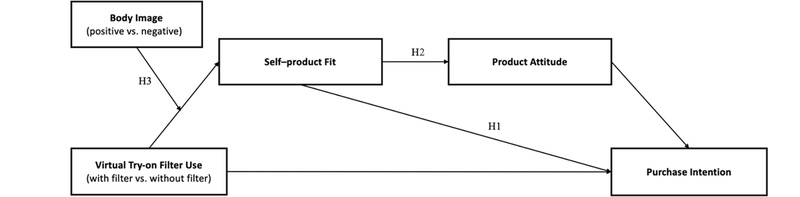
Conceptual framework of this research.
3. Methods
3.1. Design and stimuli
The study employed a single-factor 2 (virtual try-on filter use: with filter vs. without filter) between-subjects design. As experimental stimuli, we used brand-specific AR virtual try-on applications embedded within the Taobao platform, developed by two jewelry brands (Tiffany and Graff). Although both applications were integrated into the same platform and shared comparable layouts and functionalities, they differed in the application of beauty filters: the Tiffany application incorporated a beauty filter, whereas the Graff application did not. Both applications offered a wide selection of jewelry items, including rings, necklaces, and earrings, and enabled users to virtually try on products, take photos, and view the wearing effect. However, in this study, participants were instructed to try on hand jewelry only (rings and bracelets), as these products involve more consistent and controllable operations and photographing processes, thereby enhancing the internal validity of the experiment. The applications allowed participants to select different designs and zoom in or out to examine details of materials and craftsmanship, providing a realistic inspection experience. Fig. 2 shows examples of the try-on effects from each brand.
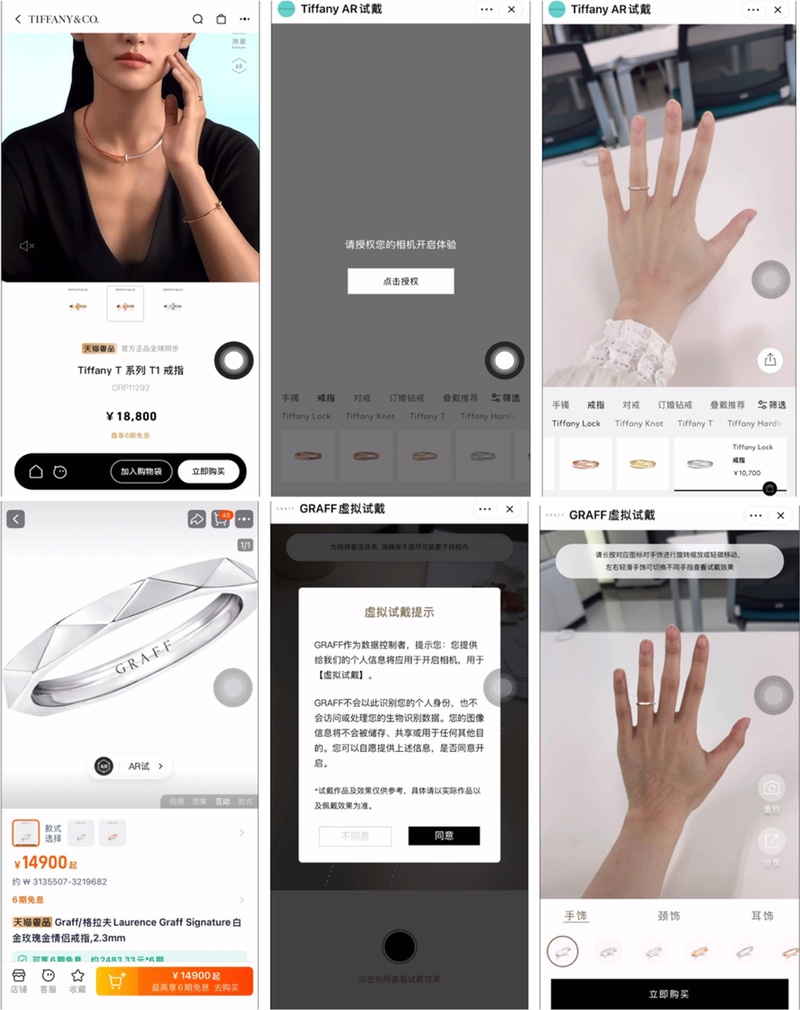
The sample images of the experimental stimuli (top: with filter; bottom: without filter).
3.2. Participants
A total of 108 valid participants (100 per cent female; Mage = 26.9, SD = 6.46) were recruited for this study. Recruitment was conducted over a two-week period in March 2025 using a convenience sampling strategy. This sampling method has been used in previous studies on specific issues related to consumers (e.g., Trivedi et al., 2022). A survey link hosted on Wenjuanxing (https://www.wjx.cn/) was distributed to a wide and varied sample of Chinese consumers via social media platforms (e.g., WeChat), personal contacts, and word of mouth. To ensure product relevance, only women were eligible to participate, as the virtual try-on involved jewelry items. Prior research has shown that women are generally more sensitive and responsive to the experiential aspects of jewelry usage and to the effects of beauty filters compared to men (Stokburger-Sauer & Teichmann, 2013; Anani et al., 2024). Therefore, AR jewelry virtual try-on technology might be especially valuable for female consumers, their perceptions and attitudes toward the presence or absence of beauty filters are expected to offer practical implications for real-world applications and form a suitable research sample. Eligibility criteria included owning a mobile device with a functioning camera and having the Taobao application installed, as this was necessary to complete the virtual try-on tasks, take photos of the wearing effects, and ensure the accuracy and consistency of the experimental data.
3.3. Procedure
At the beginning of the survey, participants read an informed consent form and indicated their agreement to participate. Subsequently, participants were assigned at random to one of two experimental groups: with filter condition (N = 56) or without filter condition (N = 52). Then, participants read detailed instructions on how to complete the experimental task using the Taobao application. The study scenario was described as follows: “Please imagine that you are planning to purchase a ring for an upcoming special occasion (e.g., a wedding anniversary, family celebration, or birthday party). You would like to choose a ring that is both beautiful and suits you well. However, because you do not have time to visit physical stores and try on the products in person, you decide to use an online virtual try-on experience instead.” Participants were instructed to scan a QR code provided by the researchers to access the Taobao application and select the designated online product display page from the menu. The experimental task was identical across conditions: participants were required to use the Taobao application to try on multiple rings or bracelets and then choose the one they liked best. After performing the experimental task, participants completed a survey measuring the following constructs: purchase intention (3 items; Meyers-Levy & Maheswaran, 2004), self–product fit (3 items; Park & Lin, 2020), and attitude toward the product (5 items; Spassova & Lee, 2013). All items were rated on seven-point Likert scales (1 = “strongly disagree” to 7 = “strongly agree”). In addition, body image was measured with one item adapted from Yim and Park (2019): “Do you wish to change the shape of parts of your body?” (1 = “not at all” to 7 = “very much”). This item was chosen because it provides a concrete and easily comprehensible indicator of participants’ current body image relative to their usual perception, which is useful for capturing the situational impact of the AR virtual try-on experience. Although multi-item validated scales for body image exist, prior research has demonstrated that single-item measures can effectively assess state-like constructs in short-term experimental manipulations (e.g., Hollett et al., 2024; Rosenberg, 2009). Participants then completed a manipulation check item: “Do you think the virtual try-on you just experienced included a beauty filter?” (1 = “without filter” to 7 = “with filter”), adapted from Niu (2021). Finally, they provided demographic information and were thanked for their participation. Additionally, several control variables were considered: brand familiarity (1 = “very unfamiliar” to 7 = “very familiar”) and brand attitude (1 = “very negative” to 7 = “very positive”). Details of all measurement items can be found in Table 1, with reliability coefficients ranging from acceptable to excellent levels.

Measurement validity and reliability
4. Results
4.1. Manipulation check
First, we conducted a manipulation check to assess whether the filter usage condition effectively influenced perceptions. Results indicated that participants in the beauty filter condition reported significantly stronger perceived filter effects (t = 2.06, p = .042; Mwith filter = 3.95, SD = 1.66; Mwithout filter 3.31, SD = 1.55), confirming the validity of the manipulation. Regarding the control variables, no significant differences emerged for brand attitude (t = –0.04, p = .965). However, there was a marginally significant difference in brand familiarity between conditions (t = 1.86, p = .065). Therefore, brand familiarity was included as a covariate in subsequent analyses.
4.2. Construct validity
To assess the measurement model’s validity, a confirmatory factor analysis (CFA) was performed. In line with established recommendations, multiple model fit indices were evaluated to obtain a comprehensive assessment of fit quality. The results showed that the model fit the data adequately: χ²/df (41) = 1.66, CFI = 0.969, NFI = 0.927, TLI = 0.959, IFI = 0.970, and RMSEA = 0.078. The RMSEA value, in particular, met the widely accepted criterion of being below 0.08, reflecting an acceptable approximation of model fit (Browne & Cudeck, 1992; Arbuckle, 2006).
Convergent and discriminant validity were examined through several indicators, including standardized factor loadings, Cronbach’s alpha, composite reliability (CR), and average variance extracted (AVE), as presented in Table 1. All items showed statistically significant factor loadings above the recommended threshold (Hair et al., 2010), and all AVE values exceeded the 0.50 threshold suggested by Fornell and Larcker (1981), indicating satisfactory convergent validity. Reliability measures for all constructs—Cronbach’s alpha and CR—were above 0.70, confirming internal consistency and construct reliability (Bagozzi & Yi, 1988).
Table 2 summarizes discriminant validity. The strongest observed correlation among the latent variables was 0.836, remaining below the 0.850 limit, thereby supporting discriminant validity (Kline, 1998). Furthermore, the square roots of AVE for each construct were higher than the corresponding inter-construct correlations, providing additional confirmation of discriminant validity in accordance with Fornell and Larcker(1981) criteria.
Discriminant validity of constructs
4.3. Common method variance
To evaluate the potential influence of common method bias, Harman’s single-factor approach was applied using confirmatory factor analysis, where all observed variables were constrained to load onto a single latent factor, as recommended by Podsakoff et al. (2003). The resulting model demonstrated poor fit: χ²/df (44) = 237.444, GFI = 0.654, CFI = 0.779, NFI = 0.745, and RMSEA = 0.203, indicating that a single-factor structure did not adequately represent the data. A model comparison further confirmed this inadequacy; the one-factor solution fit significantly worse than the original multi-factor measurement model (Δχ2 = 169.541, Δdf = 3, p < .001). These results show that common method bias was not a serious issue in this study.
4.4. Serial mediation analysis
A serial mediation test was conducted using PROCESS macro (Model 6) with 5000 bootstrap samples (Hayes, 2017). The results showed that without a filter significantly increased perceived self-product fit (β = 0.745, SE = 0.263, 95% CI [0.224, 1.267]). Perceived self-product fit had a significant positive effect on product attitude (β = 0.513, SE = 0.064, 95% CI [0.386, 0.641]) and purchase intention (β = 0.511, SE = 0.076, 95% CI [0.361, 0.662]). Product attitude further had a significant positive impact on purchase intention (β = 0.266, SE = 0.091, 95% CI [0.085, 0.447]). These results are shown in Table 3.
Serial mediation analysis results
The direct effect of filter usage on purchase intention was not significant (β = 0.181, SE= 0.167, 95% CI [–0.151, 0.512]). However, the total indirect effect through perceived fit and product attitude was significant (β = 0.477, SE = 0.172, 95% CI [0.161, 0.827]). Specifically, the indirect effect via perceived fit alone was significant (β = 0.381, SE = 0.141, 95% CI [0.130, 0.688]), while the indirect path through product attitude alone was not significant (β = –0.006, SE = 0.048, 95% CI [–0.100, 0.097]). The sequential indirect effect through both perceived fit and product attitude was significant (β = 0.102, SE = 0.053, 95% CI [0.025, 0.229]) (see Table 4 and Fig. 3). These findings support H1(a)(b)(c) and H2(a)(b)(c). Analyses excluding brand familiarity yielded similar results.
Direct effect and indirect effect results
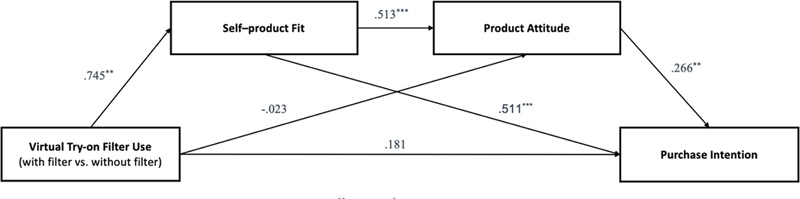
Serial mediation model.
4.5. Moderated mediation of body image
To examine the moderating effect of body image, we followed Gelman and Park (2009) and Yim and Park (2019) in splitting the data into three groups representing negative, moderate, and positive body image. The moderate group was excluded, leaving participants with positive body image (Mpositive = 4.69, SD = 0.97) and negative body image (Mnegative = 2.48, SD = 0.73). The results of the ANCOVA revealed a marginally significant interaction effect of beauty filter usage and body image on perceived self-product fit (F (1, 103) = 3.49, p = .065, see Fig. 4). There was also a significant main effect of beauty filter usage (Mwith filter = 4.43, SD = 1.47 vs. Mwithout filter 5.03, SD = 1.31; F (1, 103) = 9.16, p = .003), whereas the main effect of body image was not significant (p = .830). Further pairwise analysis showed that when body image was positive, participants in the without-filter condition (M = 5.35, SD = 0.28) reported significantly greater perceived self-product fit than those in the withfilter condition (M = 4.07, SD = 0.27; F (1, 103) = 10.87, p = .001). No such difference was found among participants with a negative body image (p = .372). Thus, H3a was supported.
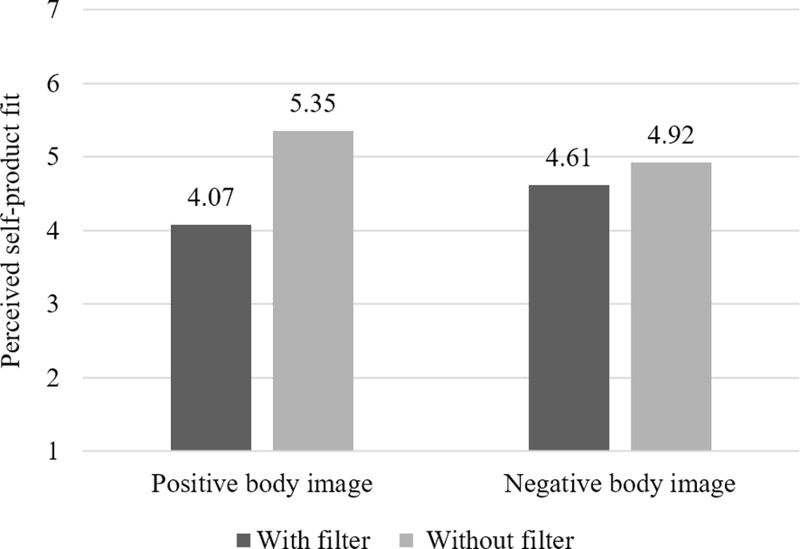
Interaction effect of beauty filter use and body image on perceived self–product fit.
To test H3b, a serial moderated mediation analysis (Process Model 83, 5,000 bootstraps; Hayes, 2017) was conducted with filter usage as the independent variable (0 = with filter, 1 = without filter), body image as the moderator, perceived self-product fit as the first mediator, product attitude as the second mediator, purchase intention as the dependent variable, and brand familiarity as the covariate. The results revealed a significant moderated mediation effect (β = 0.067, SE = 0.040, 95% CI = [0.010, 0.165]). In the positive body image (+1 SD), the moderated mediation effect was significant (β = 0.190, SE = 0.088, 95% CI = [0.059, 0.403]), but not for the negative body image (−1 SD) (β = 0.004, SE = 0.058, 95% CI = [-0.120, 0.120]) (see Fig. 5). Therefore, H3b was validated. Additional analyses excluding brand familiarity yielded consistent findings.
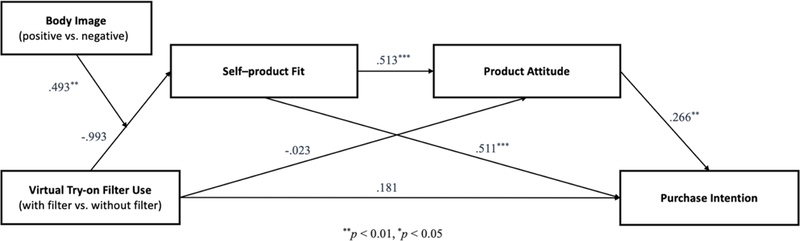
Moderated mediation model.
5. General Discussion
5.1. Summary of Findings
This study examines how the use of beauty filters in AR jewelry virtual try-on affects consumers’ shopping decisions. The current results show that beauty filters influence consumers’ purchase intentions by affecting their self-product fit, which then impacts their product attitude and finally their intention to buy. In particular, this study also looks at how consumers’ body image evaluation moderates this path. The results show that presenting jewelry products in virtual try-ons without beauty filters can increase consumers’ perception of self–product fit. This result then indirectly improves their intention to buy. Unlike past studies, people often perceive filters as beneficial tools in everyday life and on social media. They help narrow the gap between the real self and the ideal self, enhance personal appeal and self-evaluation, and facilitate alignment between the self and product image, which in turn fosters more positive attitudes and behaviors (Javornik et al., 2021). However, this study focuses on AR virtual try-on. In this context, consumers are less concerned with achieving the ideal self and place greater emphasis on the authenticity and reliability of the visual experience. This is particularly salient in the case of jewelry—a luxury category rooted in identity expression and personalized value. While filters may enhance appearance at an idealized level, they simultaneously diminish the perceived realism of the product display. As a result, consumers may question the validity of the virtual try-on, weakening the perceived fit between the self and the product (Nann et al., 2024; Taheran et al., 2024). Overall, this results in negative product attitudes and lower purchase intention. These findings highlight that the impact of filter use is highly context-dependent. In social media or everyday shopping settings, filters may reinforce the ideal self and generate positive effects. By contrast, in AR virtual shopping, authenticity becomes the dominant factor shaping consumer evaluations. When the pursuit of an ideal look conflicts with perceived authenticity, consumers prioritize experiences that align more closely with reality. Drawing on self-congruity theory (Sirgy et al., 2008), when consumers perceive that a product matches their self-image, they experience stronger psychological identification and more favorable evaluations, which in turn enhance purchase intention (Lee et al., 2012). Within AR try-on services, avoiding filters reduces psychological distance from one’s self-image (Ozimek et al., 2023; Ryding & Kuss, 2020). This increases perceived authenticity of the product display, thereby strengthening consumers’ intention to purchase.
Self–product fit and product attitude in virtual try-ons are recognised as key psychological factors influencing purchase intention (Sirgy, 2008; Malär et al., 2011; Javornik et al., 2021). While it was initially expected that the absence of beauty filters would directly increase purchase intention through enhanced self–product fit, the results reveal a more nuanced mechanism. Specifically, virtual try-ons without beauty filters significantly strengthen consumers’ perceived self–product fit, which in turn improves product attitude.
Although beauty filters create an idealised appearance, they simultaneously undermine perceptions of authenticity. As a result, consumers may doubt the product’s true alignment with their self-image, leading to weaker self–product fit and consequently less favourable product attitudes. Thus, filters do not directly alter product attitude but instead exert their influence through the mediating role of self–product fit.
Importantly, the findings also indicate that self–product fit alone does not directly affect purchase intention. Rather, product attitude serves as the crucial mediator. As a comprehensive psychological evaluation, product attitude reflects consumers’ overall assessment of the product and plays a central role in purchase decisions (Boyland & Halford, 2013; Yao & Huang, 2017). Therefore, product attitude is confirmed as the key mechanism linking AR virtual try-on experiences to purchase intention, particularly in contexts where authenticity is paramount.
The results indicate that body image moderates the impact of beauty filters on perceived self–product fit. Specifically, the effect of beauty filters on self–product fit is stronger among consumers with high body image. Those who are more satisfied with their appearance tend to prefer realistic, unedited visual presentations. For them, the idealized images produced by beauty filters may conflict with their actual self, thereby weakening their perceived fit with the product and diminishing positive evaluations (Malär et al., 2011; Javornik & Pizzetti, 2017). Furthermore, the findings lend support to self-discrepancy theory (Higgins, 1987). Beauty filters can exacerbate the gap between a consumer’s ideal self and actual self, reducing the psychological sense of fit with the product.
5.2. Theoretical Implications
This study makes two main theoretical contributions to existing research. First, it advances academic understanding by clearly evaluating the role of beauty filters in AR experiences and examining how they influence self–product fit and product attitude through psychological processes. While prior research on AR virtual try-ons has largely focused on technical aspects such as interaction, realism, and visual immersion (Song et al., 2020), far fewer studies have explored the underlying psychological mechanisms. In particular, little attention has been paid to how visual presentations, such as the use of filters, shape self-perception and product evaluation. Moreover, there has been no clear consensus on how to measure the effects of beauty filters in AR try-on contexts.
Grounded in self-congruity theory (Sirgy, 2008) and self-discrepancy theory (Higgins, 1987), this study introduces self–product fit as a key measure of psychological processes in AR virtual try-ons. It demonstrates that virtual try-ons without beauty filters enhance consumers’ self–product fit, which subsequently improves product attitude and purchase intention. These findings provide new evidence of the psychological effects of visual self-presentation and address a gap in the AR literature concerning the role of visual realism in shaping consumers’ psychological fit with products. In particular, this study clarifies the pathway by which self–product fit influences product attitude, thereby offering a deeper understanding of consumer psychology in virtual retail settings.
Second, this study challenges prior research that emphasizes the positive role of beauty filters in daily life and social media—where they are thought to enhance consistency with the ideal self and improve self-presentation (Javornik et al., 2021; Sirgy, 2008). In contrast, the results show that within AR virtual try-ons, beauty filters diminish perceptions of authenticity, reducing self–product fit and consequently lowering product attitude and purchase intention. This effect is especially salient in the context of jewelry, a product category with strong symbolic meaning and identity expression. Compared with fashion or cosmetics, jewelry try-ons depend more heavily on authenticity, making the “unreality” caused by filters more pronounced. By focusing on jewelry, this study not only fills a gap in AR try-on research but also extends theoretical understanding of the limits of AR technology in high-value product categories.
In addition, this study confirms that consumers’ individual characteristics—particularly body image—play an important moderating role in AR virtual try-ons. This addresses a gap in prior research, which has paid limited attention to individual differences. Although some studies have noted the potential influence of body image on consumer responses in AR environments (Yim & Park, 2019), few have examined how body image shapes psychological responses and purchase decisions in relation to filter use.
The findings reveal that consumers’ satisfaction with their appearance strongly affects their acceptance of beauty filters. Specifically, those with higher body image prefer realistic, unedited visual presentations. This extends insights from self-discrepancy theory by showing how differences between the ideal and real self affect consumer behavior in AR contexts. It also demonstrates the moderating role of body image in shaping self–product fit, product attitudes, and purchase intentions. By clarifying these interactions, the study expands the applicability of body image research to immersive shopping experiences and provides a foundation for future investigations into how consumer traits interact with AR environments.
5.3. Managerial Implications
When designing such services, firms should carefully consider the potential negative psychological impact of beauty filters and avoid focusing solely on visual appeal. The findings demonstrate that realistic virtual displays, compared to images enhanced with idealized filters, significantly improve consumers’ psychological fit with products. Accordingly, companies should prioritize AR systems capable of accurately recognizing users’ real facial and body features to ensure authenticity in product presentation. High-fidelity displays allow consumers to examine details such as the material and texture of jewelry more closely, thereby strengthening product attitudes and purchase intentions. For jewelry and other high-value accessory categories in particular, authenticity—not beautification—should be the guiding principle in AR try-on design.
Second, this study shows that consumers’ body image strongly influences the effectiveness of AR try-on experiences. Managers should therefore pay close attention to differences across consumer groups. The results indicate that consumers with higher body image satisfaction perceive lower self-product fit and demonstrate weaker purchase intentions when beauty filters are applied. Accordingly, companies should be cautious with—or even avoid—overly beautifying filters when designing virtual try-on functions. Instead, firms can enhance the try-on experience by improving the accuracy of AR modeling, as well as the realism of textures and lighting, rather than relying on filters. Brands may also benefit from offering personalized options, such as allowing users to adjust filter use or intensity to match their preferences. Moreover, strengthening emotional engagement and interactivity—through features like multi-angle views or dynamic try-on simulations—can further enhance product attitudes and boost purchase confidence.
Finally, companies expanding online should integrate AR virtual try-on services. While online shopping is widespread, many consumers hesitate due to the inability to test products physically. Highly realistic AR try-ons address this barrier by immersing consumers in the shopping process and increasing decision confidence. The technology is widely accessible through smartphones and other mobile devices, making adoption simple. By providing high-quality AR try-on experiences, firms can strengthen purchase intention, enhance decision satisfaction, and improve both sales performance and customer experience.
5.4. Limitations and Future Research
This study has several limitations that future research should address. First, the beauty filters examined were based on existing AR jewelry try-on applications, which limited the degree of control over filter effects. The study primarily compared consumer perceptions of using versus not using beauty filters and explored how these perceptions influenced psychological states and purchase intentions. However, because of restrictions in commercial applications, it was not possible to precisely manipulate or adjust the intensity of the filters (e.g., varying levels of beautification). As a result, this study could not fully investigate how different levels of filter intensity influence self–product fit or psychological ownership. Future research could overcome this limitation by developing or customizing AR try-on systems that allow for fine-tuned adjustments of filter strength. This would enable a more detailed analysis of how varying degrees of beautification interact with consumer characteristics—such as body image—while also providing greater control over individual differences in perception.
Second, this study focused on current AR virtual try-on applications and targeted potential users—specifically women aged 18–30. This limits the generalizability of the findings to more diverse groups, such as older adults and men, who may respond differently. Prior research suggests that younger consumers are generally more technologically adept and experience less anxiety when adopting new technologies (Vishwanath & Goldhaber, 2003), making them more receptive to AR try-on services. By contrast, older consumers often face greater challenges in technology adoption. Gender differences may also influence responses: compared to men, women tend to place greater importance on direct product experiences, which AR try-ons replicate more effectively than traditional online shopping formats. Consequently, AR try-ons may enhance women’s shopping experiences to a greater extent than men’s (Garbarino & Strahilevitz, 2004). These findings suggest that the positive effects identified in this study may be less pronounced among older consumers or men. Future research should therefore include more diverse demographic groups and investigate whether age and gender moderate the influence of beauty filters on purchase intentions in AR try-on settings.
Finally, the study’s relatively small sample size presents another limitation. Although the use of PROCESS analysis and bootstrapping techniques can partially mitigate the impact of small samples on reliability (Hayes, 2017), and statistical checks (e.g., G*Power) indicated adequate statistical power, the sample was still limited in scope—focusing primarily on young women of similar age and occupational backgrounds. While young women are commonly used in studies of emerging technologies such as AR try-ons, this approach does not fully address issues of generalizability. Future studies should employ larger, more diverse samples to provide stronger external validity and to ensure that findings can be extended to a wider population.
References
- Arbuckle, J. (2006). Amos 7.0 user’s guide. Marketing Division, SPSS Incorporated.
-
Anani, P. W., Mintah, F. D., Danso, A. A. A., & Churcher, E. W. (2024). Filtered reality: Exploring the motives and socio-demographic factors of smartphone beauty filter usage among university students in Ghana. Cogent Arts & Humanities, 11(1), 2392381.
[https://doi.org/10.1080/23311983.2024.2392381]

-
Andrada, G. (2025). Beauty filters in self-perception: The distorted mirror gazing hypothesis. Topoi, 44, 367-378.
[https://doi.org/10.1007/s11245-024-10149-1]
-
Appel, M., Hutmacher, F., Politt, T., & Stein, J.-P. (2023). Swipe right? Using beauty filters in male Tinder profiles reduces women's evaluations of trustworthiness but increases physical attractiveness and dating intention. Computers in Human Behavior, 148, 107871.
[https://doi.org/10.1016/j.chb.2023.107871]
-
Bagozzi, R. P., & Yi, Y. (1988). On the evaluation of structural equation models. Journal of the Academy of Marketing Science, 16, 74-94.
[https://doi.org/10.1007/BF02723327]
-
Boyland, E. J., & Halford, J. C. G. (2013). Television advertising and branding: Effects on eating behaviour and food preferences in children. Appetite, 62, 236-241.
[https://doi.org/10.1016/j.appet.2012.01.032]
-
Browne, M. W., & Cudeck, R. (1992). Alternative ways of assessing model fit. Sociological Methods & Research, 21(2), 230-258.
[https://doi.org/10.1177/0049124192021002005]
-
Chen, R., Xu, T. & Guo, Y. (2025). Filtering a beauty justification: the effect of filtered selfies on preferences for hedonic versus utilitarian products. Marketing Letters, 36(1), 79-95.
[https://doi.org/10.1007/s11002-024-09728-4]
-
Cheng, V. W., Choi, S. H., & Cheung, H. H. (2019). Mixed reality for virtual jewelry fitting. Journal of Marketing Development and Competitiveness, 13(3).
[https://doi.org/10.33423/jmdc.v13i3.2237]
-
Fornell, C., & Larcker, D. F. (1981). Evaluating structural equation models with unobservable variables and measurement error. Journal of Marketing Research, 18(1), 39-50.
[https://doi.org/10.1177/002224378101800104]
-
Garbarino, E., & Strahilevitz, M. (2004). Gender differences in the perceived risk of buying online and the effects of receiving a site recommendation. Journal of Business Research, 57(7), 768–775.
[https://doi.org/10.1016/S0148-2963(02)00363-6]
- Grand View Research. (2025). Virtual try-on market size, share & trends analysis report 2024–2030. Retrieved August 25, 2025, from https://www.grandviewresearch.com
-
Gelman, A., & Park, D. K. (2009). Splitting a predictor at the upper quarter or third and the lower quarter or third. The American Statistician, 63(1), 1-8.
[https://doi.org/10.1198/tast.2009.0001]
- Hair, J. F., Anderson, R. E., Babin, B. J., & Black, W. C. (2010). Multivariate data analysis: A global perspective (7th ed.). Pearson Education.
-
Halliwell, E. (2013). The impact of thin idealized media images on body satisfaction: Does body appreciation protect women from negative effects? Body Image, 10(4), 509-514.
[https://doi.org/10.1016/j.bodyim.2013.07.004]
- Hayes, A. F. (2017). Introduction to mediation, moderation, and conditional process analysis: A regression-based approach. Guilford Publications.
-
Hermann, A. D., Leonardelli, G. J., & Arkin, R. M. (2002). Self-doubt and self-esteem: A threat from within. Personality and Social Psychology Bulletin, 28(3), 395-408.
[https://doi.org/10.1177/0146167202286010]
-
Higgins, E. T. (1987). Self-discrepancy: A theory relating self and affect. Psychological Review, 94(3), 319-340.
[https://doi.org/10.1037/0033-295X.94.3.319]
-
Hilken, T., de Ruyter, K., Chylinski, M., Mahr, D., & Keeling, D. I. (2017). Augmenting the eye of the beholder: Exploring the strategic potential of augmented reality to enhance online service experiences. Journal of the Academy of Marketing Science, 45(6), 884-905.
[https://doi.org/10.1007/s11747-017-0541-x]
-
Hollett, R. C., Bhusal, M., Gilani, S. Z., Harms, C., & Griffiths, S. (2024). Experimental evidence that activewear retail imagery elicits physiological, attentional, and self-reported markers of body image threat in women. Body Image, 51, 101778.
[https://doi.org/10.1016/j.bodyim.2024.101778]
-
Hong, Y., & Pavlou, P. A. (2014). Product fit uncertainty in online markets: Nature, effects, and antecedents. Information Systems Research, 25(2), 328-344.
[https://doi.org/10.1287/isre.2014.0520]
-
İmre, Ş., & Özseven, T. (2024). Virtual jewelry experiences in the jewelry industry: A review on virtual and augmented reality applications. In 2024 8th International Symposium on Innovative Approaches in Smart Technologies (ISAS) (pp. 1-4). IEEE.
[https://doi.org/10.1109/ISAS64331.2024.10845744]
-
Isakowitsch, C. (2023). How augmented reality beauty filters can affect self-perception. In L. Longo & R. O’Reilly (Eds.), Artificial intelligence and cognitive science. AICS2022. Communications in Computer and Information Science (Vol. 1662) (pp. 239-250). Springer.
[https://doi.org/10.1007/978-3-031-26438-2_19]
-
Javornik, A., Marder, B., Pizzetti, M., & Warlop, L. (2021). Augmented self: The effects of virtual face augmentation on consumers’ self-concept. Journal of Business Research, 130, 170-187.
[https://doi.org/10.1016/j.jbusres.2021.03.026]
-
Javornik, A., Rogers, Y., Moutinho, A. M., & Freeman, R. (2016). Revealing the shopper experience of using a “magic mirror” augmented reality make-up application. In Conference on designing interactive systems (Vol. 2016, pp. 871-882). Association for Computing Machinery (ACM).
[https://doi.org/10.1145/2901790.2901881]
- Javornik, A., & Pizzetti, M. (2017). “Mirror mirror on the wall, who is real of them all?” – The role of augmented self, expertise and personalisation in the experience with augmented reality mirror. Advances in Consumer Research, 45, 423-427. Association for Consumer Research.
-
Kim, J., & Forsythe, S. (2008). Sensory enabling technology acceptance model (SE-TAM): A multiple-group structural model comparison. Psychology & Marketing, 25(9), 901-922.
[https://doi.org/10.1002/mar.20245]
- Kivisense. (2024, February 1). Virtual try-on jewelry: How AR is transforming the jewelry industry. Kivisense Blog. Retrieved September 8, 2025, from https://tryon.kivisense.com/blog/virtual-try-on-jewelry/
-
Kline, R. B. (1998). Software review: Software programs for structural equation modeling: Amos, EQS, and LISREL. Journal of Psychoeducational Assessment, 16(4), 343-364.
[https://doi.org/10.1177/073428299801600407]
-
Kumar, U. H., & Ambeesh, M. S. (2022). Virtual try on: A study on the changing dimensions of jewellery retailing through augmented reality. In Industry 4.0 and climate change (pp. 189-195). CRC Press.
[https://doi.org/10.1201/9781003293576-16]
-
Lee, E. M., Park, S.-Y., Rapert, M. I., & Newman, C. L. (2012). Does perceived consumer fit matter in corporate social responsibility issues?. Journal of Business Research, 65(11), 1558-1564.
[https://doi.org/10.1016/j.jbusres.2011.02.040]
-
Lee, K. C., & Chung, N. (2008). Empirical analysis of consumer reaction to the virtual reality shopping mall. Computers in Human Behavior, 24(1), 88-104.
[https://doi.org/10.1016/j.chb.2007.01.018]
-
Lv, X., Liang, Y., Luo, J., & Liu, Y. (2022). Icing on the cake or gilding the lily? The impact of high-modified model images on purchase intention. Journal of Retailing and Consumer Services, 68, 103078.
[https://doi.org/10.1016/j.jretconser.2022.103078]
-
Malär, L., Krohmer, H., Hoyer, W. D., & Nyffenegger, B. (2011). Emotional brand attachment and brand personality: The relative importance of the actual and the ideal self. Journal of Marketing, 75(4), 35-52.
[https://doi.org/10.1509/jmkg.75.4.35]
-
Meyers-Levy, J., & Maheswaran, D. (2004). Exploring message framing outcomes when systematic, heuristic, or both types of processing occur. Journal of Consumer Psychology, 14(1-2), 159-167.
[https://doi.org/10.1207/s15327663jcp1401&2_18]
-
Myers, P. N., & Biocca, F. A. (1992). The elastic body image: The effect of television advertising and programming on body image distortions in young women. Journal of Communication, 42(3), 108–133.
[https://doi.org/10.1111/j.1460-2466.1992.tb00802.x]
- Nann, L., Finken, D., Döring, T., & Hofstetter, R. (2024). The illusion of luxury: Augmented reality’s clash with brand essence. Marketing Review St. Gallen, 41(2), 50-57. https://hdl.handle.net/10419/312040
- Niu, Y. (2021). Magic Mirror, Magic Mirror, Am I Attractive: The Effect of Virtual Makeover Uses on Chinese College Females' Self-Evaluation. The University of Wisconsin-Madison.
-
Ozimek, P., Lainas, S., Bierhoff, H.-W., & Rohmann, E. (2023). How photo editing in social media shapes self-perceived attractiveness and self-esteem via self-objectification and physical appearance comparisons. BMC Psychology, 11(1), 99.
[https://doi.org/10.1186/s40359-023-01143-0]
-
Park, H. J., & Lin, L. M. (2020). The effects of match-ups on the consumer attitudes toward internet celebrities and their live streaming contents in the context of product endorsement. Journal of Retailing and Consumer Services, 52, 101934.
[https://doi.org/10.1016/j.jretconser.2019.101934]
-
Podsakoff, P. M., MacKenzie, S. B., Lee, J.-Y., & Podsakoff, N. P. (2003). Common method biases in behavioral research: A critical review of the literature and recommended remedies. Journal of Applied Psychology, 88(5), 879-903.
[https://doi.org/10.1037/0021-9010.88.5.879]
-
Poushneh, A. (2021). How close do we feel to virtual product to make a purchase decision? Impact of perceived proximity to virtual product and temporal purchase intention. Journal of Retailing and Consumer Services, 63, 102717.
[https://doi.org/10.1016/j.jretconser.2021.102717]
-
Poushneh, A., & Vasquez-Parraga, A. Z. (2017). Discernible impact of augmented reality on retail customer’s experience, satisfaction and willingness to buy. Journal of Retailing and Consumer Services, 34, 229–234.
[https://doi.org/10.1016/j.jretconser.2016.10.005]
-
Prajapat, J., Sathe, M., Shah, S., & Raut, C. (2022). Jewellery try-on using AR. International Journal of Computer Engineering in Research Trends, 9(4), 66-72.
[https://doi.org/10.22362/ijcert/2022/v9/i04/v9i0401]
-
Pylvänäinen, P. (2003). Body image: A tripartite model for use in dance/movement therapy. American Journal of Dance Therapy, 25, 39–55.
[https://doi.org/10.1023/A:1025537132755]
-
Rosa, J. A., Garbarino, E. C., & Malter, A. J. (2008). Keeping the body in mind: The influence of body esteem and body boundary aberration on consumer beliefs and purchase intentions. Journal of Consumer Psychology, 16(1), 79-91.
[https://doi.org/10.1207/s15327663jcp1601_10]
-
Rosenberg, H. (2009). Clinical and laboratory assessment of the subjective experience of drug craving. Clinical Psychology Review, 29(6), 519–534.
[https://doi.org/10.1016/j.cpr.2009.06.002]
-
Ryding, F. C., & Kuss, D. J. (2020). The use of social networking sites, body image dissatisfaction, and body dysmorphic disorder: A systematic review of psychological research. Psychology of Popular Media, 9(4), 412-435.
[https://doi.org/10.1037/ppm0000264]
-
Schilder, P. (2013). The image and appearance of the human body. Routledge.
[https://doi.org/10.4324/9781315010410]
-
Shi, M., Zhang, C., & Hu, J. (2020). An innovative marketing strategy: Adopting AR & VR in jewelry sales. In 2020 2nd International Conference on Applied Machine Learning (ICAML) (pp. 333-338). IEEE.
[https://doi.org/10.1109/ICAML51583.2020.00074]
-
Sirgy, M. J. (1982). Self-concept in consumer behavior: A critical review. Journal of Consumer Research, 9(3), 287-300. https://www.jstor.org/stable/2488624
[https://doi.org/10.1086/208924]
- Sirgy, M. J. (1986). Self-congruity: Toward a theory of personality and cybernetics. Praeger Publishers/Greenwood Publishing Group.
-
Sirgy, M. J., Lee, D.-J., Johar, J. S., & Tidwell, J. (2008). Effect of self-congruity with sponsorship on brand loyalty. Journal of Business Research, 61(10), 1091-1097.
[https://doi.org/10.1016/j.jbusres.2007.09.022]
-
Song, H. K., Baek, E., & Choo, H. J. (2020). Try-on experience with augmented reality comforts your decision: Focusing on the roles of immersion and psychological ownership. Information Technology & People, 33(4), 1214-1234.
[https://doi.org/10.1108/ITP-02-2019-0092]
- Snap Inc. (2023, August 28). Tiffany & Co. and Snap bring iconic bracelets to life in AR. Retrieved September 8, 2025, from https://newsroom.snap.com/tiffany-and-co-and-snap-bring-iconic-bracelets-to-life-in-ar
- Soper, T. (2023, September 1). Tiffany & Co. brings digital diamonds and AR mirrors to the US Open. Vogue Business. Retrieved September 29, 2025, from https://www.voguebusiness.com/technology/tiffany-and-co-brings-digital-diamonds-ar-mirror-to-us-open
-
Spassova, G., & Lee, A. Y. (2013). Looking into the future: A match between self-view and temporal distance. Journal of Consumer Research, 40(1), 159–171.
[https://doi.org/10.1086/669145]
- Statista. (2025). Global jewelry market – Statistics & facts. Statista. Retrieved September 8, 2025, from https://www.statista.com/topics/5163/jewelry-market-worldwide/#topicOverview
-
Stokburger-Sauer, N. E., & Teichmann, K. (2013). Is luxury just a female thing? The role of gender in luxury brand consumption. Journal of Business Research, 66(7), 889-896.
[https://doi.org/10.1016/j.jbusres.2011.12.007]
- Taheran, F., Thomas, V., Mortazavi, A., & Amiri, D. (2024). Through the filter lens: The negative impact of beauty filters in influencer marketing. AMA Summer Academic Conference Proceedings, 35, 447-450. from https://digitalcommons.odu.edu/marketing_pubs/30
-
Tiggemann, M., Anderberg, I., & Brown, Z. (2020). Uploading your best self: Selfie editing and body dissatisfaction. Body Image, 33, 175–182.
[https://doi.org/10.1016/j.bodyim.2020.03.002]
-
Trivedi, J., Kasilingam, D., Arora, P., & Soni, S. (2022). The effect of augmented reality in mobile applications on consumers’ online impulse purchase intention: The mediating role of perceived value. Journal of Consumer Behaviour, 21(6), 1219-1232.
[https://doi.org/10.1002/cb.2047]
-
Vendemia, M. A., & DeAndrea, D. C. (2021). The effects of engaging in digital photo modifications and receiving favorable comments on women’s selfies shared on social media. Body Image, 37, 74-83.
[https://doi.org/10.1016/j.bodyim.2021.01.011]
-
Vishwanath, A., & Goldhaber, G. M. (2003). An examination of the factors contributing to adoption decisions among late-diffused technology products. New Media & Society, 5(4), 547-572.
[https://doi.org/10.1177/146144480354006]
-
Wang, Y., Chu, X., Nie, J., Gu, X., & Lei, L. (2022). Selfie-editing, facial dissatisfaction, and cosmetic surgery consideration among Chinese adolescents: A longitudinal study. Current psychology, 41(12), 9027-9037.
[https://doi.org/10.1007/s12144-020-01280-4]
-
Yao, C., & Huang, P. (2017). Effects of placement marketing on product attitude and purchase intention in traditional industry. Eurasia Journal of Mathematics, Science and Technology Education, 13(12), 8305-8311.
[https://doi.org/10.12973/ejmste/78701]
-
Yang, J., Teran, C., Battocchio, A. F., Bertellotti, E., & Wrzesinski, S. (2021). Building brand authenticity on social media: The impact of Instagram ad model genuineness and trustworthiness on perceived brand authenticity and consumer responses. Journal of Interactive Advertising, 21(1), 34-48.
[https://doi.org/10.1080/15252019.2020.1860168]
-
Yim, M. Y.-C., Chu, S.-C., & Sauer, P. L. (2017). Is augmented reality technology an effective tool for e-commerce? An interactivity and vividness perspective. Journal of Interactive Marketing, 39, 89-103.
[https://doi.org/10.1016/j.intmar.2017.04.001]
-
Yim, M. Y.-C., & Park, S.-Y. (2019). “I am not satisfied with my body, so I like augmented reality (AR)”: Consumer responses to AR-based product presentations. Journal of Business Research, 100, 581-589.
[https://doi.org/10.1016/j.jbusres.2018.10.041]