
Perceived vs. Actual Sustainability:Packaging Types and Perceived Environmental Friendliness

©2025 The Korean Fashion and Textile Research Journal(KFTRJ). This is an open access journal. Articles are distributed under the terms of the Creative 52 Commons Attribution Non-Commercial License (http://creativecommons.org/licenses/by-nc/4.0), which permits unrestricted use, distribution, and reproduction in any medium, provided the original work is properly cited.
Abstract
This study examined the impact of packaging type on consumer-perceived environmental friendliness (PEF), attitude, and repurchase intention using PROCESS macro model 6. As sustainability gains importance in consumer decision-making, companies are increasingly adopting eco-friendly packaging strategies. However, consumers often evaluate a product’s environmental impact based on perceived sustainability rather than actual sustainability, relying on visual cues and heuristics instead of objective environmental factors. This study investigated whether mixed-material packaging is perceived as more environmentally friendly than plastic-only packaging despite its potential for greater material usage and environmental impact. The results confirmed the existence of a PEF bias, in which the addition of paper to plastic packaging enhanced consumer perceptions of eco-friendliness, leading to more positive brand attitudes and increased repurchase intentions. Furthermore, PEF and attitude sequentially mediated the relationship between packaging type and repurchase intention, demonstrating that consumer perceptions significantly influenced purchasing behavior. These findings contribute to the sustainability marketing research by highlighting the gap between actual and perceived environmental sustainability. Companies should educate consumers about the true environmental impact of packaging, promote minimalist packaging as a premium and responsible choice, and leverage sustainability messaging to align consumer perceptions with genuine eco-friendly practices. This study provides both theoretical and practical implications for sustainable branding and packaging strategies, advocating for consumer education and responsible business practices to foster authentic, sustainability-driven consumer engagement.
Keywords:
packaging type, perceived environmental friendliness (PEF), brand attitude, repurchase intention, sustainability marketing1. Introduction
As e-commerce continues to expand, parcel delivery volumes have risen by over 10% annually. The global e-commerce market is projected to reach $4.8 trillion by 2025, with online sales expected to account for 23% of total retail transactions by 2027 (International Trade Administration, n.d.). In 2023, the total volume of parcel deliveries in South Korea reached 5.15 billion, a 22.45% increase from 2022 (National Logistics Information Center, n.d.), with economically active adults using delivery services an average of 84.9 times per year. This surge has led to a significant increase in packaging materials, particularly plastic and cardboard, contributing to environmental pollution when not properly recycled. The United States Environmental Protection Agency ([EPA], 2020) reports that packaging waste accounts for approximately one-third of the 250 million pounds of waste generated annually in the U.S., making up 7-10% of the total environmental impact.
This study aims to examine whether consumer perceptions of brand image and repurchase intention differ based on the type of plastic-only packaging versus plastic packaging with an additional paper box. This study argues and empirically demonstrates that consumers tend to perceive overpackaged products, which are packaged in mixed materials, as more environmentally friendly compared to products packaged solely in plastic. This effect is referred to as perceived environmental friendliness (PEF), which implies that when the amount of plastic in a product's packaging remains constant, the addition of paper leads consumers to believe that the packaging is more eco-friendly.
As consumer interest in sustainability continues to grow, companies are increasingly focusing on developing eco-friendly products and enhancing their marketing strategies (Han, 2017; Park & Ryoo, 2021). Consumers in the fast fashion industry often base their purchasing decisions on perceived sustainability rather than actual sustainability, influenced by greenwashing, marketing claims, and visual cues, while overlooking the industry's true environmental impact (Lu et al., 2022). In particular, the impact of packaging type and design on perceived environmental friendliness (PEF) has become a significant research topic, as consumers often assess sustainability based on visual cues and heuristics rather than objective environmental factors (Herbes et al., 2020). Consumers assess packaging sustainability primarily through visual cues such as color (green, brown) and material (paper, cardboard), along with verbal labels and eco-claims (Magnier et al., 2016).
While previous studies have examined consumer attitudes toward eco-friendly packaging, they have predominantly focused on functional attributes such as recyclability and biodegradability or the sustainability of packaging in food and e-commerce industries (Kim, 2020; Kim et al., 2021; Lim et al., 2016). However, this study takes a different approach by analyzing how product material influences repurchase intention through PEF and brand attitude, specifically within the context of fashion retail packaging. By employing a serial mediation model, this research empirically verifies the existence of PEF bias, demonstrating that mixed packaging is perceived as more environmentally friendly than plastic packaging, despite the potential for increased material usage.
These findings suggest that consumers assess a product’s eco-friendliness based on the visual impression created by its packaging rather than objective sustainability factors, highlighting the need for brands to develop more effective sustainability communication strategies. Additionally, this study provides insights into eco-friendly consumer behavior and sustainability marketing strategies. Companies should develop effective brand communication strategies to enhance consumer environmental awareness and position minimalist packaging as a premium and responsible choice.
2. Theoretical Background and Hypothesis Development
2.1. Packaging Type: Perceived vs. Actual Sustainability
Packaging serves to protect products from external impact, ensuring safe transportation throughout the distribution process while maintaining the product’s original value, ultimately enhancing consumer satisfaction by providing convenience (Wells, 2007). The functional aspects of packaging design have been emphasized in various studies, highlighting key attributes such as preservation, convenience, aesthetics, marketability, and sustainability (Chong, 2012; Ryu & Ha, 2016). Beyond its functional role, packaging acts as a communication medium between the producer and the consumer, delivering product-related information and fostering a connection between the brand and its customers. Since packaging is the first element consumers interact with post-purchase, rather than the product itself, it plays a pivotal role in influencing purchase decisions at the final stage of consumer choice (Kang & Lee, 2019).
Previous studies have shown that sustainable packaging attributes, such as recyclability, biodegradability, and material composition, significantly impact brand loyalty and repurchase behavior (Lindh et al., 2016). Consumers often perceive paper-based or mixed-material packaging as more environmentally responsible compared to plastic-only alternatives, leading to higher levels of trust, positive brand association, and an increased likelihood of repeat purchases (Sokolova et al., 2023). Additionally, consumer expectations regarding corporate sustainability practices further reinforce the connection between packaging type and repurchase intention. Brands that align with environmentally conscious packaging trends tend to foster stronger customer loyalty, as consumers increasingly prefer companies that demonstrate a commitment to sustainability (Van Birgelen et al., 2009).
Packaging serves as a visual and tactile cue that shapes consumer perceptions of sustainability, often influencing judgments about a product’s environmental impact regardless of its actual sustainability (Magnier et al., 2016). Consumers rely on heuristic decision-making, where they assess a package’s environmental friendliness based on material type, color, texture, and design features, rather than conducting an objective evaluation of its full life-cycle impact (Steenis et al., 2017). For example, packaging that appears minimalist, natural, or biodegradable is often perceived as environmentally friendly, even if the actual production, transportation, or disposal process generates significant waste or carbon emissions. Similarly, matte textures, earthy tones, and paper-based materials tend to be associated with sustainability, whereas glossy finishes, synthetic appearances, and plastic components are often viewed as environmentally harmful, regardless of the material’s actual recyclability or environmental footprint (Lindh et al., 2016).
Thus, theoretical insights and empirical results clearly indicate that packaging type plays an important role in influencing perceived environmental friendliness and repurchase intention. Based on these findings, the following hypotheses are proposed:
H1. Packaging type influences repurchase intention.
H2. Packaging type influences perceived environmental friendliness
2.2. Perceived Environmental Friendliness in Packaging
Consumers' perception of perceived environmental friendliness (PEF) in packaging plays a crucial role in sustainable consumption behavior and product selection (Gershoff & Frels, 2015). In general, consumers tend to believe that paper is more environmentally friendly than plastic, and they use this belief as a basis for evaluating the environmental impact of packaging (Haws et al., 2014). These cognitive bias leads consumer to focus not on the absolute amount of packaging material used but on the presence of specific materials and their relative proportions, influencing their assessment of environmental friendliness (Sokolova et al., 2023).
The PEF bias refers to the phenomenon in which consumers perceive packaging with an additional layer of paper as more environmentally friendly, even when it contains the same amount of plastic (Sokolova et al., 2023). This perception is rooted in the "Paper = Good, Plastic = Bad" cognitive heuristic, where consumers strongly believe that plastic is harmful to the environment, and this belief influences their evaluation of packaging (van Dam, 1996). Furthermore, consumers rely on proportional reasoning when assessing packaging sustainability, meaning that the higher the proportion of paper to plastic, the more environmentally friendly the packaging is perceived to be (De Langhe & Puntoni, 2015). In other words, adding paper does not necessarily improve environmental sustainability, yet consumers still tend to prefer such packaging.
This PEF bias significantly impacts consumers' decision-making processes, influencing both product evaluation, repurchase intention and willingness to pay (Magnier et al., 2016). Research has shown that consumers are willing to pay a higher price for packaging that includes paper, and this pattern is consistently observed across various product categories, including food, cosmetics, and electronics (Olsen et al., 2014). Additionally, the PEF bias influences brand perception, leading consumers to view brands that incorporate paper packaging as more environmentally responsible than those that use plastic-only packaging (Lin & Chang, 2012). This misperception presents a critical challenge for companies attempting to adopt truly sustainable packaging strategies, as it may affect their branding and marketing efforts (White et al., 2019).
Therefore, the PEF bias leads consumers to perceive mixed-material packaging as more sustainable than plastic-only alternatives, which in turn increases their likelihood of repurchasing from brands that use such packaging. Given the strong relationship between perceived environmental friendliness and consumer loyalty, it is expected that PEF will mediate the effect of packaging type on repurchase intention, reinforcing the role of sustainability perceptions in shaping long term consumer behavior.
H3. PEF mediates the effect of packaging type on repurchase intention.
2.3. Attitude Toward the Brand
Attitude is defined as a learned behavioral tendency in which consumers consistently respond in a favorable or unfavorable manner toward a specific object (Choi & Lee, 2012; Fishbein & Ajzen, 1977). In the context of branding, consumers who develop a positive attitude toward a brand are more likely to engage in repeat purchases of the brand’s products, even when faced with competitive pricing strategies from rival firms (Reichheld & Sasser, 1990). According to the Theory of Reasoned Action (TRA), attitude is one of the strongest predictors of behavior, meaning that consumers who develop a positive attitude toward a brand are more likely to engage in repeat purchases (Abdul-Muhmin, 2010). Attitude is the variable that has the greatest influence on purchase intention, and it is possible to predict future behavior regarding whether to purchase a product based on the consumer's attitude (Bloemer & Kasper, 1995). Moreover, perceived packaging attributes, such as sustainability and design, significantly influence brand attitude, thereby affecting consumer behavior (Oh et al., 2023).
When consumers form a favorable attitude toward a brand, their purchase intention increases, which ultimately translates into actual purchasing behavior (Ra, 2018). Furthermore, consumer attitudes provide valuable insights into brand perception and help businesses predict market behavior. Since consumers interact with a product’s packaging as their first point of contact post-purchase, the perceived attributes of the packaging can significantly shape their attitude toward the brand. Kudeshia and Kumar (2017) suggest that past purchasing experiences shape brand attitudes, which in turn influence consumer repurchase behavior. If consumers perceive a brand’s packaging as environmentally friendly and well-designed, it can enhance their brand attitude, leading to stronger repurchase intentions. Given that attitude acts as a psychological bridge between perceived product attributes and consumer behavior, it is expected that attitude will mediate the relationship between packaging type and repurchase intention, reinforcing the role of consumer perception in driving brand loyalty.
This study posits that delivery packaging, as the first physical interaction between consumers and a product post-purchase, plays a crucial role in shaping consumer brand attitude. Consumers often assess a brand’s identity and values based on its packaging, which serves as an important visual and tactile cue that reinforces brand perception. The material, design, and perceived sustainability of the packaging influence consumer evaluations, ultimately affecting their attitude toward the brand (Sokolova et al., 2023). Given this context, this study examines how perceived packaging attributes contribute to the formation of consumer brand attitudes and identifies which attributes have the most significant positive impact on brand perception and repurchase intention.
H4. Attitude mediates the effect of packaging type on repurchase intention.
2.4. The Mediating Role of PEF and Attitude on Repurchase Intention
Perceived value plays a crucial role in influencing consumer brand attitudes and purchase decisions, helping to differentiate products in a competitive market and fostering customer loyalty (Zeithaml, 1988). Within the realm of sustainable consumption, perceived environmental friendliness (PEF) has emerged as a key factor influencing consumer perceptions of brands that adopt eco-friendly packaging strategies (Chen & Chang, 2012). This concept reflects consumers’ subjective assessment of a product’s environmental impact, shaped by their concerns about sustainability and expectations regarding responsible production and disposal practices (ST Wang, 2013). According to Lin and Huang (2012), when consumers perceive a brand’s packaging as environmentally friendly, they develop a more positive brand attitude, which in turn enhance their purchase and repurchase intentions. Additionally, social influence and moral self-perception contribute to shaping consumer attitudes toward brands that adopt sustainable practices, reinforcing the idea that people are more likely to engage with brands perceived as socially and morally responsible (White et al., 2019).
Several studies highlight the importance of consumer perception in shaping attitudes toward a brand. Smith (2015) indicates that consumers tend to develop positive brand associations when a company adopts environmentally responsible packaging solutions. Additionally, consumers are more inclined to support brands that align with their environmental values, which enhances their purchase intention. According to Nguyen et al. (2021), consumers often view eco-friendly packaging as a sign of high brand credibility, which positively influences their brand evaluations and purchase decisions. Similarly, a study by Kaur and Singh (2023) found eco-friendly packaging fosters ethical and responsible brand perceptions, leading to higher consumer trust, a stronger brand attitude, and an increased likelihood of repurchasing.
Consumers' perception of environmental friendliness in packaging influences not only their brand attitude but also their repurchase decisions, forming a structured decision-making process. Given that consumers often rely on visual and heuristic cues rather than objective sustainability assessments, the perceived environmental impact of packaging serves as a key driver of brand-related attitudes and behavioral outcomes (Sokolova et al., 2023). This study posits that packaging type influences repurchase intention indirectly, with PEF and brand attitude acting as sequential mediators in the decision-making process. Fig. 1 is the research model of this study.
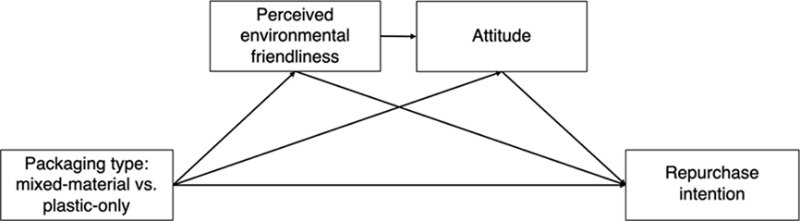
Research model (drawn by authors).
H5. Packaging type influences repurchase intention through the sequential mediation of PEF and brand attitude.
3. Method
3.1. Stimuli
The stimuli were created by editing images of paper boxes downloaded from the Internet and plastic packaging images generated using OpenAI’s ChatGPT DALL·E model. In the mixed-material packaging condition, the plastic-wrapped clothing was placed inside a brown paper box, in contrast, in the plastic-only packaging condition, the same clothing item was shown sealed in a clear, resealable plastic bag without an outer box (Fig. 2). The clothing item inside the packaging was kept identical across both conditions to ensure that the stimuli were only manipulating the packaging type rather than the product attributes. Brand names, product types, and other potential distractions were removed to ensure that the stimuli focused solely on the packaging material rather than external influences.

Stimuli (left: mixed-material; right: plastic-only).
3.2. Measurements
In this study, the delivery package is defined as the “packaging condition that safely stores the product and maintains its original value during distribution and delivery.” The independent variable was packaging type (0 = mixed-material, 1 = plastic-only), which was divided into two groups. The dependent variable was repurchase intention (α = .951), adapted from Choo and Park (2013). The mediator variables, attitude (α = .965) and perceived environmental friendliness (α = .952), were adapted from Oh et al. (2023) and Sokolova et al. (2023) and modified to fit this study. Each scale was measured using a three-item, 5-point Likert scale (1 = “strongly disagree”; 5 = “strongly agree”).
3.3. Procedure
A one-factor (packaging type: mixed-material vs. plastic-only) between-subject experiment was designed. This study was conducted online through a professional research company. The sample consisted of 200 adults, all of whom had prior experience purchasing clothing online. Excluding one participant who did not respond correctly, the responses of 199 participants were used for the analysis. The survey was conducted over a one-week period, from March 21 to March 28, 2024. Participants were randomly assigned to one of the two experimental conditions (Nmixed-material = 99, Nplastic-only = 100). To ensure that respondents accurately understood and envisioned the scenario, illustrative images were provided along with the scenario (Fig. 2). After that participants were asked to complete the questionnaire. To further control for potential confounding variables, additional demographic and shopping behavior-related questions were included at the end of the survey. These questions covered aspects such as age, gender, level of education, monthly spending on fashion products (Table 1).

Demographic information of participants
4. Results
4.1. Measurement Assessment
To assess the reliability and validity of the constructs used in this study, exploratory factor analysis (EFA) was conducted (Table 2). The constructs measured include repurchase intention, brand attitude, and perceived environmental friendliness, with each construct assessed using three items. The factor loadings for all measurement items exceeded 0.7, indicating acceptability. Reliability was confirmed as all constructs—repurchase intention (Cronbach’s α = .951, CR = .861), attitude (Cronbach’s α = .965, CR = .876), and perceived environmental friendliness (Cronbach’s α = .952, CR = .854)-exceeded the recommended 0.7 threshold for Cronbach’s alpha and composite reliability (CR), indicating strong internal consistency. Convergent validity was verified as the average variance extracted (AVE) values for repurchase intention (.673), attitude (.702), and PEF (.660) all surpassed the 0.5, suggesting that the constructs adequately explain the variance in their indicators (Fornell & Larcker, 1981). These results confirm that the constructs effectively measure their intended concepts, supporting the reliability and validity of the measurement model. In addition, as a result of checking the correlation between variables, repurchase intention showed a positive correlation with PEF (r = .764, p < .001) and attitude (r = 739, p < .001). Additionally, PEF and attitude were also positively correlated (r = .754, p < .001) (Table 3).
Results of factor loading
Correlation analysis between variables(N = 199)
4.2. The Main Effect of Packaging Type
One-way ANOVA indicated a significant effect of packaging type on repurchase intention and perceived environmental friendliness (Table 4). Participants showed higher repurchase intention when presented with the mixed-material condition than the plastic-only packaging condition (Mmixed-material = 3.851, SD = .680; Mplastic-only = 2.276, SD = .658; F(1,197) = 275.442; p < .001), indicating that repurchase intention is higher for mixed-material packaging compared to plastic-only packaging, thus supporting H1 (Fig. 3). Additionally, participants showed higher PEF when presented with the mixed-material condition than when presented with the plastic-only packaging condition (Mmixed-material = 4.040, SD = .648; Mplastic-only = 2.336, SD = .813; F(1,197) = 266.830; p < .001), supported H2 (Fig. 3).
ANOVA results of repurchase intention and PEF by packaging type
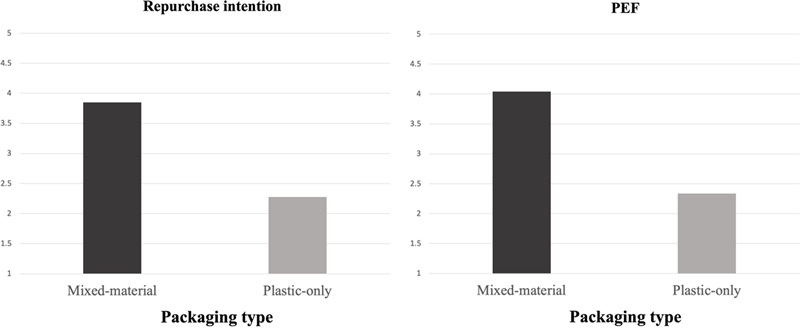
The main effect of packaging type on repurchase intention & PEF.
4.3. The Mediating Effects of PEF and Attitude in the Relationship Between Packaging Type and Repurchase Intention
To examine the serial mediation effect of perceived environmental friendliness (PEF) and attitude in the relationship between packaging type and repurchase intention, this study applied Model 6 of the PROCESS macro (Hayes, 2017). Packaging type was coded as a dummy variable, where mixed-material packaging was set as the reference category (0) and plastic-only packaging was coded as (1). The research model consists of packaging type as the independent variable (X), repurchase intention as the dependent variable (Y), and two mediating variables: PEF (M1) and attitude (M2). By applying this model, the study aims to verify whether PEF and attitude sequentially mediate the effect of packaging type on repurchase intention, providing empirical support for the hypothesized indirect effect.
The results of the direct effects analysis are presented in Table 5. First, an analysis of the relationship between packaging type and PEF revealed that packaging type had a significant negative effect on PEF (b = –1.703, p < .001). Next, the relationship between packaging type and attitude was examined, showing that packaging type had a significant negative direct effect on attitude (b = –.767, p < .001). In contrast, PEF had a significant positive direct effect on attitude (b = .437, p < .001), indicating that the more environmentally friendly consumers perceive the packaging to be, the more likely they are to develop a positive attitude toward it. Finally, an analysis of the direct effects of packaging type, PEF, and attitude on repurchase intention showed that packaging type had a significant negative effect on repurchase intention (b = –.699, p < .001). In contrast, PEF had a significant positive effect on repurchase intention (b = .290, p < .001), and attitude also had a significant positive effect on repurchase intention (b = .251, p < .001). These findings suggest that when consumers perceive packaging as environmentally friendly, they develop a more positive attitude, which in turn increases their repurchase intention.
Direct effects between variables
Table 6 presents the results of the indirect effects analysis examining the mediating role of PEF and attitude in the relationship between packaging type and repurchase intention. First, the indirect effect of packaging type on repurchase intention through PEF alone was significant (indirect effect = –.479, SE = .114, CI95% = [–.711, –.258]). Indicating a statistically significant mediation effect, as the confidence interval did not include zero. Second, the indirect effect of packaging type on repurchase intention through attitude alone was also statistically significant (indirect effect = –.186, SE = .053, CI95% = [–.297, –.087]). Lastly, when considering both PEF and attitude as serial mediators, the indirect effect of packaging type on repurchase intention was significant as well (indirect effect = –.181, SE = .051, CI95% = [–.289, –.085]). Since all 95% bootstrap confidence intervals did not contain zero, the results indicate that PEF and attitude sequentially mediate the relationship between packaging type and repurchase intention. This supports the hypothesis 3, 4, 5 that perceived environmental friendliness and attitude play critical roles in shaping consumer repurchase behavior based on packaging type.
Indirect effects between variables
5. General Discussion
This study analyzed the impact of packaging material on repurchase intention using a serial mediation model, confirming that perceived environmental friendliness (PEF) and attitude serve as key mediators in this relationship. The findings indicate that when eco-friendly elements, such as a paper box, are included in the packaging, consumers are more likely to perceive the product as environmentally friendly (increased PEF), leading to a more positive brand attitude and ultimately higher repurchase intention. In other words, PEF and attitude play a crucial role in shaping repurchase intention, and incorporating eco-friendly packaging elements not only directly enhances brand attitudes and purchase decisions but also has a significant indirect positive effect through PEF and attitude.
Additionally, this study examined the impact of packaging type on PEF and empirically confirmed the existence of PEF bias, wherein mixed-material packaging is perceived as more environmentally friendly than plastic-only packaging. Consumers tend to assess packaging sustainability based on visual cues and heuristics rather than actual environmental impact, which positively influences their repurchase intention. However, this consumer perception may not always align with actual environmental impact. Despite the additional material use in mixed-material packaging potentially leading to an environmental impact similar to or greater than plastic-only packaging, consumers still perceive it as more sustainable. These findings suggest that companies need to implement effective consumer education and communication strategies to foster a truly sustainable consumption culture.
This study makes a theoretical contribution by considering both perceived environmental friendliness (PEF) and attitude as sequential mediators in explaining consumer purchase behavior, rather than treating them as independent mediators as in previous research (Anshu et al., 2022; Loh & Hassan, 2022; Sokolova et al., 2023). By empirically verifying how the process of perceiving a product as environmentally friendly and the subsequent formation of brand attitudes influence purchase intention, this study refines the understanding of eco-friendly consumption behavior. Furthermore, this study empirically confirms the existence of PEF bias, demonstrating that consumers tend to make purchase decisions based on perceived sustainability rather than actual sustainability. This suggests that consumers are highly influenced by visual cues and packaging design, leading them to assess a product’s sustainability based on appearance rather than environmental effectiveness, which can result in misconceptions about a product’s true environmental impact. These findings highlight the significant role of consumer perception in eco-friendly consumption behavior and sustainability marketing research, emphasizing the need for further studies to address the gap between actual environmental sustainability and consumer perception.
Also, this study has practical implications as it confirms that consumers tend to evaluate a product’s eco-friendliness based on visual cues and packaging design rather than actual environmental sustainability. This finding highlights the need for companies to go beyond merely leveraging consumer biases and instead play an active role in bridging the gap between perceived and actual environmental impact. Furthermore, companies must actively counteract greenwashing risks by implementing corporate social responsibility (CSR) initiatives that emphasize environmental education and consumer awareness. Adopting sustainability-focused brand strategies, such as Starbucks’ ban on plastic straws and Patagonia’s development of eco-friendly clothing, can further enhance consumer awareness and encourage sustainable consumption behavior by demonstrating tangible commitments to environmental responsibility. By adopting such strategies, brands can contribute to a more sustainable marketplace where both businesses and consumers make environmentally responsible choices based on facts rather than perception.
Despite offering valuable insights into consumer perceptions of environmentally friendly packaging, this study has several limitations. As it employed an experimental design using image-based stimuli, the study may have been limited in reflecting the complexity of real-world shopping environments. Additionally, the study's reliance on a single product category (clothing) restricts the applicability of the findings to other categories, such as food or electronics, where packaging functions and consumer expectations may differ. Future research should consider employing more immersive and ecologically valid experimental settings that better reflect real-world shopping experiences, such as virtual simulations or field experiments. Expanding the study across various product categories with differing packaging functions would also enhance the generalizability of the results. Furthermore, investigating individual differences—such as consumers’ level of environmental knowledge, personal values, or prior experience with sustainable packaging—could provide deeper insight into the conditions under which PEF bias occurs and how it influences consumer decision-making.
References
-
Abdul-Muhmin, A. G. (2010). Repeat purchase intentions in online shopping: The role of satisfaction, attitude, and online retailers' performance. Journal of International Consumer Marketing, 23(1), 5-20.
[https://doi.org/10.1080/08961530.2011.524571]

- Annual Performance of Lifestyle Logistics. (n.d.). National Logistics Information Center
-
Anshu, K., Gaur, L., & Singh, G. (2022). Impact of customer experience on attitude and repurchase intention in online grocery retailing: A moderation mechanism of value Co-creation. Journal of Retailing and Consumer Services, 64, 102798.
[https://doi.org/10.1016/j.jretconser.2021.102798]
-
Bloemer, J. M., & Kasper, H. D. (1995). The complex relationship between consumer satisfaction and brand loyalty. Journal of Economic Psychology, 16(2), 311-329.
[https://doi.org/10.1016/0167-4870(95)00007-B]
-
Chen, Y. S., & Chang, C. H. (2012). Enhance green purchase intentions: The roles of green perceived value, green perceived risk, and green trust. Management Decision, 50(3), 502-520.
[https://doi.org/10.1108/00251741211216250]
-
Choi, W. S., & Lee, S. B. (2012). The effect of servicescape of an eco-friendly restaurant on customer perceived value, attitude and behavior intention. Culinary Science & Hospitality Research, 18(5), 45-62.
[https://doi.org/10.20878/cshr.2012.18.5.004004004]
-
Chong, C. Y. (2012). A study on the eco package design guideline. Journal of Korea Design Knowledge, 21, 185-195.
[https://doi.org/10.17246/jkdk.2012..21.018]
-
Choo, T. G., & Park, H. H. (2013). The effect of consumption value on attitude and repurchase intention of secondhand fashion goods - The moderating role of self-confidence in fashion coordination-. Journal of Korean Society of Clothing and Textiles, 37(4), 618-630.
[https://doi.org/10.5850/JKSCT.2013.37.4.618]
- ‘Containers and packaging: Product-specific data’. (2023, February 9). United States Environmental Protection Agency. Retrieved February 10, 2025, from https://www.epa.gov/facts-and-figures-about-materials-waste-and-recycling/containers-and-packaging-product-specific
-
De Langhe, B., & Puntoni, S. (2015). Bang for the buck: Gain-loss ratio as a driver of judgment and choice. Management Science, 61(5), 1137-1163.
[https://doi.org/10.1287/mnsc.2014.2045]
- Fishbein, M., & Ajzen, I. (1977). Belief, attitude, intention, and behavior: An introduction to theory and research. Philosophy and Rhetoric, 10(2), 130-132.
-
Fornell, C., & Larcker, D. F. (1981). Evaluating structural equation models with unobservable variables and measurement error. Journal of Marketing Research, 18(1), 39-50.
[https://doi.org/10.1177/002224378101800104]
-
Gershoff, A. D., & Frels, J. K. (2015). What makes it green? The role of centrality of green attributes in evaluations of the greenness of products. Journal of Marketing, 79(1), 97-110.
[https://doi.org/10.1509/jm.13.0303]
-
Han, S. E. (2017). A study on the success factors and implications of social enterprise -Focusing on the eco-social enterprise-. Social Economy & Policy Studies, 7(1), 115-154.
[https://doi.org/10.22340/seps.2017.02.7.1.115]
-
Haws, K. L., Winterich, K. P., & Naylor, R. W. (2014). Seeing the world through GREEN-tinted glasses: Green consumption values and responses to environmentally friendly products. Journal of consumer psychology, 24(3), 336-354.
[https://doi.org/10.1016/j.jcps.2013.11.002]
- Hayes, A. F. (2017). Introduction to mediation, moderation, and conditional process analysis: A regression-based approach. Guilford publications.
-
Herbes, C., Beuthner, C., & Ramme, I. (2020). How green is your packaging -A comparative international study of cues consumers use to recognize environmentally friendly packaging. International Journal of Consumer Studies, 44(3), 258-271.
[https://doi.org/10.1111/ijcs.12560]
- International Trade Administration. (n.d.). Ecommerce Sales & Size Forecast. U.S. Department of Commerce. Retrieved April 12, 2025, from https://www.trade.gov/ecommerce-sales-size-forecast
- Kang, S. Y., & Lee, K. H. (2019). The effects of HMR package design on the brand image, attitude and purchase intention. Journal of Foodservice Management Society of Korea, 22(5), 35-63.
-
Kaur, K., & Singh, J. (2023). Assessing eco-friendly marketing approaches in India's agri-food sector through sustainability metric. European Economic Letters (EEL), 13(5), 626-636.
[https://doi.org/10.52783/eel.v13i5.802]
-
Kim, D. H. (2020). A study on the shipping box design of online stores -Based on both graphic and sustainable characteristics-. A Journal of Brand Design Association of Korea, 18(1), 221-232.
[https://doi.org/10.18852/bdak.2020.18.1.221]
-
Kim, N., Hwang, K., & Yang, S.-B. (2021). The influence of perceived value of fresh food early-morning delivery services on continuous use intention: Focusing on the value-based adoption model. The Journal of Internet Electronic Commerce Research, 21(3), 1-26.
[https://doi.org/10.37272/JIECR.2021.06.21.3.1]
-
Kudeshia, C., & Kumar, A. (2017). Social eWOM: does it affect the brand attitude and purchase intention of brands?. Management Research Review, 40(3), 310-330.
[https://doi.org/10.1108/MRR-07-2015-0161]
- Lim, E., Kim, G., Oh, E., & Joung, S. (2016). An exploratory study on sustainability & packaging -Centered on transition to sustainable packaging-. Journal of Consumer Studies, 27(5), 197-219.
-
Lin, P. C., & Huang, Y. H. (2012). The influence factors on choice behavior regarding green products based on the theory of consumption values. Journal of Cleaner Production, 22(1), 11-18.
[https://doi.org/10.1016/j.jclepro.2011.10.002]
-
Lin, Y. C., & Chang, C. C. A. (2012). Double standard: The role of environmental consciousness in green product usage. Journal of Marketing, 76(5), 125-134.
[https://doi.org/10.1509/jm.11.0264]
-
Lindh, H., Olsson, A., & Williams, H. (2016). Consumer perceptions of food packaging: Contributing to or counteracting environmentally sustainable development?. Packaging Technology and Science, 29(1), 3-23.
[https://doi.org/10.1002/pts.2184]
-
Loh, Z., & Hassan, S. H. (2022). Consumers’ attitudes, perceived risks and perceived benefits towards repurchase intention of food truck products. British Food Journal, 124(4), 1314-1332.
[https://doi.org/10.1108/BFJ-03-2021-0216]
-
Lu, X., Sheng, T., Zhou, X., Shen, C., & Fang, B. (2022). How does young consumers’ greenwashing perception impact their green purchase intention in the fast fashion industry? An analysis from the perspective of perceived risk theory. Sustainability, 14(20), 13473.
[https://doi.org/10.3390/su142013473]
-
Magnier, L., Schoormans, J., & Mugge, R. (2016). Judging a product by its cover: Packaging sustainability and perceptions of quality in food products. Food Quality and Preference, 53, 132-142.
[https://doi.org/10.1016/j.foodqual.2016.06.006]
-
Nguyen, A. T., Yến-Khanh, N., & Thuan, N. H. (2021). Consumers’ purchase intention and willingness to pay for eco-friendly packaging in Vietnam. Sustainable Packaging, 289-323.
[https://doi.org/10.1007/978-981-16-4609-6_11]
-
Oh, Y., Lee, S., & Cho, M. (2023). Effects of e-commerce fresh food delivery package attributes on consumer attitude and purchase intention. Culinary Science & Hospitality Research, 29(3), 57-71.
[https://doi.org/10.20878/cshr.2023.29.3.007]
-
Olsen, M. C., Slotegraaf, R. J., & Chandukala, S. R. (2014). Green claims and message frames: How green new products change brand attitude. Journal of Marketing, 78(5), 119-137.
[https://doi.org/10.1509/jm.13.0387]
-
Park, J. H., & Ryoo, H. Y. (2021). Sustainable eco-friendly service concept design for online fresh food delivery. Journal of Integrated Design Research, 20(4), 77-92.
[https://doi.org/10.21195/jidr.2021.20.4.005]
-
Ra, C. I. (2018). The effects of selection attributes on attitude and repurchase intention for home meal replacement (HMR): Focused on moderating role of brand trust. Culinary Science & Hospitality Research, 24(3), 25-34.
[https://doi.org/10.20878/cshr.2018.24.3.003]
- Reichheld, F. F., & Sasser, W. E. (1990). Zero defections: Quality comes to services. Harvard Business Review, 68(5), 105-111.
-
Ryu, J. Y., & Ha, H. S. (2016). A study on relationship among attributes of ramen package design, ramen image and Chinese customer's choice of ramen. Culinary Science & Hospitality Research, 22(4), 156-169.
[https://doi.org/10.20878/cshr.2016.22.4.011011011]
- Smith, M. M. (2015). Impact of environmentally friendly packaging on consumers' attitudes and patronage intentions toward apparel retail brands [Undergraduate thesis, University of Arkansas]. University of Arkansas Library Repository. https://scholarworks.uark.edu/etd/
-
Sokolova, T., Krishna, A., & Döring, T. (2023). Paper meets plastic: The perceived environmental friendliness of product packaging. Journal of Consumer Research, 50(3), 468-491.
[https://doi.org/10.1093/jcr/ucad008]
-
Steenis, N. D., Van Herpen, E., Van Der Lans, I. A., Ligthart, T. N., & Van Trijp, H. C. (2017). Consumer response to packaging design: The role of packaging materials and graphics in sustainability perceptions and product evaluations. Journal of Cleaner Production, 162, 286-298.
[https://doi.org/10.1016/j.jclepro.2017.06.036]
-
ST Wang, E. (2013). The influence of visual packaging design on perceived food product quality, value, and brand preference. International Journal of Retail & Distribution Management, 41(10), 805-816.
[https://doi.org/10.1108/IJRDM-12-2012-0113]
-
Van Birgelen, M., Semeijn, J., & Keicher, M. (2009). Packaging and proenvironmental consumption behavior: Investigating purchase and disposal decisions for beverages. Environment and Behavior, 41(1), 125-146.
[https://doi.org/10.1177/0013916507311140]
-
Van Dam, Y. K. (1996). Environmental assessment of packaging: The consumer point of view. Environmental Management, 20(5), 607-614.
[https://doi.org/10.1007/BF01204134]
-
Wells, L. E., Farley, H., & Armstrong, G. A. (2007). The importance of packaging design for own‐label food brands. International Journal of Retail & Distribution Management, 35(9), 677-690.
[https://doi.org/10.1108/09590550710773237]
-
White, K., Habib, R., & Hardisty, D. J. (2019). How to SHIFT consumer behaviors to be more sustainable: A literature review and guiding framework. Journal of Marketing, 83(3), 22-49.
[https://doi.org/10.1177/0022242919825649]
-
Zeithaml, V. A. (1988). Consumer perceptions of price, quality, and value: a means-end model and synthesis of evidence. Journal of Marketing, 52(3), 2-22.
[https://doi.org/10.1177/002224298805200302]