유니버설 디자인의 적합성 평가를 위한 툴 개발 연구 : 뉴시니어 세대의 운동복을 중심으로

©2024 The Korean Fashion and Textile Research Journal(KFTRJ). This is an open access journal. Articles are distributed under the terms of the Creative 52 Commons Attribution Non-Commercial License (http://creativecommons.org/licenses/by-nc/4.0), which permits unrestricted use, distribution, and reproduction in any medium, provided the original work is properly cited.
Abstract
In recent years, a variety of products with a universal design have been developed and used. However, there has been little research on universal design in the area of fashion design. Product Performance Program (PPP) developed by Tripod have mainly been used for universal design evaluation over the past years, such elements are not perfectly suitable for the industry. Accordingly, evaluation elements of universal design suitable for this industry will be refined and the principle of evaluating the fitness on the universal fashion design will be re-established in this study. In this study, five representative theories on universal design were analyzed. By analyzing the results of earlier studies, three principles of universal fashion design included ‘flexibility’, ‘cognition’ and ‘efficiency’ added up with ‘aesthetics’ and ‘psychology’. Finally, 14 check lists and such five principles were obtained. It should be noted that the tools for evaluating the suitability of universal fashion design developed in this study are meaningful, in that they re-established a new principle of universal design in terms of ever-changing fashion, not in terms of pre-existing clothing. It is meaningful to review the possibility of applying this tool into the suitability of universal fashion design by using 14 specific check lists and weights in each category.
Keywords:
universal design, new senior, university, sportswear, check-list키워드:
유니버설 디자인, 뉴시니어, 보편성, 운동복, 체크리스트1. 서 론
유니버설 디자인(Universal Design)의 개념은 설계에서부터 능력이나 연령에 관계없이 다양한 사용자들이 쉽게 이용할 수 있는 환경 및 제품의 디자인을 말한다. 유니버설 디자인은 보편적 설계를 통해 누구나 편리하고 사용상 차별을 없앤다는 점에서 다양한 분야에서 폭넓게 적용되고 있다(Han & Han, 2020). 유니버설 디자인 개념의 대상은 일반인뿐만 아니라, 장애인이나 노인을 포함하며 이러한 사회적 약자들의 요구를 만족시킬 수 있도록 제품이나 서비스 디자인 및 사회적 제도 개선에 이르기까지 폭넓게 활용되고 있다.
반면, 유니버설 디자인 개념이 적용된 운동복에 대한 선행연구는 주로 장애인을 대상으로 하고 있으며(Hong & Seok, 2003; Moon & Chung, 2008; Park, 2018; Peak & Chun, 2005) 노인을 대상으로 한 유니버설 디자인 의류에 대한 연구는 브랜드 개발 연구(Kim, 2024), 스마트 의류 디자인 연구(Koo et al. 2017) 및 인식 연구(Jung et al., 2004)에 국한되어 있다. 따라서 고령화 사회로의 전환과 뉴시니어 인구가 증가하고 있는 시점에서, 이들을 대상으로 한 의류의 유니버설 디자인에 대한 적합성 연구가 요구된다. 기존의 유니버설 디자인 평가는 노스캐롤라이나 대학의 유니버설 디자인의 7원칙(The Center for Universal Design, 2000) 이나, 트라이포드사의 PPP(Product Performance Program, Nakagawa, 2005)을 사용한 체크리스트(Check list)법이 주 평가 방법으로 사용되어 왔기 때문에 그 항목들이 패션디자인 분야에 완벽히 적합한 항목이 아니라고 판단된다. 따라서 본 연구에서는 패션디자인 분야에 적합한 유니버설 디자인의 평가 항목을 새롭게 정의하고 유니버설 패션디자인에 대한 적합성을 평가할 수 있는 원칙을 재정립 하고자 하였다.
유니버설 디자인의 저자 Yoshihiko et al.(2005)는 유니버설 디자인의 사고(思考)에 대해서 ‘유니버설 디자인의 사고는 사람을 고령이나 장애 등으로 분류하지 않으며, 그 대신에 각각의 사람에게 진정으로 필요한 욕구가 무엇인지가 관심의 대상이고, 그 욕구에 맞는 것을 제공하려는 노력이 중요하다’라고 하였다. 또한 유니버설 디자인 텍스트북과 유니버설 디자인 매뉴얼의 저자인 Nakagawa(2005)는 ‘다양한 사용자를 존중하는 디자인이 유니버설 디자인이다’라고 하였다. 이외에도 Namgoong(2011)는 지금까지의 문헌과 이론적 개념은 초반에는 주로 장애와 노인들이 기준이 되어 디자인의 도입과 발전을 이루었지만, 시간이 지나면서 점차 다수의 사람들을 대상으로 모든 필요성과 요구의 범위가 커지게 되었다고 하였다. 따라서 유니버설 디자인의 개념을 현재의 시점에서 재정리하고, 이를 바탕으로 접근성, 편리성, 변모성, 동등성, 융통성 등의 모든 인간의 편리성을 위한 디자인적인 방향성을 지니고 있는 디자인 개념적 특징을 지니고 있다고 해석하였다. 유니버설 디자인을 목적으로 다양한 제품들이 개발되고 사용되어지고 있지만, 유니버설 디자인의 개념 및 적용에 관한 연구는 어떤 제품이나 시설, 환경 등이 유니버설 디자인의 원칙 측면에서 얼마나 적합하게 디자인 되었는지에 대한 평가연구가 주를 이루고 있으며, 유니버설 디자인이 적용된 의류에 대한 평가연구는 부족한 실정이다. 노스캐롤라이나 대학의 유니버설 디자인 센터에서는 제품에 대한 유니버설 디자인 성능 평가척도 및 평가시트를 유니버설 디자인 원칙에 근거하여 개발하였다. 이 방법은 주로 정성적인 측면에서 상세하게 분석할 수 있는 방법을 제공하고 있지만, 전문가의 지식에 근거하여 제품의 보편성을 종합적으로 판단할 수 있는 정량적 지표를 제공하지 못하고 있다고 평가받고 있다(Lee, 2005).
따라서 본 연구에서는 의류제품에 적합한 유니버설 디자인의 평가항목을 새롭게 정의하고 유니버설 디자인 의류를 평가할 수 있는 방법을 제안하고자 하였다. 마우스 제품을 대상으로 하여 제품의 보편성을 평가한 선행연구(Jung, 2007)를 참고하여 개발한 유니버설 의류제품이 유니버설 디자인의 원칙 측면에서 얼마나 적합하게 디자인 되었는지를 평가하였다.
2. 이론적 배경
2.1. 유니버설 디자인 개념
유니버설 디자인의 시작은 1961년 미국이 세계 최초로 배리어 프리 디자인(Barrier-free design)의 기준을 책정한 데에서 시작되었으며, 그 기준은 일부 한계가 있었지만, 세계적으로 배리어 프리 디자인의 기준을 마련했다는 데 큰 의미를 가진다. 배리어 프리 디자인에서 시작된 유니버설 디자인이 최근에는 장애인, 고령자, 여성, 저소득층, 어린이 등 사회 약자층의 관심을 받아왔으나, 이제는 ‘모든 사람을 위한 디자인(Design for All)’ 또는 ’평생 디자인(Lifespan Design)'으로 그 의미의 범위를 넓혀 궁극적으로 인간을 위한 디자인의 개념으로 인식되면서, 21세기 디자인의 핵심적 개념으로 자리잡아가고 있다. 다양한 관점에서의 유니버설 디자인의 정의를 살펴보면, 오레곤 대학의 스텐 존스는 배리어 프리와 유니버설 디자인의 본질적인 차이를 ‘배리어 프리는 그 경험의 질은 생각하지 않는 것이며, 유니버설 디자인은 이용에 따른 경험의 질을 문제로 하고 있다.’ 라고 정의하고 있다. 유니버설 패션(universal fashion)은 일본 유니버설 협회에서 가장 먼저 사용된 용어로, ‘universal design’과 ‘fashion’이 합쳐진 즉, 일반 상품에 기능성을 추가하고 다양한 체형과 사이즈를 고려하여 능력이나 연령에 제한 없이 사용할 수 있도록 패션성과 기능성을 갖춘 의류상품이라고 할 수 있다(Moon & Chung, 2008 (as cited in Moon, 2007); Tanaka & Mitera, 2007 (as cited in Na et al., 2009)).또한 유니버설 패션은 누구나 사용할 수 있는 보편성을 지니므로 연령을 불문하고 선호할 수 있는 디자인적 요소를 지녀야 하는데, 일반 의류와 디자인과 형태에서는 차이가 없으면서 기능성이 강조되어 편안한 의복으로 제시되어야 한다(Moon & Chung, 2008 (as cited in Moon, 2007)). 하지만 지금까지 패션분야의 유니버설 디자인에 대한 인식은 대부분 장애인 및 노인의복으로 한정되어있으며, 연구의 방향성 또한 이들을 대상으로 하는 기능 중심으로 진행되어왔다. 따라서 유니버설 패션디자인 제품을 젊은 층의 비장애인이 착용하는 경우는 매우 드물며, 패션제품이 밀집되어있는 일반 소매점에서도 쉽게 구입할 수 없다. Moon(2006)에 따르면 유니버설 패션 디자인을 전개할 때에는 세 가지 측면을 고려해야 하는데, 첫 번째가 의복을 입는 대상인 인간에 대한 이해이며, 그 다음으로 의복디자인을 할 때의 기본조건과 요구조건 그리고 구성요소를 파악해야 하고, 마지막으로 유니버설 패션의 이해를 통한 디자인 고안이라는 세 가지 측면을 고려해야 한다고 하였다. 특히 본 연구에서는 첫번째 측면, 즉 인간의 심신 상태에 대한 이해를 바탕으로 쾌적한 디자인을 제안하고, 디자인을 구상할 때 착용자의 생활환경이나 취미, 요구 사항 등의 이해를 통해 이를 디자인으로 이끌어내야 한다는 사항에 대한 필요성을 인식하여 유니버설 패션디자인의 적합성 평가를 위한 툴의 필수 항목으로 설정함으로써 기존 유니버설 패션 디자인 연구와의 차별성을 두고자 하였다.
2.2. 뉴시니어 세대를 위한 유니버설 패션
한국의 전후 베이비붐세대는 건강, 여유있는 자산, 적극적인 소비의욕을 가진다는 점에서 종전 시니어 세대와는 다른 ‘뉴시니어(New Senior)’로 지칭한다. 또한 다양한 대중문화의 유입과 진화, 경제·사회적 성장을 동시에 경험한 뉴시니어는 문화·사회적 배경에서 비롯된 특유의 세대적 특성을 보유하고 있으며, 젊음, 향수, 자아의 세 가지 키워드로 특징지어진다. Rhee and An(2008)에 따르면 유니버설 패션은 QQL(quality of life, 생활의 질)을 높이는 매개체가 될 수 있는데, 의복을 선택하고 입는 행위는 자기실현의 표시이며, 치장은 즐거움인 동시에 마음에 드는 의복을 통해 사회참가를 촉진하고 자아 존중감을 향상시키는 효과가 있다고 하였다. 이처럼 고령화와 함께 신체기능의 일부가 저하되지만, 뉴시니어 세대는 사회와의 소통, 인간관계 강화, 소속감을 주는 단체에 대한 욕구와, 노년기의 정체성을 확보하고자 하는 자아실현의 욕구를 가지고 있다고 보고되고 있기 때문에(Kim & Park, 2020), 본 연구에서는 뉴시니어 세대의 운동복을 대상으로 한 유니버설 패션디자인의 적합성 평가 항목에 심리성과 심미성을 추가하였다.
3. 연구방법
3.1. 자료수집
사례 연구에 적용 가능한 시니어 의류 디자인과 완제품 개발을 위하여 포커스 그룹 인터뷰(Focus Group Interview)를 1회, 90분가량 수행하였다. 포커스 그룹 인터뷰를 실시하기 위해 4-12명 사이의 동질적인 집단을 구성하여야한다(Morgan, 1997)는 선행연구를 참고하여 대상은 60대 노인 8명(남성 2명, 여성 6명) 이었으며, 자발적 참여 의사를 표시한 연구대상자로, 나이를 동질적인 집단으로 보고 구성하여, 성별은 불균형이 발생하였다. 연구 참여자에게는 반구조화된 질문지를 활용해 심층적 응답을 유도하였으며, 반구조화된 질문지의 내용을 Table 1에 제시하였다.

Key questions for semi-structured FGI (Focus Group Interview)
주요 조사내용은 운동 현황, 운동복 구매 행태 및 운동복 이용 행태에 관한 내용으로, 모두 녹음과 전사과정을 거쳤으며, 인터뷰 진행에 앞서 참여자의 익명보장과 연구목적에 대한 사전설명, 개인정보수집과 연구 참여 동의를 받았다. 인터뷰는 D광역시 한국패션산업연구원 회의실을 이용하여 서로 간 자유로운 대화와 의견을 나눌 수 있는 환경을 조성하였다. 참여자들에게 시각화된 자료를 제공해 유니버설 디자인에 대한 의미와 개발내용, 운동복의 범위를 이해시켜 유니폼과 혼돈하지 않도록 하였다.
3.2. 연구방법 및 범위
본 연구에서는 유니버설 디자인의 대표 이론 4가지(Lonald, 1991; Nakagawa, 2005; Roberta, 1999; The Center for Universal Design, 2008) 모두에서 공통적으로 추구되는 보편성(universality)을 유니버설 디자인의 적합성으로 정의하고, 선행연구의 교집합을 통해 유니버설 디자인 원칙을 총 5가지로 재정립 하였다. 의류제품에 적합한 5가지 유니버설 디자인 원칙의 세부 체크리스트 가이드라인은 우선적으로 국/내외 문헌연구를 통해 수집하고, 포커스 그룹을 대상으로 심층면접에서 도출된 내용을 최대한 반영하여 체크리스트 가이드라인을 도출하고자 하였다. 전문가 5인(특수체육 전공 교수(경력 17년) 1인, 의류학전공 교수 3인(경력 각 7년, 12년 14년), 패션업체 디자이너 1인(경력 15년))의 토의를 통해 세부 체크리스트 가이드라인을 확정하였다. 또한, 전문가 3인(의류학 전공 교수 2인, 패션업체 디자이너 1인)이 각 항목의 점수 및 상대적 중요도의 가중치를 부여하였다. 본 연구에서는 의류제품의 보편성을 평가할 시 가중치가 부여된 세부 체크리스트에 대한 합으로 평가하도록 설계하였다. 연구방법과 단계별 내용은 아래와 같다(Table 2).
Research method and steps
UNIX 방법에서는 본 연구에서 평가 할 의류제품에 대한 보편성을 평가하기 위하여 두 단계의 평가체계를 갖는다. 첫 번째 단계는 평가 기준들의 상대적 중요성에 대한 가중치를 구하고 평가 기준들에 대한 평점을 부여하는 단계이다. 그리고 두번째 단계에서는 전문가의 평가를 통하여 얻어진 데이터들로부터 보편성 지수를 구하는 것이다. UNIX 방법을 적용하기 위해서 먼저 각 평가 기준들의 상대적인 중요도를 결정하였다. 각 평가기준의 중요도 가중치는 Eq. 1에 의하여 계산하였다. 이 방법은 각 기준들에 대하여 그 중요도의 가중치를 0과 100 사이의 값으로 부여하고 각 기준의 중요도 평점을 모든 기준들에 부여한 평점의 합으로 나누어서 계산하는 방식이다(Jung, 2007).
| Eq. 1. |
where, wj = j번째 평가기준의 상대적 가중치
aj = j번째 평가기준의 중요도 평점
다음으로, 보편성 지수를 구하기 위해서는 먼저 평가하고자하는 제품에 대한 각 기준의 디자인 적합도를 평가하여야 한다. 평가기준의 디자인 적합도는 Fig. 1의 평가척도를 활용하여 평가한다.

Evaluation scale for evaluation criteria.
이 방법에서는 평가제품에 대한 평가기준들의 디자인 적합성을 Fig. 1의 양식에 평가하도록 하고, 그 위치를 100점 척도로 환산하도록 한다. 이 때 각 평가기준의 가중치를 사용하여 평가제품에 대한 평가기준의 평점을 가중 평균함으로써 평가대상의 보편성 지수를 구할 수 있다. 평가 대상제품의 보편성 지수는 Eq. 2에 의하여 구하여진다.
| Eq. 2. |
where, wi = i번째 평가기준의 가중치
Ri = i번째 평가기준에 대한 디자인 적합도 평점
이 때 UNIX는 0부터 1사이의 값을 갖게 되는데, 1에 가까울수록 유니버설 디자인의 원칙에 근거하여 적합하게 디자인되었다고 결론 내릴 수 있다. 만약, 여러 개의 평가제품이 존재한다면, 각 제품의 UNIX를 비교함으로써 유니버설 디자인 관점에서 더 적합한 제품을 선정하거나 우선순위를 상대적으로 정할 수 있다.
4. 연구결과
문헌과 실증연구를 통해 도출한 유니버설 디자인의 다섯 가지 원리의 세부 항목에 적합한 디자인 요소를 반영하여 남성과 여성 시니어 운동복 상의와 하의 디자인을 개발하였다.
또한 연구자가 개발한 유니버설 평가 툴을 활용하여 유니버설 디자인의 원칙 측면에서 제품이 얼마나 적합하게 디자인 되었는지를 평가하기 위한 방법으로 선행연구(Jung, 2007)의 UNIX(university index)를 적용하여 분석하였다. 이를 위해 첫번째 단계로, 평가기준들의 상대적 중요성에 대한 가중치를 구하고 평가기준들에 대한 평점을 부여하도록 하였다. 두 번째 단계에서는 전문가의 평가를 통하여 얻어진 데이터들로부터 보편성 지수를 구하였다.
4.1. 유니버설 디자인 원리 적용 시니어 의류 디자인 개발
본 연구에서 도출한 유니버설 디자인의 다섯 가지 원리 즉, 1) 유연성 : 의복의 착용과 탈의가 용이하며, 운동 환경에서 편리하게 사용될 수 있는지, 2) 인지성 : 착용 중 문제점 보완 및 기능성 디자인과 소재의 적용 여/부, 3) 효율성 : 대상의 체형과 특성에 설계된 디자인인지, 4) 심미성 : 신체 결점을 최소화 시켜줄 수 있으며, 색상과 디자인이 마음에 드는지, 5) 심리성 : 일반적인 제품과 다르지 않고, 구매의사가 있는지를 적용하여 시니어 대상 운동복의 유니버설 적합성 평가 연구에 적용가능한 시니어 의류 디자인을 개발하였으며, 이를 Fig. 2와 Fig. 3에 제시하였다.
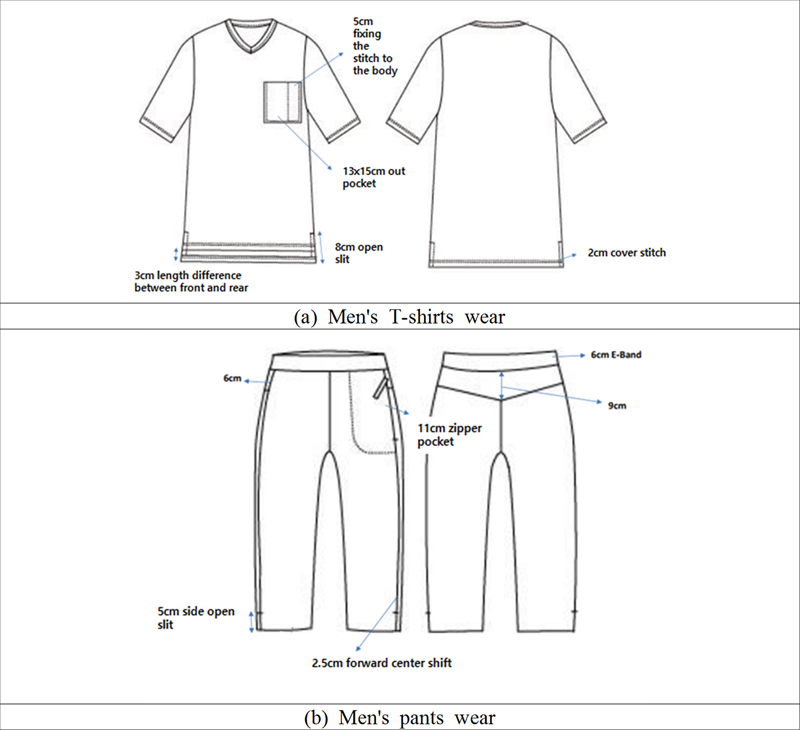
Prototype of senior men's wear.
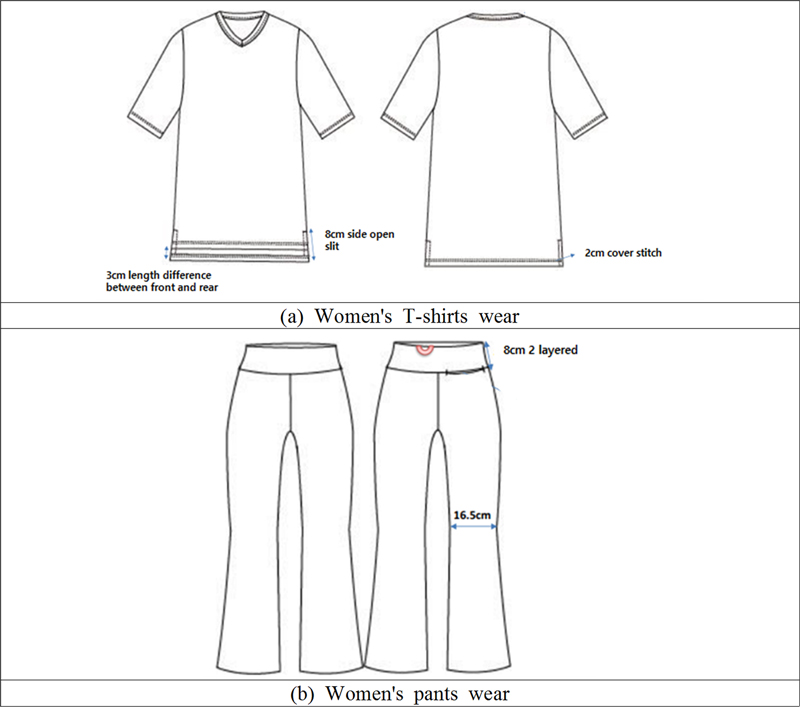
Prototype of senior women's wear.
유니버설 패션의 다섯 가지 원리 중 첫째, ‘유연성’을 만족시키기 위하여 상의의 네크라인을 브이넥으로 디자인하여 기존 라운드 넥 디자인에 비해 개구부를 확장하여, 착용과 탈의를 쉽게 할 수 있도록 하였다. 또한 신체활동이 둔화되는 시니어의 특성을 반영하여 쉽게 여닫을 수 있도록 지퍼 여밈과 자석 단추 부자재를 적용한 디자인으로 개발하였다. 둘째, ‘인지성’을 고려하여 돋보기나 소지품을 보관할 수 있도록 상의에 주머니를 디자인하였고, 하의에는 물건을 넣고 빼기 쉽도록 옆쪽 주머니 입구를 사선으로 설계하였다. 또한 신축성이 우수, 접촉냉감성이 뛰어난 비스코스 레이온과 폴리에스터 복합소재를 적용하여 더운 환경에서의 운동 시, 인체 부담을 최소화 할 수 있도록 하였다. 또한 탈/부착이 가능하도록 설계하여, 사용자가 원하지 않을 때는 언제든지 제거할 수 있도록 디자인하였다. 셋째, ‘효율성’ 부분은 시니어의 체형과 특성을 반영하여 허리부분을 살짝 프린세스 라인으로 설계하였으며, 시니어 체형의 특징으로 허리가 굽은 경우를 감안하여 활동 시 허리 부분이 보이는 것을 방지하기 위하여 뒷 길이를 앞 길이보다 더 길게 설계하였다. 또한 배가 나온 체형에 맞추어 옆 솔기 사이에 사이드 슬릿(slit)을 주고, 복부 부분의 앞 너비가 뒷 너비보다 더 여유 있게 설계하였다. 또한 등이 굽은 경우를 고려하여, 뒷 어깨와 팔 부분에 여유분을 주어 착용감과 활동성을 부여하였다. 넷째, ‘심미성’을 고려하여, 시니어 대상의 신체 결점을 최소화할 수 있도록 체형과 심미성을 고려하여, 앞 소매는 일반 소매(set-in), 뒷 소매는 라글란 소매로 디자인하여 외관의 만족도를 향상시키고자 하였다. 마지막으로 ‘심리성’ 부분은 일반인이 착용하는 의류 디자인과 눈에 띄게 다르게 보이지 않도록 전 연령이 일반적으로 운동 시 많이 착용하는 의류 상의인 티셔츠와 7부 길이의 팬츠로 디자인하였으며, 시니어 대상들이 운동복을 구매할 때 선호하는 컬러로 조사된 ‘파스텔 톤’ 컬러 중 2024 S/S 유행 컬러(pantone 16-5127-TPX)를 반영한 디자인을 적용하여 디자인 및 패턴 설계하였다.
4.2. 평가기준의 중요도 가중치
본 연구에서는 유니버설 의류제품의 보편성을 평가하기 위하여 의류학 분야의 전문가 세 명을 대상으로 개발된 평가툴의 14가지 항목에 대해서 평가를 진행하였다. 14가지 항목은 미국 노스캐롤라이나 유니버설 디자인 센터(The Center for Universal Design, 2000)가 공표한 원칙을 ‘유연성’, ‘인지성’, ‘효율성’, ‘심미성’ 및 ‘심리성’으로 기준하여, 여러 선행연구(Lonald, 1991; Nakagawa, 2005; Roberta, 1999; Tanaka & Mitera, 2007) 내용을 참고하여 비교, 보완하여 도출하였다 (Table 2).
Check list of Details items about universal clothing
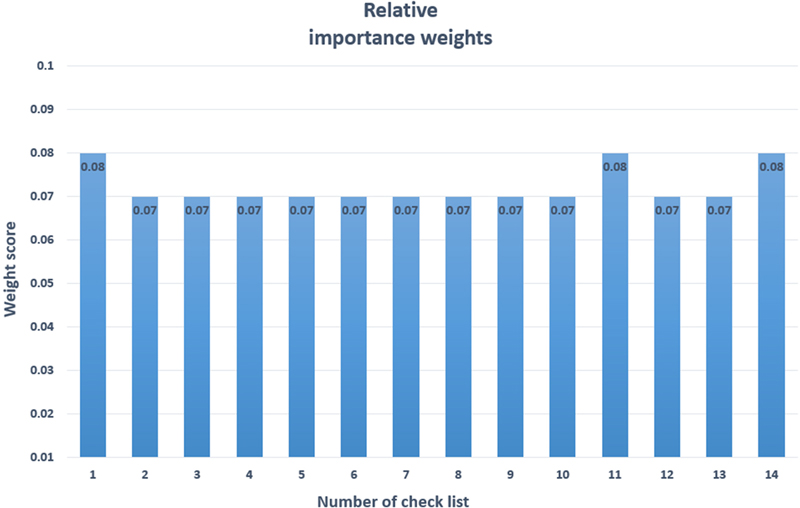
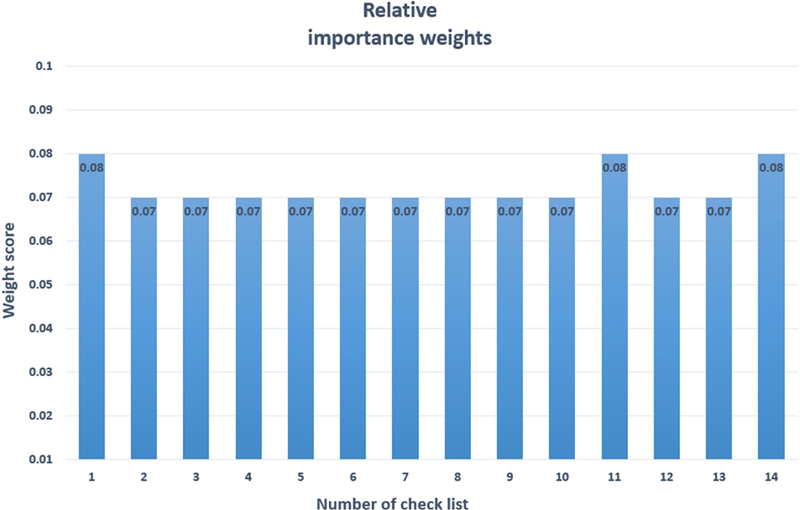
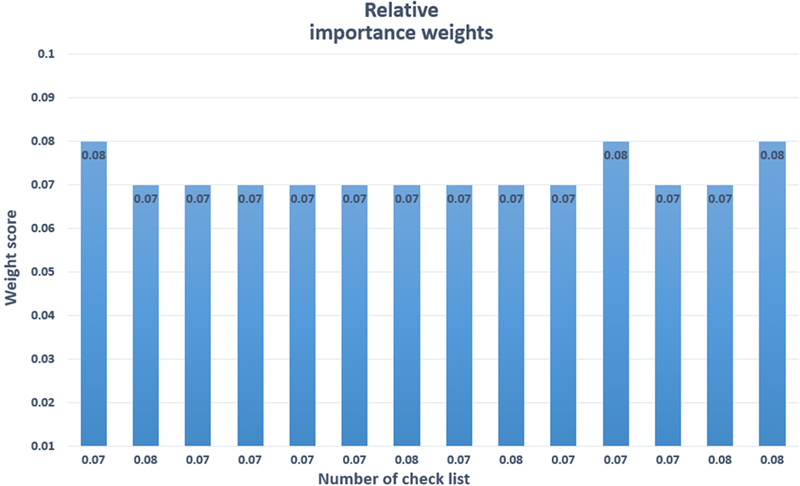
평가결과를 토대로 각 평가기준의 가중치를 구하였다. 전문가에 의하여 부여된 각 평가기준에 대한 중요도 평점의 합을 전체 평점의 합으로 나누어 각 평가기준의 상대적인 중요도 가중치를 구하였다. 각 대상별 결과는 Fig. 4부터 Fig. 7에 제시하였다.
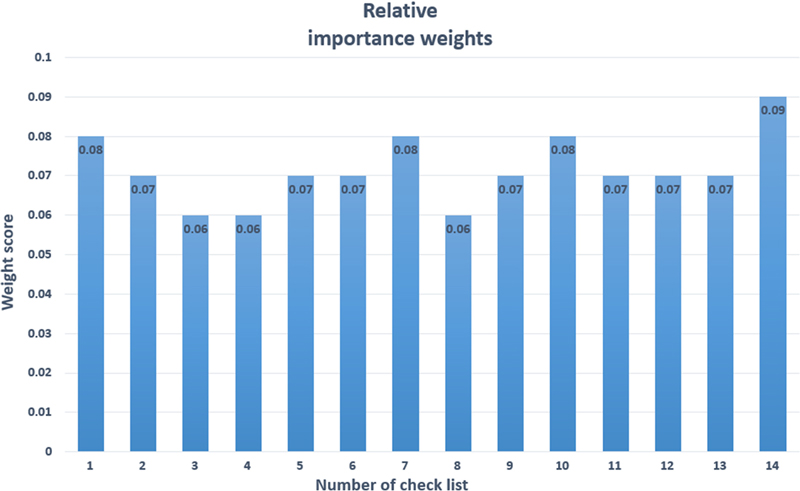
Weight of importance for evaluation standard. (normal men's wear (a)-1)
Weight of importance for evaluation standard. (normal women's wear (a)-2)
Weight of importance for evaluation standard. (universal men's wear (b)-1)
Weight of importance for evaluation standard. (universal women's wear (b)-2)
4.3. 평가기준에 대한 평점부여
의류학 분야의 전문가 세 명을 대상으로 (Fig. 8)의 일반 의류 한 벌 (a)-1, 2와 유니버설 의류 한 벌 (b)-1, 2에 대한 각 평가기준별 디자인 적합도를 평가하도록 하였다 (Table 3, 4). 일반 의류의 디자인으로 제시된 (a)-1, 2는 기존 소유하고 있는 운동복의 컬러와 디자인 중 마음에 들지 않는 부분이 마음에 들지 않는 색상과 패턴이라고 응답한 부분을 참고하여 예상한 디자인이다. 평점부여는 선행연구에서 제시한 척도를 활용하여 각 평가기준에 대한 제품별 적합도를 해당되는 위치에 표시하도록 하였고, 이것을 100점 척도로 환산하고 (Eq. 3)~(Eq. 6)에 의해 UNIX를 계산하여, 각 의류의 보편성 지수로 도출하였다.
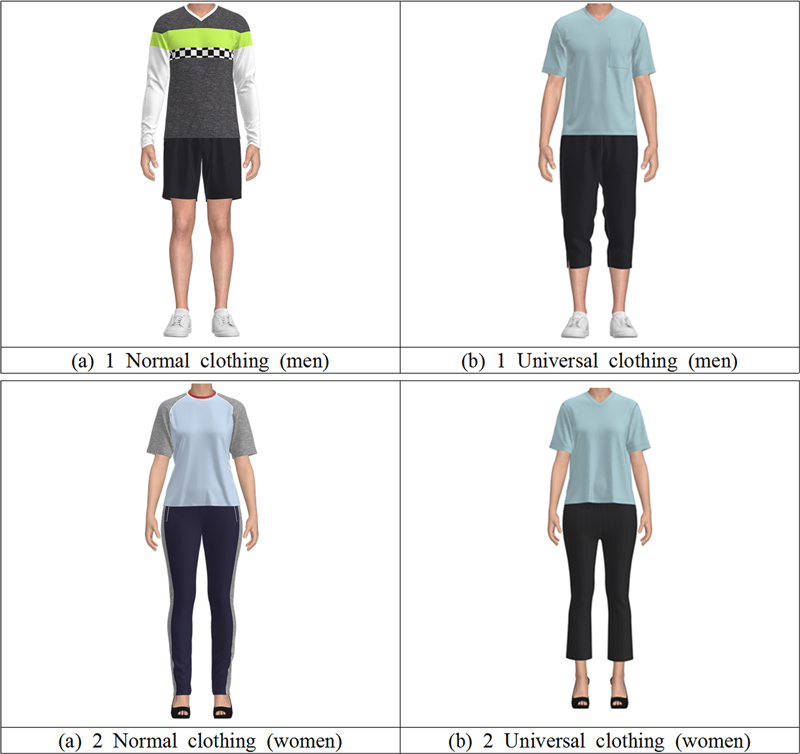
Prototype of senior wear: (a) normal clothing vs (b) universal clothing.
| Eq. 3. |
| Eq. 4. |
| Eq. 5. |
| Eq. 6. |
일반 의류와 유니버설 디자인이 적용된 의류를 비교하여 보편성 지수를 계산한 결과, 일반 의류의 남성 의류와 여성 의류의 보편성 지수는 각각 0.72와 0.75로, 남성 의류의 보편성 지수보다 여성 의류의 보편성 지수가 높게 나타났다. 유니버설 의류의 남성 의류와 여성 의류의 보편성 지수는 각각 0.94와 0.95로 성별 간 보편성 지수의 차이는 거의 없는 것으로 확인하였다. 반면, 일반 의류에 비해 유니버설 디자인이 적용된 의류의 보편성 지수가 훨씬 높을 것을 알 수 있었다.
5. 결론 및 고찰
유니버설 디자인은 보편적 설계를 통해 누구나 편리하고 사용상 차별을 없앤다는 점에서 다양한 분야에 폭넓게 적용되고 있으나 특히, 뉴 시니어 세대의 운동복 디자인 개발에 대한 연구는 매우 부족한 실정이다. 또한, 의류를 포함한 다양한 제품과 서비스에 대한 유니버설 디자인 개념이 적용된 연구가 선행되었으나, 이들의 유니버설 디자인의 적합성에 대한 명확한 정의와 평가는 거의 이루어지지 않고 있다. 따라서 본 연구에서는 유니버설 디자인의 대표 이론 4가지 모두에서 공통적으로 추구되는 보편성을 유니버설 디자인의 적합성으로 정의하고, 선행연구의 교집합을 통해 유니버설 디자인 원칙을 총 5가지로 재정립 하였다. 유니버설 디자인은 어린이·고령자·여성·장애인 등의 사회적 약자를 포함한 다양한 사람들이 활동하는 데 필요한 사항을 충족시키는 디자인으로 알려져 있다. 또한 유니버설 디자인 원리가 적용되는 사례는 건축, 공간 디자인 및 제품 디자인 분야로 다양하기 때문에 의류 제품 개발에 적용 가능한 평가항목의 도출이 필요하다. 본 연구는 여러 선행연구(Lonald, 1991; Nakagawa, 2005; Roberta, 1999; Tanaka & Mitera, 2007) 내용을 참고하여 유니버설 디자인 원리를 비교, 보완하여 의류제품에 적합하도록 평가항목을 도출하였다. 또한 포커스 그룹을 대상으로 심층면접에서 도출된 내용을 최대한 반영하여 평가항목 도출에 반영하였다는 데에 기존 평가 지표와의 차별성을 가진다. 다만, 여러 선행연구와 학자들의 이론을 참고하여 체크리스트 항목을 선별하는 과정을 전문가 세 명의 의견으로 도출하였기 때문에 내용의 검토와 평가가 제한적일 수 있다는 한계점을 가지고 있다. 이에 향후 추가적인 연구에서는 전문가 수를 늘려 체크리스트 항목의 선별 과정의 한계점을 최소화 할 수 있는 보완점이 요구된다.
본 연구에서 도출한 유니버설 패션의 다섯 가지 원리는 유연성, 인지성, 효율성, 심미성 및 심리성이며, 이 원리에 의거하여 개발된 유니버설 의류제품의 보편성을 평가하기 위하여 의류학 분야의 전문가 세 명을 대상으로 개발된 평가툴의 14가지 항목에 대해서 평가를 진행하고, 평가결과를 토대로 각 평가기준의 가중치를 구하였다. 따라서 본 연구에서는 의류제품에 적합한 유니버설 디자인의 평가항목을 새롭게 정의하고 유니버설 디자인 의류를 평가할 수 있는 방법을 제안하였다는 데에 의의가 있다고 판단된다.
이상의 결과로부터 유니버설 디자인이 적용된 의류의 보편성 지수가 훨씬 높을 것을 알 수 있었다(UNIX(a)-1=0.72 < UNIX(b)-1=0.94, UNIX(a)-2=0.75 < UNIX(b)-3=0.95). 즉, 유니버설 디자인 측면에서 유니버설 디자인 의류(b)가 훨씬 적합하게 디자인된 것을 확인할 수 있었다. 본 연구에서 개발된 유니버설 패션 디자인의 적합성 평가를 위한 툴은 시대의 흐름을 반영한 ‘뉴시니어 의류’ 관점의 새로운 유니버설 디자인 원칙을 재정립 하였다는데 의의가 있으며, 세부적으로 도출된 14개의 체크리스트와 각 항목의 가중치 점수를 활용하여 유니버설 패션 디자인의 적합성에 대한 객관적인 평가 툴로 적용 가능성을 검토한데에 의미가 있다고 판단된다. 또한, 추후 다양한 분야의 의류 디자인 사례연구를 통해 본 연구에서 개발된 평가툴에 대한 검증을 위한 후속연구를 진행할 예정이다.
Acknowledgments
이 논문은 2023-2024년도 창원대학교 자율연구과제 연구비 지원으로 수행된 연구결과임
References
-
Han, Y. S., & Han, C. S. (2020). A study on the wearing practices and preference of the sportswear for physically disabled persons : At the point of view of universal design. The Korea Journal of Sports Science, 29(6), 83-93.
[https://doi.org/10.35159/kjss.2020.12.29.6.83]

- Hong, S. S., & Seok, H. J. (2003). Altering ready-made garments for the Handicapped : For the wheelchair users. Journal of the Korean Society of Clothing and Textiles, 27(8), 873-882.
-
Jung, K, T. (2007). Expert evaluation method for the suitability of universal design. Journal of Ergonomics Society of Korea, 26(4), 57-64.
[https://doi.org/10.5143/JESK.2007.26.4.057]
-
Jung, G. T., Song, B. H., Shin, H. B., & Yoon, H. K. (2004). A Comparative study on the old's and the young's depth perception for universal design. Journal of the Ergonomics Society of Korea, 23(3), 111-119.
[https://doi.org/10.5143/JESK.2004.23.3.111]
-
Kim, M. A., & Park, S. H. (2020). Suggestion of new senior women styling applying fashion therapy. Journal of Fashion Design, 20(3), 53-69.
[https://doi.org/10.18652/2020.20.3.4]
-
Kim, M. Y. (2024). A study on the convergence strategy on the development of fashion brands specialized for senior consumers using universal design concepts. The Korean Society of Science & Art, 42(3), 37-51.
[https://doi.org/10.47294/KSBDA.25.2.23]
-
Koo, H. R., Jeon, D. J., & Lee, J. H. (2017). Research on heart rate sensing clothing design for seniors based on universal fashion. Fashion & Textile Research Journal. 19(6). 692-700.
[https://doi.org/10.5805/SFTI.2017.19.6.692]
- Lee, Y. S. (2005). 21st century environment and product design theory and practice. Seoul : Yonsei University Press.
- Lonald L. Mace (1991). Accessible and universal design, State of North Carolina : NC State University.
- Moon, S. J. (2007). Universal fashion design. Paju : KSI.
-
Moon, S. J. (2006). Study on development of universal fashion design for the elderly & disabled women. [Doctoral dissertation, Chung-Ang University].
[https://doi.org/10.23169/cau.000000009284.11052.0000274]
- Moon, S. J., & Chung, S. H. (2008). The development of universal fashion design for disabled women. Journal of the Korean Society of Costume, 58(9), 142-150.
- Morgan, David L. (1997). Planning Focus Group (Focus Group Kit). New York : SAGE Publications.
- Na, H. S., Byun, J. Y., Mun, J. H., & Cho, Y. J. (2009). Development of vest design for disabled women. Journal of the Korean Society of Costume, 59(7), 77-85.
- Nakagawa, S. Universal design manual. Seoul : Design Locus, 2005.
- Namkoong, Y. J. (2011). Reestablish concepts analysis of universal design research. Design Forum, 31(5), 381-390.
-
Park, S. H. (2018). The study of prototype pattern design and manufacture status for Para ice hockey players’ functional inner-wear. Journal of the Korean Society of Costume, 68(3), 140-151.
[https://doi.org/10.7233/jksc.2018.68.3.140]
- Peak, J. E., & Chun, J. S. (2005). Un universal clothing design for the persons with disabled. Journal of the Korean Society of Design Culture, 11(4), 52-61.
- Rhee, N, H., & An, J, S.(2008). The effect of universal fashion and an offer of design – with a focus on fashion show for the disabled- . Journal of the Korean Society of Costume, 58(7), 1-12.
- Roberta L. N. (1999). Universal design (Lee, Y. S, Trans.). Seoul: Taelim. (Original work published 1978).
- Tanaka, N., & Mitera, S. (2007). Universal fashion : Suggestion of wearing clothing design that anyone can enjoy.
- The Center for Universal Design, Evaluating the universal design performance of products, N. C. State University, 2000.
- Yoshihiko, K., Hong, C. S., & Yang, S. Y. Universal design. Seoul : Sunin Press, 2005.