
The Hidden Figures: Discovering Global Apparel Manufacturers’ CSR Activities According to the Global Standards

©2024 The Korean Fashion and Textile Research Journal(KFTRJ). This is an open access journal. Articles are distributed under the terms of the Creative 52 Commons Attribution Non-Commercial License (http://creativecommons.org/licenses/by-nc/4.0), which permits unrestricted use, distribution, and reproduction in any medium, provided the original work is properly cited.
Abstract
Despite the growing importance of corporate social responsibility (CSR) in the apparel industry, most existing research focuses on the CSR activities of well-known apparel brands and retailers, not manufacturers. The purpose of this study was to examine the CSR activities of global apparel manufacturers using the two most widely accepted global CSR frameworks: the United Nations’ Sustainable Development Goals (SDGs) and Global Reporting Initiative (GRI) standards. A comparison was employed based on the legitimacy theory. For this purpose, a content analysis was conducted on five apparel manufacturers’ CSR activities disclosed in their annual sustainability reports published on the firms’ official websites. The analysis was both quantitative (frequency) and qualitative (intensity). The results revealed that all firms conducted CSR activities related to environmental and social activities more actively than they conducted economic activities, with higher frequency and intensity scores for both the GRI and SDGs. However, based on each firm’s economic development level, size, and years of experience, their applications of resources/technology to CSR and approaches to certain issues (e.g., gender and diversity issues) differed, supporting the legitimacy theory. The results provide academic implications by providing empirical information on apparel manufacturers’ CSR activities as well as practical implications for other manufacturers seeking to develop CSR programs that meet the global standards.
Keywords:
Corporate social responsibility, apparel, manufacturer, sustainability, reporting1. Introduction
The apparel industry has caused many problems, including unethical working environments and environmental pollution (Dissanayake et al., 2017; Nayak et al., 2019). Specifically, most of these problems occur in the production stage. For instance, about 20% of the clean water contamination in the world is attributed to textile dyeing and finishing process during the production (European Parliament, 2023). Since most of the major apparel manufacturers are concentrated in developing countries due to their low labor costs (Parschau and Hauge, 2020), those countries’ low level of corporate social responsibility (CSR) awareness often exacerbates the problems (Simpson and Aprim, 2018).
Nevertheless, the majority of the existing research is focused on the CSR activities of well-known apparel brands and retailers (e.g., Chan et al., 2020; Feng and Ngai, 2020; Woo and Jin, 2016), not manufacturers. Compared to the apparel brands that actively promote CSR activities using strategic marketing capabilities, apparel manufacturers’ CSR is often behind the scenes (Choi and Han, 2019). The global apparel manufacturing industry ranked seventh in market size measured by revenue and is the 25th largest global manufacturing industry (IBIS World, 2023). Given the position manufacturers occupy in the apparel industry, it would be difficult to achieve sustainability in the industry without their engagement.
When assessing firms’ CSR activities, it is important to compare those within regional contexts due to the diverse environmental factors influencing the firms’ approaches to CSR (Dobers and Halme, 2009). Legitimacy theory offers a theoretical framework for this, by positing that firms across different regions pursue different CSR approaches to conform to the standards valued by the society where they belong (Burhan and Rahmanti, 2012). For instance, the majority of apparel manufacturers are in Asia, and some of them are located in developing countries while the others are located in more economically developed countries (European Parliament, 2020; Wondrium Daily, 2017). These firms may have different approaches to CSR, as the CSR suitable for developing countries and developed countries differ (Amos and Awuah, 2017). Because the ultimate purpose of CSR for firms is to gain the legitimacy for their existence in the society by fulfilling their responsibilities toward the society (Burhan and Rahmanti, 2012), it is important to understand firms’ different approaches to CSR within their national and cultural contexts.
Therefore, the purpose of this study is to examine the CSR activities of global apparel manufacturers across regions and compare those based on legitimacy theory. With this aim, this study employs the content analysis method by systematically analyzing the CSR contents in the firms’ annual sustainability reports both quantitatively (frequency) and qualitatively (intensity), following previous studies (Holder-Webb et al., 2009; Woo and Jin, 2016). The results will shed light on the manufacturing side of the CSR research in the apparel industry, as well as provide practical implications for apparel manufacturers in designing their CSR programs meeting the global standards and for consumers who desire to critically assess global apparel manufacturers’ current CSR practices.
2. Literature Review
2.1. Corporate Social Responsibility (CSR) and CSR Reporting
Corporate social responsibility (CSR) is a broad concept embracing issues ranging from workers’ rights and community investment to sustainability and market relations (Blowfield and Murray, 2008; White et al., 2017). Wood (1991) defined CSR as corporate responsibility for the environment and society, derived from the fact that companies are genuinely interconnected. According to Carroll’s (1979) framework, CSR encompasses areas that are economic, legal, ethical, and discretionary, and each area can be assessed in light of a company’s stakeholders. Since then, the idea of CSR has transformed from a philanthropic strategy to a strategic business requirement (Latif and Sajjad, 2018).
Stakeholders analyze a firm’s CSR management via CSR reporting (Velte et al., 2020). CSR reporting refers to the process through which a corporation informs its stakeholders about the social, environmental, and financial effects (Gray, 2006). In order to assess different firms’ CSR reporting by using consistent and verifiable metrics, global standards for CSR reporting were developed and an increasing number of firms are adopting those frameworks. The Global Reporting Initiative (GRI) is an international organization founded in 1999 that assists companies by providing global common standards in multiple languages that can communicate their impact. More than 1,500 global companies have utilized this guideline of objective indicators of CSR activities (GRI, 2011; Legendre and Coderre, 2013). The framework consists of three primary areaseconomic, environmental, and social responsibilities. Under each area, firms report specific area-related activities using sub-codes.
Additionally, because firms’ CSR is often guided by the global regulatory standard, such as the United Nation’s Sustainable Development Goals (SDGs), much of the latest research links UN SDGs to GRI and applies both in analyzing firms’ CSR performances (Calabrese et al., 2021; ElAlfy et al., 2020; Tsalis et al., 2020). The SDGs, developed by the United Nations in 2015, consist of 17 global goals and 169 targets that highlight the current sustainability concerns (Sauermann et al., 2020). Because the GRI standard gives a comprehensive set of indicators to analyze the firms’ contribution to SDGs (Rosati and Faria, 2019), García and Isabel (2021) posited that it provides support to businesses in documenting their impact on the SDGs. Therefore, many recent studies applied these SDGs and the GRI framework together in analyzing firm’s CSR disclosures (e.g. Calabrese et al., 2021, ElAlfy et al., 2021, Costa et al., 2022).”
2.2. Apparel Industry and CSR
Most apparel is produced by the practice of outsourcing from developing or underdeveloped nations to achieve low production costs (Rudell, 2006). This kind of supply chain has resulted in unfair wages, human rights violations, unsafe working conditions, and air and water pollution (Chowdhury et al., 2018). For this reason, CSR has been an important issue in the apparel industry (Todeschini, 2017). As consumers are becoming more interested in understanding who created their clothes and where they were made (Armstrong et al., 2016), apparel firms are called to disclose their CSR activities either as part of their annual business reports or as standalone documents. As a result, apparel firms have actively demonstrated the environmental and social impact of their businesses, such as environmental pollution and unethical working conditions (Dissanayake and Wijesingha, 2017).
In light of the growing interest in CSR in the apparel industry, several researchers aimed to study apparel brands’/retailers’ CSR and their CSR reporting practices. Mann et al., (2014) investigated the CSR practices of the leading apparel specialty retailers’ and found that compliance to legal or regulatory requirements may serve as a significant motivator for companies to engage in more active CSR communication with stakeholders via their websites. Li and Leonas (2020) analyzed the sustainable performances of small and medium-sized apparel firms and introduced their strategies to incorporate the sustainability concept to the business more efficiently. Focusing on CSR reporting, Islam and Deegan (2010) analyzed the CSR disclosures in the annual reports of two multinational apparel brands, Nike and H&M. As results, they found that the brands’ social and environmental disclosures are the response to the social and environmental issues faced in the industry (Islam and Deegan, 2010). Furthermore, Woo and Jin (2016) compared six apparel brands’ CSR communications on their websites and reports, and found that the brands’ communication strategies differ by their nationality and cultural background.
These previous studies together show that there have been many attempts to analyze apparel brands’/retailers’ CSR activities. However, they were predominantly focused on the CSR reporting of apparel brands/retailers, not manufacturers (Ali et al., 2017), and certain aspects of CSR only (e.g., environments/sustainability). Given that most of social issues related to CSR are occurring in the production stage of apparel industry where developing nations are involved, this research gap emphasizes a need for examining apparel manufacturers’ CSR activities.
2.3. Legitimacy Theory
Legitimacy theory has been employed in literature to explain the justification of expecting CSR from organizations (Fernando and Lawrence, 2014). First, legitimacy refers to a broad perception or assumption that an entity's actions are considered desirable, correct, or suitable within a socially constructed framework of norms, values, and beliefs (Suchman, 1995). Following this concept, legitimacy theory assists organizations by facilitating voluntary disclosures of social and environmental practices to fulfill their social obligations, thereby gaining the legitimacy of their existence in the society (Burlea and Popa, 2013). Firms’ investment into CSR reporting is understood as part of this effort. By disclosing CSR, companies show that their CSR activities align with societal norms and values (Shabana and Ravlin, 2016). Therefore, legitimacy theory has been employed to examine firms’ CSR disclosures according to their environmental backgrounds. For instance, Eccles and Krzus (2010) posited that firms regarded as less transparent in developing countries report CSR actively as a means of reducing the legitimacy gap. Furthermore, Kamal and Deegan (2013) found that the CSR reporting of textile and garment firms in Bangladesh is shaped by societal expectations in their communities.
Legitimacy theory also offers a theoretical framework explaining why firms across different regions can pursue different CSR approaches to conform to the standards valued by the society where they belong (Burhan and Rahmanti, 2012). According to legitimacy theory, a firm and its society are connected by societal binding, and this requires the firm to act in conformity with the norms of the society in order to survive (Burhan and Rahmanti, 2012). That is, because company interacts with the society in which the company is currently located (Islam, 2017), firms act in response to social perceptions, expectations, and values in the society where they belong (O’donovan, 2002). This indicates that firms are influenced by the environment surrounding them, and thus their CSR activities reflect the characteristics of their environmental conditions (Fransen, 2013). This offers that in examining global apparel manufacturers’ CSR activities, there should be an understanding about their different regional contexts that might have resulted in different approaches to CSR.
2.4. Research Questions
The purpose of this study is to examine global apparel manufacturers’ CSR activities and compare the similarities and differences in their CSR activities, based on legitimacy theory. For this, two research questions are developed. First, this study investigates the current CSR disclosures of global apparel manufacturers (RQ1). Second, this study compares how the approaches of those global apparel manufacturers’ CSR disclosures are similar to or different from each other (RQ2). These two research questions are stated as follows:
- RQ1: How are global apparel manufacturers currently disclosing CSR?
- RQ2: How do the approaches of CSR disclosures differ among global apparel manufacturers?
3. Method
3.1. Sample Selection
In order to select sample apparel manufacturers, a systematic sample selection process was employed (see Figure 1). First, the list of apparel manufacturer members of Sustainable Apparel Coalition (SAC) was retrieved. SAC is a non-profit coalition of apparel firms that aim to enhance sustainability in the global apparel industry, founded in 2010 (Radhakrishnan, 2014). Because their members are expected to have accessible CSR reporting information, their member list was used as the initial pool, which provided a list of 67 apparel manufacturers.
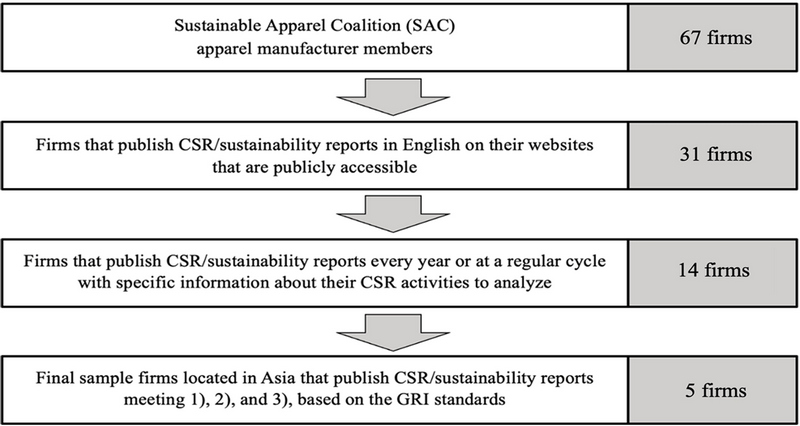
Selection process for sample firms.
From this list, two researchers assessed the accessibility of the firms’ CSR reports by rating them as “high,” “medium,” or “low.” “High” was assigned when the firms published their reports regularly and adapted GRI standards with an affluent amount of information. “Medium” was assigned when the firms adapted GRI standards but didn’t have specific information. “Low” was assigned when the firms didn’t adapt any global standards like GRI and didn’t offer information about their CSR programs. Among these, 31 firms were found to disclose CSR reports in English on their official websites. However, some of their reports were dated or irregularly updated, and those that regularly publish updated reports were narrowed down to 14 firms.
Among these, five firms disclosed clearly structured CSR reports based on the GRI standards: Arvind (India), APR (Indonesia), Hirdaramani (Sri Lanka), Crystal International (Hong Kong, China), and Toray (Japan). These firms also had commonalities by being located in Asia, providing a geographic cohesiveness that enhances a fair comparison of their CSR activities. Additionally, given that Asia represents the major producer/exporter of textiles and apparel in the world market, it was deemed appropriate to analyze their CSR disclosures to investigate major apparel manufacturers’ CSR disclosures as the research purpose. The summary of the descriptions of these five firms selected as the final sample are provided in Table 1. Arvind, established in 1931 in India, serves 135 countries by producing denim, knits, and woven. Crystal, established in 1970 in Hong Kong, China, has about 48,000 employees by producing a wide range of apparel, including sportswear and outdoor apparel. Hirdaramani, established in 1980 in Sri Lanka, produces denim, woven, and knits. Interloop, established in 1992 in Pakistan, produces both yarns and apparel with over 30,000 employees. Lastly, Toray, established in 1926 in Japan, serves 27 countries by producing both fibers and fabrics (see Table 1).

Description of the sample firms
3.2. Content Analysis
For the method of analysis, content analysis was conducted on the five firms’ CSR reports. Content analysis is the research method that classifies enumeration data into groups according to criteria (Krippendorff, 2018; Unerman, 2000). This method has been widely used as a tool for extracting contents from published reports in social science research (Laskar and Maji, 2016) and to analyze firms’ CSR disclosures (e.g., Gao, 2011; Holder-Webb et al., 2009; Lock and Seele, 2016; Woo and Jin, 2016). Among various CSR disclosures, CSR reports are a significant representative of the firms’ CSR activities (Du et al., 2010). The latest version of the five firms’ CSR reports (2022) published at the time of analysis (May to July 2023) were analyzed.
For the criteria of analysis, two global CSR reporting guidelines, GRI standards and UN SDGs, were used. Because firms’ CSR is often guided by UN SDGs as the global regulatory standard, much of the latest research links UN SDGs to GRI and applies both in analyzing firms’ CSR performances (Calabrese et al., 2021; ElAlfy et al., 2020; Tsalis et al., 2020). Following this, this study employed both GRI standards and UN SDGs as the analysis criteria using the GRI’s linkage of the GRI indicators to each of the SDGs (GRI, 2021). Under each area of GRI’s three primary areas, firms report specific area-related activities using sub-codes: GRI 201-1~207-4 (economic, 17 sub-codes), GRI 301-1~308-2 (environmental, 32 sub-codes), GRI 401-1~419-1 (social, 40 sub-codes) (GRI, 2020). The most recent version of the GRI standards is the 2021 updated version (excluding GRI 307, 412, and 419), but the GRI 2020 version was used because the five firms specified CSR activities for the excluded codes. UN SDGs are the 17 primary goals that the United Nations proposes for sustainability, including reduced inequality, climate action, and partnerships for goals (United Nations, 2023).
For coding procedure, first, two researchers independently evaluated the five firms’ CSR reports following previous studies (Holder-Webb et al., 2009; Woo and Jin, 2016). The evaluation included both quantitative (frequency) and qualitative (intensity) assessment, as the amount and depth of information in each disclosure varies, and as such the intensity of each disclosure should complement the frequency of disclosure (Holder-Webb et al., 2009; Woo and Jin, 2016). Frequency was coded as “1” every time a CSR disclosure about a specific GRI sub-code appears in the report. For intensity, referring to previous studies (Laskar and Maji, 2016; Tsalis et al., 2018), a four-point scale (from “0” to “3”) was used (see Table 2). The inter-coder reliability of the initial coding was .87 (267 codes out of 306 codes were matched between the two coders). After the initial coding, the third researcher reviewed the results and performed discussions until the disagreement between the other two was resolved.
Qualitative (intensity) assessment criteria for CSR disclosure
4. Results
4.1. How Global Apparel Manufacturers Are Currently Disclosing CSR
Overall, the five apparel manufacturers conducted CSR related to environmental and social activities more than economic activities. In all firms, the frequency and intensity scores of the GRI were higher in social and environmental areas than in economic areas (see Table 3). In particular, Toray and Arvind most actively reported CSR in all areas with high GRI scores. Toray (78) and Arvind (46) pursued environmental CSR more intensively than the others (ranging 28-38). In the social area, similarly, Toray (70) and Arvind (45) had higher intensity than the others (ranging 10-33). Furthermore, Toray (21) and Arvind (27) also reported higher intensity in economic CSR than the others that only scored below 8. Crystal and Hirdaramani conducted little economic-related CSR and focused intensely on environmental and social CSR.
The five apparel manufacturers’ CSR performances by GRI scores
For specific GRI codes, all five manufacturers conducted CSR related to the five environmental GRIs (302-4, 303-5, 305-5, 306-2, 306-3) and the four social GRIs (403-5, 403-6, 403-9, 404-1) (see Table 4). Hirdaramani did not carry out economic CSR related to GRI, so there were no CSR activities common to all manufacturers in the economic GRI codes.
The five apparel manufacturers’ commonly implemented GRI codes per category
Regarding GRI 302-4 (Reduction of energy consumption), 303-5 (Water consumption) and 305-5 (Reduction of GHG emissions), the manufacturers primarily conducted CSR related to energy and water consumption, conservation, and GHG emission reduction. In particular, they implemented an initiative to use renewable energy, such as solar power and biomass, and implemented CSR activities to protect the environment by developing their own technologies (Arvind, p. 81: Emission reduction, pp. 76-77: Energy use and emission; Crystal, p. 20: Crystal Net zero 2050; Hirdaramani, pp. 8-9: Energy & GHG; Interloop, p. 22: Energy consumption and reduction, p. 24: Water withdrawal; Toray, pp. 150-151: Installing renewable energy systems).
Regarding GRI 306-2 (Management of significant waste-related impacts) and 306-3 (Waste generated), they divided waste into hazardous and non-hazardous parts and managed waste according to the category. The firms also performed CSR related to products, technologies, and recycling that could generate less waste pursuing sustainability (Arvind, pp. 103-105: Waste management; Crystal, pp. 32-35: Waste management; Hirdaramani, pp. 20-21: Waste generated; Interloop, p. 31: Waste management; Toray, pp. 250-260: Realizing a circular economy).
Regarding GRI 403-5 (Worker training on occupational health and safety), 403-6 (Promotion of worker health), and 403-9 (Worker-related injuries), they operated programs for the overall health and safety of their employees. These programs included practical safety education from employees’ risk awareness and included education for women or the disabled. They also provided various programs to help employees balance family and work, improving the employee welfare (Arvind, p. 50: Safety; Crystal, pp. 52-53: Safeguarding employees’ health and safety, pp. 54-55: Employee well-being; Hirdaramani, p. 33: Occupational health & safety, pp. 38-43: WOW initiative programs; Interloop, p. 38: Health & safety; Toray, pp. 290-295: Creating a positive workplace for employees).
Regarding GRI 404-1 (Average hours of training per year per employee), all firms were engaged in CSR activities related to overall education for executives and employees. It conducted training programs that subdivided categories, such as job level, gender, work field, etc., and provided training to develop employees’ careers (Arvind, p. 48: Learning and development; Crystal, pp. 58-63: Talent grooming; Hirdaramani, p. 32: General training & education; Interloop, p. 41: Training and development; Toray, pp. 274-281: Securing and developing human resources to create new value).
The five manufacturers’ CSR performances according to the UN SDGs revealed similar patterns to those based on the GRI. Scores by SDGs were based on linking the SDGs and the GRI standards, which GRI announced as official data in 2022 (the scores were the sum of the intensity of individual GRI codes linked to SDGs; see Appendix). First, all five manufacturers scored high on SDG 8 (Decent work and economic growth), which is mainly comprised of GRI 400 (social) codes, and SDG 12 (responsible consumption and production), which apply to the GRI 300 (environmental) (see Figure 2). Like GRI, all manufacturers actively implemented CSR activities related to environmental and social SDGs, such as, minimizing the environmental impact of production and improving workers’ welfare and local communities.
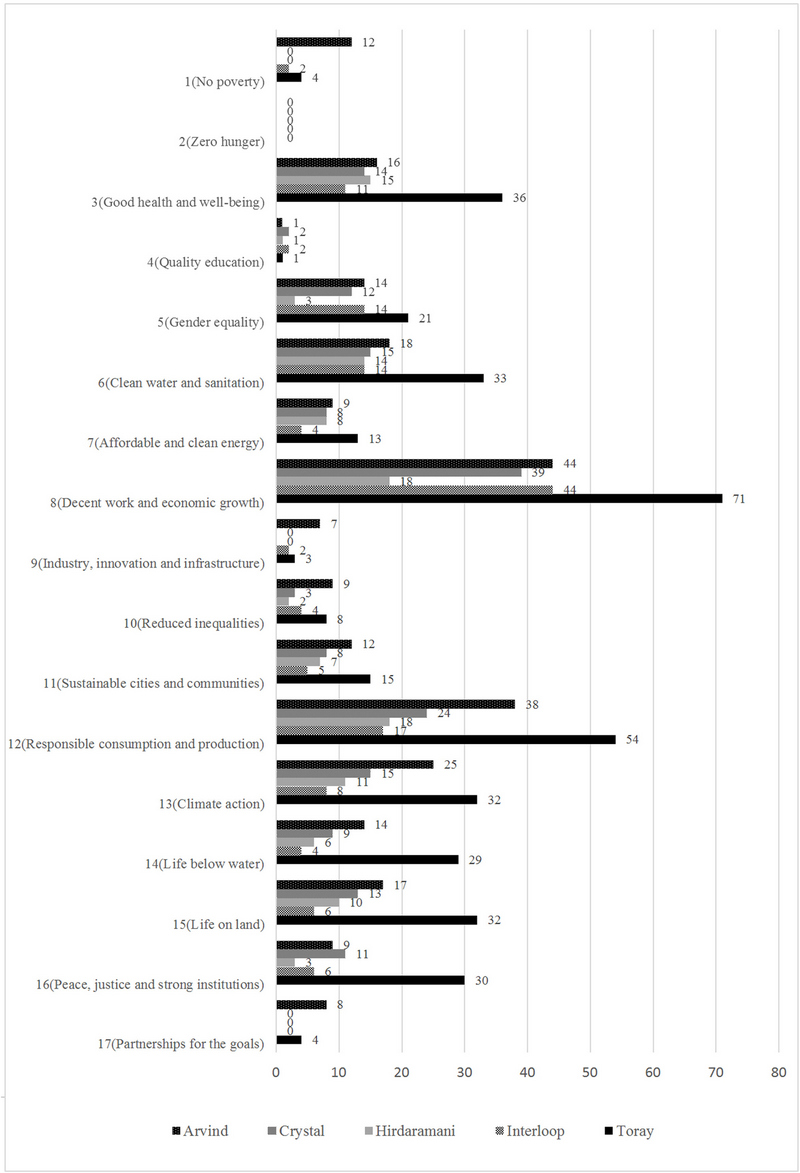
The Five Apparel Manufacturers’ CSR Performances by UN SDGs.
For specific activities, regarding SDG13 (Climate action), Arvind (25), Crystal (15), and Toray (32) showed higher SDG scores than Hirdaramani (11) and Interloop (8). Particularly, Toray showed noticeably higher SDG scores in SDG3 (Good health and wellbeing)— 6 (Clean water and sanitation), 14 (Life below water), 15 (Life on land), and 16 (Peace, justice and strong institutions)—than other firms (all above 29). Arvind was the second following Toray for these activities. For SDG5 (Gender equality) and SDG8 (Decent work and economic growth), Arvind, Crystal, Interloop, and Toray similarly showed higher scores than Hirdaramani. These patterns are presented in Figure 2.
4.2. How the Approaches of CSR Disclosures Differ among Global Apparel Manufacturers
Despite the common patterns that the five manufacturers showed in their CSR activities, the way in which they executed those activities revealed some differences (see Table 5, 6). First, there was a difference in their country of origin’s economic development level. Among the five firms, some CSR codes were only adopted in relatively more economically developed regions. For instance, only Toray (headquartered in Japan) and Crystal (headquartered in Hong Kong, China) addressed GRI 308-2 (Negative environmental impacts in the supply chain), 405-1 (Diversity), 414-2 (Negative social impacts in the supply chain), and 416-2 (Non-compliance to the health and safety) (see Table 5). They focused on managing environmental and social risks within the entire supply chain in producing their products and implemented third-party monitoring programs (Crystal, pp. 37-38: Higg index; Toray, pp. 303-314: Socially responsible procurement initiatives at Toray group). In other words, the firms based in more economically developed countries concentrated on issues that could arise within the overall supply chain and conducted CSR activities related to them. Additionally, regarding GRI 405-1 (Diversity), Crystal and Toray established policies related to employee diversity. To attract passionate and talented employees, Crystal implemented human resources policies, such as ensuring internal fairness and developing highpotential employees (Crystal, p. 56: Talent acquisition). Toray committed to building a workplace where individuals can demonstrate their abilities, as well as implementing support policies that enable female employees to be active and build their careers. For example, Toray introduced a parental leave system 20 years before it became mandatory and made efforts to increase the proportion of female senior executives and announced related plans (Toray, pp. 282-289: Promoting diversity).
The GRI codes only implemented by the apparel manufacturers in more economically developed regions (Toray and Crystal)
Examples of the apparel manufacturers’ different approaches to CSR
Moreover, regarding GRI 416-2 (Non-compliance to the health and safety), Crystal and Toray actively developed consumer safety guidelines. Crystal developed product safety guidelines to ensure that only safe substances are used throughout the entire manufacturing process (Crystal, p. 46: Handling product complaints). Toray strengthened its quality assurance regulations as well as actively maintained quality measurement devices (Toray, pp. 199-203: Initiatives for quality assurance and product safety).
Second, some CSR goals, such as recycling and energy reduction, required technological application. The firms exhibited differences in how technologies were applied to CSR according to the firms’ size, number of employees, and annual revenue. Relatively large firms that have more than 40,000 employees and annual sales of $1 billion, such as Arvind, Crystal, and Toray, implemented this through their self-developed innovative technologies. For example, regarding CSR activities related to SDG13 (Climate action), Arvind implemented its own patented technology related to ecofriendly fiber production and fiber recycling (Arvind, p. 22: Sustainable fibres, p. 23: Circularity). Crystal similarly implemented carbon neutral technology related to the jeans-making process that reduces the need for washing (Crystal, p. 23: Net zero jeans, p. 42: Smart laundry – innovations for sustainability). Toray also carried out technologies related to active biotech development, textile and film recycling (Toray, p. 247: 100% plant-based nylon fiber Ecodear N510, p. 252: 100% bio-based PET fiber). By contrast, smaller firms like Hirdaramani and Interloop chose to partner with others with the ability to offer them technological assistance. Hirdaramani collaborated with brands, such as American Eagle, to produce sustainable jeans, as well as with suppliers and customers to produce sustainable products (Hirdaramani, p. 60: Circular styles with American Eagle). Interloop partnered with World Wildlife Fund (WWF) to conserve water and collaborated with Lok Sanih to produce organic cotton produced through a traceable supply chain (Interloop, p. 24: Water stewardship, p. 28: Interloop organic kapas).
In addition to its size, the year of a firm’s establishment, which could be an indicator of its know-how, also influenced the development of technologies for CSR. Toray (established in 1926) and Arvind (established in 1931) showed higher SDG scores in SDG6 (Clean water and sanitation), SDG14 (Life below water), and SDG15 (Life on land) than the films that were established later. Toray actively built R&D infrastructure to develop their technologies and products, and as a result, it developed plant-based nylon fiber as a sustainable alternative to conventional nylon (Toray, p. 77: Establishing a corporate culture of active engagement in R&D, pp. 247-249: Green innovation-related products and R&D announced in fiscal 2021). Arvind actively invested in R&D in the development of biodegradable alternative fibers (bamboos, flax, and hemp) (Arvind, p. 22: Sustainable fibres, p. 39: Alternate fibres). In other words, Toray and Arvind, which are almost 100 years old, actively invested in strengthening R&D centers and developing sustainable technologies using their own data accumulated over a long period of time.
Moreover, there was also a difference in how the firms execute their social-related CSR activities. Regarding SDG5 (Gender equality) and SDG8 (Decent work and economic growth), Arvind, Crystal, Interloop, and Toray showed higher scores than Hirdaramani. Arvind implemented policies to protect female employees, including the development of female leaders and the creation of a safe workplace from harassment (Arvind, p. 13: Board diversity policy, p. 16: Policies – better work environment for women). Crystal similarly implemented career development programs for women, such as parental leave and an active childbirth promotion system (Crystal, p. 66: Gender equality, maternity and parenting support). Likewise, Interloop carried out activities such as reconnect programs for career-interrupted women, childcare centers, and motorcycle training to be used when commuting (Interloop, p. 39: Women empowerment, p. 44: Women on wheels program). Toray also held programs for women’s career development, regular seminars, and activities related to child and family care (Toray, pp. 282-289: Promoting diversity, pp. 290-295: Creating a positive workplace for employees). This shows that the four firms actively engaged in CSR related to women concerning SDG5 and SDG 8. Compared to this, Hirdaramani engaged individuals in activities to develop the leadership of female employees, but it put more emphasis on other types of social activities that are less relevant to SDG 5 and SDG 8, such as the support of orphanages and children’s education (Hirdaramani, p. 27: Gender equality & women in leadership, p. 46: Supporting the Ajula children’s orphanage, p. 48: Educational support for employees’ children).
5. Discussion and Implications
First, the results based on the GRI standards showed that all five firms focused on social and environmental CSR over economic CSR. The firms’ scores on the GRI’s economic dimension were the lowest compared to the society and environmental dimensions. This pattern is consistent with the previous studies that found that firms communicate the environmental and the social CSR more actively than the economic CSR (e.g. Ali et al., 2017; Parker, 2014). Second, the results based on the UN SDGs revealed similar patterns. Like the CSR performances by GRI, all manufacturers actively implemented CSR activities related to environmental and social SDGs, such as SDG 8 (Decent work and economic growth – connected to GRI 400 (social) codes) and SDG 12 (Responsible consumption and production: connected to GRI 300 (environmental) codes). This proves that apparel manufacturers are incorporating the UN SDGs into their CSR initiatives by leveraging them to the GRI standards in their latest CSR reports, supporting the recent studies that recommended consideration of both the GRI standards and the UN SDGs in analyzing firms’ CSR activities (Tsalis et al., 2020).
Third, although the five manufacturers generally exhibited similar patterns in terms of the CSR categories emphasized (environmental and social versus economic), they showed different approaches when it came to specific approaches to CSR. This supports legitimacy theory, which posits that firms’ CSR activities reflect the environmental factors in their regions, such as the norms and social issues in their country of origin (Burhan and Rahmanti, 2012). Specifically, because firms’ economic development level, size, and year of operation are proxies of corporate assets, this result can be understood by a well-known theoretical perspective in the resource-based theory (RBT) (Russo and Fouts, 1997). According to the RBT, firms’ resources, both tangible (e.g., economic capabilities and size) and intangible (e.g., experiences and knowhow), influence their strategies and competitiveness. Additionally, resources like technological advancements also influence corporate activities. Applying those to this study, it can be understood that the apparel manufacturers’ different levels of those resources resulted in the differences in their CSR performances.
Last but not least, the results of this study showed that the apparel manufacturers’ approaches to certain CSR topics, such as gender and diversity issues, are substantially different. Because such issues are closely related to cultural norms across regions, this difference can be understood in relation to cultural differences rather than economic development level or corporate assets. For instance, Arvind, Crystal, Interloop, and Toray actively pursued social CSR activities related to gender equality in India, Hong Kong-China, Pakistan, and Japan, respectively. In contrast, the Sri Lanka-based Hirdaramani was less committed to this issue. According to Hofstede’s theory of cultural dimensions, the first four regions are classified as a relatively masculine culture where there are clear gender roles often accompanied by gender inequality (Hofstede, 2011); this might have pushed the firms in those regions to pay more attention to the gender inequality issues. On the other hand, the last, Sri Lanka, is classified as a more feminine culture where feminine values are appreciated (Hofstede, 2011), which might have resulted in Hirdaramani’s less pressure on communicating about gender inequality.
This study offers several academic implications to the extant literature. First, distinguished from previous research that predominantly focused on apparel brands’/retailers’ CSR reporting, this study focused on apparel manufacturers by adding empirical evidence of the manufacturers’ CSR activities. Given the critical role of manufacturers in the global apparel industry, this approach sheds light on the status quo of global apparel manufacturers’ CSR performances. This study provides empirical support to legitimacy theory and relevant literature by showing that apparel manufacturers’ CSR approaches differ even though the firms are all located in Asia.
Additionally, this study supports recent CSR studies by showing that the analysis of CSR disclosures adhering to only GRI is not sufficient, as the global apparel manufacturers already link SDGs to their CSR activities according to the latest global standards.
For practical implications, this study provides a guide to apparel manufacturers and other firms that desire to understand CSR expectations across Asia by showing the detailed approaches of leading manufacturers in Asia. Their examples may function as benchmarks to other firms in developing CSR programs based on global standards. Moreover, by showing the major apparel manufacturers’ CSR performances based on their countries of origin, this study also provides consumers with the source of information that helps them make choices in consideration of the responsible manufacturer/origin of the product.
Despite the implications above, there are some limitations remaining for this study. First, this study selected only the five apparel manufacturers located in Asia. Although this decision was carefully made through a systematic sample selection process, it needs caution in generalizing findings to other apparel manufacturers because there could be differences due to their geographical and cultural heterogeneity, as suggested by the results of this study. Future research may expand the scope of research to other continents and compare the firms’ CSR activities on the inter-continent basis.
Second, this study compared CSR activities by analyzing the selected firms’ 2022 CSR reports. Although this approach fulfilled the objectives of the current study it cannot explore changes in the firms’ CSR activities over time. Therefore, future research may consider analyzing reports from various years and explore changes in the firms’ CSR activities over time.
Third, although this study made effort to employ well-structured analysis criteria (i.e., GRI and SDGs), as well as CSR reports (i.e., multistage sampling identifying the most clearly written CSR reports), there were still some holes in linking them together, such as some CSR activities presented in the sample firms’ CSR reports not being linked to any GRI code. For example, GRI indicators and the page didn’t match or related information in CSR reports couldn’t be found. Also, some CSR activities met multiple GRI codes under the same area, which increased the total count of that area. Therefore, when discussing the findings of this study, these imperfections within the GRI framework and the research method using corporate reports should be considered together.
References
-
Ali, W., Frynas, J.G., & Mahmood, Z. (2017). Determinants of corporate social responsibility (CSR) disclosure in developed and developing countries: A literature review. Corporate Social Responsibility and Environmental Management, 24(4), 273-294.
[https://doi.org/10.1002/csr.1410]

- Amos, G.J., & Baffour Awuah, G. (2017). In search of competitiveness through innovation-driven CSR initiatives in multinational enterprise subsidiaries in developing countries. Journal of Developing Country Studies, 7(2), 161-173.
-
Armstrong, C. M., Niinimäki, K., Lang, C., & Kujala, S. (2016). A use-oriented clothing economy? Preliminary affirmation for sustainable clothing consumption alternatives. Sustainable Development, 24(1), 18-31.
[https://doi.org/10.1002/sd.1602]
- Arvind. (2022). Sustainability Report 2022, Arvind, Retrieved October 19, 2023, from https://www.arvind.com/pdf/Arvind_SR_22.pdf
- Blowfield, M., & Murray, A. (2008). Corporate responsibility: A critical introduction. Oxford University Press, USA
-
Burhan, A. H. N., & Rahmanti, W. (2012). The impact of sustainability reporting on company performance. Journal of Economics, Business, & Accountancy Ventura, 15(2), 257-272.
[https://doi.org/10.14414/jebav.v15i2.79]
-
Burlea, A. S., & Popa, I. (2013). Legitimacy theory. Encyclopedia of corporate social responsibility, 21, 1579-1584.
[https://doi.org/10.1007/978-3-642-28036-8_471]
-
Calabrese, A., Costa, R., Gastaldi, M., Ghiron, N.L., & Montalvan, R.A.V. (2021). Implications for Sustainable Development Goals: A framework to assess company disclosure in sustainability reporting. Journal of Cleaner Production. 319, 128624.
[https://doi.org/10.1016/j.jclepro.2021.128624]
-
Carroll, A. B. (1979). A three-dimensional conceptual model of corporate performance. Academy of Management Review, 4(4), 497-505.
[https://doi.org/10.5465/amr.1979.4498296]
-
Chan, H.L., Wei, X., Guo, S., & Leung, W.H. (2020). Corporate social responsibility (CSR) in fashion supply chains: A multi-methodological study. Transportation Research Part E: Logistics and Transportation Review, 142, 102063.
[https://doi.org/10.1016/j.tre.2020.102063]
-
Choi, D., & Han, T. I. (2019). Green practices among fashion manufacturers: Relationship with cultural innovativeness and perceived benefits. Social Sciences, 8(5), 138.
[https://doi.org/10.3390/socsci8050138]
-
Chowdhury, M.M.H., Umme, N.J., & Nuruzzaman, M. (2018). Strategies for mitigating supply-side barriers in the apparel supply chain: A study on the apparel industry of Bangladesh. Global Journal of Flexible Systems Management, 19, 41-52.
[https://doi.org/10.1007/s40171-017-0180-6]
[https://doi.org/10.5465/amr.1995.9503271994]
-
Costa, R., Menichini, T., & Salierno, G. (2022). Do SDGs really matter for business? Using GRI sustainability reporting to answer the question. European Journal of Sustainable Development, 11(1), 113-113.
[https://doi.org/10.14207/ejsd.2022.v11n1p113]
- Crystal. (2022). Crystal International Sustainability Report 2022, Crystal, Retrieved October 19, 2023, from https://www.crystalgroup.com//static/media/1683270800803_8xxL1KqYag.pdf
-
Dissanayake, D.G.K., Perera, S., & Wanniarachchi, T. (2017). Sustainable and ethical manufacturing: a case study from handloom industry. Textiles and Clothing Sustainability, 3, 1-10.
[https://doi.org/10.1186/s40689-016-0024-3]
-
Dissanayake, D.M.T.D., & Wijesingha, K.G.K.S. (2017). The relationship between people-related elements of total quality management (TQM) practices and employees’ job satisfaction in apparel industry in Gampaha District. Wayamba Journal of Management, 8(2).
[https://doi.org/10.4038/wjm.v8i2.7510]
-
Dobers, P., & Halme, M. (2009). Corporate social responsibility and developing countries. Corporate Social Responsibility and Environmental Management, 16(5), 237-249.
[https://doi.org/10.1002/csr.212]
-
Du, S., Bhattacharya, C.B., & Sen, S. (2010). Maximizing business returns to corporate social responsibility (CSR): The role of CSR communication. International Journal of Management Reviews, 12(1), 8-19.
[https://doi.org/10.1111/j.1468-2370.2009.00276.x]
- Eccles, R. G., & Krzus, M. P. (2010). Integrated reporting for a sustainable strategy: One report has the potential to significantly change how companies operate and investors think, shifting the focus from that of meeting short-term financial goals to developing a long-term business strategy that not only makes a commitment to corporate social responsibility, but also to a sustainable society. Financial Executive, 26(2), 28-33.
-
ElAlfy, A., Palaschuk, N., El-Bassiouny, D., Wilson, J., & Weber, O. (2020). Scoping the evolution of Corporate Social Responsibility (CSR) research in the Sustainable Development Goals (SDGs) era. Sustainability, 12(14), 5544.
[https://doi.org/10.3390/su12145544]
-
ElAlfy, A., Weber, O., & Geobey, S. (2021). The Sustainable Development Goals (SDGs): a rising tide lifts all boats? Global reporting implications in a post SDGs world. Journal of Applied Accounting Research, 22(3), 557-575.
[https://doi.org/10.1108/JAAR-06-2020-0116]
- European Parliament. (2020). Textile workers in developing countries and the European fashion industry, European Parliament, Retrieved October 19, 2023, from https://www.europarl.europa.eu/RegData/etudes/BRIE/2020/652025/EPRS_BRI(2020)652025_EN.pdf
- European Parliament. (2023). The impact of textile production and waste on the environment (infographics), European Parliament, Retrieved October 19, 2023, from https://www.europarl.europa.eu/news/en/headlines/society/20201208STO93327/the-impact-of-textile-production-and-waste-on-the-environment-infographics
-
Feng, P., & Ngai, C.S.B. (2020). Doing more on the corporate sustainability front: A longitudinal analysis of CSR reporting of global fashion companies. Sustainability, 12(6), 2477.
[https://doi.org/10.3390/su12062477]
- Fernando, S., & Lawrence, S. (2014). A theoretical framework for CSR practices: Integrating legitimacy theory, stakeholder theory and institutional theory. Journal of Theoretical Accounting Research, 10(1), 149-178.
-
Fransen, L. (2013). The embeddedness of responsible business practice: Exploring the interaction between national-institutional environments and corporate social responsibility. Journal of Business Ethics, 115(2), 213-227.
[https://doi.org/10.1007/s10551-012-1395-2]
-
Gao, Y. (2011). CSR in an emerging country: a content analysis of CSR reports of listed companies. Baltic Journal of Management, 6(2), 263-291.
[https://doi.org/10.1108/17465261111131848]
-
García-Sánchez & Isabel-María. (2021). Corporate social reporting and assurance: The state of the art: Información social corporativa y aseguramiento: El estado de la cuestión. Revista de Contabilidad-Spanish Accounting Review, 24(2), 241-269.
[https://doi.org/10.6018/rcsar.409441]
-
Gray, R. (2006). Social, environmental, and sustainability reporting and organizational value creation? Whose value? Whose creation? Accounting, Auditing and Accountability Journal, 19(3), 319-348.
[https://doi.org/10.1108/09513570610709872]
- GRI. (2011). The global leader for impact reporting, GRI, Retrieved October 26, 2023, from https://www.globalreporting.org/Pages/default.aspx
- GRI. (2020). GRI Standards glossary, GRI, Retrieved October 31, 2023, from https://www.globalreporting.org/standards/media/2594/gri-standard-glossary-2020.pdf
- GRI. (2021). Linking the SDGs and the GRI Standards, GRI, Retrieved May 15, 2023, from https://www.globalreporting.org/search/?query=Linking+the+SDGs+and+the+GRI+Standards
- GRI. (2022). Continuous improvement, GRI, Retrieved October 26, 2023, from https://www.globalreporting.org/standards, /
- Hirdaramani. (2022). 2022 Sustainability Report, Hirdaramani, Retrieved October 19, 2023, from https://www.hirdaramani.com/sustainability-reports/2022.pdf
-
Hofstede, G. (2011). Dimensionalizing cultures: The Hofstede Model in context. Online Readings in Psychology and Culture, 2(1).
[https://doi.org/10.9707/2307-0919.1014]
-
Holder-Webb, L., Cohen, J.R., Nath, L., & Wood, D. (2009). The supply of corporate social responsibility disclosures among US firms. Journal of Business Ethics, 84, 497-527.
[https://doi.org/10.1007/s10551-008-9721-4]
- IBIS World. (2023). Global apparel manufacturing, IBIS World, Retrieved October 19, 2023, from https://www.ibisworld.com/global/market-size/global-apparel-manufacturing, /
- Interloop. (2022). Sustainability Report 2022, Interloop, Retrieved October 19, 2023, from https://www.interloop-pk.com/wp-content/uploads/2022/12/Sustainability-Report-2022.pdf
- Islam, M.A. (2017). CSR reporting and legitimacy theory: some thoughts on future research agenda. In: The Dynamics of Corporate Social Responsibility. Springer International Publishing.
-
Islam, M.A., & Deegan, C. (2010). Media pressures and corporate disclosure of social responsibility performance information: a study of two global clothing and sports retail companies. Accounting and Business Research, 40(2), 131-148.
[https://doi.org/10.1080/00014788.2010.9663388]
-
Kamal, Y., & Deegan, C. (2013). Corporate social and environment-related governance disclosure practices in the textile and garment industry: Evidence from a developing country. Australian Accounting Review, 23(2), 117-134.
[https://doi.org/10.1111/j.1835-2561.2012.00205.x]
-
Krippendorff, K. (2018). Content analysis: An introduction to its methodology. Sage publications.
[https://doi.org/10.4135/9781071878781]
-
Laskar, N., & Maji, S.G. (2016). Corporate sustainability reporting practices in India: myth or reality? Social Responsibility Journal, 12(4), 625-641.
[https://doi.org/10.1108/SRJ-05-2015-0065]
-
Latif, K.F., & Sajjad, A. (2018). Measuring corporate social responsibility: A critical review of survey instruments. Corporate Social Responsibility and Environmental Management, 25(6), 1174-1197.
[https://doi.org/10.1002/csr.1630]
-
Legendre, S., & Coderre, F. (2013). Determinants of GRI G3 application levels: the case of the fortune global 500. Corporate Social Responsibility and Environmental Management, 20(3), 182-192.
[https://doi.org/10.1002/csr.1285]
-
Li, J., & Leonas, K.K. (2021). Evaluation of certified B Corps in the apparel, footwear and accessory industry. Research Journal of Textile and Apparel, 25(2), 118-138.
[https://doi.org/10.1108/RJTA-07-2020-0077]
-
Lock, I., & Seele, P. (2016). The credibility of CSR (corporate social responsibility) reports in Europe. Evidence from a quantitative content analysis in 11 countries. Journal of Cleaner Production, 122, 186-200.
[https://doi.org/10.1016/j.jclepro.2016.02.060]
-
Mann, M., Byun, S. E., Kim, H., & Hoggle, K. (2014). Assessment of leading apparel specialty retailers’ CSR practices as communicated on corporate websites: Problems and opportunities. Journal of Business Ethics, 122, 599-622.
[https://doi.org/10.1007/s10551-013-1766-3]
-
Nayak, R., Akbari, M., & Far, S.M. (2019). Recent sustainable trends in Vietnam’s fashion supply chain. Journal of Cleaner Production, 225, 291-303.
[https://doi.org/10.1016/j.jclepro.2019.03.239]
-
O’donovan, G. (2002). Environmental disclosures in the annual report: Extending the applicability and predictive power of legitimacy theory. Accounting, Auditing & Accountability Journal, 15(3), 344-371.
[https://doi.org/10.1108/09513570210435870]
-
Parker, L. (2014). Constructing a research field: a reflection on the history of social and environmental accounting. Social and Environmental Accountability Journal, 34(2), 87-92.
[https://doi.org/10.1080/0969160X.2014.938472]
-
Parschau, C., & Hauge, J. (2020). Is automation stealing manufacturing jobs? Evidence from South Africa’s apparel industry. Geoforum, 115, 120-131.
[https://doi.org/10.1016/j.geoforum.2020.07.002]
-
Radhakrishnan, S. (2014). The sustainable apparel coalition and the higg index. In Roadmap to sustainable textiles and clothing: Regulatory aspects and sustainability standards of textiles and the clothing supply chain. Singapore: Springer Singapore.
[https://doi.org/10.1007/978-981-287-164-0_2]
-
Rosati, F., & Faria, L.G. (2019). Addressing the SDGs in sustainability reports: The relationship with institutional factors. Journal of Cleaner Production, 215, 1312-1326.
[https://doi.org/10.1016/j.jclepro.2018.12.107]
-
Rudell, F. (2006). Shopping with a social conscience: Consumer attitudes toward sweatshop labor. Clothing and Textiles Research Journal, 24(4), 282-296.
[https://doi.org/10.1177/0887302X06293063]
-
Russo, M.V., & Fouts, P.A. (1997). A resource-based perspective on corporate environmental performance and profitability. Academy of Management Journal, 40(3), 534-559.
[https://doi.org/10.5465/257052]
-
Sauermann, H., Vohland, K., Antoniou, V., Balázs, B., Göbel, C., Karatzas, K., ... & Winter, S. (2020). Citizen science and sustainability transitions. Research Policy, 49(5), 103978.
[https://doi.org/10.1016/j.respol.2020.103978]
-
Shabana, K.M., & Ravlin, E.C. (2016). Corporate social responsibility reporting as substantive and symbolic behavior: A multilevel theoretical analysis. Business and Society Review, 121(2), 297-327.
[https://doi.org/10.1111/basr.12089]
-
Simpson, S.N.Y., & Aprim, E.K. (2018). Do corporate social responsibility practices of firms attract prospective employees? Perception of university students from a developing country. International Journal of Corporate Social Responsibility, 3(1), 1-11.
[https://doi.org/10.1186/s40991-018-0031-6]
-
Suchman, M. (1995). Managing Legitimacy: Strategic and Institutional approaches, Academy of Management Review, 20(3), 57l-610.
[https://doi.org/10.5465/amr.1995.9508080331]
-
Todeschini, B. V., Cortimiglia, M. N., Callegaro-de-Menezes, D., & Ghezzi, A. (2017). Innovative and sustainable business models in the fashion industry: Entrepreneurial drivers, opportunities, and challenges. Business Horizons, 60(6), 759-770.
[https://doi.org/10.1016/j.bushor.2017.07.003]
- Toray. (2022). CSR Report 2022, Toray, Retrieved October 19, 2023, from https://s3-ap-northeast-1.amazonaws.com/toray/global/sustainability/download/pdf/Toray_CSR_report2022_english_all.pdf
-
Tsalis, T.A., Malamateniou, K.E., Koulouriotis, D., & Nikolaou, I.E. (2020). New challenges for corporate sustainability reporting: United Nations' 2030 Agenda for sustainable development and the sustainable development goals. Corporate Social Responsibility and Environmental Management, 27(4), 1617-1629.
[https://doi.org/10.1002/csr.1910]
-
Tsalis, T.A., Stylianou, M.S., & Nikolaou, I.E. (2018). Evaluating the quality of corporate social responsibility reports: The case of occupational health and safety disclosures. Safety Science, 109, 313-323.
[https://doi.org/10.1016/j.ssci.2018.06.015]
-
Unerman, J. (2000). Methodological issues-Reflections on quantification in corporate social reporting content analysis. Accounting, Auditing & Accountability Journal, 13(5), 667-681.
[https://doi.org/10.1108/09513570010353756]
- United Nations. (2023). The Sustainable Development Goals Report 2023: Special edition, United Nations, Retrieved October 19, 2023, from https://unstats.un.org/sdgs/report/2023/The-Sustainable-Development-Goals-Report-2023.pdf
-
Velte, P., & Stawinoga, M. (2020). Do chief sustainability officers and CSR committees influence CSR-related outcomes? A structured literature review based on empirical-quantitative research findings. Journal of Management Control, 31(4), 333-377.
[https://doi.org/10.1007/s00187-020-00308-x]
-
White, C.L., Nielsen, A.E., & Valentini, C. (2017). CSR research in the apparel industry: A quantitative and qualitative review of existing literature. Corporate Social Responsibility and Environmental Management, 24(5), 382-394.
[https://doi.org/10.1002/csr.1413]
- Wondrium daily. (2017). Asian Tigers: Economics and the development of the Asian nations, Wondrium daily, Retrieved October 19, 2023, from https://www.wondriumdaily.com/asian-tigers-economics-asian-nations/
-
Woo, H., & Jin, B. (2016). Apparel firms’ corporate social responsibility communications: Cases of six firms from an institutional theory perspective. Asia Pacific Journal of Marketing and Logistics, 28(1), 37-55.
[https://doi.org/10.1108/APJML-07-2015-0115]
-
Wood, D. (1991). Corporate social performance revisited. Academy of Management Review, 16(4), 691-717.
[https://doi.org/10.5465/amr.1991.4279616]
Appendix
Appendix 1. Carbon Emission of Labeled Interior Products
Linking the SDGs and the GRI Standards