4차 산업혁명 인식과 창업지식, 창업 마인드 및 창업 의지의 구조적 관계 : 미용 전공대학생을 대상으로

©2023 Fashion and Textile Research Journal (FTRJ). This is an open access journal. Articles are distributed under the terms of the Creative 52 Commons Attribution Non-Commercial License (http://creativecommons.org/licenses/by-nc/4.0), which permits unrestricted use, distribution, and reproduction in any medium, provided the original work is properly cited.
Abstract
This study aimed to reveal the structural relationship between the awareness of the 4th industrial revolution, entrepreneurship knowledge, entrepreneurship mind, and entrepreneurship intention in college students majoring in beauty. To this end, the study used a questionnaire to survey college students majoring in beauty. A total of 300 copies of the questionnaire were distributed, and after weeding out insincere responses, 283 copies were used for a final analysis. The analysis was carried out using SPSS 26.0. The results are as follows: First, the awareness of the 4th industrial revolution had a positive effect on entrepreneurship knowledge, entrepreneurship mind, and entrepreneurship intention of the subjects, and entrepreneurship mind had an effect on entrepreneurship intention. Second, it was verified that the goodness of fit of the structural model on the relationship between the awareness of the 4th industrial revolution and entrepreneurship intention was satisfactory. After analyzing the hypotheses on the structural model, it was discovered that all of them were adopted. In respect to the awareness of the 4th industrial revolution and entrepreneurship intention, the indirect effect of entrepreneurship knowledge and entrepreneurship mind were statistically significant. In conclusion, this study investigated the structural relationship between the awareness of the 4th industrial revolution and entrepreneurship in college students majoring in beauty, with the goal of providing basic data for entrepreneurship education.
Keywords:
4th industrial revolution, entrepreneurship, entrepreneurship knowledge, entrepreneurship mind, entrepreneurship intention키워드:
4차 산업혁명, 창업, 창업지식, 창업 마인드, 창업 의지1. 서 론
최근 4차 산업혁명으로 인해 산업 형태 및 산업구조가 급격한 변화를 겪으면서 미래에 불확실성과 불안감이 커지고 있다. 특히 4차 산업혁명으로 고기술 수반 직종을 제외한 현존하는 일자리 중 약 14%가 사라질 것으로 추정되고 있으며, 대기업 일자리도 동시에 감소 될 것으로 분석되고 있다(Lee, 2019). 이에 청년 실업률이 심각한 사회적 문제로 대두되면서 대학 내에서는 선제적으로 대응하기 위해 창업 분야에 관심을 쏟고 있는 것이 현실이다(Park, 2017). 창업이란 새로운 조직이나 사업체를 만드는 과정으로 대학에서는 창업 활성화를 위해 다양한 특강, 동아리 활동 및 경진대회 등 다양한 프로그램을 제공하여 청년 창업을 지원하고 있다(Hwang, 2020).
4차 산업 시대에 유망산업 중 하나인 미용 서비스 분야 역시 로봇이 대체할 수 없는 인적 기술을 통한 소자본 창업의 가능성 때문에 더욱 창업 분야에 관심이 높아지고 있다(Park, 2017). 이에 미용 관련 학과들은 학생들에게 다양한 창업 관련 특강, 창업 캠프, 창업 동아리 등의 활동들을 지원하고, 학생들은 이론 외에 현장에 필요한 기술 습득을 통하여 창업을 고려하고 있다(Yun & Park, 2022). 이는 일반학과에 비해 미용 전공 대학생들에 경우 미용이라는 기술 전문 분야의 특수성이 있기 때문이라 할 수 있다(Moon & Jeon, 2023). 그러나 미용분야의 창업과 관련된 연구를 살펴보면 주로 미용 창업과 교육 프로그램 관련 연구(Kang, 2021), 창업 결정 요인과 창업 의도 간의 관련성 연구(Chen & Lee, 2021; Chang & Kang, 2022) 등이 주로 이루어지고 있으며, 4차 산업혁명과 미용과 관련된 연구로는 어플리케이션 기술 관련 연구(Kim, 2023) 등 특허와 관련된 기술 연구가 주로 이루어졌을 뿐 미용 서비스 분야에서의 4차 산업혁명의 인식과 창업과의 관련성 연구는 미흡한 실정이다.
이에 본 연구에서는 격변하고 있는 4차 산업혁명이라는 시대적 환경에서 미용 전공대학생의 4차 산업혁명에 대한 인식과 창업지식, 창업 마인드 및 창업 의지의 구조적 관계를 밝혀 미용 전공에 대한 대학 교육에서의 4차 산업혁명 시대에서 미용 서비스 창업에 대한 기초자료를 제공하고자 한다.
2. 이론적 배경
2.1. 4차 산업혁명
2016년 다보스 포럼에서 4차 산업 혁명이 주제로 다루어지면서 한국에서도 4차 산업혁명이 크게 부각 되고 있다. 4차 산업혁명의 정의는 명확하게 통일되어 있지 않지만 주로 인공지능, 사물인터넷, 빅데이터, 증강현실, 가상현실 등이 산업기술에 융합된 인류 최대의 혁명이라 할 수 있으며, 산업의 패러다임전환으로 미래사회의 급격한 변화를 예고하고 있다(Cho, 2020).
4차 산업혁명 시대의 도래로 소비의 형태는 블록체인과 같은 기술 발전으로 개인 소유 형태에서 공유중심 체제로 전환될 것으로 예상되며, 노동력 중심에서 첨단과학 기술로의 급격한 전환과 함께 기업의 효율화로 노동시장과 일자리 변화로 고용의 문제가 발생 될 것이다(Hwang, 2019).
미용산업 분야에서도 4차 산업혁명과 발맞추어 최첨단 기술에 미용산업을 접목한 뷰티테크를 선보이기도 하고 미용 서비스와 IT 기술을 융합한 맞춤형 서비스를 모델링하는 등 다양한 형태로 진화할 것으로 전망되고 있다(Yuk, 2018). 이에 미용 전공 대학생들은 4차 산업혁명 시대를 인식하고 미용 현장에 변화 상황에 대처하는 등의 미래에 대한 준비가 필요할 것으로 사료된다.
2.2. 창업지식
창업지식은 창업과 관련한 구체적 지식에 관한 개념으로 창업 관련 지식이라고 할 수 있다(Jung & Jung, 2018). 창업에 있어서는 관련 지식이 높을수록 창업 의지나 욕구가 발생 되는 직접적 원인이 되기도 한다(Timomons, 1994). 창업지식에는 창업의 시작부터 자원관리, 경영관리, 사업계획 및 마케팅 부분까지 전 분야가 해당된다고 할 수 있으며(Cha, 2012), 창업지식을 습득할수록 기업가적 태도나 기회 인식이나 벤처 참여에 대해 자신감을 키울 수 있기 때문에 대학생들에게는 창업지식 습득이 매우 중요하다고 할 수 있다(Boldureanu et al., 2020). 또한 선행연구에 따르면 창업 교육을 통한 창업지식의 습득 수준이 높을수록 창업 의지에 직접적 영향을 주기 때문에 창업지식습득을 위한 창업 교육의 역할이 매우 중요할 것으로 보여진다(Jung & Jung, 2018).
2.3. 창업 마인드
창업 마인드는 창업자가 창업의 유지와 지속적 발전을 위해 행동하는 모든 과정을 의미한다(Kim, 2019). 본래 마인드는 개인의 신념이나 태도, 사고방식이라는 뜻으로 목표와 행동을 결정하고 도전하고자 하는 창업자의 마음가짐을 의미한다(Lee & Ha, 2022). 창업 마인드는 창업자의 경영을 포함한 창업에 관련된 광범위한 내용뿐만 아니라 창업 관련 시장을 이해하고 도전하는 의식을 가지고 과감한 자세로 임하는 자세가 포함된 개념이다(Kwon & Kim, 2023). 또한 창업은 창업 이후 성공할 것이라는 믿음이 반드시 동반되어야 창업을 지속할 수 있으므로 창업자에게 창업 마인드는 무엇보다 중요하다 할 수 있다(Kim, 2020a).
2.4. 창업 의지
창업은 새롭게 사업을 시작하여 경제적 성과를 얻는 것으로 창업 의지는 창업이나 창업 과정을 결정하는 개인적이고 내적인 의지를 말한다(Ko et al, 2017). 창업 의지는 창업을 시작하고자 하는 열망과 인식에서 시작되는 것으로 계획된 행동이론과 사회인지 이론에 기초하며 예비창업자에게는 창업으로 가는 첫 실행 관문이라 할 수 있으며(Ajzen, 1991; Zhao & Wibowo, 2021), 의사결정과 창업 행동에 영향을 미치는 중요한 변수라 할 수 있다(Leaze, 2002). Shapero(1984)의 창업 의지에 대한 선행연구에 따르면 국가나 지역 경제의 침체로 벗어나려는 욕구가 강할수록 높아지는 것을 확인할 수 있었고, Krueger et al.(2000)은 창업의 인지된 욕구나 실현 가능성이 높을수록 창업 의지가 높은 것으로 확인된 바 있다.
3. 연구방법
3.1. 연구가설
본연구의 가설은 다음과 같다.
H1. 4차 산업혁명 인식은 창업지식에 정(+)의 영향을 미칠 것이다.
H2. 4차 산업혁명 인식은 창업 마인드에 정(+)의 영향을 미칠 것이다.
H3. 4차 산업혁명 인식은 창업 의지에 정(+)의 영향을 미칠 것이다.
H4. 창업지식은 창업 의지에 정(+)의 영향을 미칠 것이다.
H5. 창업 마인드는 창업 의지에 정(+)의 영향을 미칠 것이다.
3.2. 측정 도구
측정 도구는 선행연구를 본 연구에 맞게 수정 보완하여 사용하였다. 먼저 4차 산업혁명의 인식은 Won(2019), Kwon (2022)과 창업지식은 Jung and Jung(2022)과 Lee(2022) 등을 참고하였다. 창업 마인드는 Kim(2019)과 Jung(2020) 창업 의지는 Kim(2019)과 Won(2019)의 연구를 참고하였으며 5점 Likert 척도로 구성하였다.
3.3. 자료수집 및 분석
본 연구는 광주 전남지역 미용 전공대학생 중 창업과 관련된 수업, 동아리 활동 등을 경험한 학생을 대상으로 설문조사를 실시하였다. 조사 기간은 2022년 5월 1일부터 3주간 실시하였으며 조사원이 연구의 취지를 설명하고 작성하도록 하였다. 총 300부를 배포하여 불성실한 응답을 제외한 283부를 최종 분석하였다.
수집된 자료는 SPSS 21.0과 AMOS 통계 프로그램을 이용하여 분석하였다. 분석 방법은 빈도분석, 신뢰도와 타당성 검증을 위한 탐색적 요인분석, 각 요인 간의 인과관계 모형에 대한 적합도 평가와 연구모형에 대한 경로계수 파악을 위하여 구조방정식 모델을 사용하였다.
조사대상자의 일반적 특성으로 남성 31명(11.0%), 여성 252명(89.0%)으로 나타났다. 대학 유형은 2년제 대학 115명(40.6%), 4년제 대학 168(59.4%)로 나타났으며, 창업 예상 시기는 대학 재학 중 18명(6.4%), 졸업 후 1년 이내 29명(10.2%), 졸업 후 1-3년 미만 49명(17.3%), 졸업 후 3-5년 미만 66명(23.3%), 졸업후 5-10년 미만 79명(27.9%), 졸업 후 10년 이상 42명(14.8%)으로 나타났다.
4. 연구 결과 및 고찰
4.1. 측정 도구의 타당성 및 신뢰도
탐색적 요인분석 및 신뢰도 분석은 Table 1과 같다. 먼저 4차 산업혁명 인식에 있어 KMO는 0.75, Bartlett의 구형성 검증은 752.253(df = 10, p = 0.0)로 유의한 것으로 나타났고, 창업지식에 있어 KMO는 0.879, Bartlett의 구형성 검증은 1318.47(df = 21, p = 0.0)로 유의한 것으로 나타났다. 또한 창업 마인드에 있어 KMO는 0.864, Bartlett의 구형성 검증은 1101.297(df = 21, p = 0.0)로 유의한 것으로 나타났고, 창업 의지에 있어 KMO는 0.912, Bartlett의 구형성 검증은 1785.317(df = 36, p = 0.0)로 유의한 것으로 나타났다.

Exploratory factor analysis and reliability analysis
본 연구의 각각의 요인에 대한 요인 적재치는 0.4 이상으로 나타나 구성개념의 타당성이 검증되었으며 신뢰도 분석결과 ‘4차 산업혁명 인식’ 0.855, ‘창업지식’ 0.911, ‘창업 마인드’0.895, ‘창업 의지’ 0.927로 나타나 신뢰할만한 수준으로 볼 수 있다.
연구가설 검정에 앞서 외생변수와 내생변수에 대해 확인적 요인분석을 실시한 결과는 Table 2와 같다. 분석 결과 연구 단위의 적합도 지수 중 χ² = 573.482(df = 310, p = 0.00), χ²/df = 1.850, RMR = 0.069, GFI = 0.871, AGFI = 0.831, NFI = 0.901, TLI = 0.941, IFI = 0.952, CFI = 0.951, RMSEA = 0.055로 연구단위 적합도가 적절하게 구성되었다는 것이 증명되었다. 또한 척도들이 해당 요인들에 대한 대표성을 갖는지를 평가하기 위해 CR(Construct Reliability와 AVE (Average Variance Extracted)를 계산한 결과 모든 요인의 CR은 기준치인 0.70 보다 높게 나타났으며, AVE도 기준치인 0.5 보다 높아 사용된 측정항목들이 충분히 대표성을 가진다고 말할 수 있다.
Results of confirmatory factor analysis of measurement model
각 요인들 간의 상관관계를 분석한 결과는 Table 3과 같다. 먼저 상관관계 분석 결과 4차 산업혁명 인식과 창업지식, 창업마인드, 창업 의지의 각 변수간 상관관계는 모두 정(+)의 상관관계가 있는 것으로 나타났다(p < .05). 또한 구성개념들의 판별 타당성은 Fornell and Larcker(1981)가 제시한 상관계수의 제곱값과 AVE를 비교하는 엄격한 기준으로 살펴보았다. 가장 높은 상관계수인 창업 마인드와 창업 의지 간의 상관계수 제곱값은 0.286이고, 가장 낮은 AVE값으로 4차 산업혁명 인식이 0.538로 상관계수 제곱값 보다 더 높은 것으로 나타나 구성개념들의 판별 타당성은 확보되었음을 확인하였다.
Correlation and discriminant validation
4.2. 구조모형 및 가설 검증
본 연구의 가설에 의한 전체적인 구조모형의 적합도를 분석한 결과는 Table 4와 같다. 분석결과 구조모형의 적합도 지수 중 χ² = 613.763(df = 316, p = 0.000), χ²/df = 1.942, RMR = 0.070, GFI = 0.863, AGFI = 0.823, NFI = 0.900, TLI = 0.934, IFI = 0.946, CFI = 0.945, RMSEA = 0.058로 기본적인 요건을 충족하고 있으므로 전반적인 적합도는 양호하다는 것이 증명되었다.
Verification of goodness of fit of structural model
본 연구에서 설정한 구조모형에 대한 가설을 분석한 결과는 Table 5와 같다. 먼저 4차 산업혁명 인식과 창업지식의 관계를 분석한 결과 4차 산업혁명 인식의 경로계수는 0.423, C.R값이 5.530(p < .001)으로, 창업지식에 정(+)의 영향을 미치는 것으로 나타나 가설 1은 채택되었고, 4차 산업혁명 인식과 창업 마인드의 관계를 분석한 결과 4차 산업혁명 인식의 경로계수는 0.175, C.R값이 2.540(p < .05)으로 창업 마인드에 정(+)의 영향을 주는 것으로 나타나 가설 2는 채택되었다. 또한 4차 산업혁명 인식과 창업 의지의 관계를 분석한 결과 4차 산업혁명 인식의 경로계수는 0.134, C.R값이 2.183(p<.05)으로, 창업의지에 정(+)의 영향을 주는 것으로 나타나 가설 3은 채택되었고, 창업지식과 창업 의지의 관계를 분석한 결과 창업지식의 경로계수는 0.142, C.R값이 2.368(p < .05)로, 창업 의지에 정(+)의 영향을 주는 것으로 나타나 가설 4는 채택되었다. 마지막으로 창업 마인드와 창업 의지의 관계를 분석한 결과 창업 마인드의 경로계수는 0.551, C.R값이 7.697(p < .001)로, 창업 의지에 정(+)의 영향을 주는 것으로 나타나 가설 5는 채택되었다.
Path coefficients of structural model
4.3. 직, 간접효과 및 총효과 검증
4차 산업혁명 인식과 창업 의지의 관계에서 창업지식 및 창업 마인드의 간접효과 검증을 위하여 부트스트레핑(bootstrapping)을 통해 간접효과를 산출하였다. Table 6과 같이 간접효과의 95% 신뢰구간 내에 0이 포함되어 있는지를 확인하기 위하여 95% 신뢰구간의 하한값과 상한값을 분석한 결과 간접효과는 0.157(CI: 0.069, 0.262)로 경로의 신뢰구간에서 0을 포함하지 않았으므로 4차 산업혁명 인식과 창업 의지의 관계에서 창업지식 및 창업 마인드의 간접효과는 통계적으로 유의하다고 볼 수 있다.
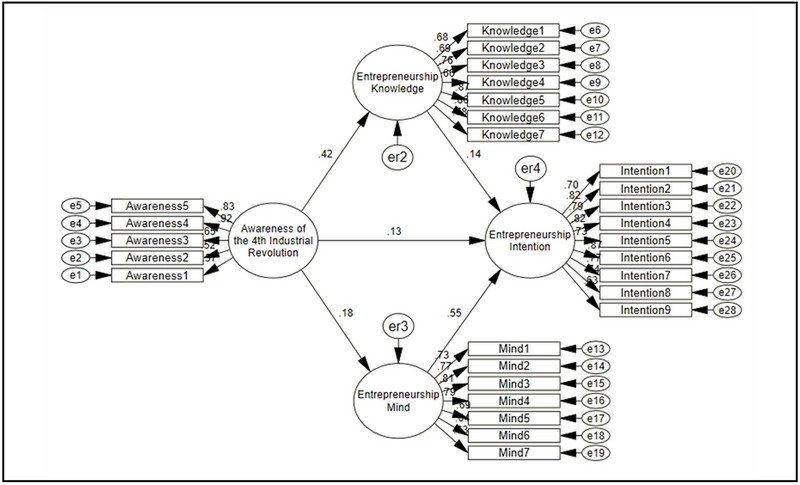
Path estimate of the research model.
Verification of direct, indirect and total effects
5. 결 론
본 연구는 창업 관련 수업이나 동아리 활동 등의 경험이 있는 미용 전공대학생을 대상으로 4차 산업혁명 인식과 창업지식, 창업 마인드 및 창업 의지의 구조적 관계를 연구하였으며 결론은 다음과 같다.
첫째, 4차 산업혁명 인식과 창업지식과의 관계를 분석한 결과 정의 영향을 주는 것으로 나타났고 4차 산업혁명 인식이 창업 마인드의 관계를 분석한 결과 정의 영향을 미치는 것으로 나타났다. 또한, 4차 산업혁명 인식이 창업 의지에 정의 영향을 미쳤으며, 창업지식과 창업 의지에 관계 역시 정의 영향을 주는 것으로 나타났다. 창업 마인드와 창업 의지와의 관계를 분석한 결과 역시 정의 영향을 미치는것으로 나타났다. 이러한 결과는 Kim(2020b)과 Lee(2016) 연구와 같이 4차 산업혁명의 인식이 높아질수록 고용에 대한 불안과 미래에 대한 불확실성으로 인해 창업을 생각하는 학생이 많다는 결과와 일치함을 확인할 수 있었다. 또한 Ko(2017) 연구에서 나타난 바와 같이 대학 교육에서 4차 산업혁명을 대비하기 위한 일환으로 창업과 관련된 프로그램 운영을 통해 창업에 대한 지식과 창업 마인드를 지속적으로 인식시키고 있기 때문으로 해석해 볼 수 있다. 이에 따라 미용 서비스 업무를 주로 담당하는 미용 전공 대학생에게 막연한 창업에 대한 프로그램 운영보다는 4차 산업혁명에 대한 인식을 높이고 대비하기 위한 구체적이고 체계적인 창업 교육이 필요할 것으로 사료된다.
둘째, 4차 산업혁명 인식과 창업 의지 관계에 대한 구조모형의 적합도와 창업지식 및 창업 마인드의 간접효과를 검증한 결과 모두 통계적으로 유의한 것을 확인할 수 있었다.
이러한 연구 결과를 통해 미용 전공대학생의 4차 산업혁명에 대한 인식은 미용 서비스 분야에서도 창업지식, 창업 마인드, 창업 의지와 구조적으로 영향을 미친다는 사실을 알 수 있었다. 이에 따라 대학 내에서 학생들에게 4차 산업혁명에 대한 정확한 이해와 함께 다양한 정보 제공 및 교육 프로그램을 제공함으로써 학생 스스로가 창업역량을 높여줄 필요성이 있을 것으로 사료된다. 그러나 광주 전남지역을 대상으로 한 연구가 진행되어 지역적으로 일반화하기에 무리가 있어 보여 연구 대상이나 지역을 좀 더 넓힌 포괄적 연구가 필요할 것으로 보이며 후속하여 미용과 관련된 창업 교육 프로그램 연구나 기존의 창업방식이 아닌 4차 산업혁명시대에 맞는 미용 서비스 창업 모델에 대한 연구도 진행되어야 할 것으로 사료된다.
Acknowledgments
본 연구는 2023학년도 송원대학교 학술연구비 지원을 받아 연구되었음(A2023-08).
References
-
Ajzen, I. (1991). The theory of planned behavior. Organizational Behavior and Human Decision Processes, 50(2), 179-211.
[https://doi.org/10.1016/0749-5978(91)90020-T]

-
Boldureanu, G. A., Ionescu, A. M. , Bercu, A., Bedrule, M. V. & Boldureanu, D. (2020). Entrepreneurship education through successful entrepreneurial models in higher education institutions. Sustainability, 12(3), 1-33.
[https://doi.org/10.3390/su12031267]
- Cha, H. S. (2012). The influence of government policies and university education on entrepreneurship and start-up [Doctoral dissertation, University of Seoultech]. Riss. https://snut.dcollection.net/public_resource/pdf/000001396340_20231012210714.pdf, .
-
Chang, H. K., & Kang, S. L. (2022). Effect of beauty shop startup determining factors on startup performance. Journal of beauty Art Management, 16(4), 21-37.
[https://doi.org/10.22649/JBAM.2022.16.4.21]
-
Chen, X. W., & Lee, J. H. (2021). A study on the influence factors on entrepreneurial intention of Chinese university students in beauty and cosmetics majors. Journal of the Korean Society of Beauty And Art, 22(1), 257-270.
[https://doi.org/10.18693/jksba.d2021.22.1.257]
-
Cho, H. E. (2020). A study on the awareness and preparation of the forth industrial revolution of some health department college students. Journal of the Korea Convergence Society, 11(12), 291-299.
[https://doi.org/10.15207/JKCS.2020.11.12.291]
-
Fornell, C., & Larcker, D. F. (1981). Evaluating structural equation models with unobservable variables and measurement errors. Journal of Marketing Research, 18(1), 39-50.
[https://doi.org/10.2307/3151312]
- Hwang, D. H. (2020). The effects of entrepreneurial environment characteristics on entrepreneurial spirit and entrepreneurial intention of university students [Doctoral dissertation, University of Chungang]. Riss. https://dcollection.cau.ac.kr/public_resource/pdf/000000232045_20231012202938.pdf
- Hwang, S. Y. (2019). Study on the effect of digital education and digital competency on the entrepreneurial intention in the fourth industrial revolution age - Based on the perception of elementary school students [Master’s thesis, University of Chungang]. Riss. https://dcollection.cau.ac.kr/public_resource/pdf/000000230815_20231012203422.pdf
-
Jung, Y. S. & Jung H. Y. (2018). The structural relationships among undergraduates’ individual characteristics, startup education, startup-relevant knowledge and the entrepreneurial intentions. Journal of Business Venturing and Entrepreneurship, 13(6), 75-87.
[https://doi.org/10.16972/apjbve.13.6.201812.75]
- Jung. S. A. (2020). The effects of entrepreneur's education satisfaction and management mind factors on selecting startup brand and successful startup [Master’s thesis, University of Hanbat], Riss. https://kw.dcollection.net/public_resource/pdf/200000299840_20231012203731.pdf.
- Kang, H. J. (2021). A study on the development of start-up education program for beauty shop [Doctoral dissertatio,. University of Seoul venture]. Riss. https://svu.dcollection.net/public_resource/pdf/200000368717_20231012203922.pdf.
-
Kim, C. H. (2020a). The influence of perception and core competence of the 4th industrial revolution on the university student’s will to start business - Focusing on the moderating effect of creativity. Journal of the Korean Entrepreneurship Society, 15(3), 76-98.
[https://doi.org/10.24878/tkes.2020.15.3.76]
- Kim, D. Y. (2019). A study on the influence of the founding mindset on successful factors of establishment - Focusing on satisfaction of entrepreneurship education [Master’s thesis, University of Kwangwoon]. Riss. https://kw.dcollection.net/public_resource/pdf/200000200101_20231012204140.pdf
-
Kim, J. W. (2023). Comparative analysis of beauty application technologies in the 4th industrial revolution. Journal of The Korean Society of Cosmetology, 29(1), 239-246.
[https://doi.org/10.52660/JKSC.2023.29.1.239]
- Kim, S. M. (2020). Impacts of entrepreneurship and social capital on college students’ entrepreneurial intention - Focusing on the moderating effects of career decision self-efficacy [Master's thesis, University of Kookmin]. Riss. https://kookmin.dcollection.net/public_resource/pdf/200000287056_20231012210337.pdf.
- Ko, H. J. (2017). Direction of entrepreneurship education in the era of the 4th industrial revolution. Proceedings of the of The Korea Entrepreneurship, Conferences. Korea., pp. 51-73.
-
Ko, S. H., Park, U. J., & Bae, B. Y. (2017). An influence of intolerance of uncertainty on entrepreneurial intention of college students: focused on start-up support system perception. Asia-Pacific Journal of Business Venturing and Entrepreneurship, 17(5), 95-104.
[https://doi.org/10.16972/apjbve.17.5.202210.95]
-
Krueger, N. F., Reilly, M. D., & Carsrud, A. L. (2000). Competing models of entrepreneurial intentions. Journal of Business Venturing, 15(5), 411-432.
[https://doi.org/10.1016/S0883-9026(98)00033-0]
-
Kwon, G. H. & Kim, M. S. (2023). A study on the analysis of nurses' perception of the fourth industrial revolution and the importance and performance of future core nursing competencies in a tertiary hospital. Journal of Korean Clinical Nursing Research, 29(1), 95-106.
[https://doi.org/10.22650/JKCNR.2023.29.1.95]
- Leazar, E. P. (2002, August), Entrepreneurship, NBER Working Paper N.9109, pp. 1-51. https://www.nber.org/system/files/working_papers/w9109/w9109.pdf
-
Lee, J. Y. (2022). The effect of individual entrepreneurship orientation on entrepreneurial intention - Focusing on the mediation of need for achievement and entrepreneurial knowledge acquisition. Journal of the Korean Entrepreneurship Society, 17(5), 1-28.
[https://doi.org/10.24878/tkes.2022.17.5.1]
-
Lee, J. Y., & Ha, T. K. (2022). An empirical study on the effects of seniors’ growth·fixed mindset and entrepreneurial ability on entrepreneurial intentions: focusing on the mediating effects of entrepreneurship efficacy. Asia-pacific Journal of Business Venturing and Entrepreneurship, 17(6), 89-104.
[https://doi.org/10.16972/apjbve.17.6.202212.89]
- Lee, S. B. (2016). The effect of individual characteristics and environmental factors on college students’ entrepreneurial intentions - Mediating role of entrepreneurship education. Korean Business Education Review, 31(2), 117-138.
- Lee. S. M. (2019). A study on the practice of management and start-up education in the era of the fourth industrial revolution. Proceedings of The Korea Entrepreneurship, Conferences, Korea. 1-18.
-
Moon, S. H., & Jeon, H. J. (2023). Influence of career maturity of college students majoring in beauty on immersion in the major. The Korean Fashion and Textile Research Journal, 25(1), 13-118.
[https://doi.org/10.5805/SFTI.2023.25.1.113]
- Park, J. H. (2017). Study on factors influencing on performance of beauty art business [Doctoral dissertation, University of Hannam University]. Riss. https://hannam.dcollection.net/public_resource/pdf/000002376232_20231012205221.pdf, .
- Shapero, A. (1984). The entrepreneurial event. In: C. A. Kent (Eds.) The environment for entrepreneurship (pp. 21-40)., M.A.: Lexington Books, Toronto.
- Timmons, J. A. (1994). New venture creation - Entrepreneurship for the 21st Century, Boston, MA: Irwin McGraw-Hill.
- Won. S. P. (2019). The effects of perception of the 4th industrial revolution and entrepreneurship on entrepreneurial intention and behavior [Doctoral dissertation, University of Sungkyunkwan]. Riss. https://dcollection.skku.edu/public_resource/pdf/000000151014_20231012205506.pdf
- Yuk, H. J. (2018). A study on the analysis and prediction of K-beauty service industry in the era of the fourth industrial revolution [Master’s thesis, Konyang University]. Riss. https://konyang.dcollection.net/public_resource/pdf/200000083295_20231012205845.pdf
- Yun, M. Y., & Park, N. H. (2022). Study on the policy of supporting university students in the beauty field through social big data analysis - Based on exploratory data analytics. Journal of the Korean Applied Science and Technology, 39(6), 853-863.
-
Zhao, H., & Wibowo, A. (2021). Entrepreneurship resilience : Can psychological traits of entrepreneurial intention support overcoming entrepreneurial failure?. Frontiers in Psychology, 12, 1-12.
[https://doi.org/10.3389/fpsyg.2021.707803]