
A Study on the Perception of Metaverse Fashion Using Big Data Analysis

©2023 Fashion and Textile Research Journal (FTRJ). This is an open access journal. Articles are distributed under the terms of the Creative 52 Commons Attribution Non-Commercial License (http://creativecommons.org/licenses/by-nc/4.0), which permits unrestricted use, distribution, and reproduction in any medium, provided the original work is properly cited.
Abstract
As changes in social and economic paradigms are accelerating, and non-contact has become the new normal due to the COVID-19 pandemic, metaverse services that build societies in online activities and virtual reality are spreading rapidly. This study analyzes the perception and trend of metaverse fashion using big data. TEXTOM was used to extract metaverse and fashion-related words from Naver and Google and analyze their frequency and importance. Additionally, structural equivalence analysis based on the derived main words was conducted to identify the perception and trend of metaverse fashion. The following results were obtained: First, term frequency(TF) analysis revealed the most frequently appearing words were “metaverse,” “fashion,” “virtual,” “brand,” “platform,” “digital,” “world,” “Zepeto,” “company,” and “game.” After analyzing TF-inverse document frequency(TF-IDF), “virtual” was the most important, followed by “brand,” “platform,” “Zepeto,” “digital,” “world,” “industry,” “game,” “fashion show,” and “industry.” “Metaverse” and “fashion” were found to have a high TF but low TF-IDF. Further, words such as “virtual,” “brand,” “platform,” “Zepeto,” and “digital” had a higher TF-IDF ranking than TF, indicating that they had high importance in the text. Second, convergence of iterated correlations analysis using UNICET revealed four clusters, classified as “virtual world,” “metaverse distribution platform,” “fashion contents technology investment,” and “metaverse fashion week.” Fashion brands are hosting virtual fashion shows and stores on metaverse platforms where the virtual and real worlds coexist, and investment in developing metaverse-related technologies is under way.
Keywords:
metaverse, fashion, platform, virtual digital, big data1. Introduction
In the era of the Fourth Industrial Revolution, the metaverse service, which builds a society in the virtual world enabling various experiences close to reality, has rapidly expanded with the growth of virtual reality(VR), augmented reality(AR), and mixed reality (MR) technologies and the prolonged non-contact era due to COVID-19. Consumers in need of communication and experience due to the non-contact environment could release their desire for experience in virtual spaces and place value on a virtual world that is not real. Further, the metaverse, in which users experience and communicate in a virtual world, is becoming a megatrend in the industry, especially for Generation Z, who is familiar with the digital environment(Kim, 2022; Kim & Kim, 2022).
Today, the metaverse, which refers to a digital world where virtual and reality are connected, is expanding beyond games to various industries and emerging as an important keyword. It introduces virtual worlds, avatars, and products on metaverse platforms such as Fortnite, Roblox, Animal Crossing, Zepeto, and ifland. The users create their virtudk..al characters in the virtual world and interact with people through social activities such as SNS within the metaverse(Kim & Lee, 2022; Kim et al., 2022c).
As the non-contact era has unfolded due to COVID-19, the fashion industry, which has evolved with the development of digital technology, is also rapidly changing in line with the changes in creative and reciprocal metaverse consumption paradigms by introducing products and services based on virtual digital fashion shows and online platforms. Additionally, as interest in sustainable fashion has recently increased, it provides services allowing users to wear virtual digital costumes in virtual worlds, such as virtual social media platforms and games, and AR/VR services at virtual pop-up stores.
Previous studies on metaverse have been conducted in the industrial field and through case studies on metaverse and fashion convergence( Lee & Lim, 2021; Park, 2021), the fashion-brand metaverse(Kim & Kim, 2022; Kim et al., 2022b; Lee & Um, 2021), the virtual space using metaverse technology(Kim & Ahn, 2021; Kim, 2021), and the metaverse fashion platform(Kim et al., 2022a; Yoo & Choi, 2022). However, case studies on the perception of metaverse fashion are still insufficient.
Therefore, this study aims to analyze the perception and trend of metaverse fashion using big data. To this end, in this study, metaverse and fashion-related words were extracted through text-mining techniques. Their importance was analyzed, and structural equivalence analysis was conducted, focusing on the derived keywords to identify the perception and trend of metaverse fashion. By analyzing the perception of metaverse fashion using big data at a time when the use of metaverse is accelerating across all industries, this study aims to present basic data to derive the direction of future fashion-industry marketing strategies based on the analysis of rapidly changing fashion-industry trends.
2. Theoretical background
2.1. Metaverse fashion
The metaverse—the new future space going beyond the boundaries between reality and the virtual—is rapidly emerging. “Metaverse” is a combination of the word “Meta,” which means “higher, transcendent,” and “Universe,” which means “world, universe,” meaning a virtual world beyond reality(Kim, 2020). The metaverse is a 3D-based virtual world in which daily activities and economic life are conducted through virtual avatars that represent individuals beyond merely chatting or playing games, referring to a reality that expands into the virtual space by combining with it(Choi & Pyun, 2021; Kim & Yoo, 2021). Posting daily life on SNS such as Facebook, Instagram, and Kakao Story, as well as partaking in the Internet or various online activities and enjoying online games, are all ways to live in the metaverse(Kim, 2020). Amid the non-contact trend caused by COVID-19, the metaverse, which is highly utilized in various content fields such as games, education, marketing, and entertainment, is attracting attention. In particular, when examining the main targets enjoying the metaverse, those belonging to Generation Z, who are skillful with digital devices and online platforms, are the main subject of focus(Park, 2021).
Representative metaverse platforms include Animal Crossing, Roblox, Minecraft, and Zepeto, which provide virtual spaces and allow users to do what they do in reality. Roblox is an online game platform that allows users to program games in Roblox Studio and enjoy games created by other users. It is gaining popularity among those in their early teens as it appears that American teenagers are spending more time on it than on YouTube. In Roblox, users can enjoy games and communicate through avatars and make their own games. “Fortnite” is a Battle Royale game released by Epic Games with more than 350 million users, comprising the following: “Fortnite Save the World,” where users compete against computers; “Fortnite Battle Royale,” where users compete against each other; “Fortnite Creative,” where users build their own islands; “Party Royale,” a space for communication between users. Naver’s Zepeto is a global metaverse platform with 200 million users worldwide and is currently collaborating with overseas fashion brands such as Gucci and Ralph Lauren. Zepeto utilizes a combination of AR, VR, and life logging technologies, and within it, customers’ avatars can purchase and wear virtual fashion products to engage in social media activities in virtual spaces. Unlike existing SNS such as Instagram and Facebook, in which users express themselves, Zepeto is a metaverse platform where users can upload virtual character content different from their real self on their feed and communicate with friends they know offline or that they made within the Zepeto world(Kim & Yoo, 2021; Park, 2021). Such metaverse is emerging as a new future space beyond the limits of physical space, as a convergence of general-purpose technologies such as big data, 5G network, XR, AI, and blockchain, and various contents are being developed based on highly related technologies( Lee, 2021b; Lee & Jeon, 2022).
Considering previous studies related to the metaverse, some metaverse fashion case studies included the following: a metaverse fashion marketing case study (Kim & Lee, 2022); a fashion-brand metaverse flagship store case study(Kim & Kim, 2022); metaverse-based games and fashion convergence cases(Lee & Lim, 2021); a case study using metaverse according to the change in marketing in luxury fashion brands(Lee & Um, 2021); a case study on the virtual fashion industry through fashion brands’ convergence with metaverse (Park, 2021). Additionally, studies have been conducted on the following: a metaverse online fashion shopping mall application service proposal(Jeon & Kim, 2022); development of hanbok fashion design for metaverse avatars(Shin & Yum, 2022); a virtual space revitalization plan using metaverse technology(Kim & Ahn, 2021); gallery space utilization based on metaverse technology(Kim, 2021); a prospect on metaverse performance(Lee & Choi, 2021); a virtual fashion style preference and consumption pattern analysis of users on the metaverse platform Zepeto(Kim et al., 2022a); collaboration with the metaverse platform Zepeto(Yoo & Choi, 2022). As such, various studies have been conducted on the metaverse, but studies on the perception and trend of metaverse fashion are still insufficient.
2.2. Big data analysis
Big data is a general database software referring to excessive data that exceed the scope of storage, management, and analysis( Jun & Seo, 2013). Analysis methods using big data include data mining, text mining, social network analytics, cluster analysis, opinion analysis, and semantic network analysis and are widely used for consumer perception and trend change analysis as well as market analysis(Kim, 2017, Lee et al., 2017).
Text mining is the process of finding useful information and knowledge from large amounts of data, including documents, e-mails, and online texts, and extracting patterns(Lee et al., 2022; Salloum et al., 2017). Text mining is a big data analysis method that refines unstructured large-capacity text data through morpheme analysis and natural language processing and extracts keywords to find the connected meaning between major keywords (Song & Lim, 2021). Word frequency represents the frequency of appearance by calculating the number of appearances of keywords from the collected data. Term frequency-inverse document frequency( TF-IDF) is the value multiplied by term frequency(TF) and inverse document frequency(IDF), referring to the statistic value indicating the importance of the word in a specific phrase. It prevents an important word from being interpreted as such depending on its frequency of appearance. N-gram analysis represents the connection relationship of n consecutive words by statistical language modeling; the high frequency between words means that the frequency of the two words appearing abreast is high(Kim, 2020; Lee, 2021a).
Network analysis is a method of analyzing interconnectivity based on the frequency and associative relationship of simultaneous appearances between words based on text mining. The network is a data structure comprising nodes and edges. Centrality analysis is considered a measure of the importance and influence of nodes, and it includes degree, betweenness, proximity, and eigenvector centrality. Degree centrality is a measure of how many nodes are connected to a node, and numerous connected nodes increase centrality. Betweenness centrality refers to a node highly dependent on connection with other nodes. Finally, proximity centrality indicates how close the node is to other words(Song, 2022).
Semantic network analysis helps analyze and derive structural relationships and meanings between words by applying text to social network analysis. It originated from social network theory, which refers to people’s connected networks. It is an analysis mainly used in social science and a method to explain the relationship between meaningful words and words based on whether two words appeared simultaneously in an analysis unit such as sentences or paragraphs. In semantic network analysis, each word has an interactive relational position and belongs to a specific network accordingly but has an organic relationship and influence with another word(Jang, 2019).
Convergence of iterated correlations(CONCOR) analysis is a cluster analysis that creates blocks and identifies the relationship between them by iterating until the correlation of the matrix data converges based on Pearson’s correlation to derive clusters between words with homogeneous characteristics(Kim & Jun, 2014).
Recently, various studies using big data analysis have been conducted in fashion. Considering the trends of previous studies, those on the analysis of consumer perception or trend using big data have been conducted. Specifically, these include studies on the following: the perception of 3D printing fashion(Cho, 2020); the perception of the fashion streaming service(Kim, 2018); consumer perception of the Hi Seoul Fashion Show(Han, 2019); consumer perception of swimwear(Lee et al., 2017); consumer perception of golf wear(Lee & Lee, 2018); consumer perception of bags(Lee & Jung, 2020); the change in fashion perception following the spread of COVID-19(Kang, 2021); the change in perception of leggings( Han, 2021); consumer upcycling perception(Cho, 2022); the change in perception of fashion rental service before and after COVID-19(Kang, 2022); the perception of digital fashion tech (Song & Lim, 2021); the perception of fashion platforms and fashion smart factories(Song, 2021). Moreover, some studies on fashion trends have been conducted using big data, such as the following: a study analyzing the periodic cycle of fashion trends (Kim & Byun, 2020); a study on fashion trend prediction(Rickman & Cosenza, 2007); a study analyzing fashion trends through text mining(Jang & Kim, 2020); an analysis on consumers’ clothing management method trend through big data(Koo, 2020). Additionally, studies on brands or fashion products using text mining, including a study on the change in evaluation of the Gucci brand using big data(Huh & Lee, 2019), a comparative analysis of domestic and foreign sports goods brands (Kim & Lee, 2018), and a big data analysis of Generation Z fashion(Sung, 2020), have also been conducted. As such, research on big data analysis through text mining has been conducted in various ways in the fashion field. Nevertheless, research on the perception of metaverse fashion using big data analysis is still insufficient. Accordingly, this study aims to analyze the perception and trend of metaverse fashion using big data analysis by extracting metaverse and fashion-related words using TEXTOM, analyzing their importance, and conducting structural equivalence analysis based on the derived main words.
3. Research Methods
3.1. Subjects and scope of study
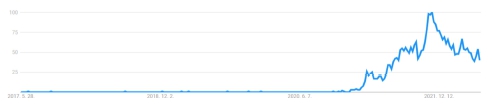
The data collection and analysis methods for big data analysis in this study are as follows( Table 1). Data were analyzed using TEXTOM 6.0, a big data analysis solution program that can collect, refine, and even process matrix data generation in a web environment using text-mining technology. Big data collection was conducted through the nation’s largest portal sites, Naver and Google, with keywords including both “metaverse” and “fashion,” and big data were collected from Naver(web documents, news, blogs, cafes, jisik-IN, academic information) and Google(web documents, news, and Facebook). As for the collection period, data were collected using Google Trends from January 2021 to April 2022, when the search volume for the metaverse began to increase(Fig. 1). The raw data collected were corrected, unified, or deleted from the TEXTOM program through the process of refining and morpheme analysis, which is a preprocessing stage.

Data collection and analysis
“Google Trend” Metaverse search word results.
3.2. Analysis method and procedure
In this study, a one-mode symmetrical matrix was derived after keyword extraction and frequency analysis using TEXTOM. UCINET 6(Ver. 6.746) was used to identify the connection structure between keywords derived in this way, and the network was created and results visualized using the NetDraw function. The specific process is as follows. First, text-mining analysis of TF, TF-IDF, and N-gram was conducted using the final refined data, and word cloud visualization analysis was performed. Next, structural equivalence analysis of the words was performed using UCINET 6(Ver. 6.746) to understand the structure of perception in metaverse fashion. When analyzing the network structure, there may be a limit to visualization if there are many nodes; thus, the top 50 words in terms of frequency were used for analysis. Moreover, a one-mode symmetrical matrix with the same row and column based on the frequency of simultaneously appearing keywords was derived, and centrality indices were identified. Using UNICET’s NetDraw on the derived matrix, the study identified the relationship between words, visualized the network between words related to metaverse fashion, and conducted a CONCOR analysis to derive clusters formed by words with similarities.
4. Results and Discussion
4.1. TF and TF-IDF analysis results
A total of 5,765 words were extracted through the text refining process, and the frequency analysis results on the top 50 frequency words are shown in Table 2. Words with more than 4,000 appearances were “metaverse” and “fashion”; words with 700-899 appearances were “virtual” and “brand,” and words with 500-699 appearances were “platform” and “digital.” The frequency of “world,” “Zepeto,” “company,” “game,” “fashion show,” “industry,” “corporation,” “technology,” “avatar,” and “design” was 300-499 times. The results of examining the top-ranked major words reveal that the technological development and service of the metaverse fashion platform are accelerating, centering on “virtual,” “digital,” and “brand.” Additionally, virtual digital fashion shows are becoming a major issue, centering on global fashion brands during the COVID-19 pandemic.
Frequency analysis results
The words that showed 200-299 appearances were “market,” “space,” “Gucci,” “global,” “reality,” “generation,” “contents,” “item,” “marketing,” “luxury goods,” “investment,” “closing,” and “designer.” Fashion luxury brands can be seen selling and marketing fashion items in metaverse virtual spaces targeting the MZ generation. The growth of the metaverse platform market in the fashion industry is rapidly increasing.
Furthermore, words including “education,” “week,” “era,” “research,” “service,” “Seoul,” “expansion,” “development,” “trend,” “news,” “distribution,” “future,” “production,” “COVID-19,” “sale,” “Korea,” “culture,” “domestic,” “model,” “stock,” and “virtual reality” showed an appearance of 100-199 times.
The results of TF analysis and TF-IDF analysis for the top 30 text frequencies are shown in Table 3. The results of TF analysis, which indicates words with high frequency, were, in order, “metaverse” (5,473 words), “fashion” (4,034 words), “virtual” (804 words), “brand” (717 words), “platform” (684 words), “digital” (521 words), “world” (482 words), “Zepeto” (466 words), “company” (400 words), and “game” (395 words).
TF & TF-IDF analysis
Unlike TF analysis, which represents the number of simple appearances of words extracted from text mining, TF-IDF analysis is the value multiplying TF and IDF and is an analysis method representing how important a word is in a particular document. The results of TF-IDF analysis, indicating the text’s importance, showed that “virtual” (1174.3) was the most important word, followed by “brand” (1131.7), “platform” (1055.8), “Zepeto” (1002.9), “digital” (978.7), “world” (901.8), “industry” (877.0), “game” (848.8), “fashion show” (844.1), and “industry” (829).
“Metaverse” and “fashion” words were found to have a high TF but low TF-IDF, and words such as “virtual,” “brand,” “platform,” “Zepeto,” and “digital” had a higher TF-IDF ranking than TF, indicating that they were of high importance in the text.
4.2. Word cloud and N-gram results
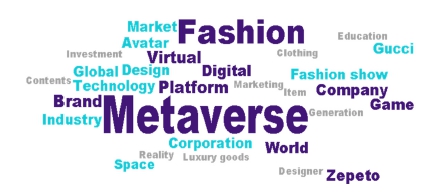
The results of word cloud analysis, which shows the visualized results by expressing the appearance frequency of extracted words derived as a result of text-mining analysis in a two-dimensional space in a cloud shape for easy recognition, are shown in Fig. 2. The word cloud visualization results show the frequency of text appearance in the size and location of letters. As shown in the frequency analysis results, the high frequency of “metaverse” and “fashion” is significant and located in the center. They are followed, in order, by words such as “virtual,” “brand,” “platform,” “digital,” “world,” “Zepeto,” “company,” and “game.”
Word cloud of key words.
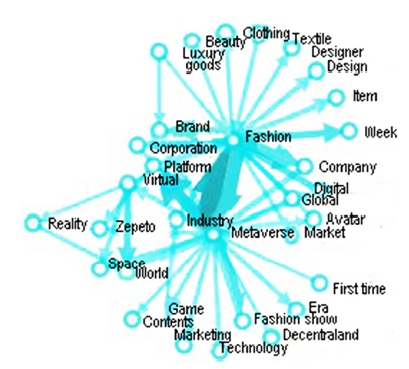
N-gram was conducted to analyze the degree of density and simultaneous appearance between keywords on metaverse fashion. Fig. 3 shows the results of N-gram analysis, a big data analysis technique used to analyze the frequency and density of simultaneous appearance of keywords in the text on the network. The results of the analysis showed that the simultaneous appearance of “metaverse-fashion” (734) and “fashion-metaverse” (476) was the most common, and their degree of density was also high. Next, the simultaneous appearance was highest in the order of “meta-platform” (409), “fashion-brand” (335), “fashion-industry” (286), “metaverse-fashion show” (201), and “fashion-week” (176).
N-gram of key words.
4.3. Analysis results of network visualization and structural equivalence analysis
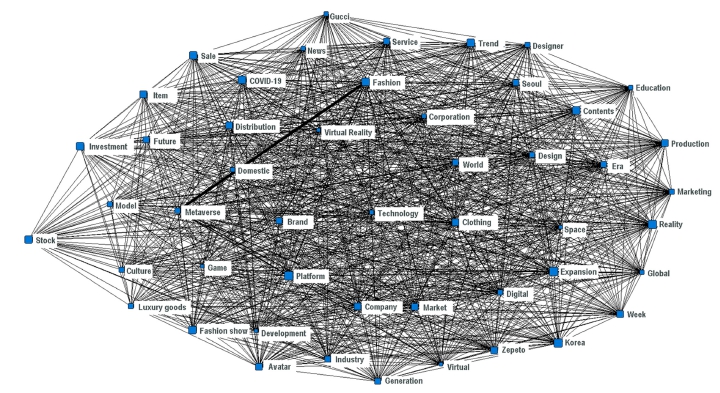
UNICET is a program that visualizes and expresses networks between simultaneously appearing words and clearly expresses the close relationship of quantified data in the type of connection structure. Further, CONCOR analysis is a structural equivalence analysis that divides highly related nodes into groups, considering the degree of connection between nodes at similar structural locations in the entire network structure. Therefore, in this study, network visualization and CONCOR analysis using NetDraw of UNICET were conducted. To visually derive the pattern and connection relationship between keywords for metaverse fashion, a one-mode symmetrical matrix based on the simultaneous appearance correlation of the top 50 words of degree centrality was derived. Subsequently, words were classified into clusters through structural equivalence analysis.
In network visualization, nodes express interrelationships, confirming the frequency of the simultaneous appearance of two keywords through the thickness of the line connecting them. Considering the network visualization results in Fig. 4, keywords such as “virtual,” “platform,” “digital,” and “Zepeto” with high betweenness centrality are connected in a thick line, centering on the “metaverse” and “fashion” keywords, indicating high relevance between keywords. Fig. 5 shows the results of CONCOR analysis using the network data, as a result of which four clusters were formed.
Network visualization of key words.
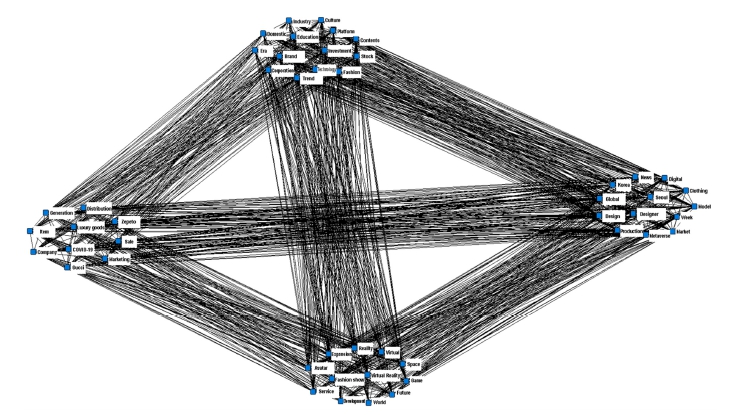
Concor visualization of key words.
The first group was named “virtual world” because it included keywords such as “virtual,” “reality,” “future,” “world,” “avatar,” “game,” “development,” “service,” “space,” and “expansion.” The metaverse refers to a three-dimensional surreal world where the virtual and real worlds converge and interact; it is serviced through games and virtual SNS platforms such as Fortnite, Minecraft, Roblox, Animal Crossing, and Zepeto. The technologies of VR, AR, and MR have expanded into the fashion world, indicating that global fashion companies are using virtual stores, showrooms, and fashion shows.
The second group was named the “metaverse distribution platform” because it included keywords such as “Zepeto,” “luxury goods,” “Gucci,” “industry,” “distribution,” “items,” “generation,” “COVID-19,” “marketing,” and “sales.” In this group, it was found that the non-contact life due to COVID-19 was in full swing. Further, the market for the metaverse, where users communicate and experience daily life in virtual spaces, is growing in the MZ generation, which is sensitive to digital technology and trend changes. Moreover, it could be found that luxury fashion brands such as Gucci, which are competitively entering the metaverse platform Zepeto, are actively providing services and marketing that allow users to wear and purchase fashion items and engage in SNS activities in virtual spaces.
The third group was named “fashion contents technology investment” because it included keywords such as “content,” “technology,” “investment,” “company,” “fashion,” “industry,” “brand,” “platform,” and “trend.” It was found that investments related to the development of fashion-metaverse platforms, blockchain, and Non-fungible Token (NFT) technologies that can utilize digital content in a space where the virtual and real worlds coexist are actively underway. It is believed that investment in platform developers that cooperate with domestic and foreign fashion brands and provide services to produce and distribute digital fashion content is being actively made.
The fourth group was named “metaverse fashion week” because it included keywords such as “digital,” “clothing,” “design,” “designer,” “metaverse,” “market,” “global,” “week,” “model,” “production,” and “Korea.” Global fashion brands participated in the metaverse fashion week, which introduces fashion runways and collections using digital technology, and held digital fashion shows. It also provided a service that sells fashion items and NFTs at virtual digital stores. It was found that it was being transformed and coexisted from Paris, Milan, New York, and the London Fashion Week to the Metaverse Fashion Week in the virtual digital world. The Korean fashion industry is also conducting metaverse fashion shows and virtual stores using the metaverse platform and selling collaboration fashion NFTs with fashion designers.
In the COVID-19 pandemic environment, the fashion industry’s virtual digital transformation has been accelerating. Global fashion brands are participating in the Metaverse Fashion Week, where fashion items are sold in the virtual store space of the metaverse platform, in which the virtual and real worlds coexist and fashion runways and collections using digital technology are presented, and they are conducting virtual fashion shows. Additionally, in the fashion industry, investments in metaverse platforms, blockchain, and NFT technology development are being actively pursued. It is determined that fashion startups with technology can grow and develop through various types of fashion platforms that are being developed in a stable manner.
5. Conclusion
This study analyzed the perception and trend of metaverse fashion using big data. Based on this, metaverse and fashion-related words were extracted, and their importance was analyzed through text-mining techniques. Further, the results of the perception and trend of metaverse fashion by conducting structural equivalence analysis focusing on the derived major words are as follows.
First, using TEXTOM 6.0, data from January 2021 to April 2022 were collected for keywords, including both “metaverse” and “fashion,” on Naver and Google. A total of 5,765 words were extracted through the preprocessing process of refinement and morpheme analysis.
Second, as a result of TF analysis of the top 30 words with the highest frequency, the most frequently appeared words were “metaverse,” “fashion,” “virtual,” “brand,” “platform,” “digital,” “world,” “Zepeto,” “company,” and “game.” After analyzing TF-IDF, which indicates how important a word is in a specific document, “virtual” was the most important, followed by “brand,” “platform,” “Zepeto,” “digital,” “world,” “industry,” “game,” “fashion show,” and “industry.” “Metaverse” and “fashion” were found to have a high TF but a low TF-IDF, and words such as “virtual,” “brand,” “platform,” “Zepeto,” and “digital” had a higher TF-IDF ranking than TF, indicating that they were of high importance in the text.
Third, the results of word cloud visualization showed that “metaverse” and “fashion”—words with high TF—were large and located in the center, followed by “virtual,” “brand,” “platform,” “digital,” “world,” “Zepeto,” “company,” and “game.” As a result of the N-gram analysis, the simultaneous appearance of “metaverse-fashion” was the highest, followed by “metaverse-platform” (409), “fashion-brand” (335), “fashion-industry” (286), “metaverse-fashion show” (201), and “fashion-week” (176).
Fourth, as a result of network visualization and CONCOR analysis using NetDraw of UNICET, four clusters were formed. The first group included keywords such as “virtual,” “reality,” “future,” “world,” “avatar,” “game,” “development,” “service,” “space,” and “expansion”; thus, it was classified as “virtual world.” The second group included keywords such as “Zepeto,” “luxury,” “Gucci,” “industry,” “distribution,” “items,” “generation,” “COVID-19,” “marketing,” and “sales”; thus, it was classified as a “metaverse distribution platform.” The third group included keywords such as “content,” “technology,” “investment,” “company,” “fashion,” “industry,” “brand,” “platform,” and “trend”; hence, it was classified as “fashion contents technology investment.” The fourth group included keywords such as “digital,” “clothing,” “design,” “designer,” “metaverse,” “market,” “global,” “week,” “model,” “production,” and “Korea”; therefore, it was classified as “metaverse fashion week.”
As the results of this study suggest, the metaverse is widely developing in all industries and continues to grow into concepts including VR, AR, and MR technologies. Global fashion brands are running virtual fashion shows and stores on metaverse platforms where the virtual and real worlds coexist, and investment in developing metaverse-related technologies is under way. It is deemed necessary to change the education community’s interest and education paradigm related to metaverse fashion, which will be the growth engine of the future fashion industry.
Recently, studies on metaverse fashion have been actively conducted in the field of clothing and textile, but studies on metaverse fashion case analysis are still the main ones. This study is of academic significance in that it analyzed the trend of perception of metaverse fashion through text mining techniques of big data analysis, focusing on the metaverse fashion market, which is diversifying with the development of advanced technology. It is also meaningful as it provides insights into current and potential issues of both the metaverse fashion industry and academia using big data analysis, extracting meaningful information from unstructured data on Internet portals and communities. Therefore, it is hoped that these will be basic data for predicting the overall digital transformation of the fashion industry through various technology convergence, including metaverse, and the direction of fashion marketing strategy and service development utilizing such transformation. As this study collected and utilized text data limited to Korea’s major portal websites, it is difficult to generalize that all trends in social perception and characteristics related to “metaverse” and “fashion” were considered. In the future, it is expected that data from domestic and overseas portal sites will be collected and analyzed, and more practical and reliable analysis will be possible through consumer surveys.
Acknowledgments
This work was supported by the Ministry of Education of the Republic of Korea and the National Research Foundation of Korea (NRF-2022S1A5A2A01046690).
References
-
Cho, Y. J. (2020). A study on perception of 3D printing fashion using big data analysis. The Korean Society of Science & Art, 38(1), 271-283.
[https://doi.org/10.17548/ksaf.2020.01.30.271]

-
Cho, Y. J. (2022). An exploratory study on consumers’ perception towards upcycling through big data analysis. The Journal of Next-generation Convergence Technology Association, 6(2), 172-185.
[https://doi.org/10.33097/JNCTA.2022.06.02.172]
- Choi, E., & Pyun. J. (2021). Effect of brand experience on brand attitude within Meta-bus through avatars - Focused on Gucci villa in Zepeto. Journal Korea Society of Visual Design Forum, 73, 83-94.
- Han, K. H. (2019). A study on the consumer's perception of HiSeoul fashion show using big data analysis. Journal of Fashion Business, 23(5), 81-95.
-
Han, K. H.. (2021). A study on leggings perception change with big data analysis - Based on covid-19. The Korea Journal of Sport, 19(3), 51-65.
[https://doi.org/10.46669/kss.2021.19.3.005]
-
Huh, J., & Lee, E. J. (2019). Trend analysis of fashion brand evaluation using big data: Focusing on Gucci brand. Journal of the Korean Society of Costume, 69(6), 38-51.
[https://doi.org/10.7233/jksc.2019.69.6.038]
- Jang, J. M. (2019). Analysis of K-league major discourse discovered through big data - Based on the online community. Unpublished doctoral dissertation, Chungnam National University, Daejeon.
-
Jang, N. K., & Kim M. J. (2020). Material as a key element of fashion trend in 2010-2019 - Text mining analysis. Fashion & Textile Research Journal, 22(5), 551-560.
[https://doi.org/10.5805/SFTI.2020.22.5.551]
-
Jeon, H. J., & Kim, G. D. (2022). Suggestion of metaverse based online fashion shopping mall application service - Focused on the virtual fitting service. Journal of Digital Contents Society, 23(4), 589-601.
[https://doi.org/10.9728/dcs.2022.23.4.589]
- Jun, C. N., & Seo, I. W. (2013). Analyzing the bigdata for practical using into technology marketing - Focusing on the potential buyer extraction. Journal of Marketing Studies, 21(2), 181-203.
-
Kang, E. M. (2021). Changes in fashion perception due to the spread of COVID-19 - Focusing on the comparison between 2019 and 2020. Journal of the Korean Society of Design Culture, 27(1), 15-27.
[https://doi.org/10.18208/ksdc.2020.27.1.15]
-
Kang, E. M. (2022). Changes in perception of fashion rental service before and after COVID-19 through big data. Journal of the Korean Society of Design Culture, 28(1), 1-15.
[https://doi.org/10.18208/ksdc.2022.28.1.1]
- Kim, D. H., & Lee, J. H. (2022). A case study on metaverse fashion marketing of global fashion luxury brand. Journal of Art & Design Research, 25(1), 11-24.
-
Kim, G. M., & Ahn, J. A. (2021). A study on the activation of virtual space using metaverse zepeto app. Journal of Cultural Product & Design, 66, 375-383.
[https://doi.org/10.18555/kicpd.2021.66.032]
-
Kim, H. S. (2017). An exploratory study on the semantic network analysis of food tourism through the big data. Culinary Science & Hospitality Research, 23(4), 22-32.
[https://doi.org/10.20878/cshr.2017.23.4.003]
- Kim, H. W., & Jun, C. N. (2014). An exploratory study on content creation methods utilizing big data - Linguistic and story resources for effective creation of TV home shopping content. Journal of Cybercommunication Academic Society, 31(3), 5-51.
-
Kim, J. H., & Lee, J. M. (2018). Comparison and analysis of domestic and foreign sports brands using text mining and opinion mining analysis. Journal of the Korea Contents Association, 18(6), 217-234.
[https://doi.org/10.5392/JKCA.2018.18.06.217]
-
Kim, J. S. (2018). A study on the perception of fashion streaming service using text mining analysis - Focused on PROJECT ANNE. Journal of Fashion Design, 18(1), 107-118.
[https://doi.org/10.18652/2018.18.1.7]
-
Kim, K. (2021) A study on the ‘exhibition space and applicability using metaverse technology’. Design Research, 6(4), 152-160.
[https://doi.org/10.46248/kidrs.2021.4.152]
-
Kim, K. H., & Byun, H. W. (2020). The analysis of fashion trend cycle using big data. Journal of the Korea Convergence Society, 11(12), 113-123.
[https://doi.org/ 10.15207/JKCS.2020.11.12.113]
-
Kim, K., Seong, O., & Kim, S. (2022a). Analysis of virtual fashion style preferences and purchasing behavior of metaverse platform “Zepeto” users. Journal of Fashion Business, 26(3), 33-49.
[https://doi.org/10.12940/JFB.2022.26.3.33]
- Kim, S. (2020). Metaverse. Paju: PlanB Design
-
Kim, S. H., & Yoo, J. Y. (2021). A Study on the recognition and acceptance of metaverse in the entertainment industry - Focusing on the case of K-pop idol ‘aespa’ fandom. Journal of the Korea Entertainment Industry Association, 15(7), 1-15.
[https://doi.org/10.21184/jkeia.2021.10.15.7.1]
-
Kim, S. R. (2022). An analysis of changes in perception of metaverse fashion before and after Covid-19 using topic modeling based on text mining. The Journal of Next-generation Convergence Technology Association, 6(10), 2043-2055.
[https://doi.org/10.33097/JNCTA.2022.06.10.2043]
-
Kim, W. B., Hur, H. J., & Choo, H. J. (2022b). Case study on fashion brand flagship store in metaverse. Journal of the Korean Society of Clothing and Textiles, 46(3), 545-563.
[https://doi.org/10.5850/jksct.2022.46.3.545]
-
Kim, W. R., Park, E. J., & Ko, J. M. (2022c). A study on fashion brand on metaverse platform using business model canvas. Journal of Communication Design, 79, 320-333.
[https://doi.org/10.25111/jcd.2022.79.22]
-
Kim, Y., & Kim, J. (2022). Luxury fashion brands case analysis of using metaverse. Journal of Fashion Business, 26(3), 50-71.
[https://doi.org/10.12940/JFB.2022.26.3.50]
-
Koo, Y. S. (2020). Trend analysis on clothing care system of consumer from big data. Fashion & Textile Research Journal, 22(5), 639-649.
[https://doi.org/10.5805/SFTI.2020.22.5.639]
-
Lee, A., & Lee, J. H. (2018). A study of perception of golfwear using big data analysis. Fashion & Textile Research Journal, 20(5), 533-547.
[https://doi.org/10.5805/SFTI.2018.20.5.533]
-
Lee, E. J., & Jeon, J. (2022). Effect of experience of fashion brand metaverse virtual reality store on perceived avatar identification, perceived fun, and consumer-brand self-congruity. The Journal of the Convergence on Culture Technology, 8(4), 387-395.
[https://doi.org/10.17703/JCCT.2022.8.4.387]
-
Lee, E. S., & Um, G. J. (2021). A case study using metaverse according to marketing changes in fashion luxury brands. Design Research, 6(4), 375-386.
[https://doi.org/10.46248/kidrs.2021.4.375]
-
Lee, J. H., & Choi, E. Y. (2021). Performance distribution in metaverse, a new paradigm. Journal of Korean Dance, 54, 51-68.
[https://doi.org/10.52892/RIKD.2021.54.3]
-
Lee, J. H., Lee, J. M., Kim, W. K., & Kim, H. G. (2017). A study on perception of swimsuit using big data text-mining analysis. Korean Journal of Sport Science, 28(1), 104-116.
[https://doi.org/10.24985/kjss.2017.28.1.104]
-
Lee, J. M. (2021a). A study on home training market prospect and development plan using big data analysis. The Korean Journal of Physical Education, 60(1), 189-202.
[https://doi.org/10.23949/kjpe.2021.1.60.1.15]
-
Lee, J. Y., & Jung, H. J. (2020). Exploring consumers’ perceptions of bags using the SNS big data. A Journal of Brand Design Association of Korea, 18(1), 55-70.
[https://doi.org/10.18852/bdak.2020.18.1.55]
- Lee, S. (2021b). Metaverse begins. Seoul: Good moring media.
- Lee, S. Y., & Lim, J. S. (2021). A study on fashion contents based on Metaverse - Focused on the case of fashion game applying gamification. Proceeding of the Korean Society of Fashion Design. Spring Conference, Korea, pp. 47-48.
-
Lee, Y., Lee, H. K., & Choi, Y. (2022). Consumer perception of 3D printing fashion - A text-mining analysis. Korean Society of Fashion Design, 22(3), 75-88.
[https://doi.org/10.18652/2022.22.3.5]
-
Park, K. S. (2021). A case study of virtual fashion industry of fashion brands through convergence with metaverse. The Korean Society of Science & Art, 39(4), 161-178.
[https://doi.org/10.17548/ksaf.2021.09.30.161]
-
Rickman, T. A., & Cosenza, R. M. (2007). The changing digital dynamics of multichannel marketing - The feasibility of the weblog: text mining approach for fast fashion trending. Journal of Fashion Marketing and Management, 11(4), 604-621.
[https://doi.org/10.1108/13612020710824634]
-
Salloum, S. A., Al-Emran, M., & Shaalan, K. (2017). Mining social media text - Extracting knowledge from Facebook. International Journal of Computing and Digital Systems, 6(2), 73-81.
[https://doi.org/10.12785/IJCDS/060203]
-
Shin, H. R., & Yum, M. S. (2022). Development of new hanbok fashion design for metaverse avatars - Focused on the metaverse platform ‘ZEPETO’. Korean Society of Fashion Design, 22(3), 161-179.
[https://doi.org/10.18652/2022.22.3.10]
-
Song, E. Y. (2021). A study on the perception of fashion platforms and fashion smart factories using big data analysis. Fashion & Textile Research Journal, 23(6), 799-809.
[https://doi.org/10.5805/SFTI.2021.23.6.799]
- Song, E. Y. (2022). A study on the clothing production system by digital transformation. Unpublished doctoral dissertation, Sookmyung Women’s University, Seoul.
-
Song, E. Y., & Lim, H. S. (2021). Perceptions and trends of digital fashion technology - A big data analysis. Fashion & Textile Research Journal, 23(3), 380-389.
[https://doi.org/10.5805/SFTI.2021.23.3.380]
-
Sung, K. S. (2020). Social media big data analysis of Z-generation fashion. Journal of the Korea Fashion & Costume Design Association, 22(3), 49-61.
[https://doi.org/10.30751/kfcda.2020.22.3.49]
-
Yoo, Y. J., & Choi, J. H. (2022). A study on the collaboration of metaverse platform Zepeto - Focusing on fashion items. Journal of Basic Design & Art, 3(2), 377-393.
[https://doi.org/10.47294/KSBDA.23.2.26]