
A Systematic Review on Smart Manufacturing in the Garment Industry

© 2020 (by) the authors. This article is an open access article distributed under the terms and conditions of the Creative Commons Attribution license (http://creativecommons.org/licenses/by/3.0/), which permits unrestricted use, distribution, and reproduction in any medium, provided the original work is properly cited.
Abstract
Since Industry 4.0, there is a growing interest in smart manufacturing across all industries. However, there are few studies on this topic in the garment industry despite the growing interest in implementing smart manufacturing. This paper presents the feasibility and essential considerations for implementing smart manufacturing in the garment industry. A systematic review analysis was conducted. Studies on garment manufacturing and smart manufacturing were searched separately in the Scopus database. Key technologies for each manufacturing were derived by keyword analysis. Studies on key technologies in each manufacturing were selected; in addition, bibliographic analysis and cluster analysis were conducted to understand the progress of technological development in the garment industry. In garment manufacturing, technology studies are rare as well as locally biased. In addition, there are technological gaps compared to other manufacturing. However, smart manufacturing studies are still in their infancy and the direction of garment manufacturing studies are toward smart manufacturing. More studies are needed to apply the key technologies of smart manufacturing to garment manufacturing. In this case, the progress of technology development, the difference in the industrial environment, and the level of implementation should be considered. Human components should be integrated into smart manufacturing systems in a labor-intensive garment manufacturing process.
Keywords:
systematic review analysis, smart manufacturing, smart factory, garment manufacturing, key technology1. Introduction
Smart Manufacturing, also referred to as Industry 4.0, tries to achieve manufacturing flexibility, mass customization, better quality, and improved productivity through the integration of various technologies (Zhong et al., 2017). Manufacturing industry could overcome the impact of intense competition and the ongoing rise of manufacturing cost by applying a fully integrated and collaborative manufacturing system that responds in real-time to meet the continuously changing needs of the factory, supply chain, and customer (Thompson, 2014).
Among the manufacturing industries, garment manufacturing has the most labor-intensive characteristics. Garment manufacturing processes are difficult to be automated because the product is continuously changing following the fashion trend and the production process varies by size and design. Consequently, many of the automation technologies that have been successfully introduced in most industries have failed to be successful in the garment manufacturing process. Meanwhile, the product life cycle of garment is getting shorter as being a part of the trend named “fast fashion”. Now the garment manufacturers are under the pressure of falling behind the competition unless they fulfill the complex demand of the fashion market.
But despite the growing interest in implementing smart manufacturing in the garment industry, there are few studies on this topic. Therefore, in this study, a systematic review analysis was conducted to explore the feasibility of implementing smart manufacturing in the garment industry. First, previous studies on garment manufacturing and smart manufacturing were searched in the Scopus database, and key technologies were derived from each manufacturing. Next, studies on key technologies in each manufacturing were selected, and Bibliographic Analysis and Cluster Analysis were conducted to find out the progress of technological development in the garment industry. Finally, the feasibility and essential considerations of smart manufacturing in the garment industry were discussed.
2. Materials and methods
In this study, a systematic review analysis was conducted following the method of Denyer and Tranfield (2009). The systematic review analysis specifies and analyzes literature review according to a specially designed method, which provides a basis for evaluating whether the research avoided cherry-picking in the selection process of literature review and was carried out properly (Briner & Denyer, 2012). The overview of the systematic review analysis systematic review analysis is as shown in Fig. 1.
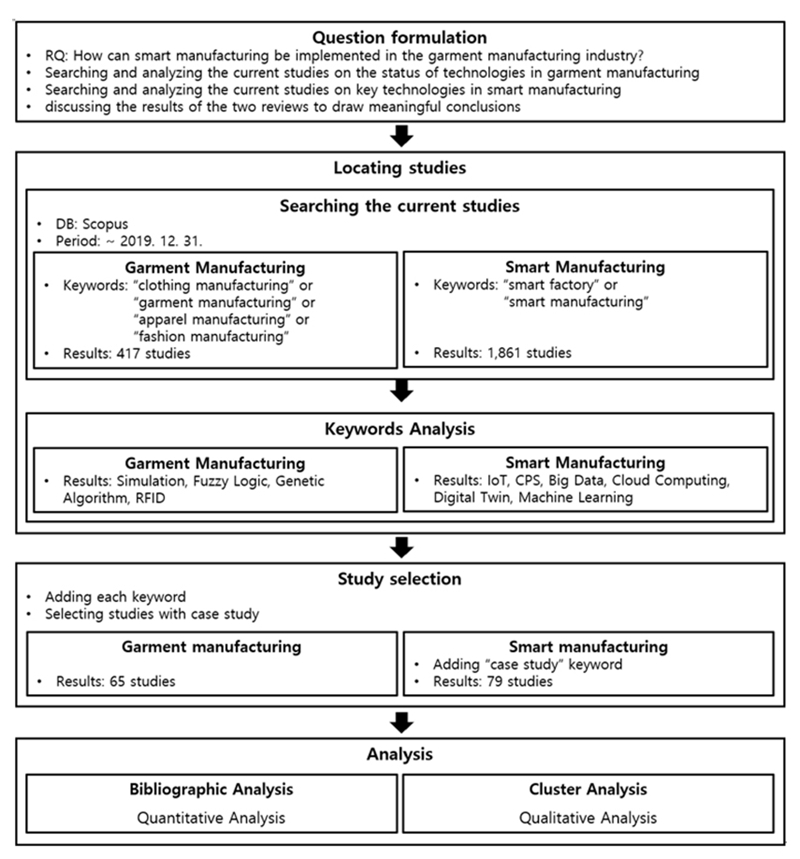
Overview of the systematic review analysis.
2.1. Question formulation
This study aimed to analyze previous studies for implementing smart manufacturing in the garment industry. Especially, it was reviewed in terms of key technologies. First, since there are few studies on smart manufacturing in the garment industry, studies were searched and analyzed to find out the status of technologies in garment manufacturing. Next, Studies conducted on smart manufacturing in other manufacturing industries were searched and analyzed to find out key technologies in smart manufacturing. Finally, the results of the two reviews were discussed by conducting analyses to draw meaningful conclusions.
2.2. Locating studies
In this study, Scopus was chosen as the search database, which is the largest database of abstracts and citations containing peer-reviewed scientific journals, books, and seminars. Studies until December 2019 were included in the database. Studies on garment manufacturing and smart manufacturing has been searched respectively using the keywords containing the meaning of garment manufacturing and smart manufacturing. Key technologies in each manufacturing were derived through keyword analysis of the searched studies.
The detailed search method is shown in Table 1. There are several keywords that mean garment manufacturing. Keywords for the search of studies on garment manufacturing were garment manufacturing, apparel manufacturing, clothes manufacturing, clothing manufacturing, and fashion manufacturing. In this study, garment manufacturing was used to cover all these keywords. Studies involving these keywords in the title and author keywords were searched in Scopus database. The written language was limited to English. And studies with unknown authors and sources are excluded. As a result, 417 studies were found.

Search methods for each manufacturing in database
Next, VOSviewer, a bibliographic analysis tool was used for keyword analysis of these searched studies. Keyword analysis was conducted through co-occurrence of author keywords in these studies. The relatedness of keywords is measured by analyzing how many times the author keywords occur together. The more keywords occur in studies, the more important they can be considered. Therefore, the frequency of occurrence of keywords was adjusted so that around fifteen keywords can remain. As a result, fourteen keywords out of a total of 936 keyword occurred six or more times, the relatedness of keywords is as shown in Fig. 2. The size of the circle means relative occurrences, and the link means the relatedness between keywords. Among fourteen keywords, keywords directly related to technology were selected as key technologies. Finally, simulation, fuzzy logic, genetic algorithms, and RFID were selected as four key technologies in garment manufacturing.
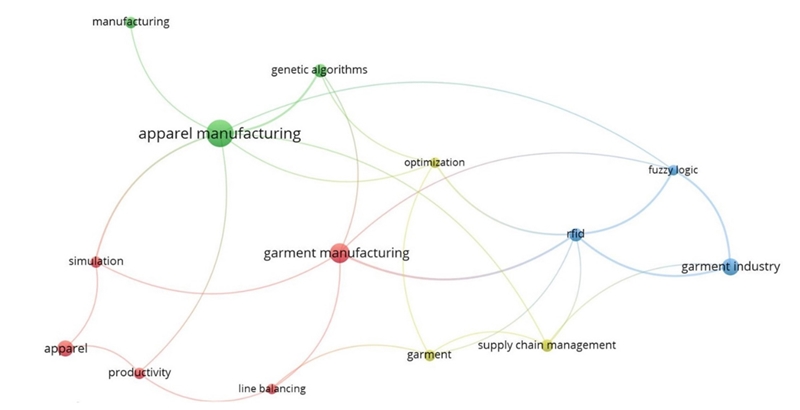
Keyword analysis of studies on garment manufacturing using co-occurrence.
The same method was applied to select key technologies in smart manufacturing. Keywords for the search of studies about smart manufacturing were smart manufacturing used in United States and smart factory used in Europe. In this study, smart factory and smart manufacturing were regarded as the same meaning and used unified as smart manufacturing. Through the same procedure, 1,861 studies were found (Table 1) and keyword analysis was conducted. Thirteen keywords out of a total of 3,930 keyword occurred forty or more times, the relatedness of keywords is as shown in Fig. 3.Finally, IoT (Internet of things), CPS (Cyber-Physical System), big data, cloud computing, digital twin, and machine learning were selected six key technologies in smart manufacturing.
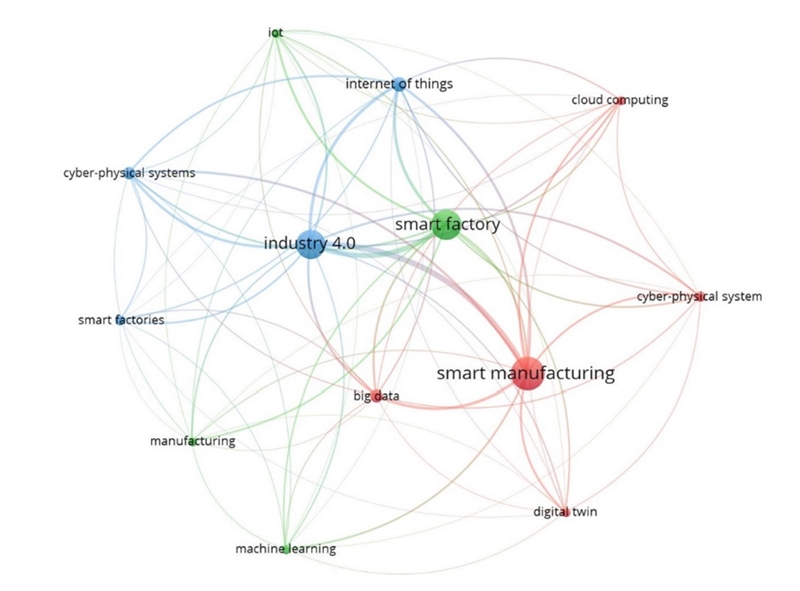
Keyword analysis of studies on smart manufacturing using co-occurrence.
2.3. Study selection
Each key technology was added to the search query to select studies only related to key technologies from the searched studies of each manufacturing (Table 1). As a result, 65 studies including key technologies (simulation, fuzzy logic, genetic algorithms, RFID) were selected out of 417 studies searched for garment manufacturing, and 669 studies including key technologies (IoT, CPS, big data, cloud computing, digital twin, machine learning) were selected out of 1,861 studies searched for smart manufacturing. However, because these studies selected in smart manufacturing included too much desk research, ‘case study’ was added to the search query to explore how key technologies were actually used in manufacturing. Finally, 79 studies were selected in smart manufacturing.
3. Analysis and results
Bibliographic analysis and cluster analysis were conducted only with the selected studies on the key technologies of each manufacturing to find out the progress of technological development. Bibliographic analysis was conducted by year and country for quantitative analysis. Also cluster analysis was conducted by bibliographic coupling analysis for qualitative analysis.
3.1. Bibliographic analysis
Fig. 4 shows the number of studies by year on the key technologies of garment manufacturing and smart manufacturing. As can be seen in Fig. 4, starting from the first paper published in 1990, one to seven studies have been continuously conducted every year since 2000 on key technologies of garment manufacturing. Meanwhile, the studies on the key technologies of smart manufacturing are rapidly increasing since 2014. The number of publications jumped from one in 2014 to 25 in 2019.
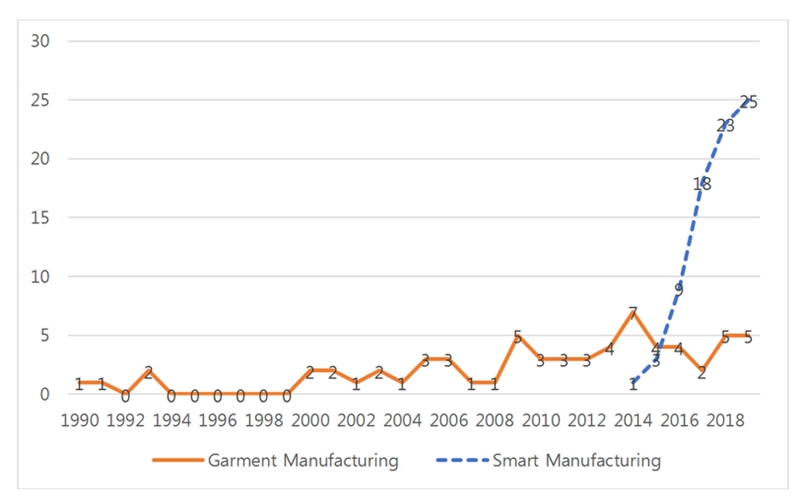
Studies by year on the key technologies of garment manufacturing and smart manufacturing.
Table 2 shows the top seven sorted countries in the order based on the number of studies of key technologies in each manufacturing. In case the countries of co-authors were the same, it was counted as one, otherwise it was counted separately. In the case of garment manufacturing, 35.1% of the studies were conducted in Hong Kong, especially 62.3% of the studies were conducted in Greater China. In the case of smart manufacturing, 17.0% of the studies were conducted in China, 14.0% of the studies were conducted in South Korea, and 12.0% of the studies were conducted in United States. In addition, 19.0% of the studies were conducted in Europe, including Germany, the birthplace of Industry 4.0.
Studies by country on the key technologies of each manufacturing
3.2. Cluster analysis
Cluster analysis was conducted by bibliographic coupling analysis. Bibliographic coupling analysis finds out how many references are shared between studies, and classifies clusters based on this. Through this cluster analysis, it is possible to understand the relationship between studies and the progress of the studies. Bibliographic coupling analysis was conducted on studies with citation of five or higher among the selected studies in each manufacturing. In addition, unrelated studies were removed.
Fig. 5 shows the results of Bibliographic Coupling Analysis conducted with selected studies in garment manufacturing. Studies with less than five citations or non-configurations in the network were removed. Finally, 24 studies remained and clustered into three groups. In Fig. 5, the size of each frame is proportional to the number of citations, and the distance between frames means how many references are shared between studies. Unfortunately, the three studies overlapped the other studies so much that they were not shown in the fig. 5. Details on cluster classification are presented in Tables 3, 4, and 5.
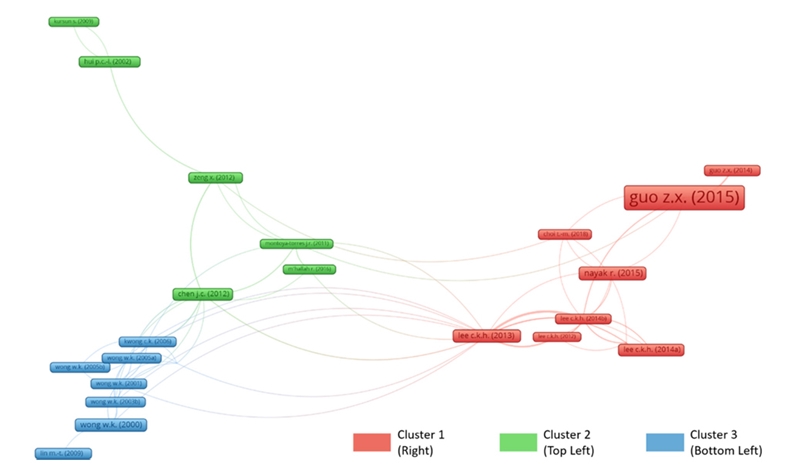
Results of bibliographic coupling analysis in garment manufacturing.
Studies belonging to cluster 1 in garment manufacturing: RFID Technology
Table 3 shows the details of eight studies belonging to cluster 1. Studies belonging to cluster 1 applied RFID technology to solve problems such as production scheduling and quality assurance in garment manufacturing. In addition, two researcher teams conducted two or more studies, especially, Lee’s research team conducted five studies continuously.
Studies conducted by Lee’s research team can be regarded as two linked study. Lee et al. (2013) presented an RFID-based resource allocation system which integrated RFID technology and fuzzy logic to achieve better resource allocation in the garment manufacturing process. The viability of the proposed framework of the RFID-based resource allocation system was evaluated through a case study of Hong Kong based garment manufacturing company. Lee et al. (2013) and Lee et al. (2014b) conducted studies on the same subject on the RFID-based resource allocation system. The only difference between the two studies is that Lee et al. (2013) focused more on fuzzy logic, and Lee et al. (2014b) focused more on data management. Lee et al. (2014a) presented an RFID-based recursive process mining system using a fuzzy association rule to find the relationships between production process parameters and product quality. Fixed preproduction data, real-time production data, and quality data were collected using RFID technology and used in the mining algorithm. It was found that the production efficiency was improved, and the quality of the product was also improved by reducing the number of defects. Lee et al. (2016) came out of Lee et al. (2014a), and genetic algorithms have been applied to the same RFID-based recursive process mining system for improved quality assurance. In summary, Lee’s research team developed systems using fuzzy logic and genetic algorithms based on RFID technology to solve resource allocation and quality assurance problems in garment manufacturing.
The two studies conducted by Guo’s research team are also on the same system. Guo’s research team proposed an RFID based decision support system to handle production monitoring and generate effective production scheduling. RFID technology was applied to monitor the production record of workpiece and the performance of operator on each key workstation. A cloud-based pilot system enabled the head office to monitor the production progress of each factory and assign orders.
Table 4 shows the details of eight studies belonging to cluster 2. Cluster 2 consists of studies on planning and scheduling in garment manufacturing. Especially, there are many studies on balancing control of the assembly line. The balancing control of the assembly line is the most important issue for production control in garment manufacturing, and Cluster 2 is a group of studies to solve it. As a solution, the optimization of operator allocation has been attempted in several studies. It is because the degree of automation in garment manufacturing is very low, especially assembly lines still need a lot of operators. Therefore, it is inevitable to come up with a solution considering the operator.
Studies belonging to cluster 2 in garment manufacturing: planning and scheduling
Several studies attempted to optimize operator allocation to solve the balancing control of the assembly line. Hui et al. (2002) developed a fuzzy-operator-allocation system with fuzzy logic for operator allocation. To evaluate the performance of the system, that of the supervisors were compared in a men's shirt factory. The system increased production efficiency by 30% over supervisors. Kursun and Kalaoglu (2009) applied simulation for the balancing control of the assembly line. Process and time were analyzed to simulate a single assembly line of sweatshirts. Based on this analysis, bottlenecks were determined. Three scenarios have been proposed for adding operators of bottlenecks. As a result of the study, daily production increased and average staying time per process decreased. Zeng et al. (2012) proposed an operator allocation optimization model based on the Pareto Utility Discrete Differential Evolution algorithm to solve the assembly line balancing problem. The study was conducted reflecting the labor-intensive characteristics of garment manufacturing such as operator skill levels, job sharing, and operator revisiting. Chen et al. (2012) developed a grouping genetic algorithm to solve the assembly line balancing problem. This study also considered operator skill levels. It was shown that the more workers at the workstation and the more workers with multiple skills in the line are allocated, the higher the production and the shorter the production cycle.
Table 5 shows the details of eight studies belonging to cluster 3. Genetic algorithms were used in all studies in cluster 3. Unusually, cluster 3 consists of studies conducted by Wong’s research team, except for one study. Since Kwong et al. (2006) also includes Wong, it should be treated as the same research team. In fact, cluster 3 is a group of studies in which one research team applied genetic algorithms to solve various problems in garment manufacturing.
Studies belonging to cluster 3 in garment manufacturing: genetic algorithms
The studies conducted by Wong’s research team are as follows. There are continuous studies to optimize fabric spreading and cutting sequencing. Wong et al. (2000) applied genetic algorithms to solve the problem of fabric spreading and cutting sequencing in garments manufacturing equipped with the computerized cutting system. Wong (2003a) also applied genetic algorithms to solve the same problem. The only difference between the two studies was the model. Kwong et al. (2006) also applied genetic algorithms combined with fuzzy logic to determine the fabric cutting schedule. On the other hand, there are studies on planning and scheduling. Wong et al. (2005b) presented the architecture of a real-time segmentation rescheduling using genetic algorithms to handle the many uncertain and dynamic events that influence the original production planning in garment manufacturing. This study was also an optimization problem with bundling added to fabric spreading and cutting sequencing. Wong et al. (2001) presented a two-tier hierarchy model with genetic algorithms to generate the master production schedule and implement the detailed production schedule in garment manufacturing. Wong et al. (2005a) proposed the garment manufacturing line balancing technique using genetic algorithms to minimize the overall makespan. As a result, it was shown that the assembly makespan calculated from the genetic optimization procedure was less than the theoretically calculated value.
Bibliographic Coupling Analysis for smart manufacturing was conducted in the same method as garment manufacturing. In addition, the included review study was removed. Finally, 29 studies remained and clustered into four groups (Fig. 6). Also, the five studies overlapped the other studies so much that they were not shown in the Fig. 6. Details on cluster classification are presented in Tables 6, 7, 8 and 9.
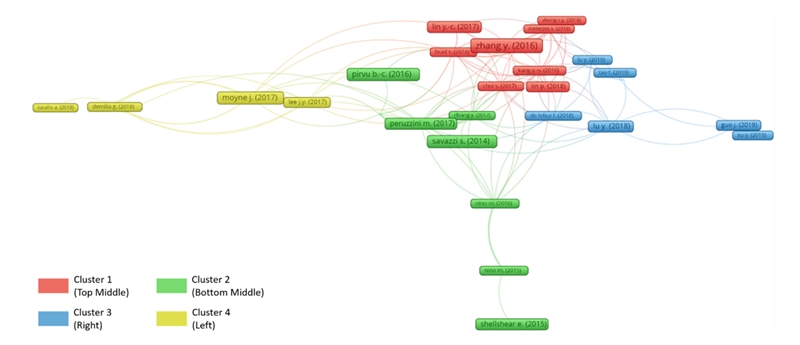
Results of bibliographic coupling analysis in smart manufacturing.
Studies belonging to cluster 1 in smart manufacturing: IoT
Table 6 shows the details of eight studies belonging to cluster 1. Cluster 1 mainly consists of studies applied IoT in smart manufacturing. IoT technology has been used to collect data in real-time through sensors, RFID, and so on. By analyzing the data collected, it is possible not only to monitor and control manufacturing status in real time, but also to constantly modify the plan.
There are various studies related to IoT technology. Zhang et al. (2016) presented an architecture that provides real time production performance and exception diagnosis in advance through data collected from IoT technology in manufacturing shop floor. Kang et al. (2016) argued that traceability data management is the key to smart manufacturing and designed a performance prediction model for stable operation of traceability systems in the supply chain. Lin et al. (2017) proposed a system to increase and maintain production yield in the semiconductor manufacturing process. A part of the proposed system was implemented and tested by installing 13 sensors in the etching equipment and analyzing the data collected through the sensors. Lin et al. (2018) presented an IoT-enabled real time synchronization for an automobile standard part factory. The synchronization mechanisms used rule-based heuristics and real time production data, and an advanced planning and scheduling system framework was developed for the automation of the synchronization mechanisms. Zhong (2018) analyzed the datasets obtained from RFID-based factory. The analysis evaluated the quality of batches, workers, processes, and machines.
Table 7 shows the details of eight studies belonging to cluster 2. Cluster 2 mainly consists of studies on how to design smart manufacturing. Because studies on smart manufacturing have been conducted since 2014 (Fig. 4), the design of smart manufacturing is still one of the main study topics. Several of these studies in smart manufacturing were conducted with operators in mind, that is, from an anthropocentric perspective.
Studies belonging to cluster 2 in smart manufacturing: design of smart manufacturing
There are studies suggesting an architecture or framework on how to design and construct to implement smart manufacturing. Savazzi et al. (2014) proposed industry-standard methods and tools to support coverage prediction and deployment optimization of wireless cloud networks for IoT, considering highly dense building blockage and interference-limited radio access. Shellshear et al. (2015) provided a simulation tool for digital factory that avoids expensive physical verification and does not interfere with existing production. To prove the effectiveness of this tool, a simulation was performed on the rust protection process at the Volvo car factory to determine whether a collision problem occurred in that process. Niño et al. (2016) presented architectural requirements for capturing, integrating, and analyzing big data generated by manufacturing companies operating the same process in factories distributed around the world. Zheng and Ming (2017) proposed a general architecture for the construction of smart manufacturing workshops. Especially, a capability maturity model for evaluating the level of smart manufacturing of individual companies was proposed and applied to automotive companies.
Some of the study on the design of smart manufacturing still focused on humans. Pirvu et al. (2016) argued that since CPS was designed to work in social space, it would increasingly cover social aspects when used in smart factory implementation. Previous work defined an anthropocentric cyber-physical system that integrates the physical component, the computational component, and the human component (Zamfirescu et al., 2013). The anthropocentric cyber-physical reference architecture for smart factories was proposed, and it was argued that to implement this, technological advances in service-oriented architectures, semantic Web, and human-machine interaction are required. Peruzzini and Pellicciari (2017) proposed a design method of human-centered adaptive manufacturing system that can be adapted to human-machine interaction and operators’ needs.
Table 8 shows the details of seven studies belonging to cluster 3. Cluster 3 mainly consists of studies on CPS or digital twin in smart manufacturing. CPS is a concept about the interaction of the physical and the cyber, and a system in which physical operations are monitored, controlled, and integrated by cyber computing (Monostori, 2018). Digital twin for smart manufacturing is the virtual counterparts of the physical devices, which enable real-time optimizations, decision making, and predictive maintenance through real-time synchronization from sensor data as well as assessment at the design stage (Negri et al., 2017). After all, CPS and digital twin have differences in terms of emphasis, but they are concepts of the same purpose.
Studies belonging to cluster 3 in smart manufacturing: CPS or digital twin
There are studies suggesting a framework for the implementation of digital twin or CPS. Lu and Xu (2018) proposed a test-driven resource virtualization framework for the industry to create digital twin to achieve the fast production of individualized products. Also, Lu et al. (2019) proposed an open system architecture that enables the distribution and manufacturing of assets in the most energy-efficient way on inter-connected factory network. De Felice et al. (2018) proposed a method of digitizing a logistic process to optimize warehouse management for railway company. Guo et al. (2019) presented a modular-based digital twin model for factory design. The modular approach was applied to reduce the workload and time. Yoon et al. (2019) proposed a reference architecture of the smart factory information service bus, a middleware for transmitting manufacturing information and services at various levels of machines, factories, and enterprises in a smart factory environment. This service bus is an implementation of CPS.
Table 9 shows the details of six studies belonging to cluster 4. Cluster 4 mainly consists of studies on big data in smart manufacturing. Analyzing big data collected in the manufacturing environment and processing it into meaningful results is a major study area of smart manufacturing.
Studies belonging to cluster 4 in smart manufacturing: big data
There are studies that provide an architecture of smart manufacturing using big data analytics. Saldivar et al. (2016a, b) developed an analytic framework for the prediction of customer needs to achieve mass customization. In the presented framework, the user inputs and requirements were processed to extract the key design characteristics by identifying patterns from big data. Moyne and Iskandar (2017) provided a roadmap for implementing smart manufacturing in the semiconductor manufacturing industry by profiling a variety of big data analytical methods. In this process, it was argued that analytical solutions could not be managed by data alone due to the characteristics of the semiconductor manufacturing industry. Lee et al. (2017) proposed an architecture and system modules for big data analysis platform to implement smart factory in small and medium-sized enterprises.
4. Discussion
4.1. Level of study on technology in garment manufacturing
Studies on garment manufacturing and smart manufacturing were searched in the Scopus database, and key technologies were extracted from garment manufacturing and smart manufacturing respectively through keyword analysis of the searched studies. Studies involving extracted key technologies were searched again in each manufacturing. Finally, the studies on the key technologies of each manufacturing was analyzed. As a result of listing studies on key technologies in garment manufacturing by year, the number of studies is too small, although the studies have been conducted steadily (Fig. 4). Also, unlike studies on key technologies in smart manufacturing that were conducted evenly in Asia, the United States, and Europe, many studies on key technologies in garment manufacturing were conducted especially in Greater China (Table 2). As a result of clustering and analyzing studies on technologies in garment manufacturing based on the similarity of the reference, a small number of teams conducted very similar studies or conducted studies to solve various problems with limited technologies (Table 3, 5). In conclusion, although studies on technologies in garment manufacturing have been conducted continuously, but the number of studies is very small and only a few research teams have studied it.
Fig. 7 compares the years in which study on each key technology was first conducted in manufacturing and garment manufacturing, respectively. The first study of each technology was searched in the Scopus database. This comparison gives a rough approximation of technological gaps between garment manufacturing and other manufacturing. In manufacturing, simulation, genetic algorithms, fuzzy logic, RFID were first searched in 1968, 1989, 1984 and 1998, respectively. In garment manufacturing, simulation, genetic algorithms, fuzzy logic, and RFID were first searched in 1990, 2000, 2000, and 2009 respectively (Fig. 7(a)). Depending on the technologies, the garment industry is 11 to 22 years behind other manufacturing industries. Also, in manufacturing, IoT, machine learning, digital twin, cloud computing, CPS, and big data were first searched in 2010, 1989, 2015, 2008, 2010, and 2009, respectively. In garment manufacturing, IoT, machine learning, and cloud computing were first searched in 2019, 2019, and 2014, respectively, but the rest were not (Fig. 7(b)). In other words, there are technological gaps between garment manufacturing and other manufacturing and studies on technologies such as digital twin, CPS and big data in garment manufacturing have not even been started.
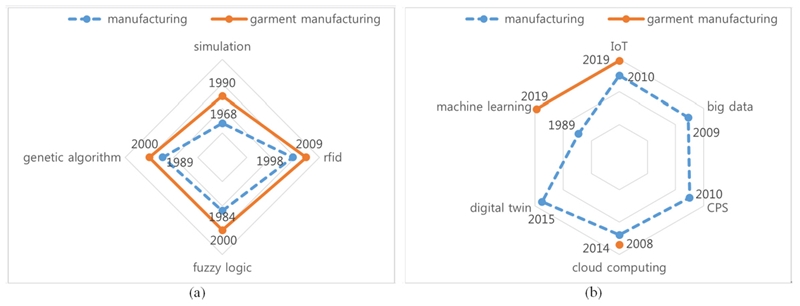
Comparison of the years in which study on each key technology was first conducted in manufacturing and garment manufacturing respectively (in Scopus database); (a) key technologies in garment manufacturing, (b) key technologies in smart manufacturing.
4.2. Level of study on technology in smart manufacturing
Studies on smart manufacturing are still in its infancy. There are many studies on key technologies in smart manufacturing, but most of them are desk research, and a few studies include case study (Table 1). As a result of listing studies on key technologies in smart manufacturing by year, it can be confirmed that it started in 2014 (Fig. 4). Also, studies on key technologies in smart manufacturing clustered into four group through bibliographic coupling analysis. The studies belonging to cluster 2 were about the design of smart manufacturing. Even the studies belonging to the rest of the cluster mainly suggest the overall architecture of smart manufacturing, and only a fraction of the proposed architecture was actually implemented. In other words, most of the proposed architecture was not implemented in manufacturing industry. Therefore, many studies on smart manufacturing are still needed.
4.3. Comparison of garment manufacturing and smart manufacturing
Table 10 shows the results of cluster analysis for each manufacturing. Cluster 1 in garment manufacturing is a group of studies using RFID, and cluster 1 in smart manufacturing is a group of studies using IoT. RFID is one of the representative technologies used to construct IoT. In smart manufacturing, IoT is intended to acquire a large amount of data from components such as operators, machines, and products. RFID is mainly used for tracking products. Cluster 1 of each manufacturing is a group of studies collecting data in manufacturing. Cluster 2 in garment manufacturing is a group of studies on planning and scheduling. Especially, most studies are on control of assembly lines for optimizing production. Cluster 3 in smart manufacturing is a group of studies on CPS or digital twin. The purpose of CPS or digital twin is to monitor, control, and integrate manufacturing in real time by analyzing big data obtained through IoT, thereby real time optimization, predictive maintenance, and dynamic decision making. On a larger scale, cluster 2 in garment manufacturing and cluster 3 in smart manufacturing are studies for production optimization. Cluster 3 in garment manufacturing is a group of studies using genetic algorithms. Genetic algorithms are one of the useful solutions to the optimization problem and are still used in many fields. Cluster 4 in smart manufacturing is a group of studies using big data. Analyzing big data is also aimed at solving various problems in manufacturing. In other words, studies on technologies in the garment industry are a few and are technically behind other manufacturing industries, but the direction of studies is toward smart manufacturing. Therefore, more studies are needed to apply the key technologies of smart manufacturing to garment manufacturing. Especially, there is a need for studies on digital twin, CPS, and big data, which are the key technologies of smart manufacturing that have not yet started.
The results of cluster analysis for each manufacturing
However, there are essential considerations in applying key technologies of smart manufacturing to the garment industry. The level of implementation and the priority of smart manufacturing first should be considered. For example, the main studies on cluster 2 in garment manufacturing are about balancing assembly lines in planning and scheduling. Therefore, instead of applying smart manufacturing directly to all processes in garment manufacturing, it can be implemented with the priority of solving the line balancing problem on the assembly lines in garment manufacturing. Also, just as each industry has different architectures in implementing smart manufacturing, it should be considered the progress of technological development and the difference in the industrial environment.
Especially, labor-intensive industries such as garment manufacturing require operators to be integrated into the smart manufacturing systems as human components. In smart manufacturing, some of the studies on the design of smart manufacturing belonging to cluster 2 were conducted mainly on human-machine interaction and operators. A study of the anthropocentric perspective of production in Industry 4.0 also concluded that the role of humans is not disappearing but changing (Rauch et al., 2019). No matter how advanced the level of factory automation is, the monitoring, controlling, and decision-making cannot be performed by a machine. On the other hand, there are studies that considered operators in garment manufacturing. However, unlike the dynamic acquisition of the operator's skill level by analyzing the data collected in smart manufacturing, the results were static and disposable in garment manufacturing because the skill level of operators was manually entered. Therefore, operators in the garment industry should be considered as one of the major components, and a method of dynamically collecting and analyzing their data should be studied.
5. Conclusion
In this paper, a systematic review analysis was conducted on technical aspects to find the way to smart manufacturing in the garment industry. First, previous studies on garment manufacturing and smart manufacturing were searched in the Scopus database. And key technologies of garment manufacturing and smart manufacturing were derived by keyword analysis of searched studies. Studies were selected that actually performed these key technologies in each manufacturing. Bibliographic analysis and cluster analysis were conducted with these selected studies. Finally, the feasibility of implementing smart manufacturing and essential considerations for implementing smart manufacturing in the garment industry were proposed by discussing the findings of these analyses.
Simulation, fuzzy logic, genetic algorithms, and RFID technologies were derived as key technologies in garment manufacturing. IoT, CPS, big data, cloud computing, digital twin, and machine learning technologies also were derived as key technologies in smart manufacturing. Bibliographic analysis of the studies of the key technologies selected in each manufacturing revealed that studies on technologies in garment manufacturing are not only rare but also locally biased. Since 2000, the number of studies on key technologies in garment manufacturing is around three per year. And 35.1% of the studies were conducted in Hong Kong, especially 62.3% of those studies were conducted in Greater China. Also, it was confirmed through cluster analysis that studies on key technologies in garment manufacturing were conducted by limited research teams.
In addition, there are technological gaps compared to other manufacturing. Depending on the technologies, the garment industry is 11 to 22 years behind other manufacturing industries. And there are still no studies on CPS, big data, digital twin, which are key technologies for smart manufacturing. However, studies on smart manufacturing are still in its infancy, and the direction of studies in garment manufacturing is toward smart manufacturing. Therefore, more studies are needed to apply the key technologies of smart manufacturing to garment manufacturing. In this case, the progress of technology development, the difference in the industrial environment, and the level of implementation should be considered. Above all, human components should be integrated into smart manufacturing system in labor-intensive garment manufacturing process.
Acknowledgments
This work was supported by NRF(National Research Foundation of Korea) Grant funded by the Korean Government(NRF-2019-Fostering Core Leaders of the Future Basic Science Program/Global Ph.D. Fellowship Program)
References
-
Brad, S., Murar, M., & Brad, E. (2018). Design of smart connected manufacturing resources to enable changeability, reconfigurability and total-cost-of-ownership models in the factory-of-the-future. International Journal of Production Research, 56(6), 2269-2291.
[https://doi.org/10.1080/00207543.2017.1400705]

-
Briner, R. B., & Denyer, D. (2012). Systematic review and evidence synthesis as a practice and scholarship tool. In Rousseau, D. M. (Eds.), Handbook of evidence-based management: Companies, classrooms and research (pp. 112-129). New York: Oxford University Press.
[https://doi.org/10.1093/oxfordhb/9780199763986.013.0007]
-
Chen, J. C., Chen, C. C., Su, L. H., Wu, H. B., & Sun, C. J. (2012). Assembly line balancing in garment industry. Expert Systems with Applications, 39(11), 10073-10081.
[https://doi.org/10.1016/j.eswa.2012.02.055]
-
Chiang, Y., & Lee, D. (2017). Smart manufacturing with the internet of makers. Journal of the Chinese Institute of Engineers, 40(7), 585-592.
[https://doi.org/10.1080/02533839.2017.1362324]
-
Choi, S. S., Kang, G. H., Jun, C. M., Lee, J. Y., & Han, S. J. (2017). Cyber-physical systems: a case study of development for manufacturing industry. International Journal of Computer Applications in Technology, 55(4), 289-297.
[https://doi.org/10.1504/IJCAT.2017.10006845]
-
Choi, T. M., Yeung, W. K., Cheng, T. E., & Yue, X. (2018). Optimal scheduling, coordination, and the value of RFID technology in garment manufacturing supply chains. IEEE Transactions on engineering Management, 65(1), 72-84.
[https://doi.org/10.1109/TEM.2017.2739799]
-
D’Emilia, G., Gaspari, A., & Natale, E. (2018, April). Measurements for smart manufacturing in an Industry 4.0 scenario a case-study on a mechatronic system. In 2018 Workshop on Metrology for Industry 4.0 and IoT (pp. 1-5). IEEE.
[https://doi.org/10.1109/METROI4.2018.8428341]
-
De Felice, F., Petrillo, A., & Zomparelli, F. (2018). Prospective design of smart manufacturing: An Italian pilot case study. Manufacturing Letters, 15, 81-85.
[https://doi.org/10.1016/j.mfglet.2017.12.002]
- Denyer, D., & Tranfield, D. (2009). Producing a systematic review. In D. A. Buchanan & A. Bryman. (Eds.), The SAGE Handbook of Organizational Research Methods (pp. 671-689). London: SAGE.
-
Guo, J., Zhao, N., Sun, L., & Zhang, S. (2019). Modular based flexible digital twin for factory design. Journal of Ambient Intelligence and Humanized Computing, 10(3), 1189-1200.
[https://doi.org/10.1007/s12652-018-0953-6]
-
Guo, Z. X., Wong, W. K., & Guo, C. (2014). A cloud-based intelligent decision-making system for order tracking and allocation in apparel manufacturing. International Journal of Production Research, 52(4), 1100-1115.
[https://doi.org/10.1080/00207543.2013.838650]
-
Guo, Z., Ngai, E., Yang, C., & Liang, X. (2015). An RFID-based intelligent decision support system architecture for production monitoring and scheduling in a distributed manufacturing environment. International Journal of Production Economics, 159, 16-28.
[https://doi.org/10.1016/j.ijpe.2014.09.004]
-
Hui, P. L., Chan, K. C., Yeung, K. W., & Ng, F. F. (2002). Fuzzy operator allocation for balance control of assembly lines in apparel manufacturing. IEEE Transactions on Engineering Management, 49(2), 173-180.
[https://doi.org/10.1109/TEM.2002.1010885]
-
Kang, Y. S., Park, I. H., & Youm, S. (2016). Performance prediction of a MongoDB-based traceability system in smart factory supply chains. Sensors, 16(12), 2126.
[https://doi.org/10.3390/s16122126]
- Kursun, S., & Kalaoglu, F. (2009). Simulation of production line balancing in apparel manufacturing. Fibres & Textiles in Eastern Europe, 17(4), 68-71.
-
Kwong, C. K., Mok, P. Y., & Wong, W. K. (2006). Determination of fault-tolerant fabric-cutting schedules in a just-in-time apparel manufacturing environment. International Journal of Production Research, 44(21), 4465-4490.
[https://doi.org/10.1080/00207540600597047]
-
Lee, C. K. H., Choy, K. L., Law, K. M. Y., & Ho, G. T. S. (2012, December). An intelligent system for production resources planning in Hong Kong garment industry. In 2012 IEEE International Conference on Industrial Engineering and Engineering Management (pp. 889-893). IEEE.
[https://doi.org/10.1109/IEEM.2012.6837868]
-
Lee, C. K. H., Choy, K. L., Ho, G. T., & Law, K. M. Y. (2013). A RFID-based resource allocation system for garment manufacturing. Expert Systems with Applications, 40(2), 784-799.
[https://doi.org/10.1016/j.eswa.2012.08.033]
-
Lee, C. K. H., Ho, G. T. S., Choy, K. L., & Pang, G. K. H. (2014a). A RFID-based recursive process mining system for quality assurance in the garment industry. International Journal of Production Research, 52(14), 4216-4238.
[https://doi.org/10.1080/00207543.2013.869632]
-
Lee, C. K. H., Choy, K. L., Law, K. M. Y., & Ho, G. T. S. (2014b). Application of intelligent data management in resource allocation for effective operation of manufacturing systems. Journal of Manufacturing Systems, 33(3), 412-422.
[https://doi.org/10.1016/j.jmsy.2014.02.002]
-
Lee, C. K. H., Choy, K. L., Ho, G. T., & Lam, C. H. (2016). A slippery genetic algorithm-based process mining system for achieving better quality assurance in the garment industry. Expert systems with Applications, 46, 236-248.
[https://doi.org/10.1016/j.eswa.2015.10.035]
-
Lee, J. Y., Yoon, J. S., & Kim, B. H. (2017). A big data analytics platform for smart factories in small and mediumsized manufacturing enterprises: An empirical case study of a die casting factory. International Journal of Precision Engineering and Manufacturing, 18(10), 1353-1361.
[https://doi.org/10.1007/s12541-017-0161-x]
-
Lin, M. T. (2009). The single-row machine layout problem in apparel manufacturing by hierarchical order-based genetic algorithm. International Journal of Clothing Science and Technology, 21(1), 31-43.
[https://doi.org/10.1108/09556220810898872]
-
Lin, P., Li, M., Kong, X., Chen, J., Huang, G. Q., & Wang, M. (2018). Synchronisation for smart factory-towards IoTenabled mechanisms. International Journal of Computer Integrated Manufacturing, 31(7), 624-635.
[https://doi.org/10.1080/0951192X.2017.1407445]
-
Lin, Y. C., Hung, M. H., Huang, H. C., Chen, C. C., Yang, H. C., Hsieh, Y. S., & Cheng, F. T. (2017). Development of advanced manufacturing cloud of things (AMCoT) -A smart manufacturing platform. IEEE Robotics and Automation Letters, 2(3), 1809-1816.
[https://doi.org/10.1109/LRA.2017.2706859]
-
Loo, G. S., Tang, B. C., & Janczewski, L. (2000, September). An adaptable human-agent collaboration information system in manufacturing (HACISM). In Proceedings 11th International Workshop on Database and Expert Systems Applications (pp. 445-449). IEEE.
[https://doi.org/10.1109/DEXA.2000.875064]
-
Lu, Y., Peng, T., & Xu, X. (2019). Energy-efficient cyber-physical production network: Architecture and technologies. Computers & Industrial Engineering, 129, 56-66.
[https://doi.org/10.1016/j.cie.2019.01.025]
-
Lu, Y., & Xu, X. (2018). Resource virtualization: a core technology for developing cyber-physical production systems. Journal of Manufacturing Systems, 47, 128-140.
[https://doi.org/10.1016/j.jmsy.2018.05.003]
-
M'Hallah, R., & Bouziri, A. (2016). Heuristics for the combined cut order planning two?dimensional layout problem in the apparel industry. International Transactions in Operational Research, 23(1-2), 321-353.
[https://doi.org/10.1111/itor.12104]
-
Menezes, S., Creado, S., & Zhong, R. Y. (2018). Smart manufacturing execution systems for small and medium-sized enterprises. Procedia CIRP, 72, 1009-1014.
[https://doi.org/10.1016/j.procir.2018.03.272]
-
Mok, P. Y., Cheung, T. Y., Wong, W. K., Leung, S. Y. S., & Fan, J. T. (2013). Intelligent production planning for complex garment manufacturing. Journal of Intelligent Manufacturing, 24(1), 133-145.
[https://doi.org/10.1007/s10845-011-0548-y]
-
Monostori, L. (2018). Cyber-physical systems. The International Academy for Production (Eds.), CIRP Encyclopedia of Production Engineering (pp. 1-7). Berlin: Springer.
[https://doi.org/10.1007/978-3-642-35950-7_16790-1]
-
Montoya-Torres, J. R., & Vargas-Nieto, F. (2011). Solving a bi-criteria hybrid flowshop scheduling problem occurring in apparel manufacturing. International Journal of Information Systems and Supply Chain Management, 4(2), 42-60.
[https://doi.org/10.4018/jisscm.2011040103]
-
Moyne, J., & Iskandar, J. (2017). Big data analytics for smart manufacturing: Case studies in semiconductor manufacturing. Processes, 5(3), 39.
[https://doi.org/10.3390/pr5030039]
-
Negri, E., Fumagalli, L., & Macchi, M. (2017). A review of the roles of digital twin in cps-based production systems. Procedia Manufacturing, 11, 939-948.
[https://doi.org/10.1016/j.promfg.2017.07.198]
-
Niño, M., Blanco, J. M., & Illarramendi, A. (2015, October). Business understanding, challenges and issues of Big Data Analytics for the servitization of a capital equipment manufacturer. In 2015 IEEE International Conference on Big Data (Big Data) (pp. 1368-1377). IEEE.
[https://doi.org/10.1109/BigData.2015.7363897]
-
Niño, M., Sáenz, F., Blanco, J. M., & Illarramendi, A. (2016, July). Requirements for a big data capturing and integration architecture in a distributed manufacturing scenario. In 2016 IEEE 14th International Conference on Industrial Informatics (INDIN) (pp. 1326-1329). IEEE.
[https://doi.org/10.1109/INDIN.2016.7819372]
-
Peruzzini, M., & Pellicciari, M. (2017). A framework to design a human-centred adaptive manufacturing system for aging workers. Advanced Engineering Informatics, 33, 330-349.
[https://doi.org/10.1016/j.aei.2017.02.003]
-
Pirvu, B. C., Zamfirescu, C. B., & Gorecky, D. (2016). Engineering insights from an anthropocentric cyber-physical system: A case study for an assembly station. Mechatronics, 34, 147-159.
[https://doi.org/10.1016/j.mechatronics.2015.08.010]
-
Rauch, E., Linder, C., & Dallasega, P. (2019). Anthropocentric perspective of production before and within Industry 4.0. Computers & Industrial Engineering, 139, 105644
[https://doi.org/10.1016/j.cie.2019.01.018]
-
Saldivar, A. A. F., Goh, C., Chen, W. N., & Li, Y. (2016a, July). Self-organizing tool for smart design with predictive customer needs and wants to realize Industry 4.0. In 2016 IEEE congress on evolutionary computation (CEC) (pp. 5317-5324). IEEE.
[https://doi.org/10.1109/CEC.2016.7748366]
-
Saldivar, A. A. F., Goh, C., Li, Y., Chen, Y., & Yu, H. (2016b, September). Identifying smart design attributes for Industry 4.0 customization using a clustering Genetic Algorithm. In 2016 22nd International Conference on Automation and Computing (ICAC) (pp. 408-414). IEEE.
[https://doi.org/10.1109/IConAC.2016.7604954]
-
Savazzi, S., Rampa, V., & Spagnolini, U. (2014). Wireless cloud networks for the factory of things: Connectivity modeling and layout design. IEEE Internet of Things Journal, 1(2), 180-195.
[https://doi.org/10.1109/JIOT.2014.2313459]
-
Shellshear, E., Berlin, R., & Carlson, J. S. (2015). Maximizing smart factory systems by incrementally updating point clouds. IEEE Computer Graphics and Applications, 35(2), 62-69.
[https://doi.org/10.1109/MCG.2015.38]
-
Tao, F., Tang, Y., Zou, X., & Qi, Q. (2019). A field programmable gate array implemented fibre channel switch for big data communication towards smart manufacturing. Robotics and Computer-Integrated Manufacturing, 57, 166-181.
[https://doi.org/10.1016/j.rcim.2018.12.005]
-
Tarallo, A., Mozzillo, R., Di Gironimo, G., & De Amicis, R. (2018). A cyber-physical system for production monitoring of manual manufacturing processes. International Journal on Interactive Design and Manufacturing, 12(4), 1235-1241.
[https://doi.org/10.1007/s12008-018-0493-5]
- Thompson, K. D. (2014, April 25). Smart manufacturing operations planning and control program. NIST. Retrieved August 27, 2020, from https://www.nist.gov/programs-projects/smart-manufacturing-operations-planning-and-control-program
-
Wong, W. K., Chan, C. K., & Ip, W. H. (2000). Optimization of spreading and cutting sequencing model in garment manufacturing. Computers in Industry, 43(1), 1-10.
[https://doi.org/10.1016/S0166-3615(00)00057-9]
-
Wong, W. K., Chan, C. K., & Ip, W. H. (2001). A hybrid flowshop scheduling model for apparel manufacture. International Journal of Clothing Science and Technology, 13(2), 115-131.
[https://doi.org/10.1108/09556220110390737]
-
Wong, W. K. (2003a). A selection of a fabric-cutting system configuration in different types of apparel manufacturing environments. The International Journal of Advanced Manufacturing Technology, 22(9-10), 641-648.
[https://doi.org/10.1007/s00170-003-1567-4]
-
Wong, W. K. (2003b). Optimisation of apparel manufacturing resource allocation using a generic optimised table-planning model. The International Journal of Advanced Manufacturing Technology, 21(12), 935-944.
[https://doi.org/10.1007/s00170-002-1414-z]
-
Wong, W. K., Chan, C. K., Kwong, C. K., Mok, P. Y., & Ip, W. H. (2005a). Optimization of manual fabric-cutting process in apparel manufacture using genetic algorithms. The International Journal of Advanced Manufacturing Technology, 27(1-2), 152-158.
[https://doi.org/10.1007/s00170-004-2161-0]
-
Wong, W. K., Leung, S. Y. S., & Au, K. F. (2005b). Real-time GA-based rescheduling approach for the pre-sewing stage of an apparel manufacturing process. The International Journal of Advanced Manufacturing Technology, 25(1-2), 180-188.
[https://doi.org/10.1007/s00170-003-1819-3]
-
Xu, Y., Sun, Y., Liu, X., & Zheng, Y. (2019). A digital-twin-assisted fault diagnosis using deep transfer learning. IEEE Access, 7, 19990-19999.
[https://doi.org/10.1109/ACCESS.2018.2890566]
-
Yoon, S., Um, J., Suh, S. H., Stroud, I., & Yoon, J. S. (2019). Smart Factory Information Service Bus (SIBUS) for manufacturing application: Rquirement, architecture and implementation. Journal of Intelligent Manufacturing, 30(1), 363-382.
[https://doi.org/10.1007/s10845-016-1251-9]
-
Zamfirescu, C. B., Pirvu, B. C., Schlick, J., & Zuehlke, D. (2013). Preliminary insides for an anthropocentric cyber-physical reference architecture of the smart factory. Studies in Informatics and Control, 22(3), 269-278.
[https://doi.org/10.24846/v22i3y201303]
-
Zeng, X., Wong, W. K., & Leung, S. Y. S. (2012). An operator allocation optimization model for balancing control of the hybrid assembly lines using Pareto utility discrete differential evolution algorithm. Computers & Operations Research, 39(5), 1145-1159.
[https://doi.org/10.1016/j.cor.2011.07.020]
-
Zhang, Y., Wang, W., Wu, N., & Qian, C. (2016). IoT-enabled real-time production performance analysis and exception diagnosis model. IEEE Transactions on Automation Science and Engineering, 13(3), 1318-1332.
[https://doi.org/10.1109/TASE.2015.2497800]
-
Zheng, M., & Ming, X. (2017). Construction of cyber-physical system-integrated smart manufacturing workshops: A case study in automobile industry. Advances in Mechanical Engineering, 9(10), 1-17.
[https://doi.org/10.1177/1687814017733246]
-
Zhong, R. Y. (2018, March). Analysis of RFID datasets for smart manufacturing shop floors. In 2018 IEEE 15th International Conference on Networking, Sensing and Control (ICNSC) (pp. 1-4). IEEE.
[https://doi.org/10.1109/ICNSC.2018.8361321]
-
Zhong, R. Y., Xu, X., Klotz, E., & Newman, S. T. (2017). Intelligent manufacturing in the context of industry 4.0: A review. Engineering, 3(5), 616-630.
[https://doi.org/10.1016/J.ENG.2017.05.015]