Role of Fashion Leadership Influencing the Effect of the Environmental Benefits of Second-hand Clothing on Continuance Usage Intention

© 2020 (by) the authors. This article is an open access article distributed under the terms and conditions of the Creative Commons Attribution license (http://creativecommons.org/licenses/by/3.0/), which permits unrestricted use, distribution, and reproduction in any medium, provided the original work is properly cited.
Abstract
Growth in the second-hand clothing (SHC) market has become noteworthy, especially for millennial consumers in Korea. This study identifies the moderating role of fashion leadership influencing the relationship between the perceived environmental benefits of SHC and continuance usage intention for millennial consumers. The hypotheses were statistically tested using online survey data, and the respondents were Korean female millennials aged between 25 and 39 years who had online shopping experiences of SHC within 3 months. Furthermore, 263 responses were analyzed by confirmatory factor, hierarchical regression, and conditional process analyses using SPSS, AMOS, and PROCESS v3.3. Results validated that the perceived environmental benefits of SHC and fashion leadership have positive effects on continuance usage intention of purchased second-hand items. Fashion leadership also moderates the relationship between the environmental benefits of SHC and continuance usage intention, showing that as the level of fashion leadership increases, the environmental benefits have more positive effects on continuance usage intention. Theoretical and practical implications were also discussed. This study will help bridge theoretical and practical gaps between purchasing and using SHC by focusing on the interaction effect of fashion leadership and its perceived environmental benefits.
Keywords:
second-hand clothing, continuance usage intention, environmental benefits, fashion leadership, millennials1. Introduction
Recently, the growth in the second-hand clothing (SHC) market has become noteworthy and has been expected to grow from $24 billion in 2018 to $51 billion in 2023, surpassing that of luxury and fast fashion (Sorokanichb, 2019). In Korea, the growth in the SHC market is estimated as 20 trillion won in 2019, which is 500% growth compared with that in 2008, especially expanding among young people (Kim, 2019b). SHC consumption is meaningful in that unwanted or underused products are redistributed by increasing their usage and lifespan (Park & Armstrong, 2017). Extending the product life cycle by reusing the original form of clothing without any further exploitation of resources may be the simplest and the most desirable way for the circular economy of fashion (Ertekin & Atik, 2015; Supple, 2019). Furthermore, at the consumer level, joining the secondary markets of reselling, recycling, gifting, or swapping is the most applicable practice of environmental consumption (Roberts-Islam, 2019; Yang et al., 2017). Conversely, donation to charities and export to the third countries invoke some socioeconomic problems, such as failing to be sold and ending up in landfills and causing the collapse of local industries (Kubania, 2015).
The long-term sustained usage of SHC must be premised in parallel with its acquisition to ensure that SHC consumption is not just another form of material consumption. The continuance usage of purchased items must also be premised to replace the production of new clothes by SHC consumption. If SHC is thrown away like fast fashion, then it would be just another form of fast consumption that is irrelevant to a circular economy. The frequency of disposal and divestment depends on how long consumers keep their clothes (Watson & Yarn, 2013). Studying what motivates consumers to contribute to a circular economy by continuously utilizing the purchased SHC items is necessary.
SHC is especially more appealing to young consumers such as millennials (born between 1981 and 1996). They have less negative attitudes toward used clothes and rather enjoy novelty, uniqueness, value for money, and fun. They are also known to have values and consumption views that are totally different from those of previous generations. They are eco-friendly with more values on access and experiences over possession and ownership, respectively (“Catch the millennials leading value consumption”, 2019, Millennials to pursue). In addition, these consumers are willing to pay double if the production and/or distribution system is reliable and eco-friendly even if the product looks the same (“How to make”, 2017). Millennials’ environmental consciousness and value consumption tend to be the growth factors of the SHC market.
Millennials are apt to be influenced by the opinion leadership and style innovativeness of fashion leaders. Recently, sustainability or slow fashion has emerged as a leading trend in fashion, to which fashion leaders react positively (Ertekin & Atik, 2015). Fashion leaders tend to have complex motives toward fast and slow fashion (Cavender & Lee, 2018). Given that they pursue slow and fast consumption simultaneously, clarifying what drives them to the slow consumption of SHC is crucial. Identifying specific conditions under which SHC consumption contributes to a circular economy warrants investigation.
The re-use of clothing has significantly contributed to reducing the environmental burden (Farrant et al., 2010). The long-term sustained usage of purchased SHC must be premised to replace the production of new clothes by SHC consumption. If SHC is thrown away like fast fashion, then it would be just another form of fast consumption that has no positive impact on a circular economy (Watson & Yarn, 2013). Previous research on SHC consumption has mainly focused on intrinsic and extrinsic motivations, consumer values, benefits, and purchasing decision factors (Herjanto et al., 2016). Little has been studied on the whole process of consumption, and the investigation of the determinants of continuous usage in circular fashion is essential.
This study seeks to identify the importance of perceived environmental benefits and the fashion leadership of SHC influencing continuance usage intention for millennials. This study will bridge the gap between the buying and continuous use of SHC by exploring the conditions under which the perceived environmental benefits of SHC and fashion leadership affect the continuous usage of purchased SHC. Practically, it will provide the basis for marketing practices and policy proposals to promote a circular economy in fashion businesses.
2. Literature review
2.1. Second-hand clothing consumption
The SHC market is growing worldwide. According to thredUP and retail analytics firm Global Data, the percentage of second-hand clothes in the closet was only 3% in 2008 but is expected to increase to 6% in 2018 and up to 13% in 2028. The market size is also expected to grow from $24 billion in 2018 to $51 billion in 2023, and it is expected to surpass the luxury market and 1.5 times the fast fashion market by 2022 (Sorokanichb, 2019). The Korean SHC market is estimated as 20 trillion won in 2019, which is 500% growth compared with that in 2008 (Kim, 2019b). According to the Korea Research Survey of 2018, clothes were 25.4% of the total second-hand trade, including offline and online trades, and reached up to 65.4% in online trade (Kim, 2018).
Under the domination of millennials in the SHC market, understanding their dynamic behavior is critical (Medalla et al., 2020). The millennial generation (1981-1996) will be making a major impact on businesses and society in the next 10 to 20 years (Nadanyiova & Das, 2020). Millennials are the second largest generation next to the Generation Z in terms of global population. They are known to have values and consumption views that are totally different from those of previous generations. According to a recent Forbes article about millennials’ lifestyle, they spend money on experiences rather than on stuff, and they put values on access over possession and experiences over ownership (“Millennials: generation”, 2018). They favor products marketed as ethical, sustainable, and environmentally friendly. In fashion consumption, consumers are reported to be willing to pay double if the production and/or distribution system is reliable and eco-friendly even if the product looks the same (Yoon, 2019). However, ironically, one in three young women considers clothes worn once or twice to be old as the British survey reported (Siegle, 2019), and they also shop fast fashion brands more than other generations (Sorensen & Jorgensen, 2019). Because they are not always eco-friendly consumers, exploring when and why they show specific interests in eco-friendly consumption, specifically the continuous usage of SHC purchased, is pertinent.
Previous research has asserted that SHC consumption represents an individual’s moral identity and that young consumers express strong environmental concerns (Isla, 2013; Schultz et al., 2005). They also express their consciousness of social responsibility through consuming SHC (Cervellon et al., 2012). Additionally, environmental values and benefits significantly influence green consumption, including SHC (Xu et al., 2014). Consumers with high environmental concerns hold in high regard the importance of the functional, social, emotional, conditional, and epistemic values of green products more significantly than those with low environmental concerns (Lin & Huang, 2012). Consumer attitude and purchase intention toward green energy brands are influenced by psychological benefits, such as warm glow, self-expressive benefits, nature experiences, and utilitarian benefits for the environment (Hartmann & Apaolaza-Ibáñez, 2012).
The fashion industry has been criticized as one of the most polluting industries in the world. According to the UN report, the fashion industry produces 20% of global wastewater and 10% of global carbon emissions, which is more than including the international flight and maritime shipping industries. As another environmental pollution indicator, the International Union for Conservation of Nature (IUCN) has estimated that 35% of all microplastics in the ocean come from the laundering of synthetic textiles like polyester (“Putting the brakes”, 2018). The destructive effect comes from not only in the process of manufacturing but also in the stage of disposal. In the disposal stage, it is reported that 87% of the total fiber input employed for clothing is incinerated or disposed of in landfills and that 13 million tons of discarded textile and apparel products were landfilled in the US in 2013 (Vrachovska, 2019) and 300,000 tons of textiles to be burned or dumped in landfills in 2018 in the UK (Siegle, 2019). Recently, fast fashion brands that offer tons of new items with a relatively low price have been blamed for overconsumption and throwaway culture. Fashion consumers buy 60% more clothes now compared with 15 years ago, and they keep only half of them. In 2018, the number of new fashion items purchased per capita was 14 worldwide and 53 in the US (Sorokanichb, 2019).
To stop the fashion industry’s negative impacts on the environment, today’s consumers are reassessing their priorities and increasingly questioning what they truly value, which leads to the birth of the New Consumerism (“The New Consumerism”, 2016). The New Consumerism impacts the whole host of industry sectors including fashion. Among the eight key consumer trends of the New Consumerism, including the issues such as circular economy, sharing economy and experience over possessions demonstrate the trend of “the end of ownership” in “The State of Fashion 2019” (Amed et al., 2018). By definition, “circular economy” is defined as a system where everything is re-used and nothing is wasted, called “zero-waste”, which is contrary to the “linear economy”, called the “take, make, and dispose” model. In this perspective, traditional fashion businesses adopt linear fashion, whereas some new formats of fashion businesses adopt circular fashion. One way of executing circular fashion is 4Rs, which include reducing, recycling, reusing, and repairing (Hill, 2019). Among them, recycling is the most actively adopted by government policies and fashion companies. For instance, fashion brands actively promote recycled fiber garments in their newest collections. However, recycled fibers are mostly limited to synthetic fibers, such as polyester (PET) or polyamide, and recycled fiber garments take tremendous energy in collecting and in reproducing PET bottles to fibers and emit more greenhouse gases.
By contrast, the reuse of the original form of clothing without any further resource usage may be the simplest and the most desirable practice for circular fashion because it extends the life cycle of a product (Supple, 2019). According to Oxfam, more than 70% of the clothes donated globally end up in Africa. A considerable portion of charity shop items fails to be sold and ends up to landfills, and it also leads to the collapse of local textile companies, which results in the proposition of ban on the import of SHC into Africa (Kubania, 2015). Therefore, Botsman and Rogers (2010) maintained that collaborative consumption, including renting and swapping, can bring great benefits by maximizing the usage and reducing the discarding as a waste. Furthermore, Ertekin and Atik (2015) maintained that the easiest way to implement slow fashion at the consumer level is to reject fast fashion and adopt sustainable consumption through SHC markets or rentals.
Buyers of SHC show interests in critical aspects, such as environmental concerns, ecology, ethics, and the avoidance of conventional channels in addition to hedonic and economic values (Guiot & Roux, 2010). Previous research on environmental concerns includes areas such as industrial channels (Mhango & Niehm, 2005; Paras et al., 2019; Sirilertsuwan et al., 2018) and consumer motivations (Ferraro et al., 2016; Styven & Mariani, 2020). Given that the environmental aspects of SHC have been mostly researched along with other variables, such as economic, psychological, and social motivations, and manifested mingled effects, focusing on environmental benefits separated from other values and identifying how they interact with consumer characteristics, such as fashion leadership, self-identity, and lifestyle, are crucial.
Herjanto et al. (2016) reviewed 131 articles on SHC between 1990 and 2014 and found that the main topics focused on consumption behavior (Ferraro et al., 2016; Norum & Norton, 2017), disposal behavior (Joung, 2013; Laitala, 2014), and trading-related issues (Lemire, 2015; Norris, 2012). Among them, the most frequently researched topics are psychological and demographic factors (Norum & Norton, 2017), consumption values (Choo & Park, 2015), buying motivations, (Napompech & Kuawiriyapan, 2011), and the classification of buyers and non-buyers (Hur, 2020; Yan et al., 2015) for SHC consumption. Although the perceived benefits of SHC are common, the behavioral results are complex and diversified from person to person and from transaction to transaction (Cervellon et al., 2012; Napompech & Kuawiriyapan, 2011), which requires specifying the consumer group in research. While previous research on SHC has mainly explored buying behavior, consumer responses related to usage and disposal also require more attention in research and practice (Kim, 2018). The continuous usage of purchased items must be premised to prolong the lifespan of clothing in the fashion cycle. Little has been studied on consumption practices after purchasing SHC (Kim, 2019a). Factors influencing the continuous usage of SHC warrant investigation in the context of circular fashion. As environmental concerns are closely related to circular economy, how they influence the longterm sustained usage of purchased items requires investigation. Who seeks environmental benefits and contributes to circular economy through SHC consumption must be identified.
Continuous usage intention is defined as “the intention to continue using a product or service without interruption” (Hong et al., 2013). Most previous studies have been conducted to investigate the determinants of the continuous use of online services, such as banking and online shopping sites. Harasis et al. (2018) analyzed 36 continuous use studies from 2009 to 2015 and found that the main interest was put on technology adoption and that the explanatory variables were perceived usefulness, perceived ease of use, attitude, confirmation, and satisfaction. In previous studies on the continuous usage intention of a smartwatch, functionality, compatibility, and fashionability or aesthetic appeal have been analyzed as main determinants (Dehghani, 2018). In fashion consumption, apparel evaluative criteria influencing the continuance usage intention of products in hand have been identified as the usability, brand, and reflected appraisals of others (Kim, 2018). Furthermore, the continuance usage intention of SHC is influenced by such perceived benefits as distinct, social, and environmental benefits (Kim, 2019a). The continued use of purchased SHC can contribute to a circular economy. On the basis of previous research, the concept of continuous usage intention could be applied to the SHC market. The effect of the environmental benefits of SHC on continuance usage intention is hypothesized as follows.
H1: The environmental benefits of SHC are positively associated with its continuance usage intention.
2.2. Fashion leadership and SHC consumption
Fashion leadership characterizes those who tend to buy or adopt new fashion earlier than others and act as pioneers in the acceptance cycle of new styles (Kang & Park-Poaps, 2010). In the fashion industry, fashion leadership is an essential concept because it plays a key role in the diffusion of new fashion trends (Goldsmith et al., 1993). Traditionally, fashion companies promote new trends through fashion leaders for only a short period, but these short fashion cycles or fast fashion contributes to high levels of material consumption (Fletcher, 2012). However, recently, one of the emerging fashion trends is sustainability or slow fashion. Slow fashion is not a new fashion, but it is a new system that pursues ethical and sustainability throughout the fashion process (Ertekin & Atik, 2015). Many high-end and mass brands actively introduce and promote slow and sustainable fashion in various ways. Eco-friendly consumption is also perceived as sexy in various industries even in architecture and travel (“How to make”, 2017). In terms of fashion consumptions, an empirical study by Cavender and Lee (2018) verified that fashion leaders have complex motives for fast fashion and slow fashion. That is, the perceptions of sustainability positively affect slow fashion consumption but do not necessarily affect the avoidance of fast fashion. Fashion leaders seem to pursue slow fashion and fast fashion simultaneously. Sorensen and Jorgensen (2019) also conducted an empirical study by Q methodology to compare millennials’ perceptions of inexpensive fast fashion and SHC. They affirmed that fast fashion is perceived to be trendy, exciting, unique, and affordable and that SHC is recognized as accessible, acceptable, authentic, sustainable, guilt-free, and rare. According to an empirical study by Langa and Amstrong (2018), fashion leadership has a significant influence on attitudes toward clothing renting and swapping. They also found a positive relationship between the need for uniqueness and swapping.
Previous research has asserted that fashion leadership is expected to encompass current trends in slow consumption and is related to SHC consumption and continuous usage. The relationship between fashion leadership and SHC consumption is expected to be fortified for those who have environmental concerns and see environmental benefits from SHC consumption.
H2: Fashion leadership is positively associated with the continuance usage intention of SHC.
H3: The positive association between environmental benefits and the continuance usage intention of SHC is amplified as a function of the level of fashion leadership.
3. Research Hypotheses and Methods
3.1. Research model and hypotheses
For the verification of the effect of the environmental benefits of SHC on the continuance usage intention of purchased SHC and the moderating effect of fashion leadership, the research model and the following hypotheses were proposed (Fig. 1).
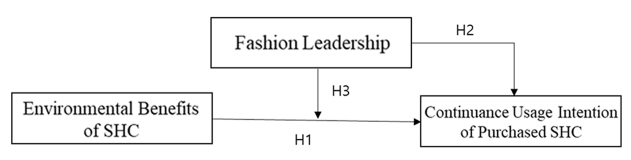
Research model.
H1: The environmental benefits of SHC are positively associated with the continuance usage intention of purchased SHC.
H2: Fashion leadership is positively associated with the continuance usage intention of purchased SHC.
H3: The positive association between environmental benefits and the continuance usage intention of purchased SHC is amplified as a function of the level of fashion leadership.
3.2. Definition of the variables
· The environmental benefits of SHC refer to the benefits that the consumption of SHC gives to the environment, including psychological and practical benefits.
· The continuance usage intention of purchased SHC online refers to an intention to continue using purchased SHC without discarding or resigning it.
· Fashion leadership refers to the characteristics that drive new fashion trends. Fashion leaders are more interested in fashion, search more fashion-related information, try new fashion items more than others, and influence other consumers’ fashion adoption.
3.3. Measurement and analysis
The variables, such as the environmental consumption benefits of SHC purchased online, continuance usage intention, and fashion leadership, were measured. The environmental benefits were measured by three items, including utilitarian and psychological aspects. The measurement items were also adopted from Khan and Mohsin (2017), Choo and Park (2013), and Hartmann and Apaolaza-Ibáñez (2012) with some modifications that suit to the current study. Moreover, the measurement scale of the continuance usage intention of SHC purchased online was adopted and modified for the research of Kim (2018). The research questions measuring fashion leadership were developed from the research of Han (2018) and Gam et al. (2014). All items were also measured on a four-point Likert scale ranging from 1 (strongly disagree) to 4 (strongly agree), excluding the midpoint (neither agree nor disagree).
The responses were statistically tested by confirmatory factor analysis using AMOS 23.0 and hierarchical regression analysis using SPSS 21.0, and the moderating effect was tested using the SPSS PROCESS macro by Hayes.
3.4. Data collection and respondent characteristics
The survey questionnaires were administered in October 2019 by the online research institute to the nationwide sample of men and women between 25 and 39 years old. Only those who replied that they had purchased SHC online within the last one year were asked to complete the questionnaire. In total, 263 questionnaires were included in the final analysis.
Table 1 shows the distribution of the respondents in terms of demographic characteristics. The total number of the respondents was 263, of which 128 (48.7%) were men and 134 (51.3%) were women. Among them, 102 (38.8%) respondents were in their late 20s; 92 (35.0%) were in their early 30s; and 69 (26.2%) were in their late 30s, with an average age of 31.4 years. The respondents’ jobs include 149 (56.7%) office workers, 17 (6.5%) sales and services, 64 (24.4%) professional jobs; 18 (6.8%) students, and 15 (5.7%) others. Eighteen (6.8%) respondents had less than high school education; 5 (4.9%) graduated from college; 214 (81.4%) graduated from a university; and 26 (9.9%) had a master’s degree or higher. In terms of monthly average income, 14 (5.3%) respondents had under 2 million won; 89 (33.8%) had more than 2 million won and less than 4 million won; 75 (28.5%) had less than 4 million won and less than 6 million won; 51 (19.4%) people had more than 8 million won; 22 (8.4%) people had more than 8 million won and less than 10 million won; and 12 (4.6%) people had more than 10 million won.

Demographic characteristics(N = 263)
The purchasing behavior of SC online are follows. In the past year, 101 (38.4%) respondents had 3-4 purchases of SC, 88 (33.5%) of them had 1-2 purchases, 39 (14.8%) of them had 5-6 purchases, and 35 (13.3%) of them made more than 7 purchases. The most recent purchase of SC online was within 1 month for 97 (36.9%) respondents, in 1-6 months for 144 (54.8%) of them, and in 6-12 months for 22 (8.4%) of them. The average expenditure per one purchase was evenly distributed from 10,000won to 100,000 won. Twenty-seven (10.3%) respondents reached over 100,000 won and less than 300,000won, and 10 (3.8%) of them reached over 300,000won.
Purchasing behavior of online SHC
4. Results and discussion
4.1. Validity and reliability of research variables
A confirmatory factor analysis was conducted to assess the discriminant validity of the measures (i.e., environmental consumption value of SHC, continuance usage intention, and fashion leadership). The results of verified confirmatory factor analysis for a measurement model showed an acceptable model fit (χ2 = 53.872 (df = 41, p = 0.086), normed χ2 = 1.314, GFI = 0.963, AGFI = 0.940, CFI = 0.941, RMSEA = 0.035, RMR = 0.027). The standardized factor loading of all the observed variables was 0.67-0.82, of which the estimates were statistically significant at p<.001, meeting the standard of convergent validity (Table 3). The Cronbach alpha of each construct was measured as an estimator of internal consistency reliability, which ranged 0.73-0.86. The composite reliability (CR) was also calculated with structural equation modeling, which ranged 0.94-0.97 (Table 3). In addition, the discriminant validity was verified as all the AVEs were higher than the squared correlations between the constructs (Table 4).
Measurement model results
AVE and squared correlation of constructs
4.2. Hierarchical regression analysis and hypothesis tests
Three-stage hierarchical regression analysis was conducted using SPSS version 23 to investigate the main and moderating effects. In step 1, the environmental benefits (ENVBNF) of SC were included as independent variables, while continuance usage intention (CNTUSG) was a dependent one. Fashion leadership (FSHLDS) was added in step 2, and the interaction term between ENVBNF and FSHLDS was included in the step 3 (Table 5).
Hierarchical regression analysis
The statistic in the Durbin-Watson test of the model was 2.004, close to 2, which allowed the autocorrelation of error to be ignored. The variance inflation factor (VIF) was examined to test multicollinearity among the independent variables. Consequently, the VIF of the independent variables was 1.08, which was less than 10, and the tolerance value was 0.93 which was more than 0.1 and proved the safety of the model in terms of multicollinearity.
In the result of hierarchical regression (Table 5), the fitness and explanatory power of the model increased significantly when the control variable, fashion leadership, was included in step 2. The main effect exhibited that the environmental benefits of SHC (ENVBNF) had a significantly positive effect on continuance usage intention of SHC (CNTUSG). In addition, fashion leadership (FSHLDS) has a significantly positive effect on the continuance usage intention of SHC (CNTUSG). The further improvement of the model was confirmed by adding interaction terms between the independent and control variables in step 3. The regression coefficient of the interaction between ENV and FSHLDS was statistically significant, which verified the moderating effect as significant. Consequently, the effect of environmental consumption value on continuance usage intention depends on the level of fashion leadership (Table 5).
4.3. Conditional process analysis of the moderating effect
The mean centers of the observed variables were analyzed using PROCESS v3.3 by Andrew F. Hayes to verify the significance of the control effect. Accordingly, the moderating effect was significant (Table 6). A positive moderating effect means that the predictive power of ENVBNF (environmental benefits of SHC) on CNTUSG (continuance usage intention of SHC) increases with increasing FSHLDS (fashion leadership). The area of significance was examined by the Johnson-Neyman method to confirm this. While hierarchical regression analysis only reveals the presence of modulatory effects, the Johnson-Neyman method using SPSS Macro specifically calculates confidence intervals, in which moderating variables are significant. For this purpose, simple slopes at the −1 SD, mean, and +1 SD of the moderating variable were calculated. In addition, the variables were mean centered to prevent multicollinearity.
Result of conditional process analysis
Conditional process analysis for the levels (−1 SD, mean, +1 SD)
Table 6 shows the result of simple slope analysis. As a result of examining the effect of ENVBNF on CNTUSG according to the level of FSHLDS, the model of the moderating effect is statistically significant (F = 33.29, p<.000) and has 27.8% explanatory power, as shown in Table 6. Specifically, the moderating effect of FSHLDS was positively significant (t = 1.92, p<.05), and the explanatory power for CNTUSG increased by 1.0% with the input of the interaction term (F = 3.69, p<.05). Therefore, FL has a moderating effect of increasing the effect of ENVBNF on CNTUSG according to its level.
By utilizing the Johnson–Neyman method, the PROCESS model suggests whether the conditional effect of ENVBNF on CNTUSG is significant for each interval of FSHLDS. The conditional effect of ENVBNF on CNTUSG was significant in all the intervals of FSHLDS below average (−1 SD, mean) and above average (+1 SD, mean). Contrarily, the mean center value of the moderator defining the Johnson–Neyman significance region was −1.42 (% below 2.66, % above 97.34). Hence, as the value of FSHLDS increases above 1.17, the effect of ECVBNF on CNTUSG increases as well.
In the graph (Fig. 2), the slope of the regression equation was larger in the above-average group (mean, +1 STD) than in the below-average group (−1 STD, mean). This suggests that ENVBNF has a greater effect on CONUSG in the higher FSHLDS group than in the low group. Therefore, the effect of ENVBNF on CONUSG is better predicted in people with high FSHLDS. Thus, Hypothesis 3 was supported.
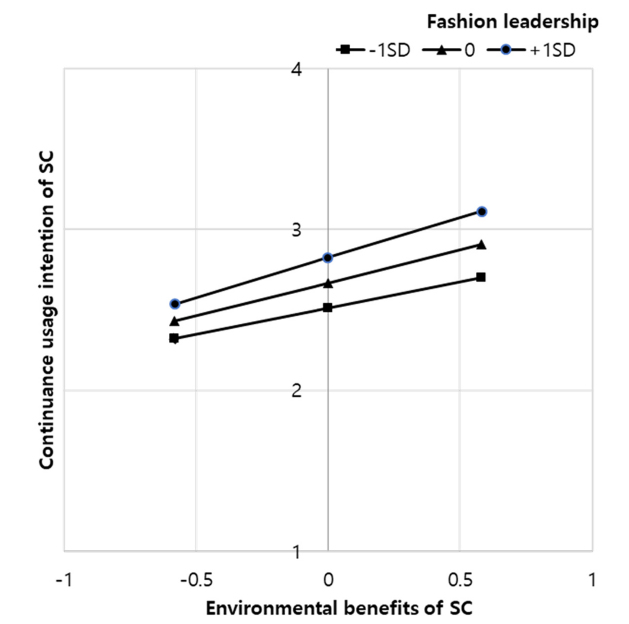
Interaction effect of fashion leadership.
5. Conclusion
This study examined the Millennial consumers to identify the effect of the environmental benefits of SHC on the continuance usage intention of purchased one and the moderating role of fashion leadership. Identifying the reinforcing factors for the continuance usage intention of purchased SHC will bridge the gap between the purchasing and consuming of SHC. Conclusions and implications based on the findings are as follows.
This study demonstrated that fashion leaders in the SHC market with eco-conscious consumerism, today’s cutting-edge issues, can contribute to sustainable fashion. This is especially effective when fashion leaders perceive eco-friendly benefits in SHC consumption. Fashion leaders among millennials who purchase SHC online are more positive on continuance usage, especially when they perceive environmental benefits to be high. It reflects the possibility that fashion leadership promotes the continuance usage of SHC amplified by perceived environmental benefits. Fashion leaders are the ones who lead new fashion trends and consumer behavior. They explore more fashion information and are more influenced by new trends, whether it is a style or a social issue. Today, circular fashion is one of the most widely used terms in the fashion industry, and global trends are gradually transforming business models from fast fashion to sustainable fashion (Khandual & Pradhan, 2019). When circular fashion is spotlighted as a buzzword, fashion leaders who know this move would support brands that are environmentally conscious and produce ethically. Given that fashion leaders act as a source of information, knowing what information they are positive about and disseminate is important. In addition, because millennials with fashion leadership are the significant target of the SHC market, emphasizing green benefits will be effective for boosting sustainability in fashion. The eco-friendly value of the sustainable usage of clothing must be communicated to inspire Millennial consumers with high eco-consciousness. Furthermore, offering specific experiences for millennials on eco-friendly consumption will be effective as they tend to highly value cultural experiences.
Further research must be developed to encompass general fashion leaders because the result of this research is confined to fashion leaders in the SHC market. Additional research is also recommended to include the selling and purchasing of SHC in various distribution channels. Moreover, a holistic model should be developed from the perspective of circular fashion, which encompasses the other values of SHC than environmental ones. While this study targets only the millennials who have experiences in purchasing SHC online, a potential consumer who is not currently a frequent buyer must also be investigated.
Acknowledgments
This work was supported by the research grant of Hansung University.
References
- Amed, I., Balchandani, A., Beltrami, M., Berg, A., Hedrich, S., & Rolkens, F. (2018). The state of fashion 2019: A year of awakening. Mckinsey & Company. Retrieved December 29, 2019, from https://www.mckinsey.com/industries/retail/our-insights/the-state-of-fashion-2019-a-year-of-awakening#
- Botsman, R., & Rogers, R. (September, 2010). What’s mine is yours: The rise of collaborative consumption. Harper Business. Retrieved December 29, 2019, from https://tantor-marketing-assets.s3.amazonaws.com/sellsheets/1920_MinelsYours.pdf
-
Cavender, R. C., & Lee, M. Y. (2018). Exploring the influence of sustainability knowledge and orientation to slow consumption on fashion leaders’ drivers of fast fashion avoidance. American Journal of Theoretical and Applied Business, 4(3), 90-101.
[https://doi.org/10.11648/j.ajtab.20180403.12]

-
Cervellon, M. C., Carey, L., & Harms, T. (2012). Something old, something used: determinants of women’s purchase of vintage fashion vs. second-hand fashion. International Journal of Retail & Distribution Management, 40(12), 956-974.
[https://doi.org/10.1108/09590551211274946]
-
Choo, T. G., & Park, H. H. (2013). The effect of consumption value on attitude and repurchase intention of secondhand fashion goods - The moderating role of self-confidence in fashion coordination. Journal of the Korean Society of Clothing and Textiles, 37(4), 618-630.
[https://doi.org/10.5850/JKSCT.2013.37.4.618]
-
Dehghani, M. (2018). Exploring the motivational factors on continuous usage intention of smartwatches among actual users. Behavior & Information Technology, 37(2), 145-158.
[https://doi.org/10.1080/0144929X.2018.1424246]
-
Ertekin, Z. O., & Atik, D. (2015). Sustainable markets motivating factors, barriers, and remedies for mobilization of slow fashion. Journal of Macromarketing, 35(1), 53-69.
[https://doi.org/10.1177/0276146714535932]
-
Farrant, L., Olsen, S. I., & Wangel, A. (2010). Environmental benefits from reusing clothes. The International Journal of Life Cycle Assessment, 15(7), 726-736.
[https://doi.org/10.1007/s11367-010-0197-y]
-
Ferraro, C., Sands, S., & Brace-Govan, J. (2016). The role of fashionability in second-hand shopping motivations. Journal of Retailing and Consumer Services, 32, 262-268.
[https://doi.org/10.1016/j.jretconser.2016.07.006]
-
Fletcher, K. (2012). Durability, fashion, sustainability - The processes and practices of use. Fashion Practice, 4(2), 221-238.
[https://doi.org/10.2752/175693812X13403765252389]
-
Gam, H. J., Man, Y. J., & Banning, J. (2014). Socially responsible apparel labels - Effects on fashion able shoppers. Family & Consumer Sciences, 42(3), 292-305.
[https://doi.org/10.1111/fcsr.12062]
-
Goldsmith, R. E., Freiden, J. B., & Kilsheimer, J. C. (1993). Social values and female fashion leadership - A cross-cultural study. Psychology & Marketing, 10(5), 399-412.
[https://doi.org/10.1002/mar.4220100504]
-
Guiot, D., & Roux, D. (2010). A second-hand shoppers’ motivation scale: antecedents, consequences, and implications for retailers. Journal of Retailing, 86(4), 355-371.
[https://doi.org/10.1016/j.jretai.2010.08.002]
-
Han, H. J. (2018). Purchasing behavior by female consumers’ benefits of golf wear - Focused on pursued images, fashion innovativeness, fashion involvement, and garment quality evaluation. Journal of Fashion Design, 18(4), 145-161.
[https://doi.org/10.18652/2018.18.4.9]
-
Harasis, A. A., Qureshi, M. I., & Rasli, A. (2018). Development of research continuous usage intention of e-commerce - A systematic review of literature from 2009 to 2015. International Journal of Engineering & Technology, 7, 73-78.
[https://doi.org/10.14419/ijet.v7i2.29.13133]
-
Hartmann, P., & Apaolaza-Ibáñez, V. (2012). Consumer attitude and purchase intention toward green energy brands - The roles of psychological benefits and environmental concern. Journal of Business Research, 65, 1254-1263.
[https://doi.org/10.1016/j.jbusres.2011.11.001]
-
Herjanto, H., Scheller-Sampson, J., & Erickson, E. (2016). The increasing phenomenon of second-hand clothes purchase - Insights from the literature. Journal Manajemen dan Kewirausahaan, 18(1), 1-15.
[https://doi.org/10.9744/jmk.18.1]
- Hill, M. (2019, August 26). The four R’s of fashion - Reduce, reuse, repair, resale. Retrieved December 23, 2019, from https://goodonyou.eco/the-four-rs-of-fashion, /
-
Hong, J. W., Lee, O. K. D., & Suh, W. J. (2013). A study of the continuous usage intention of social software in the context of instant messaging. Online Information Review, 37(5), 692-710.
[https://doi.org/10.1108/OIR-08-2011-0144]
- How to make sustainability sexy. (2017, December 4). Retrieved January 5, 2020, from https://view.iltm.com/2017/12/04/how-to-make-sustainability-sexy, /, Sustainability in the supply chain – is eco sexy? https://adconia.de/en/july-2019-sustainability-in-the-supply-chain-is-eco-sexy/July, 2019
-
Hur, E. S. (2020). Rebirth fashion: Secondhand clothing consumption values and perceived risks. Journal of Cleaner Production, 273(10), 1-16.
[https://doi.org/10.1016/j.jclepro.2020.122951]
-
Isla, V. L. (2013). Investigating second-hand fashion trade and consumption in the Philippines - Expanding existing discourses. Journal of Consumer Culture, 13(3), 221-240.
[https://doi.org/10.1177/1469540513480167]
-
Joung, H. M. (2013). Factors motivating and influencing clothing disposal behaviors. International Journal of Consumer Studies, 37(1), 105-111.
[https://doi.org/10.1111/j.1470-6431.2011.01048.x]
-
Kang, J. Y., & Park-Poaps, H. S. (2010). Hedonic and utilitarian shopping motivations of fashion leadership. Journal of Fashion Marketing and Management, 14(2), 312-328.
[https://doi.org/10.1108/13612021011046138]
-
Khan, S. N., & Mohsin, M. (2017). The power of emotional value: Exploring the effects of values on green product consumer choice behavior. Journal of Cleaner Production, 150(1), 65-74.
[https://doi.org/10.1016/j.jclepro.2017.02.187]
-
Khandual, A., & Pradhan, S. (2019). Fashion brands and consumers approach towards sustainable fashion. Fast Fashion, Fashion Brands and Sustainable Consumption, 37-54.
[https://doi.org/10.1007/978-981-13-1268-7_3]
- Kim, H. (2018). Apparel evaluative criteria determining continuance usage intention - Investigating the role of reflected appraisals for Korean women. International Review of Korean Studies, 15(1), 47-67.
-
Kim, H. S. (2019a). The effect of consumption value of shopping secondhand clothes online on continuance usage intention of purchased items - The moderating effect of gender and age. The Journal of Korean Society of Design culture, 25(4), 91-104.
[https://doi.org/10.18208/ksdc.2019.25.4.91]
- Kim, T. (2019b, August 30). 20 trillion-sized second-hand market “Increase trust”, spreading secure trading platform. Retrieved December 29, 2019, from http://techm.kr/bbs/board.php?bo_table=article&wr_id=6918
- Kubania, J. (2015, July 6). How second-hand clothing donations are creating a dilemma for Kenya. Retrieved December 29, 2019, from https://www.theguardian.com/world/2015/jul/06/second-hand-clothing-donations-kenya
-
Laitala, K. (2014). Consumers’ clothing disposal behavior - A synthesis of research results. International Journal of Consumer Studies, 38, 444-457.
[https://doi.org/10.1111/ijcs.12088]
-
Langa, C., & Armstrong, C. M. (2018). Collaborative consumption: the influence of fashion leadership, need for uniqueness, and materialism on female consumers’ adoption of clothing renting and swapping. Sustainable Production and Consumption, 13, 37-47.
[https://doi.org/10.1016/j.spc.2017.11.005]
-
Lemire, B. (2015). The secondhand clothing trade in Europe and beyond: stages of development and enterprise in a changing material world, c.1600-1850. Textile, 10(2), 144-163.
[https://doi.org/10.2752/175183512X13315695424392]
-
Lin, P., & Huang, Y. (2012). The influence factors on choice behavior regarding green products based on the theory of consumption values. Journal of Cleaner Production, 22(1), 11-18.
[https://doi.org/10.1016/j.jclepro.2011.10.002]
-
Medalla, M. E., Yamagishi, K., Tju, A. M., Tanaid, R. A., Abellana, D. P. M., Caballes, S. A., Jabilles, E. M., Himang, C., Bongo, M., & Ocampo, L. (2020). Modeling the hierarchical structure of secondhand clothing buying behavior antecedents of millennials. Journal of Modelling in Management, 29(4), 1346-1378.
[https://doi.org/10.1108/JM2-08-2019-0207]
-
Mhango, M. W., & Niehm, L. S. (2005). The second-hand clothing distribution channel: Opportunities for retail entrepreneurs in Malawi. Journal of Fashion Marketing and Management, 9(3), 342-356.
[https://doi.org/10.1108/13612020510610462]
- Millennials: generation (car) sharing. (2018, August 29). Retrieved December 30, 2019, from https://www.enel.com/stories/a/2018/08/millennials-sharing-economy.
- Millennials to pursue eco-friendly but expensive, what are their consumption values?. (2019, October 14). Retrieved January 20, 2020, from https://www.mk.co.kr/news/culture/view/2019/10/829410, /
-
Nadanyiova, M., & Das, S. (2020). Millennials as a target segment of socially responsible communication within the business strategy. Littera Scripta, 13(1), 119-134.
[https://doi.org/10.36708/Littera_Scripta2020/1/8]
- Napompech, K., & Kuawiriyapan, S. (2011). Factors influencing the selection of tutoring schools among junior high school students in Thailand. International Journal of Arts & Sciences, 4(16), 347-357.
-
Norris, L. (2012). Trade and transformations of secondhand clothing - Introduction. Textile, 10(2), 128-143.
[https://doi.org/10.2752/175183512X13315695424473]
-
Norum, P., & Norton, M. (2017). Factors affecting consumer acquisition of secondhand clothing in the USA. Journal of Fashion Marketing and Management, 21(2), 206-218.
[https://doi.org/10.1108/JFMM-10-2016-0090]
-
Paras, M. K., Curteza, A., & Varshneya, G. (2019). Identification of best reverse value chain alternatives - A study of Romanian used clothing industry. Journal of Fashion Marketing and Management, 23(3), 396-412.
[https://doi.org/10.1108/JFMM-04-2018-0060]
-
Park, H. J., & Armstrong, C. M. J. (2017). Collaborative apparel consumption in the digital sharing economy - An agenda for academic inquiry. International Journal of Consumer Studies, 41(5), 465-474.
[https://doi.org/10.1111/ijcs.12354]
- ‘Putting the brakes on fast fashion’. (2018, November 12). Retrieved December 29, 2019, from https://www.unenvironment.org/new-sand-stories/story/putting-brakes-fast-fashion
- Roberts-Islam, B. (2019, August 31). Second-hand is the answer to sustainable fashion, says Oxfam. Forbes. Retrieved December 29, 2019, from https://www.forbes.com/sites/brookerobertsislam/2019/08/31/second-hand-is-the-answer-to-sustainable-fashion-says-oxfam/#5701f3d98321
-
Schultz, P., Gouveia, V., Cameron, L., Tankha, G., Schmuk, P., & Franek, M. (2005). Values and their relationship to environmental concern and conservation behavior. Journal of Cross-Cultural Psychology, 36, 457-475.
[https://doi.org/10.1177/0022022105275962]
- Siegle, L. (2019, June 21). Fast fashion is on the rampage, with the UK at the head of the charge. Retrieved December 29, 2019, from https://www.theguardian.com/fashion/2019/jun/21/fast-fashion-is-on-the-rampage-with-uk-at-the-head-of-the-charge
-
Sirilertsuwan, P., Ekwall, D., & Hjelmgren, D. (2018). Proximity manufacturing for enhancing clothing supply chain sustainability. The International Journal of Logistics Management, 29(4), 1346-1378.
[https://doi.org/10.1108/IJLM-09-2017-0233]
-
Sorensen, K., & Jorgensen, J. (2019). Millennial perceptions of fast fashion and second hand clothing: an exploration of clothing preferences using Q methodology. Social Sciences, 8(9), 244.
[https://doi.org/10.3390/socsci8090244]
- Sorokanichb, L. (2019, December 17). By 2023, the secondhand clothes market will double to $51 billion. Here’s why. Retrieved from December 20, 2019, from https://www.fastcompany.com/90430079/by-2023-the-secondhand-clothes-market-will-double-to-51-billion-heres-why
- Supple, M. (2019). How gen Z is boosting sustainable fashion via online resellers. Retrieved January 13, 2020, https://yr.media/news/how-gen-z-is-boosting-sustainable-fashion-via-online-resellers, /
-
Styven, M. E., & Mariani, M. M. (2020). Understanding the intention to buy secondhand clothing on sharing economy platforms - The influence of sustainability, distance from the consumption system, and economic motivations. Psychology & Marketing, 37(5), 724-739.
[https://doi.org/10.1002/mar.21334]
- The new consumerism: redefining ownership, values and priorities. (2016, April 4). Euromonitor Market Research Blog. Retrieved from December 20, 2019, from https://blog.euromonitor.com/the-new-consumerism-redefining-ownership-values-and-priorities, /
- Vrachovska, M. (2019, December 28). 16 Best online thrift stores for secondhand clothing. Retrieved December 27, 2019, from https://www.almostzerowaste.com/secondhand-stores, /
-
Watson, M. Z., & Yan, R. N. (2013). An exploratory study of the decision processes of fast versus slow fashion consumers. Journal of Fashion Marketing and Management, 17(2), 141-159.
[https://doi.org/10.1108/JFMM-02-2011-0045]
-
Xu, Y., Chen, Y., Burman, R., & Zhao, H. (2014). Second hand clothing consumption - A cross cultural comparison between American and Chinese young consumers. International Journal of Consumer Studies, 38(6), 670-677.
[https://doi.org/10.1111/ijcs.12139]
-
Yan, R. N., Bae, S. Y., & Xu, H. (2015). Second-hand clothing shopping among college students - The role of psychographic characteristics. Young Consumers, 16(1), 85-98.
[https://doi.org/10.1108/YC-02-2014-00429]
-
Yang, S., Yiping, S., & Tong, S. (2017). Sustainable retailing in the fashion industry: A systematic literature review. Sustainability, 9(7), 1266.
[https://doi.org/10.3390/su9071266]
- Yoon, K. (2019, May 22). Catch the millennials leading value consumption. Retrieved December 29, 2019, from https://www.jangup.com/news/articleView.html?idxno=75261