
3D프린팅을 이용한 텍스타일 제조 기술동향
© 2018 (by) the authors. This article is an open access article distributed under the terms and conditions of the Creative Commons Attribution license (http://creativecommons.org/licenses/by/3.0/), which permits unrestricted use, distribution, and reproduction in any medium, provided the original work is properly cited.
Abstract
As an application and potential of 3D printing (3DP) accelerates in diverse industries, the use of 3DP is also increasing in the textile and fashion industry. Since the fashion trend is rapidly changing and there are high demands of customized products for customer segments, research on manufacturing of 3DP textiles has become more important. 3DP textiles have different physical and chemical properties depending on a various 3D printing technologies or materials. However, it is difficult to fabricate 3DP textiles that meets demand of garment such as flexibility, wearability, tensile strength and abrasion resistance so that 3DP in fashion industry relatively has a narrow range of applications compared to other industries. The aim of this paper is to provide a trend of research about manufacturing 3DP textiles by analyzing previous studies according to textile’s properties. This paper classifies the five types of 3DP textiles and analyses systematically. First, 3DP textiles blended with existing textiles. Second, 3DP textiles utilizing the structural design of existing textiles. Third, 3DP textiles designed with continuous units. Fourth, 3DP textiles utilizing material properties. Fifth, 3DP textiles based on smart materials. Based on this analysis, future research of manufacturing 3DP textiles needs are identified and discussed.
Keywords:
3D printing, additive manufacturing, 3D printing textiles, textiles키워드:
3D프린팅, 적층가공, 3D프린팅 텍스타일, 섬유1. 서 론
3D프린팅(3D Printing, 이하 3DP)은 3D프린터를 이용한 제조기술로 디지털 설계 데이터(Computer-aided Design·CAD)를 바탕으로 레이어를 연속적으로 적층(Layer-by-layer)하면서 삼차원 제품을 제조하는 신속 조형 기술(Rapid Prototyping·RP)을 의미한다(Ambrosi & Pumera, 2016; Gebhardt, 2012; Gibson et al., 2014). 3DP 공정은 모델링, 프린팅, 후처리의 3단계로 구성된다. 모델링은 디자인 소프트웨어나 삼차원스캐너에 의한 CAD 설계, 프린팅은 삼차원 구조물 제작, 후처리는 서포터 제거, 연마, 염색, 표면재료 증착 등 최종 상품화를 위한 마무리 과정을 각각 의미한다(Ministry of Science and ICT, 2016). 기존의 조형기술은 입체의 재료를 기계적 가공을 통해 자르거나 깎아내는 방식으로 생산하는 절삭가공(Subtractive Manufacturing·SM) 방식이다. 3DP는 기존의 절삭가공과는 반대되는 개념이며, 공식적인 기술 명칭은 적층가공(Additive Manufacturing·AM)이라 한다(Baek, 2015). 따라서 3DP는 제조업을 디지털화하여 새로운 생산방식으로 변화시킬 수 있으므로 미래유망기술 중 하나로 주목 받고 있다. 또한 3DP는 생산, 관리, 소비자 간의 상호적인 연결 체계를 확립하여 최적화를 이뤄내는 4차 산업혁명의 핵심 분야로서 그 중요성이 커지고 있다(Schwab, 2017).
3DP의 장점은 다음과 같다. 첫째, 간소화된 자동화 공정, 폐기물 재활용 능력 및 재고 위험성의 최소화로 규모와 상관없이 고도로 맞춤화된 제품을 경제적으로 만들 수 있다. 둘째, 시제품의 제작 비용 및 시간을 절감할 수 있다. 셋째, 디지털 설계 데이터 기반이기 때문에 제품 복잡도와 상관없이 설계와 수정이 용이하고 속도가 빠르다. 마지막으로 인터넷을 통해 효율적으로 공유할 수 있으므로 디자인, 생산, 소비 및 유통 패러다임의 명확한 경계가 필요하지 않게 된다(Berman, 2012; Chua & Leong, 2017; Petrick & Simpson, 2013). 따라서 3DP는 제조공정상 경제적이고 비즈니스 유연성이 있는 주요한 기술이며(Conner et al., 2014), 기계, 항공·우주, 자동차, 소비재, 전자장치, 의료, 바이오산업 분야 등에서 다양하게 활용되고 있다(MSIT, 2016; Wohlers, 2016).
최초의 3D프린터는 1986년 Charlse W. Hall의 광경화 기술(Stereolithography·SL) 특허출원을 시작으로 다음해 3D Systems에서 상용화되었다. 1900년대 초, Stratasys의 용융 적층방식(Fused Deposition Modeling·FDM)을 포함하여 Cubital의 솔리드 큐어링 방식(Solid Ground Curing·SGC)과 Helisys의 시트 접합 방식(Laminated Object Manufacturing·LOM)이 상업화되었다. 1900년대 중반에는 DTM에 의해 선택적 레이저 소결 방식(Selective Laser Sintering·SLS)과 2000년대에 이르러 Envisiontec에서 디지털 광학 기술 방식(Digital Light Processing·DLP)이 개발되었다(Kruth et al., 1998; Wohlers & Gornet, 2011). 이 밖에도 폴리젯(PolyJet), 직접 에너지 증착(Directed Metal Deposition·DMD)과 같이 매우 다양한 3D프린터 기술이 발전하였다. 재료는 각각의 적층 방식에 따라 다르며 액체, 분말 형태의 합성수지, 세라믹, 금속, 종이, 목재, 식재료 등이 될 수 있다(Kwak & Park, 2013).
3DP의 대중화는 주요 대표기술인 SLA의 특허권이 만료되고, 그 후 FDM, SLS, DMLS(Direct Metal Laser Sintering) 등의 특허 만료됨에 따라 확산되었다. 또한 Adrian Bowyer 교수가 2005년부터 시행한 Reprap(Replication Rapid Prototyping) 오픈 소스(OS) 프로젝트로 인해 3DP를 누구나 제약 없이 사용할 수 있는 환경이 제공되었다. 이는 지속 가능한 기술진보 및 가격인하라는 사회·경제적인 파급적인 효과를 나타냈다(Bowyer, 2014; Kentzer et al., 2011). 3DP의 대중화가 확산됨에 따라 시장의 규모도 점점 성장하고 있는 추세이다. 글로벌 시장조사기관 Wohlers Associates에 따르면 장비, 소재 및 관련 서비스를 포함한 세계 3DP 시장은 연평균 약 30%의 성장률을 통해 2017년 기준 60억 6,300만 달러 산업규모를 보이고 있다. 또한 2021년에는 108억 달러 규모로 고속 성장할 것으로 예측했다(Bourell, 2016; Wohlers, 2017). 국내 시장은 2015년 기준 2,230억원 규모로 성장하였고 2019년도에는 22.9%의 성장률로 5,082억원 규모로 커질 것으로 전망된다(MSIT, 2016). 세계적 IT자문기관 Gartner의 2017 전망보고서에 따르면 향후 수년 안에 글로벌 제조업의 75%가 자동화 3DP 시스템을 활용하여 광범위한 영향력을 끼칠 것으로 예측됨에 따라 더욱 각광받고 있다(Gartner, 2016).
3DP 시장 성장이 가속화되면서 의류산업에서도 제조 및 유통 혁신을 위해 다양한 방법으로 3DP가 적용되기 시작하였다. 인체 삼차원스캐닝 및 패턴 제작을 통한 단발성 3DP 의류 생산, 패션 액세서리, 신발 개발 등 실용화하기 위한 연구가 진행되었다. 그러나 타 산업분야에 비하여 섬유·의류산업에 3DP의 적용 범위는 상대적으로 작다. 이는 기술, 소재 면에서 많은 제약이 따르고 의류 제작에 필요한 유연성, 착용감, 내마모성 등의 기준을 충족시킬만한 텍스타일을 3DP로 제조하기 어렵기 때문이다(Kim, 2015; Lee et al., 2016). 그러나 의류산업은 변화의 속도가 빠르고 소비자 맞춤형 제품에 대한 수요가 다른 산업분야에 비해 높은 시장이므로 3DP에 의한 텍스타일 상업화 연구가 가속화되고 있으며, 그 중요성이 부각되고 있다(Weller et al., 2015). 따라서 본고에서는 최근 섬유·의류산업에서 3DP를 적용한 텍스타일 제조 연구동향을 제시하고자 한다.
2. 3D프린팅(3DP) 기술 개요
2.1. 3DP 공정
3DP는 종래의 절삭가공에서는 불가능했던 복잡한 구조를 가진 제품생산을 가능하게 만들었다. 3DP를 효과적으로 적용하기 위해서는 다양한 재료 및 적층 방식 기술에 적합한 삼차원 디자인과의 융합을 고려해야 한다. 3DP 공정은 일반적으로 모델링, 프린팅, 후처리로 구성된다. 이를 세분화하면 CAD 설계, STL(Stereolithography Language) 혹은 AMF(Additive Manufacturing File)로의 변환, 3D프린터 시스템으로 파일 전송, 3D프린터 기계 설정, 인쇄, 서포트 제거 및 정리, 후처리, 적용의 8단계로 나타낼 수 있다(Gibson et al., 2014; Mellor et al., 2014).
3DP는 AutoDesk, AutoCAD, SolidWorks, Creo Parametric, Rhino와 같은 CAD 소프트웨어를 이용하여 PC상에서 3차원 제품을 디자인하는 모델링으로 시작한다. CAD로 제작된 모델은 수많은 횡단면의 레이어로 나누어져 STL 또는 AMF형식의 디지털 데이터로 저장된다. 이 과정은 디자인과 생산된 제품간의 정밀성이 떨어지는 원인이 될 수 있으므로 디자인의 x, y, z-축 치수와 모델링 표면에서 작은 삼각형태로의 법선 벡터 변환 조정이 필수적이다(Gross et al., 2014; Wong & Hernandez, 2012). 3D프린터는 기술에 따라 다양한 출력조건을 설정할 수 있는데 일반적으로 채우기, 레이어 높이, 출력속도, 여유시간 속도 및 출력온도를 조절하여 형태와 물성을 다르게 제조할 수 있다(Lee, 2015). 특히, SLA 방식의 경우 Laser의 세기와 속도 등의 조건을 다르게 하여 제품의 정밀도와 인장강도를 조절 할 수 있다(Lee & Lee, 2017). 3D프린터 시스템 상의 설정이 끝나면 다양한 형태의 재료를 분사 및 경화 과정을 통해 레이어를 연속적으로 형성하면서 제품을 제조하는 실질적 프린팅 과정을 거친다(Campbell et al., 2011; Dizon et al., 2017). 후처리는 필요에 따라 적용하며 서포터 제거, 연마, 염색, 표면 재료 증착 등 최종 상품화를 위한 마무리 과정을 나타낸다(MSIT, 2016).
2.2. 3DP 재료
3DP는 20년이 넘는 기간 동안 원료가공으로서 사용되었으나 다양한 상태의 재료와 환경 친화적인 성질을 가진 재료의 합성이 개발됨에 따라 제조업에서 혁신적인 기술로 부상하기 시작했다(Campbell et al., 2011; Frazier, 2014). 3DP 기술은 일반적으로 액체, 고체 및 분말과 같은 다양한 상태의 합성수지, 플라스틱, 금속, 세라믹, 유리, 종이, 목재, 식재료 등을 활용하여 제조한다(Kwak & Park, 2013; Vanderploeg et al., 2017). 플라스틱의 경우 열가소성을 띈 물질을 사용하고, 금속은 강, 알루미늄, 청동, 티타늄 등이 있으며 세라믹에는 SiO2, TiO2 등이 포함된다(Campbell et al., 2011). 최근에는 3DP에 사용되는 기존 재료가 가진 한계점을 극복하기 위하여 재료 다양성, 구성물질, 강도 및 후처리 등을 고려한 복합재료를 새롭게 개발하고자 하는 연구가 활발하게 진행되고 있다(Gross et al., 2014). 대표적으로 탄소 나노 튜브(CNTs), 나노 와이어(NW), 금속 나노 입자(NP) 등과 같은 나노물질은 독특한 광학적, 전기 및 화학적 특성을 갖고 있다(Campbell et al., 2011). 또한 바이오플로팅(Bioplotting) 재료로 PLGA, TCP, 콜라겐, 키토산, 대두 단백질, 젤라틴 등에 주목하여 3DP 재료로서의 잠재력을 이끌어 내었다(Chia & Wu, 2015). 이러한 재료 개발은 기존 3DP를 보완하고 각 산업 분야에 넓게 적용될 수 있는 기회를 제공하며 새로운 관점으로써 적층가공에 접근할 수 있게 한다.
의류제작을 위해 주로 사용되는 3DP 재료는 PLA(Polylactic Acid), TPU(Thermal Polyurethane), Bendlay 등이 있다. PLA와 TPU는 유연성, 내식성, 마모 정도가 우수한 열가소성 플라스틱에 속하며 Bendlay는 Orbi-Tech에서 제조한 ABS(Acrylonitrile Butadiene Styrene)이다(Lee & Hong, 2016). 최근 연구에 따르면 재료 개발이 계속됨에 따라 천연 및 합성섬유 자체를 3DP 재료로써 활용될 수 있음이 보여지고 있다(Rosenau & Wilson, 2014; Vanderploeg et al., 2017). 면, 레이온, 가죽, 나일론, 폴리우레탄, 테프론, 폴리아미드와 같은 섬유를 활용한 예가 대표적이다(Abidi & Hu, 2016; Kietzmann et al., 2015; Vanderploeg et al., 2017).
2.3. 3DP 기술 분류
Table 1은 3DP 기술 개요를 나타낸다. 3DP 공정의 공통점은 재료를 적층하여 삼차원 제품을 출력하는 것이다. 따라서 적층하는 방식에 따라 Table 1과 같이 8개의 공정으로 분류할 수 있다. 섬유·의류산업에서는 FDM, SLS 기술이 가장 많이 이용되고 있으며, 그 밖에 SLA, PolyJet, Binder Jetting 등의 기술이 있다(Vanderploeg et al., 2017).

Summary of 3D printing technology (Baek, 2015; Kwak & Park, 2013)
2.4. 3D프린팅 텍스타일 연구 동향
패션 브랜드에서는 3DP를 활용한 소비자 맞춤형 제품을 제작하여 상업화 시키고자 하는 기술들이 개발되고 있으며, 개인 패션 디자이너들도 또한 기존에 볼 수 없었던 독특한 디자인들을 선보이고 있다. 특히 오트쿠틔르 컬렉션과 시제품 제작에 3DP를 적용시키는 것을 시작으로 혁신적인 디자인이 제시되고 있다. 그러나 이는 오랜 제작시간, 고비용과 같은 기술적 한계로 인하여 단발성에 그치거나, 예술적 작품에 더 가깝기 때문에 실용화 및 대중화되기에는 한계가 있었다. 최근에는 이러한 한계를 보완하기 위해서 3D프린터 및 재료 개발과 기존의 직물과 같이 유연한 디자인을 적용시키고자 하는 3DP 텍스타일 제조 연구가 활발히 진행되고 있다(Vanderploeg et al., 2017).
3DP 텍스타일 제조에 있어서 중점적으로 고려해야 할 물성은 유연성이다. 또한 3DP 텍스타일은 드레이프성, 인장강도, 내마모성 등과 같은 의류소재에 기본적으로 요구되는 특성도 만족시켜야 한다(Lussenburg et al., 2014). 3DP 텍스타일에 관한 선행 연구들을 분석한 결과, 본고에서는 3DP 텍스타일은 다섯 범주로 분류하고자 한다. 첫째, 기존 섬유와 융합한 3DP 텍스타일, 둘째, 기존 섬유의 구조적 디자인을 활용한 3DP 텍스타일, 셋째, 디자인 단위가 연속적으로 결합된 3DP 텍스타일, 넷째, 재료 물성을 활용한 3DP 텍스타일, 다섯째, 스마트 재료 기반의 3DP 텍스타일이다.
3.1. 기존 섬유와 융합한 3DP 텍스타일
기존 섬유와 융합한 3DP 텍스타일은 기존 섬유의 일정부분에 3DP로 제조된 텍스타일을 연결시키거나 섬유 위에 직접적으로 인쇄한 텍스타일을 의미한다. 3DP를 부분적으로 섬유에 적용시킬 경우, 일반적인 의류소재가 가진 인장강도 및 유연성과 같은 특성을 기반으로 다양한 삼차원 디자인을 선보일 수 있다는 장점이 있다.
Niederrhein 응용 과학 대학에서는 나일론 파우더를 소결하는 방식을 활용하여 편성물과 결합된 3DP 텍스타일을 선보였다(Fig. 1(a), (b)). SLS 방식을 적용시켰기 때문에 고해상도와 의류의 수준과 비슷한 수준의 유연성 및 섬세함을 가진 것이 특징이다(Alec, 2014). 그러나 SLS 방식은 고비용 문제로 일반 소비자들이 접근하기에 어려움이 많기 때문에 보급형 FDM으로 텍스타일을 제조한 선행연구가 많다. FDM 3D프린터는 면, 양모, 비스코스 레이온, 폴리에스터 등 기존 섬유 위에 직접적으로 인쇄할 수 있다(Fig. 1(c))(Sabantina et al., 2015). 또한 다양한 폴리머 중 PLA를 재료로 사용할 경우, 원단에 인쇄했을 때 접착력, 뒤틀림, 품질, 굴곡 면에서 가장 좋은 결과를 얻을 수 있다(Pei et al., 2015). 3D systems 회사는 3DP, 패션, IT기술을 융합하여 3DP 텍스타일의 상용화에 앞장섰다. 개인 소비자는 Fabricate 어플리케이션을 연동하여 기존 섬유 위에 3D 인쇄하는 방식으로 자신만의 독특한 의류를 제작하는 것이 가능해졌다(Fig. 1(e), (f))(Doris, 2015).
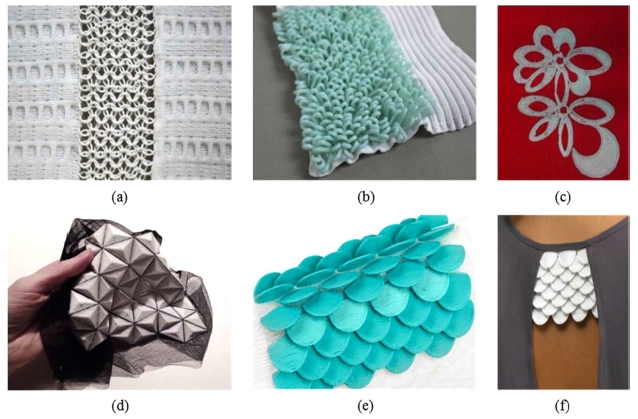
3DP textiles blended with existing textiles. (a) SLS 3DP textile structures linking with fabric. (Alec, 2014); (b) SLS 3DP on fabric. (Alec, 2014); (c) FDM 3DP on wool. (Sabantina et al., 2015); (d) FDM 3DP on polyester net. (Rosenqvist, 2016); (e) FDM 3DP on fabric. (Doris, 2015); (f) FDM 3DP textile linking with fabric. (Doris, 2015).
3.2. 기존 섬유의 구조적 디자인을 활용한 3DP 텍스타일
기존 섬유의 구조적 디자인을 활용한 3DP 텍스타일은 기존의 직물이나 편성물의 구조적 디자인 형태를 반영하여 제조한 텍스타일을 의미한다. 이는 각각의 구조적 특성을 얻음과 동시에 소비자가 섬유로 빠르게 인식할 수 있다는 이점이 있다. 평직의 경우 교차점이 가장 많아 짜임새가 우수하다. 편성물의 경우 루프의 연결에 의해 이루어지므로 신축성 및 함기성과 같은 특성을 지닐 수 있게 한다.
Fig. 1(a)와 (b)처럼 평직 형태로 디자인된 3DP 텍스타일의 경우 모델링의 복잡성을 줄이기 위해 실의 두께, 단면의 형태, 위사와 경사의 간격 등을 기준으로 다양한 샘플이 제조되었다. 선행연구에 의하면 FDM 3D프린터로 ABS를 재료로 하여 출력한 결과 경사와 위사 사이에 공간을 두어 안정적이고 내구성이 뛰어난 3DP 텍스타일을 제조할 수 있고, 출력물이 직물의 특성을 지닐 수 있다는 결과를 도출하였다. 특히 ABS의 경우 경량이면서 내구성이 강한 고분자이기 때문에 안정적인 강도를 나타낸다. 그러나 FDM 공정상 열가소성 필라멘트를 노즐로부터 고온에서 용융시키는 과정이 필수적이다. 따라서 구조적 특징상 교차점에서 앞서 경화된 부분이 다시 용융될 수 있기 때문에 작은 치수로는 출력할 수 없다는 단점이 있다(Lee et al., 2016; Partsch et al., 2015).
편성물의 구조적 형태를 반영한 3DP 텍스타일은 FDM 및 SLS 방식으로 제조되었다. FDM으로 제조할 경우 얇은 원사를 겹쳐서 출력하여 두꺼운 원사를 안정적으로 얻을 수 있다는 결과를 도출하였다(Lee et al., 2016). FDM은 BendLay, soft PLA를 재료로 하여 편성물 구조를 재현할 수 있으나 재료 특성상 유연성이 상대적으로 떨어지고, 미세한 구조로는 출력하기 어렵다(Fig. 2(c))(Melnikova et al., 2014). 반면 편성물 구조를 가진 텍스타일을 SLS으로 제조할 경우 나일론 분말(Nylon PA12)을 재료로 사용하며 유연성, 강도, 신축성 및 해상도 면에서 FDM보다 우수하였다. 또한, SLS 방식은 분말을 정밀하게 소결하여 입체적인 구조가 돋보이고 다양한 두께를 가진 텍스타일을 인쇄 가능하다는 장점이 있다. 그러나 SLS로 제조된 편성물의 원사가 얇을수록 루프 구조가 압력에 의해 부서질 수 있으므로 주의해야 한다(Fig. 2(d)~(f))(Beecroft, 2016; Melnikova et al., 2014). 이와 같이 기존 섬유 구조를 3DP로 재현시킴으로써 패션 디자인의 새로운 가능성을 제시하였다는 것에 의의가 있다.
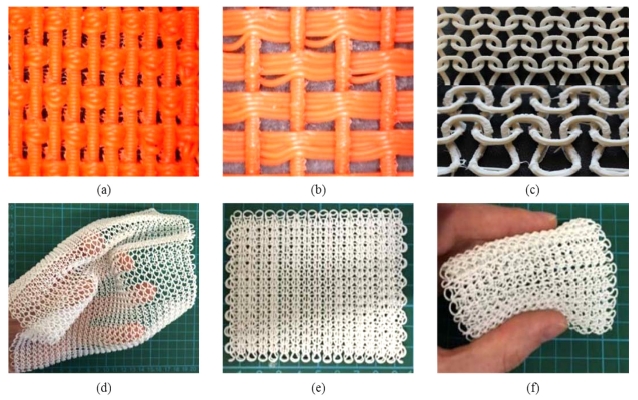
3DP textiles utilizing the structural design of existing textiles. (a) Plain weave FDM 3DP textile 1. (Partsch et al., 2015); (b) Plain weave FDM 3DP textile 2. (Partsch et al., 2015); (c) Weft knitted SLS 3DP textile (upper) & FDM 3DP textile(lower). (Melnikova et al., 2014); (d) Flexibility of weft knitted FDM 3DP textile. (Beecroft, 2016); (e) Interlock FDM 3DP textile. (Beecroft, 2016); (f) Flexibility of Interlock FDM 3DP textile. (Beecroft, 2016).
3.3. 디자인 단위가 연속적으로 결합된 3DP 텍스타일
디자인 단위가 연속적으로 결합된 3DP 텍스타일은 3DP 재료에 관계없이 적절한 구조적 특성을 고려하여 하나의 디자인 단위가 연결되면서 유연한 결합체를 이루는 텍스타일을 의미한다. 이 방법은 3DP 텍스타일 제조 연구 동향 중 가장 활발하게 진행되고 있는 범주이고, 크게 두 가지 형태로 나타난다. 첫째, 접합 부분까지 유기적으로 디자인한 형태, 둘째, 고대 유럽의 갑옷으로부터 유래한 체인메일(Chain mail) 형태가 있다. 대부분의 선행연구는 두 번째 방법으로 제조하였다.
Fig. 3은 접합부분까지 유기적으로 연결되도록 제조된 3DP 텍스타일을 나타낸다. 이 방법은 신체에 유연하게 맞는 웨어러블 제품을 제조할 수 있다는 장점이 있다. Fig. 3(a)와 (b)는 Nervous System에서 2013년부터 진행해 온 키네마틱 프로젝트의 텍스타일로 SLS 방식을 활용한 예이다. 2016년에 개발된 키네마틱 드레스의 경우 고유 디자인 단위로 구성된 3DP 텍스타일로 이루어져 있다. 각각의 디자인 단위 자체는 단단한 물성을 가지고 있으나 접합 부분을 유기적으로 연결시키는 디자인을 통해 전체적으로 유연한 구조를 가진 결합체로써의 움직임이 가능하다. 또한 이러한 구조적 특징 덕분에 텍스타일이 접힌 상태로 출력할 수 있어 효율적이다. 이는 기존 3DP 출력시간을 단축시킴과 동시에 고정된 3D프린터 크기에 의한 한계를 개선하였다. 그러나 고가의 장비가 필수적으로 필요하다는 단점이 존재한다(Nervous System, 2016).
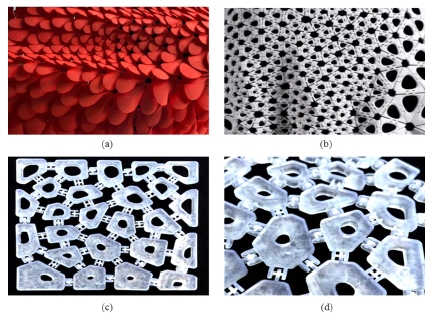
DP textiles that the joints is designed organically. (a) Kinematics petals SLS 3DP textile. (Nervous System, 2016), (b) Kinematics SLS 3DP textile. (Nervous System, 2016), (c) Assembly SLA 3DP textile. (Formlabs, 2016), (d) Details of (c). (Formlabs, 2016).
Fig. 3(c)는 MIT는 Design Objects and Interaction 프로젝트를 통해서 SLA 방식과 Clear Resin 재료를 활용한 3DP 텍스타일로, 세포의 구조와 유사한 섬유 패턴을 생성하는 알고리즘을 적용시켜 기하학적인 기본 섬유 단위와 접합 부분을 디자인하였다. 이는 유기적인 움직임이 가능한 웨어러블 제품이며 두께에 따라 내구성과 강도는 다르게 나타났다(Formlabs, 2016).
Fig. 4는 체인메일 형태로 제조된 3DP 텍스타일을 나타낸다. 결합체를 구성하는 하나의 디자인 단위는 가장 단순한 원, 삼각형과 같은 기하학적 구조를 포함하여 복잡한 삼차원 형태까지 다양하다. 체인메일과 같은 구조는 느슨하고 제약이 없기 때문에 조밀한 정도를 조절할 수 있으며 이러한 구조적 특징은 기존의 섬유와 유사하게 가볍고 유연하나 움직임에 따라 소리가 날 수 있다.
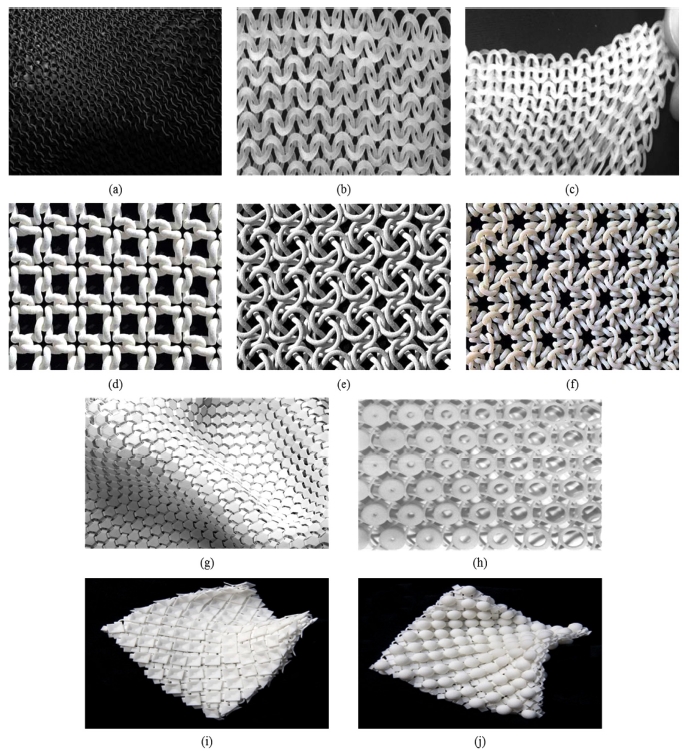
Chainmail-like 3DP textiles. (a) Kinematics triangle textile. (Nervous System, 2017), (b) Chainmail-like 3DP textile 1. (Lee & Jin, 2017), (c) Flexibility of (b). (Lee & Jin, 2017), (d) Chainmail-like 3DP textile 2. (Kalantar & Borhani, 2014), (e) Chainmail-like 3DP textile 3. (Kalantar & Borhani, 2014), (f) Chainmail-like 3DP textile 4. (Kalantar & Borhani, 2014), (g) Chainmail-like 3DP textile 5. (Scott, 2014); (h) Chainmail-like 3DP textile 6. (Scott, 2014), (i) Chainmail-like 3DP textile 7. (Digits2widgets, 2015), (j) Chainmail-like 3DP textile 8. (Digits2widgets, 2015).
단순 기하 구조를 응용하여 체인메일 형태로 제조된 3DP 텍스타일 중 상품화된 대표적인 예로 SLS으로 제조된 Kinematics triangle textile(Fig. 4(a)) 드레스와 Janne Kyttanen 디자이너의 4 in 1 드레스가 있다(Kuhn & Minuzzi, 2015; Kyttanen, 2017; Nervous System, 2017). 단순 기하를 바탕으로 설계된 Fig. 4(b)는 의류산업에서 드물게 사용되는 DLP 방식의 프린터로 제조하였다. 이를 통해 DLP방식은 FDM방식과 달리 ABS resin을 재료로 하고, 출력속도 및 표면조도 등 상품화 요건에 대한 비교 우위가 있음이 증명되었다(Lee & Jin, 2017).
Negar Kalantar와 Alireza Borhani 디자이너는 SLS와 FDM 3D 프린터를 이용하여 복잡한 삼차원의 디자인 단위가 체인메일 형태로 결합된 3DP 텍스타일의 구조적 연구를 진행했다. 이들은 텍스타일의 유연성과 강도를 모두 갖추기 위하여 기본 단위체들 간에 접합이 되어 있지는 않으나 연속적으로 간섭되어 있다. Fig. 4(d)~(f)와 같이 기본 단위는 뫼비우스의 띠를 연상시키는 삼차원 기하학 형태가 주를 이루고, 출력된 텍스타일은 구조적으로 유연하여 기존 섬유를 대체할 수 있는 잠재력을 지니고 있다(Kalantar & Borhani, 2014). Bradley Rothenberg 디자이너는 SLS를 이용하여 텍스타일을 구성하고 있는 기본 단위의 디자인은 유지하되 일부는 얇게 하거나 두껍게 함으로써 각 부분의 유연성과 착용감을 다르게 나타냈다(Fig. 4(g), (h))(Scott, 2014).
Digits2widgets 회사는 재료가 아닌 텍스타일의 구조적 디자인 변화를 통하여 유연성을 구현하였다. 체인메일의 형태를 바탕으로 기본 기하학 패턴을 설계하고 결합시켜 3DP 텍스타일이 유동적이고, 움직임에 따라 외형이 변하며 소리까지 만드는 새로운 소재로써 가능성이 있음을 나타냈다(Fig. 4(i), (j))(Digits2widgets, 2015). Johnson et al.(2013)의 연구에 따르면 체인메일의 형태로 제조된 3DP 텍스타일에 압력에 의한 저항 정도를 측정한 결과, 견고한 연결 구조로 인하여 좁은 면적으로 가하는 압력에도 영향을 거의 받지 않아 기존 섬유를 대체할 수 있음을 증명하였다(Johnson et al., 2013). 그러나 대부분의 선행연구에서 제조된 3DP 텍스타일은 유연성, 인장강도와 같은 물리적 특성을 주관적 평가로 진행되었다는 한계점이 있다.
3.4. 재료 물성을 활용한 3DP 텍스타일
재료 물성을 활용한 3DP 텍스타일은 재료 개발이 가속화됨에 따라 soft PLA, 열가소성 엘라스토머, 폴리우레탄 분말 등과 같이 유연한 3DP 재료를 사용하여 섬유로써 요구되는 특성을 나타낸 텍스타일을 의미한다. 주로 얇은 단일막의 형태와 간단한 기하학 무늬를 기반으로 설계된 단일 구조로 나뉜다. 즉, 재료의 물성만으로 유연성, 인장강도 등의 특성을 만족시키기 때문에 디자인 단위가 연속적으로 결합된 3DP 텍스타일과는 달리 상대적으로 단순하게 디자인되었다는 것이 특징이다.
Lussenburg의 선행연구에 따르면 의류를 위한 3DP 텍스타일을 제조하기 위해서는 재료가 가진 고유한 물성을 바탕으로 재료의 화학적 특성, 텍스타일 구조, 적층 방식에 따른 3DP 공정이 가진 각각의 개별적인 측면과 서로 영향을 미치는 양상에 대한 전반적인 이해가 필수적이다. Polyjet 방식을 이용할 경우 아크릴을 재료로 하여 부드러운 표면감을 가진 얇은 막 형태의 텍스타일을 제조할 수 있고(Fig. 5(a), (b)), 셀룰로오스와 같은 재료를 사용한다면 더 부드러운 외부 표면감을 가질 수 있다.
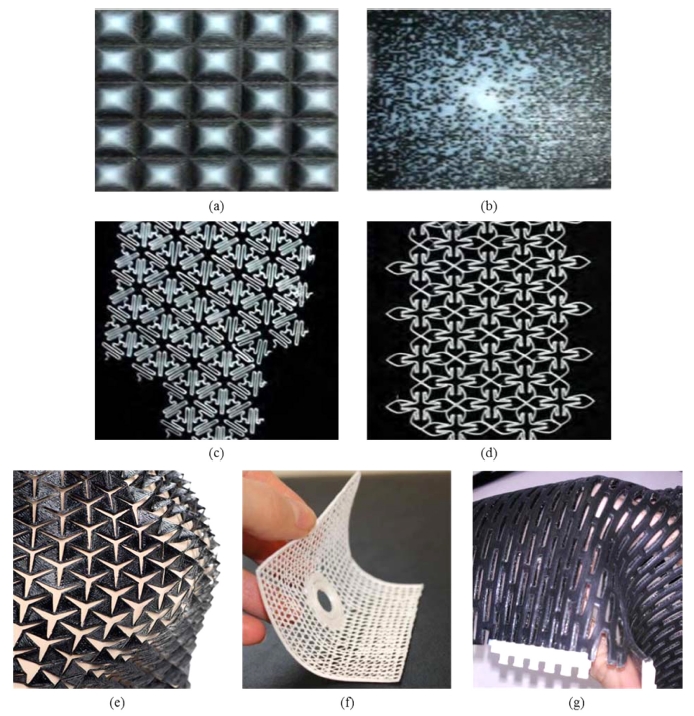
Flexible material-based 3DP textiles. (a) Sheet-like 3DP textile 1. (Lussenburg, 2014), (b) Sheet-like 3DP textile 2. (Lussenburg, 2014), (c) Thinstructure 3DP textile 1. (Lussenburg, 2014), (d) Thin-structure 3DP textile 2. (Lussenburg, 2014), (e) Thin-structure 3DP textile 3. (Millsaps, 2017), (f) Thin-structure 3DP textile 4. (Melnikova et al., 2014), (g) Thin-structure 3DP textile 5. (Mikkonen et al., 2013).
보급형 FDM 방식의 경우 속도, 경제성, 넓은 표면적 등의 장점을 지니고 있고 일반적으로 PLA를 3DP 재료로 사용한다. PLA는 열변형에 의한 수축이 적어 정밀하게 출력이 가능하지만 내구성이 약하고 표면이 매끄럽지 못하다는 단점이 있다. 따라서 Fig. 5(c) 및 (d)와 같이 간단한 기하학 혹은 스프링 무늬를 기반으로 디자인된 얇은 단일 구조로 출력하면 재료 특성으로 인한 한계점을 개선할 수 있다(Lussenburg et al., 2014; Lussenburg, 2014). Fig. 5(e)는 Mora-Sanchez 디자이너가 FDM 방식과 열가소성 폴리우레탄을 재료로 활용한 예이다. 폴리우레탄은 탄성, 저항, 전단강도가 우수하다. 이는 프린터의 적층 방식과 재료의 개별적 이해를 바탕으로 디자인하였기 때문에 신체의 움직임에 따라 패턴의 확장과 축소가 자연스럽게 일어나고, 각 개별 공정이 가진 이점을 극대화시켰다(Millsaps, 2017). 유연성을 지닌 재료로 텍스타일을 제조할 경우 Fig. 5(f)와 (g)처럼 복잡한 삼차원 디자인 단위가 필요하지 않기 때문에 쉽게 기존 섬유와 같은 범주로 인식할 수 있다. 이는 패턴 및 기능성 의류 제작에 접근하기가 쉬워진다는 이점을 나타낸다(Melnikova et al., 2014; Mikkonen et al., 2013).
3.5. 스마트 재료 기반의 3DP 텍스타일
스마트 재료 기반의 3DP 텍스타일은 생분해성, 열전도성, 전도성과 같은 특수기능을 지니게 만들어 스마트 의류의 기반이 되는 텍스타일을 의미한다. 최근 주목받고 있는 4D프린팅도 이 범주에 포함된다. 4D프린팅이란 3D프린터로 출력된 제품이 외부 자극이나 시간의 흐름에 따라 형상 또는 특성이 자가변형되는 것을 의미한다(Khoo et al., 2015).
최근 각광받는 섬유 연구 분야 중 하나로 스마트 소재 개발을 통하여 생분해성, 열전도성, 전도성과 같은 특수기능을 지니게 만들어 스마트 의류의 기반이 되는 3DP 텍스타일 제조가 있다. Tamicare의 Cosyflex가 그 대표적인 예로 산업용 3DP 기술을 개발하여 광범위한 자동화 공정 시스템을 구축하였다.이를 통해 제조업체는 환경오염의 원인이 되는 화학적 공정을 간소화하여 공정 시간을 단축시킬 수 있게 되었다. 또한 천연라텍스, 실리콘, 폴리우레탄 및 테프론과 같은 다양한 유형의 액체 고분자를 포함하여 면, 비스코스 및 폴리아미드와 같은 다양한 섬유 및 생분해성 소재를 재료로 사용할 수 있다. Cosyflex로 제작된 3DP 텍스타일은 뛰어난 유연성, 신축성, 회복력, 드레이프성을 가지고 있다. 레이어 별로 재료를 다르게 구성하는 방식이므로 제조 과정에서 센서, 전자기기 및 기타 스마트 소재를 의류에 직접적으로 인쇄 할 수 있다(Harper, 2016; Scott, 2015).
Tingting et al.(2017)의 연구에 따르면 질화붕소(BN)와 Polyvinyl Alcohol(PVA)로 구성된 나노 섬유 복합체를 재료로 하여 제조한 3DP 텍스타일은 열전도성이 높은 특성을 가진다는 결과를 도출해냈다(Fig. 6(c)). BN/PVA 복합체는 섬유 제조과정에서 균일하게 정렬되기 때문에 높은 기계적 강도와 고르게 열 분산이 될 수 있도록 결합된다. 따라서 스마트 3DP 텍스타일은 일반 면직물보다 2배 이상의 열전도성을 나타내므로 열을 빠르게 통과하게 하여 착용자를 시원하게 유지시킬 수 있다(Tingting et al., 2017). 3D프린터를 활용하여 텍스타일의 디자인적 요소뿐만 아니라 특수한 기능을 동시에 출력할 수 있는 4D프린팅도 주목 받고 있는 연구 중 하나이다. 대표적인 예로 Fig. 6(d)와 같은 Space textile이 있다. 이 3DP 텍스타일은 외부 자극인 빛이나 열에 반응하여 반사하거나 열의 양을 제어할 수 있는 자가변형 기능이 있다. 체인메일과 유사한 디자인적 구조를 가지고 있기 때문에 유연하게 여러 가지 형태로 접을 수 있으며 인장강도 또한 우수하다. 일반적인 3DP 텍스타일과 달리 특수한 기능도 함께 출력된다는 이점이 있으므로 잠재적인 스마트 의류 용도와 더불어 다양한 분야에서의 기대효과가 크다(Landau, 2017).
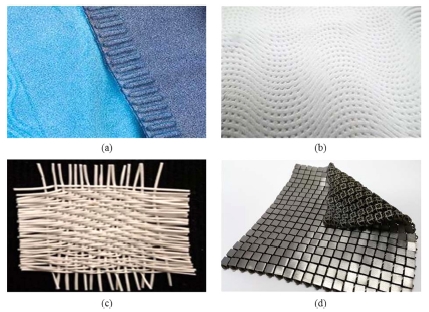
Smart material-based 3DP textiles. (a) Cosyflex 3DP textile. (Scott, 2015), (b) Cosyflex 3DP textile with embossed pattern. (Scott, 2015), (c) BN/Polyvinyl Alcohol 3DP textile. (Tingting et al., 2017), (d) Metallic space 3DP textile. (Landau, 2017).
4. 결 론
3DP의 활용은 제조업을 디지털화하여 기술집약형 산업화가 가능하도록 하는 대안기술로써 그 성장 잠재력은 무궁하다. 특히 3DP는 섬유·의류산업에서 설계, 개발, 제작 및 유통 패러다임의 혁신으로 급변하는 트렌드를 효율적으로 수용할 수 있게 한다. 3DP 특성상 적층 방식과 재료에 따라 특유의 물성이 다르게 나타나므로 그 적용 범위가 확대되었고, 삼차원 형태의 의류 제작이 가능해짐에 따라 패션분야에서는 새로운 시각적 디자인 효과를 얻게 되었다. 본고에서는 3DP 텍스타일을 의류소재로 대체하기 위해 유연성, 강도, 촉감, 내구성 등을 보완할 수 있는 관련 제조 연구 기술을 다섯 범주로 분류하였다. 따라서 본고의 분석결과를 통해 향후 3DP 텍스타일 제조 연구의 영역 확대 및 섬유·의류 산업에의 적용에 기초 자료로써 활용이 기대된다.
References
- Abidi, N., & Hu, Y., (2016), Cotton fiber dissolution and regeneration and 3d printing of cellulose based conductive composites. USPTO(US20170140848 A1).
- Alec, (2014, November, 9).), English researchers use 3D printing to produce flexible and fine textile-like structures, Retrieved January 11, 2018, from http://www.3ders.org/articles/20141109-english-researchers-use-3d-printing-to-produce-flexible-and-fine-textile-like-structures.html.
-
Ambrosi, A., & Pumera, M., (2016), 3D-printing technologies for electrochemical applications, Chemical Society Reviews, 45(10), p2740-2755.
[https://doi.org/10.1039/C5CS00714C]

- Baek, S., (2015), 3D 프린팅의 다양한 신공정 기술 및 특징 소개 [Introduction of 3D printingtechnology & applications], KIC News, 18(1), p2-10.
-
Beecroft, M., (2016), 3D printing of weft knitted textile based structures by selective laser sintering of nylon powder, IOP Conference Series: Materials Science and Engineering, 137, p012017.
[https://doi.org/10.1088/1757-899X/335/1/012101]
-
Berman, B., (2012), 3D printing: The new industrial revolution, Business Horizons, 55(2), p155-162.
[https://doi.org/10.1016/j.bushor.2011.11.003]
-
Bourell, D. L., (2016), Perspectives on additive manufacturing, Annual Review of Materials Research, 46, p1-18.
[https://doi.org/10.1146/annurevatsci-070115-031606]
-
Bowyer, A., (2014), 3D printing and humanity's first imperfect replicator, 3D Printing and Additive Manufacturing, 1(1), p4-5.
[https://doi.org/10.1089/3dp.2013.0003]
- Campbell, T., Williams, C., Ivanova, O., & Garrett, B., (2011), Could 3D printing change the world, Technologies, Potential, and Implications of Additive Manufacturing, Atlantic Council, Washington, DC.
-
Chia, H. N., & Wu, B. M., (2015), Recent advances in 3D printing of biomaterials, Journal of Biological Engineering, 9(1), p4.
[https://doi.org/10.1186/s13036-015-0001-4]
- Chua, C. K., & Leong, K. F., (2017), 3D Printing and Additive Manufacturing : Principles and Applications (The 5th edition of rapid prototyping : principles and applications ed.), Singapore, World Scientific.
-
Conner, B. P., Manogharan, G. P., Martof, A. N., Rodomsky, L. M., Rodomsky, C. M., Jordan, D. C., & Limperos, J. W., (2014), Making sense of 3-D printing: Creating a map of additive manufacturing products and services, Additive Manufacturing, 1, p64-76.
[https://doi.org/10.1016/j.addma.2014.08.005]
- Digits2widgets, (2015, January, 5), Flexible nylon SLS "Fabrics" by D2W, Retrieved January 05, 2018, from https://www.digits2widgets.com/3d-printing-portfolio/nylon-sls-fabrics/.
-
Dizon, J. R. C., Espera, A. H., Chen, Q., & Advincula, R. C., (2017), Mechanical characterization of 3D-printed polymers, Additive Manufacturing, 20, p44-67.
[https://doi.org/10.1016/j.addma.2017.12.002]
- Doris, (2015, September, 9), 3D print directly onto textiles using your cube & the new fabricate app, Retrieved January 11, 2018, from https://www.3printr.com/3d-print-directly-onto-textiles-usingyour-cube-the-new-fabricate-app-0130744/.
- Formlabs, (2016, December, 11), From CAD to product: Design education with 3D printing, Retrieved January 11, 2018, from https://formlabs.com/blog/the-future-of-design-education-with-3d-printing/.
-
Frazier, W. E., (2014), Metal additive manufacturing: A review, Journal of Materials Engineering and Performance, 23(6), p1917-1928.
[https://doi.org/10.1007/s11665-014-0958-z]
- Gartner, (2016, November, 15), Predicts 2017: 3D printing accelerates, Retrieved January 05, 2018, from https://www.gartner.com/doc/3514717.
- Gebhardt, A., (2012), Understanding additive manufacturing: Rapid prototyping-rapid tooling-rapid manufacturing, Munich, Carl Hanser Verlag GmbH Co KG.
- Gibson, I., Rosen, D., & Stucker, B., (2014), Additive manufacturing technologies: 3D printing, rapid prototyping, and direct digital manufacturing, New York, Springer.
-
Gross, B. C., Erkal, J. L., Lockwood, S. Y., Chen, C., & Spence, D. M., (2014), Evaluation of 3D printing and its potential impact on biotechnology and the chemical sciences, Analytical Chemistry, 86(7), p3240-3253.
[https://doi.org/10.1021/ac403397r]
- Harper, T., (2016, April, 27), Where 3D printing meets graphene meets smart textiles, Retrieved January 10, 2018, from http://www.timharper.net/where-3d-printing-meets-graphene-meets-smart-textiles/.
-
Johnson, A., Bingham, G. A., & Wimpenny, D. I., (2013), Additive manufactured textiles for high-performance stab resistant applications, Rapid Prototyping Journal, 19(3), p199-207.
[https://doi.org/10.1108/13552541311312193]
- Kalantar, N., & Borhani, A., (2014), Flexible textile structures-3D printing-the trasLAB, Retrieved January 10, 2018, from http://www.thetranslab. com/transkin.
-
Kentzer, J., Koch, B., Thiim, M., Jones, R. W., & Villumsen, E., (2011), An open source hardware-based mechatronics project: The replicating rapid 3-D printer, Mechatronics (ICOM), 2011 4th International Conference On, p1-8.
[https://doi.org/10.1109/icom.2011.5937174]
-
Khoo, Z. X., Teoh, J. E. M., Liu, Y., Chua, C. K., Yang, S., An, J., Leong, K. F., & Yeong, W. Y., (2015), 3D printing of smart materials: A review on recent progresses in 4D printing, Virtual and Physical Prototyping, 10(3), p103-122.
[https://doi.org/10.1080/17452759.2015.1097054]
-
Kietzmann, J., Pitt, L., & Berthon, P., (2015), Disruptions, decisions, and destinations: Enter the age of 3-D printing and additive manufacturing, Business Horizons, 58(2), p209-215.
[https://doi.org/10.1016/j.bushor.2014.11.005]
-
Kim, H. E., (2015), The research into the changes of fashion industry according to the development of 3D printing technology, Journal of the Korean Society of Fashion Design, 15(4), p17-33.
[https://doi.org/10.18652/2015.15.4.2]
-
Kruth, J., Leu, M., & Nakagawa, T., (1998), Progress in additive manufacturing and rapid prototyping, CIRP Annals-Manufacturing Technology, 47(2), p525-540.
[https://doi.org/10.1016/S0007-8506(07)63240-5]
- Kuhn, R., & Minuzzi, R., (2015), The 3d printing’s panorama in fashion design, Moda Documenta: Museu, Memoria e Design, 11(1), p1-12.
- Kwak, G. H., & Park, S. W., (2013), The trend analysis of Global 3D printer industry technology, Journal of the Korean Society of Mechanical Engineers, 53(10), p58-64.
- Kyttanen, J., (2017, August), 4 in 1 Dress, Retrieved January 10, 2018, from https://www.jannekyttanen.com/shop/4in1dress.
- Landau, E., (2017, April, 19), 'Space fabric' links fashion and engineering, Retrieved January 10, 2018, from https://www.nasa.gov/feature/jpl/space-fabric-links-fashion-and-engineering.
-
Lee, C. H., & Hong, S. Y., (2016), A characteristic analysis on 3D printing materials for textiles, Korea Science & Art Forum, 24, p343-349.
[https://doi.org/10.17548/ksaf.2016.06.24.343]
- Lee, I. Y., & Lee, Y. J., (2017), Effect of accuracy and tensile strength by laser velocity parameter & post(curing) process in stereolithography type of 3D printing, Proceedings of the Korean Society for Precision Engineering, p768-769.
- Lee, J. S., & Jin, S., (2017), Study on fashion design using DLP 3D printing, Bulletin of Korean Society of Basic Design & Art, 18(5), p449-460.
- Lee, J. S., Kim, I., & Hwang, S. J., (2016), A study on fashion design using 3D-printed fabric, Brand Design Association of Korea, 14(3), p247-256.
-
Lee, S. H., (2015), Morphology and properties of textiles manufactured by three-dimensional printing based on fused deposition modeling, Textile Science and Engineering, 52(4), p272-279.
[https://doi.org/10.12772/TSE.2015.52.272]
- Lussenburg, K., Van der Velden, N., Doubrovski, E., Geraedts, J., & Karana, E., (2014), Designing with 3D printed textiles: A case study of material driven design, iCAT 2014: Proceedings of the 5th International Conference on Additive Technologies, Vienna, Austria, p16-17.
- Lussenburg, K., (2014), Designing with 3D printed textiles, Unpublished master’s thesis, Delft University of Technology, Delft.
-
Mellor, S., Hao, L., & Zhang, D., (2014), Additive manufacturing: A framework for implementation, International Journal of Production Economics, 149, p194-201.
[https://doi.org/10.1016/j.ijpe.2013.07.008]
-
Melnikova, R., Ehrmann, A., & Finsterbusch, K., (2014), 3D printing of textile-based structures by fused deposition modelling (FDM) with different polymer materials, IOP Conference Series: Materials Science and Engineering, 62, p012018.
[https://doi.org/10.1088/1757-899x/62/1/012018]
- Mikkonen, J., ARTS, A., MYLLYMÄKI, R., KIVIOJA, S., VANHAKARTANO, S., VANHAKARTANO, S., & SUONSILTA, H., (2013), Printed material and fabric, Nordes 2013 Online proceedings, 313.
- Millsaps, B., (2017, August, 8), 2017 Red dot award winner sees 3D printing as future of fashion, Retrieved January 03, 2018, from https://3dprint.com/183463/3d-printed-loom-dress/.
- Ministry of Science and ICT, (2016, December, 27), 3d프린팅산업 진흥 기본계획 [3D printing industry promotion plan], Retrieved January 20, 2018, from http://www.msit.go.kr/web/msipContents/contentsView.do?cateId=mssw11211&artId=1360420.
- Nervous System, (2017), Kinematics link, Retrieved January 03, 2018, from https://n-e-r-v-o-u-s.com/projects/albums/kinematics-link/.
- Nervous System, (2016), Nervous system's 3d printing projects, Retrieved January 03, 2018, from https://n-e-r-v-o-u-s.com/projects/albums/kinematic-petals-dress/content/kinematic-petals-dress-7/.
- Partsch, L., Vassiliadis, S., & Papageorgas, P., (2015), 3D printed textile fabrics structures, The International Istanbul Textile Congress, Istanbul, Turkey.
-
Pei, E., Shen, J., & Watling, J., (2015), Direct 3D printing of polymers onto textiles: Experimental studies and applications, Rapid Prototyping Journal, 21(5), p556-571.
[https://doi.org/10.1108/RPJ-09-2014-0126]
-
Petrick, I. J., & Simpson, T. W., (2013), 3D printing disrupts manufacturing: How economies of one create new rules of competition, Research-Technology Management, 56(6), p12-16.
[https://doi.org/10.5437/08956308X5606193]
- Rosenau, J. A., & Wilson, D. L., (2014), Apparel Merchandising: The Line Starts here, Fairchild Books.
- Rosenqvist, K., (2016, April, 15), PART 8: The future?, Retrieved January 07, 2018, from http://www.karineggert.dk/.
-
Sabantina, L., Kinzel, F., Ehrmann, A., & Finsterbusch, K., (2015), Combining 3D printed forms with textile structures-mechanical and geometrical properties of multi-material systems, IOP Conference Series: Materials Science and Engineering, 87, p012005.
[https://doi.org/10.1088/1757-899X/87/1/012005]
- Schwab, K., (2017), The fourth industrial revolution, Crown Business.
- Scott, C., (2015, December, 23), Cosyflex: Tamicare's 3D textile printing technology goes into mass production, Retrieved January 08, 2018, from https://3dprint.com/112264/tamicare-cosyflexproduction/.
- Scott, G., (2014, October, 31), See the incredible 3d printed textiles of bradley rothenberg, Retrieved January 08, 2018, from https://3dprintingindustry.com/news/3d-printed-textiles-bradley-rothenberg-35639/.
-
Tingting, G., Zhi, Y., Chaoji, C., Yiju, L., Kun, F., Jiaqi, D., Emily, M. H., Hua, X., Boyang, L., Jianwei, S., Bao, Y., & Liangbing, H., (2017), Three-dimensional printed thermal regulation textiles, ACS Nano, 11(11), p11513-11520.
[https://doi.org/10.1021/acsnano.7b06295]
-
Vanderploeg, A., Lee, S., & Mamp, M., (2017), The application of 3D printing technology in the fashion industry, International Journal of Fashion Design, Technology and Education, 10(2), p170-179.
[https://doi.org/10.1080/17543266.2016.1223355]
-
Weller, C., Kleer, R., Piller, F. T., (2015), Economic implications of 3D printing: Market structure models in light of additive manufacturing revisited, International Journal of Production Economics, 164, p43-56.
[https://doi.org/10.1016/j.ijpe.2015.02.020]
- Wohlers, T., (2017), Wohlers Report 2017, Retrieved January 08, 2018, from https://wohlersassociates.com/2017report.htm.
- Wohlers, T., (2016), Wohlers Report 2016, Wohlers Associates, Inc.
- Wohlers, T., & Gornet, T., (2011), History of additive manufacturing. Wohlers Report: Additive Manufacturing and 3D Printing State of the Industry Annual Worldwide Progress Report.
- Wong, K. V., & Hernandez, A., (2012), A review of additive manufacturing, ISRN Mechanical Engineering, 2012.