
A Case Study on Manufacturing Processes for Virtual Garment Sample

© 2017 (by) the authors. This article is an open access article distributed under the terms and conditions of the Creative Commons Attribution license (http://creativecommons.org/licenses/by/3.0/), which permits unrestricted use, distribution, and reproduction in any medium, provided the original work is properly cited.
Abstract
Advances in 3D garment simulation technology contribute greatly to consumers becoming more immersed in movies and games by realistically expressing the garments the characters in the movie or game are wearing. The fashion industry has reached a point where it needs to maximize efficiency in production and distribution to go beyond time and space in order to compete on the global market. The processes of design and product development in the fashion industry require countless hours of work and consume vast resources in terms of materials and energy to repeat sample production and assessment. Therefore, the design and product development tools and techniques must aim to reduce the sample making process. Therefore, this study aims to study a case for comparing the real garment sample making process to the virtual garment sample making process. In this study, we have analysed the differences between the real and virtual garment making processes by choosing designated patterns. As we can see from the study results, the real and virtual garments generally are made through similar processes in manufacturing, while the time consumed for each shows great variation. In real garment making, scissoring and sewing require the greatest number of work hours, whereas in virtual garment making, most of the time was spent in the simulation process.
Keywords:
3D CAD, garment simulation, manufacturing processes, virtual garment, digital garment sample1. Introduction
Three-dimensional garment simulation technology was developed to create virtual garments on a digital human model in order to forecast and evaluate designs before the garments are actually made. Various studies over the past decade have developed cloth simulation to enhance realism(Chiricota et al., 2001; Choi & Ko, 2002; Hahn et al., 2014; Noёl, 2008; Volino & Magnenat-Thalmann, 2000). Such digital dressing technology allows for the diversification of garment designs to be assessed before they are actually made.
In order to visualize a garment over a body in a digital environment, the techniques for transforming 2D patterns into 3D configurations and modeling fabric properties are essential. Garment simulation studies(Baraff & Witkin, 1998; Fontana et al., 2005; Kim & Park, 2007; Zhong & Xu, 2009) and 3D software make it possible to design and present products virtually without any physical samples. The systems for developing 2D patterns into 3D simulations for clothing designs are currently available in the market. Examples of software that has been developed to this point are Vstitcher(Browzwear), Modaris 3D Fit(Lectra), 3D Runway(Optitex), Vidya(Assyst), Haute Couture 3D(PAD system Technologies Inc.), TUKA3D(Tukatech), CLO(Clo Virtual Fashion Inc.), and 3D CAD staprim(STAPRIM).
In particular, the rapid development of computer graphics technology brings about changes in human lives, and also has a significant impact on video games and animation. Advances in 3D garment simulation technology contribute greatly to consumers becoming more immersed in movies and games by realistically expressing the garments the characters in the movie or game are wearing.
However, the apparel industry has failed to properly utilize cloth modeling technology, when compared to other industries. The fashion industry is one of the largest global industries and among the most profitable in the world. However, the fashion industry has reached a point where it needs to maximize efficiency in production and distribution to go beyond time and space in order to compete on the global market. The processes of design and product development in the fashion industry require countless hours of work and consume vast resources in terms of materials and energy to repeat sample production and assessment. Therefore, the design and product development tools and techniques must aim to reduce the sample making process. The current market of available 3D tools makes it possible to design and present products virtually without the need for physical samples. Even though 3D simulation samples are an appropriate solution to reduce the sample process, apparel companies complain that there remains a lack of application schemes. Studies(Kim & Park, 2007) have tried to use 3D virtual technology for the apparel industry in the past, but these attempts stayed in the theoretical stages for use as a design tool.
Therefore, this study aims to study a case for comparing the real garment sample making process to the virtual garment sample making process. The study intends to evaluate the level of technology used in the virtual garment making process, identify its related issues, and review the possibilities for virtual garment making technology to replace conventional real sample making. This study may not be able to generalize its results, as it is limited to a single item of women's clothing. However, it is significant in presenting a case for the use of virtual garment making technology. In addition, by examining the current status of existing garment-creating technology, the study will suggest new plans for utilizing such technology.
2. Method
2.1. Garment design
A simple blouse was designed with a mandarin collar and hidden placket(Fig. 1). The clothing pattern was developed through flat pattern making by Inc. D3D. And it was prepared with an apparel CAD file through digitized input. SuperALPHA:plus(Yuka CAD) was used to digitize the pattern, and for seaming and plotting(Fig. 2).
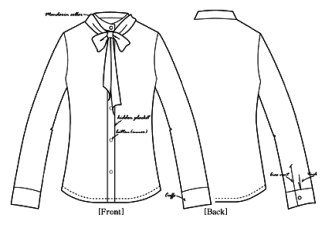
Flat design.
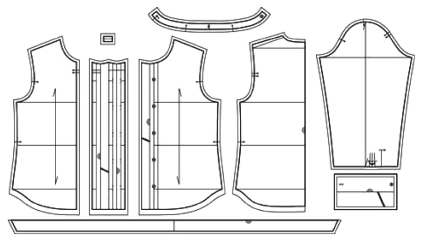
Patterns including seam allowance.
2.2. Materials
For manufacturing the real garment, 2cm of seam allowance was applied to the hemline and 1cm of seam allowance for the other seamlines, while the pattern pieces were plotted using SuperALPHA: plus. Chiffon (100% Polyester) was used as the material and processed through cutting and sewing. An overlocked plain seam was used for the seam finishing and the hemline was folded.
For virtual garment manufacturing, CLO 2.4.57(CLO Virtual Fashion Inc.) was used. CLO is a three-dimensional design tool for creating virtual garment samples in just a few clicks of the mouse. This software allows designs to be made based on patterns, and the status of completion can be checked in real time during the garment design process. Its sophisticated algorithm simulates the physical properties of fabrics to accurately depict the way they drape in reallife. Therefore, 3D garments in CLO are made using 2D patterns imported from a third-party 2D CAD system, or drawn as sketches directly in CLO, just as in real-life(Barrie, 2016).
In the experiment for making a real garment sample, we enlisted the participation of a sewing specialist with over 10 years of experience making samples. In the experiment for making a virtual garment sample, we enlisted the participation of a designer with over three years of experience working in a fashion enterprise and having completed 80 hours of CLO classes.
3. Results & discussion
3.1. Sample making process for a real garment
The real garment was produced in the following sequence: pattern preparing, cutting, and modeling(Fig. 3). Pattern preparing includes the elements of seaming, marking, and plotting. Pattern seaming is a process of making seams for sewing, marking is a process of placing pattern pieces for cutting the cloth, and plotting refers to a process for printing a pattern. The cutting process consists of unwrapping the fabric, spreading and controlling the fabric, setting patterns, scissoring off pieces, notching, controlling, and finishing pieces, marking in/out, naming, and interfacing. This step is important in the preparation for modeling, because it involves creating patterns out of fabrics. The modeling process consists of overlocking, sewing, and ironing each part of the garment. Overlocking is a type of seam finish, sewing is a stage for stitching the pattern pieces, and ironing is done to straighten and finish the seams.
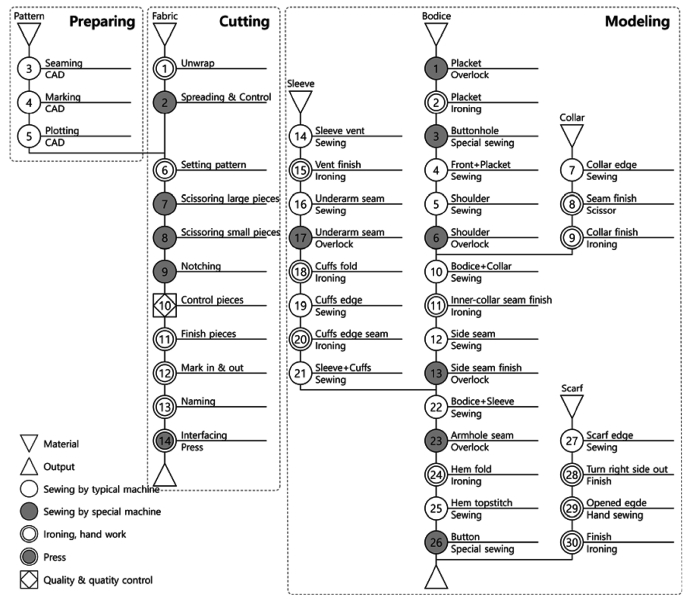
Real garment sample making process.
In the modeling process, parts of the bodice, collar, sleeves, and scarf were respectively made and combined with the bodice. In the real garment making process, scissoring and ironing were done to organize the seams after sewing the seamlines. The traffic line was very complex for a worker conducting this process, and more time was spent moving from place to place than on actual work. In particular, for the characteristics of a chiffon blouse, the edges of the seam allowance were overlocked together, and the sewing machine and overlock machine were used repeatedly, leading to a longer period of time required for this work. In addition, as the collar and cuffs were made into two layers, the right side needed to be turned out after sewing, and this process was accompanied with manual work. The machines used in the real garment making process were typical sewing machines, an overlock machine, buttonhole machine, and iron. The worker utilized each machine by moving from one to the next, in accordance with the process required.
3.2. Sample making process for a virtual garment
The process of making a virtual garment is done in the following sequence: preparing, modeling, and dressing(Fig. 4). The preparing process consists of exporting and importing the pattern, creating fabric, and editing fabric properties. Pattern placing includes the laying out of pieces for the front, sides, and back of the model shadow in a 2D pattern window.
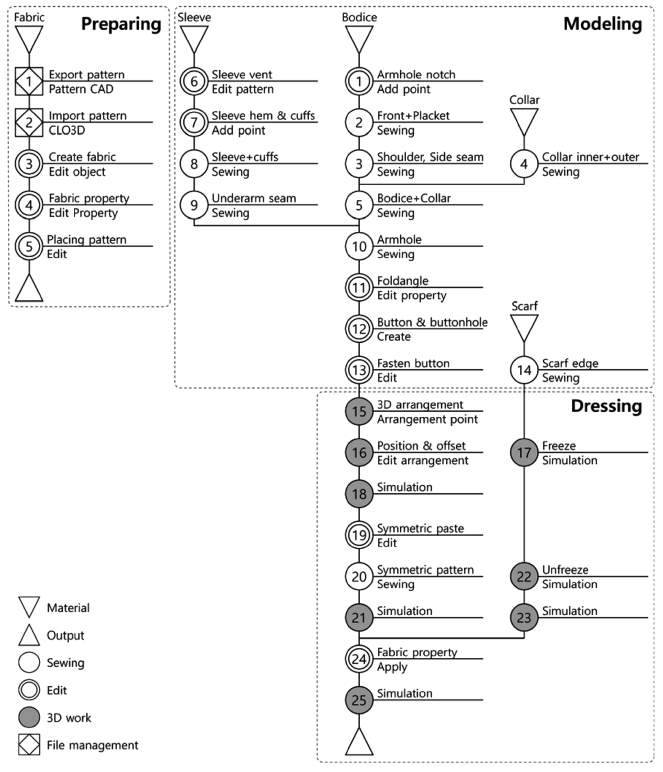
Virtual garment sample making process.
In making a virtual garment, the process of preparing combines the steps of preparing and cutting in the making of a real garment. When compared to making a real garment, it can be seen that the preparation stage for a virtual garment is greatly simplified by staying in line with file exchanges and fabric properties. Not only the CLO program used in this study, but also most other forms of 3D garment simulation software, including Optitex and V-stitcher, use 2D CAD patterns in the dxf format.
The notches set in the 2D CAD pattern are the standards for matching the seamlines in the actual sewing process, and do not work in the 3D CAD. Therefore, when the outlines must be sewn with a notch as the standard, you must add a point on the position of the notch to divide the segments. You can easily complete the sewing just by clicking on the lines to be sewn. When selecting a pair of curves and creating seams, two lines make the same effect as actual sewing.
In the 3D CAD, the processes of finishing seams, turning the right side out, and ironing are not necessary, allowing users to easily complete their garments. However, in order to express the effects of folding the fabric, such as in pleats, tucks, and crease lines, the angle must be folded for the internal line or seamline. A hidden placket was used for the blouse in this experiment to apply the function of a folded angle(Fig. 5). You can create a button and buttonhole with just one click by using the button menu, and you can also select to fasten or unfasten a button. In CLO, a button and buttonhole do not exist as images but have actual opening and closing functions and are expressed in three-dimensional shapes(Fig. 6).
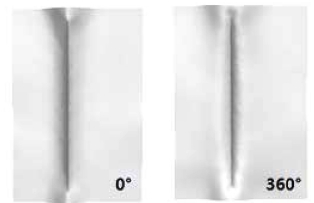
Fold angle.
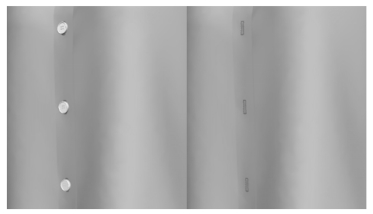
Button & buttonhole.
Unlike with a real garment, a virtual garment is made as it is worn on a human body. The digital garment consists entirely of vertices and, as actual physical laws do not apply, the clothing can go through the human body if collision properties are not designated. If there is no collision with the human body, the original shape cannot be maintained, as the garment pieces are separated before they are sewn. Therefore, the dressing process on a digital model is essential in the process of completing a virtual garment, unlike in the making of a real garment.
In the 3D window, a pattern piece is placed near the digital human model. Because there is an arrangement point on the model, the pattern piece falls into placed when it is connected to this point. The position, offset, orientation, etc., of the pattern piece being placed can be changed by using the property editor. With this menu, the pattern piece is placed to provide a similar shape to when it is worn on an actual human body(Fig. 7).
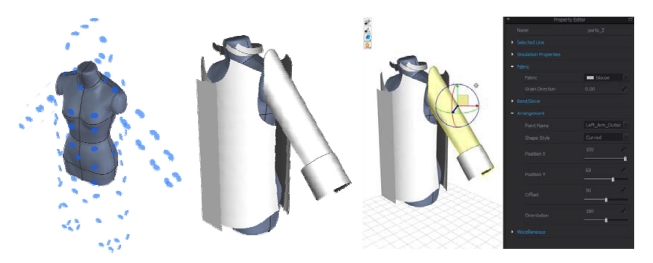
Pattern arrangement, positioning and properties.
Simulation progresses in sequence with vertex calculation. Vertex calculation is a process for assembling the virtual garment onto the simulated human body(Fig. 8). A pattern piece is composed of a vertex, and the lines sewn in the 3D CAD combine the pieces through vertex calculation. This designates the seams to be sewn and has the same role as sewing in the manufacturing process for a real garment. For a smooth simulation, a sewing line is selectively activated and deactivated to freeze or omit part of the 3D garment.
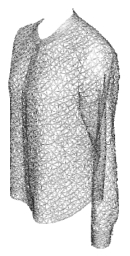
Vertex.
Garments are basically made by supposing the bilateral symmetry of the human body. The front panel of the garment design realized for this study has differences in its left part and right part at the opening, while the back and sleeves for the left and right parts are equal to each other. Therefore, first, the left part of the garment is made, and the right pattern is created through a symmetric paste. The pattern made through the symmetric paste creates a perfect pair, and if the pattern is modified, the other pattern is also changed(Fig. 9). Through this process, the left and right parts of the back are separated from each other, and a sewing line is made in the center of the back, as well. However, two backs can be combined into one through symmetric merging(Fig. 10).
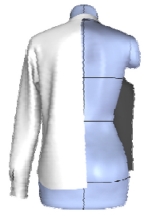
Left side.
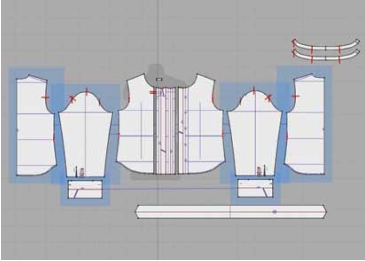
Asymmetric paste.
The texture and color, as well as the physical properties of the materials, are determined by editing the fabric properties. You can express several hundred different designs by applying the various fabric properties to a piece of pattern(Fig. 11). The freeze and unfreeze menu is used in the simulation process for items separate from the garment, such as a scarf for a blouse, to allow the item to be simulated in turn. In a real garment, tying a scarf is very simple. However, in making a virtual garment, this process demands a considerable amount of time and skill, though it remains theoretically possible. Therefore, this study did not tie the scarf into the shape of a ribbon, but rather completed it in the shape of a tie.
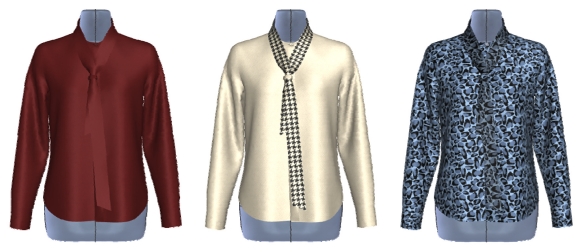
Color and textile variation.
3.3. Real vs Virtual garment
The real garment making process uses several sewing machines and irons, requiring a long traffic line for the worker and considerable time reserved for moving between the machines. However, this process can certainly be used to complete a real garment sample to be worn on a model for checking the fit and suitability for movement.
The virtual garment making process can be used to create a garment sample with a simple click of the mouse on a computer, and even fashion designers with limited experience in making samples can employ this method in the sample making process. This, however, does not result in a real garment sample being made, and no dressing can be done in this process. In order to settle the issue, the fit of a garment on an avatar is presented by suggesting a stress map, strain map, and fit map. Stress maps display the strength of the friction applied to the garment through color codes and numerical values, according to the fabric’s unit area. Strain maps show how the garment is affected by outer forces(pressure) in terms of percentages. Fit maps depict the tightness of a garment through colors(Fig. 12).
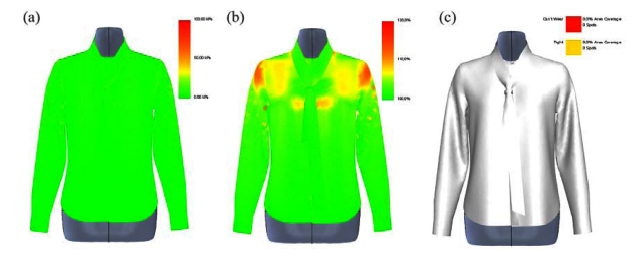
Texture display : (a) stress map, (b) strain map, and (c) fit map.
4. Conclusion
In this study, we have analyzed the differences between the real and virtual garment making processes by choosing designated patterns(Fig. 13). As we can see from the study results, the real and virtual garments generally are made through similar processes in manufacturing, while the time consumed for each shows great variation. In real garment making, scissoring and sewing require the greatest number of work hours, whereas in virtual garment making, most of the time was spent in the simulation process. In the real garment sample making process, the worker's traffic line was long, as three sewing machines and irons were used, leading to a greater amount of time spent moving between machines and doing manual work as opposed to the actual sewing time. This occurs only in sample making, whereas the production time in the apparel industry is reduced and efficiency is maximized with the use of a work flow layout in mass-production. This is a way to make a production line according to the production process and to reduce the required work time by allowing the material (not the worker) to move along the line. A considerable amount of time is spent in making a virtual garment in the elements of folding the fabric on a placket and creating the knot in a scarf. In principle, it is possible to make a knot by moving the vertex, but this demands a highly skilled technique. However, virtual garment making has its merits in the possibilities for application to various other materials once the garment has been produced, opening up the limitless potential for it to become a tool in checking designs and patterns before the real garment is manufactured.
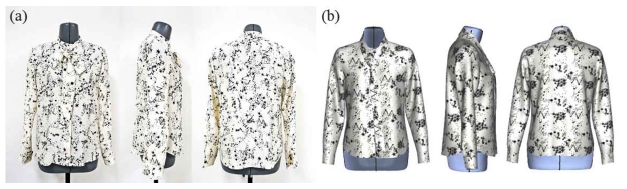
Garment samples : (a) real and (b) virtual.
As discussed thus far, digital garment technology has advanced to the point of securing numerous advantages. However, the technology has yet to reach the level required to compete with actual garments. In addition, there is great significance to the matter of a design tool allowing a designer to personally and physically reproduce his or her own ideas, present them in a substantial design, and communicate throughout the process.
Acknowledgments
This research was supported by the Daegu University Research Grant, 2016.
References
-
Baraff, D., & Witkin, A., (1998), Large steps in cloth simulation, Proceedings of SIGGRAPH 98, computer graphics proceedings, p43-54, Orlando, FL, ACM New York.
[https://doi.org/10.1145/280814.280821]

- Barrie, L., (2016, December, 8), CLO Virtual Fashion moves to Europe on 3D design demand. Just-style, Retrieved December 11, 2016, https://www.just-style.com.
-
Chiricota, Y., Cochaux, O., & Provost, A., (2001), Geometrical modelling of garments, International Journal of Clothing Science and Technology, 13(1), p38-52.
[https://doi.org/10.1108/09556220110384860]
-
Choi, K. J., & Ko, H. S., (2002), Stable but responsive cloth, Proceedings of SIGGRAPH 98, computer graphics proceedings, p604-611, Orlando, FL, USA, ACM New York.
[https://doi.org/10.1145/566570.566624]
-
Fontana, M., Rizzi, C., & Cugini, U., (2005), 3D virtual apparel design for industrial applications, Computer-Aided Design, 37, p609-622.
[https://doi.org/10.1016/j.cad.2004.09.004]
-
Hahn, F., Thomaszewski, B., Coros, S., Sumner, R., Cole, F., Meyer, M., DeRose, T., & Gross, M., (2014), Subspace Clothing Simulation Using Adaptive Bases, Proceedings of ACM SIGGRAPH, 33(4), p1-9, Vancouver, ACM New York.
[https://doi.org/10.1145/2601097.2601160]
-
Kim, S., & Park, C. K., (2007), Basic garment pattern generation using geometric modeling method, International Journal of Clothing Science and Technology, 19(1), p7-17.
[https://doi.org/10.1108/09556220710717017]
-
Noёl, P. L., (2008), Extensible dress: the future of digital clothing, Clothing & Textiles Research Journal, 26(2), p119-130.
[https://doi.org/10.1177/0887302X07310078]
-
Volino, P., & Magnenat-Thalmann, N., (2000), fast cloth simulation with collision response, CGI'00 Proceedings of the International Conference on Computer Graphics, p257-268, Geneva, Switzerland, Switzerland: IEEE Computer Society Washington, DC.
[https://doi.org/10.1109/CGI.2000.852341]
-
Zhong, Y., & Xu, B., (2009), Three-dimensional garment dressing simulation, Textile Research Journal, 79(9), p792-803.
[https://doi.org/10.1177/0040517508090779]