섬유·패션 산업 가치사슬 단계별 인공지능 도입 특성 분석 : Impact-Feasibility 프레임워크 기반 접근

©2026 The Korean Fashion and Textile Research Journal(KFTRJ). This is an open access journal. Articles are distributed under the terms of the Creative 52 Commons Attribution Non-Commercial License (http://creativecommons.org/licenses/by-nc/4.0), which permits unrestricted use, distribution, and reproduction in any medium, provided the original work is properly cited.
Abstract
This study examines how artificial intelligence (AI) adoption varies across stages of the textile and fashion industry value chain. While prior studies have explored AI applications in fashion, they have largely been discussed in isolation within specific functional domains, leaving a gap in understanding the systematic strategic patterns across the entire industry. To enable systematic comparison, the value chain is organized into five stages—planning and trend intelligence, design and product development, production and quality management, retail and commerce, and circular economy. A literature-based analysis of 41 studies was conducted, coding each by value chain stage and evaluating them along two dimensions: impact and feasibility. Impact captures strategic alignment and operational benefits, while feasibility reflects implementation conditions such as technological readiness, data infrastructure, and organizational capability. Results show that AI adoption patterns vary systematically: planning and design exhibit high impact and feasibility due to the availability of generative tools and external data. In contrast, retail shows high feasibility through established customer data, while production faces lower feasibility due to the high costs of infrastructure and technical expertise required for SMEs. Notably, the circular economy demonstrates high strategic impact but remains the least feasible due to the need for complex cross-organizational data integration. These findings suggest that AI adoption follows stage-dependent strategic logics. This provides a framework for stakeholders to prioritize investments and serves as a foundation for optimizing digital transformation strategies across the fashion industry.
Keywords:
artificial intelligence, textile and fashion industry, value chain, AI adoption, impact-feasibility framework키워드:
인공지능, 섬유·패션 산업, 가치사슬, AI 도입, impact-feasibility 분석1. 서 론
최근 인공지능(artificial intelligence, AI)은 섬유·패션 산업 전반에서 활용 범위를 크게 확장하고 있다. 과거에는 추천 시스템이나 검색과 같은 특정 기능 중심의 활용이 주로 논의되었으나, 최근에는 기획 단계의 트렌드 신호 탐지와 수요 예측, 디자인 단계의 생성형 도구 활용, 생산 단계의 공정 최적화와 품질 관리, 리테일 단계의 개인화 마케팅과 재고 운영 등 가치사슬 전반에서 AI 활용이 확산되고 있다(Imtiaz et al., 2024; Oh et al., 2025; Pak & Lee, 2020).
그러나 실제로 산업 현장에서 관찰되는 AI 도입의 성과는 기업 간에 일관성을 보이지 않는다(Hossain et al., 2024; Qu & Kim, 2025). 특히 자원과 조직 역량에 제약이 있는 중소·중견기업의 경우 특정 AI 도구를 도입하였음에도 기대했던 경영 성과가 나타나지 못하는 사례가 적지 않다(OECD, 2025). 또한 AI 도입의 필요성을 인지하고 있지만 어떤 유형의 AI를 우선적으로 도입해야 하는지, 그에 따른 성과가 어떠한 방식으로 나타날지에 대한 판단 기준이 충분히 구조화되어 있지 않아 AI 도입 결정을 유보하는 경우도 빈번하다. Ayinaddis(2025)는 이와 같은 문제의 원인이 기술 자체의 한계라기보다 기업의 기술 자원 수준, 조직 준비성, 외부 환경 요인 등 복합적인 도입 조건과 밀접하게 연관되어 있음을 지적하였다.
섬유·패션 산업의 경우 제품 기획에서 디자인, 생산, 유통, 소비 이후의 순환 관리에 이르기까지 복잡한 가치사슬 구조를 가지며, 각 단계에서 요구되는 데이터 유형과 운영 조건은 매우 상이하다. 따라서 동일한 AI 기술이라도 적용되는 가치사슬 단계에 따라 기대 효과와 실행 가능성이 달라질 수 있다. 하지만 기존 연구에서는 AI 도입을 단순히 개별 기술 사례나 특정 기능 중심으로 설명하는 경우가 많았으며(Giri et al., 2019; Noor et al., 2022; Son & Yoon, 2025), 산업 가치사슬 구조 속에서 단계별 도입 특성을 비교․분석한 연구는 상대적으로 제한적이다. 특히 AI 도입의 효과와 실행 조건을 동시에 고려하여 가치사슬 단계 간 도입 특성을 구조적으로 비교하려는 연구는 충분히 이루어지지 않았다. 섬유·패션 산업의 AI 도입에 대한 전략적 판단을 체계화하기 위해서는 가치사슬 단계별 AI 도입의 전형적 특성과 도입 조건을 구조화할 수 있는 분석 틀이 요구된다. 나아가 AI 도입을 비교 가능한 유형으로 정리하고, 도입 효과의 성격과 실행 조건을 함께 고려할 수 있는 개념적 기준을 제시할 필요가 있다.
본 연구는 섬유·패션 산업 전반에서 관찰되는 다양한 AI 도입 양상을 개별 기술이나 사례 단위가 아닌 가치사슬 관점에서 구조화하여 비교·해석할 수 있는 분석 프레임워크를 제시하는 데 목적이 있다. AI 도입을 ‘어떤 기술이 효과적인가’의 문제로 환원하기보다 가치사슬 단계별로 AI 도입이 어떠한 성격의 효과를 가지며, 어떠한 실행 조건을 요구하는가라는 전략적 판단 문제로 확장하고자 한다.
이를 위해 먼저 섬유·패션 산업의 가치사슬을 ① 기획·트렌드 인텔리전스, ② 디자인·상품 개발, ③ 생산·품질관리, ④ 리테일·커머스, ⑤ 순환경제의 다섯 단계로 구분하고, 문헌 코퍼스 기반 분석을 통해 각 단계에서 반복적으로 관찰되는 AI 도입 특성을 체계적으로 정리한다. 이후 AI 도입을 설명하기 위한 두 가지 분석 차원으로 Impact(도입 효과와 전략적 영향)와 Feasibility(도입 실행 가능성과 요구 조건)를 설정하고, 문헌 코딩을 통해 도출된 단계별 특성을 비교·분석한다. 최종적으로 가치사슬 단계별 AI 도입 패턴을 Impact-Feasibility 매트릭스 상에서 구조적으로 해석한다.
본 연구는 AI 도입의 성과를 정량적으로 평가하거나 특정 도입 순서를 제시하는 것을 목적으로 하지 않는다. 대신 문헌에서 반복적으로 나타나는 도입 특성을 비교·구조화하는 유형론적 분석 연구로서 AI 도입 판단을 위한 공통의 해석 기준을 제시하고자 한다. 이 분석 틀은 향후 실증 연구, 기업 유형별 비교 연구, 또는 정책·전략 분석에서 비교 가능성을 확보하기 위한 선행적 개념 기준으로 활용될 수 있다.
2. 이론적 배경
2.1. 섬유·패션 산업의 가치사슬별 AI 활용 연구 동향
섬유·패션 산업에서의 AI 활용에 대한 기존 연구는 기획, 디자인, 생산, 유통 등 개별 단계별로 분화되어 전개되었으며, 각 단계에서 AI가 수행하는 역할과 적용 가능성에 대한 논의가 이루어졌다.
먼저 기획·트렌드 분석 단계에서는 소비자 데이터, 소셜미디어 콘텐츠, 온라인 검색 및 판매 데이터를 활용한 트렌드 예측과 수요 분석 연구가 다수 수행되었다(Shi et al., 2021; Wazarkar & Keshavamurthy, 2020). 이들 연구는 이미지 및 텍스트 분석, 시계열 예측, 클러스터링 기법 등을 활용하여 패션 트렌드의 변화 양상을 탐지하거나 상품 기획의 정확도를 제고하는 데 AI가 기여할 수 있음을 보여준다. 특히 데이터 기반 기획이 기존의 직관 중심 의사결정을 보완할 수 있다는 점에서 AI는 의사결정 지원 도구로서의 가능성을 지닌다.
디자인·상품 개발 단계에서는 디자인 프로세스의 효율성과 창의성 지원을 중심으로 AI 활용이 논의되어 왔다(Drakou et al., 2024; Guo et al., 2023; Lund et al., 2023). 생성형 AI를 활용한 디자인 이미지 생성, 3D 가상 샘플링, 가상 피팅 기술 등은 디자인 초기 단계의 시각화 속도를 높이고, 커뮤니케이션 비용을 절감할 수 있는 도구로 제시된다. 관련 연구들은 AI가 디자이너의 창의적 판단을 대체하기보다 반복적이고 소모적인 작업을 보조하며 아이디어 탐색의 범위를 확장하는 역할을 수행할 수 있다는 점을 공통적으로 강조한다.
생산·품질관리 단계에서는 제조 공정의 효율성과 안정성을 향상시키기 위한 AI 활용 연구가 주를 이룬다(Dong et al., 2025; He et al., 2022; Nasim et al., 2024). 비전 기반 품질 검사, 예지보전, 공정 최적화, 생산 스케줄링 등의 분야에서 AI 적용 사례가 보고되었으며, 이는 불량률 감소, 비용 절감, 납기 신뢰도 향상과 같은 성과와 연결되어 논의되었다.
리테일·커머스 단계에서는 고객 데이터 기반의 개인화 추천, 가격 최적화, 재고 관리, 마케팅 자동화와 관련된 연구가 활발히 이루어졌다(Goti et al., 2023; Pillarisetty & Mishra, 2022). 온라인 및 옴니채널 환경에서 축적되는 대규모 고객 데이터를 활용하여 구매 전환율과 고객 경험을 개선하려는 시도가 다수 보고되었으며, 이 영역은 다른 가치사슬 단계에 비해 비교적 빠르게 성과가 가시화되는 특징을 보인다.
마지막으로 순환경제 단계에서는 재판매, 재활용, 제품 생애 주기 관리와 관련된 AI 활용 연구가 점차 증가하고 있다(Karmali & Valilai, 2025; Nisa et al., 2025; Ramos et al., 2023). 진품 인증, 제품 상태 판별, 소재 분류, 생애주기 추적을 위한 데이터 관리 등은 지속가능성 요구의 확산과 함께 새로운 연구 주제로 부상하고 있다. 다만 이 영역의 연구는 아직 초기 단계에 머물러 있으며 실증적 성과 분석보다는 기술적 가능성이나 개념적 방향성을 제시하는 연구가 중심을 이루고 있다.
이 같은 기존 연구들은 섬유·패션 산업의 각 가치사슬 단계에서 AI 활용 가능성과 사례를 폭넓게 제시하며 AI 기술이 산업 전반에 미치는 잠재적 영향을 다각도로 조명해 왔다. 그러나 대부분 개별 단계별 또는 기술별 논의에 초점을 두고 있어 가치사슬 전반을 통합적으로 조망하는 연구는 상대적으로 제한적이다. 그 결과 전체적인 가치사슬 구조 속에서 AI 활용 특성을 비교적으로 이해하기는 쉽지 않다.
2.2. AI 도입 판단 기준에 관한 연구
최근 인공지능과 디지털 전환 기술의 확산과 함께 AI adoption, AI readiness, digital transformation maturity와 같은 개념을 중심으로 조직의 AI 도입 조건을 설명하려는 연구가 증가하고 있다(Gökalp & Martinez, 2022; Heimberger et al., 2026; Holmström, 2022; Kırmızı & Kocaoglu, 2022; Polisetty et al., 2024).
Technology Acceptance Model(TAM)과 Technology-Organization-Environment(TOE) 프레임워크를 결합하여 AI 도입의 결정 요인을 설명하는 접근은 개인 수준의 기술 수용 요인과 조직 및 환경 차원의 도입 조건을 동시에 고려할 수 있다는 점에서 유용한 분석 틀로 활용된다. 제조 및 생산 기업을 대상으로 한 연구에서는 TAM-TOE 통합 모형을 통해 기술적 요인, 조직 준비성, 환경 압력 등이 AI 도입 의도에 유의한 영향을 미친다는 결과가 보고되었다(Chatterjee et al., 2021). 섬유·의류 제조 중소기업을 대상으로 한 연구에서도 지각된 유용성, 경쟁 압력, 조직 준비성 등의 요인이 AI 도입에 중요한 영향을 미치는 것으로 나타났으며, 이는 AI 도입이 조직 역량과 환경 조건이 결합된 의사결정 과정임을 보여준다(Qu & Kim, 2025). 기업 및 조직 차원의 AI 도입 연구를 종합적으로 분석한 연구에서도 AI 도입의 주요 동인은 경제적 기대 효과, 운영 효율성 향상, 의사결정 지원 능력과 같은 성과 기대 요인으로 나타났으며(Cubric, 2020), 동시에 데이터 부족, 기술 전문성 부족, 조직 준비성 부족과 같은 요인이 도입 장벽으로 제시되었다(Khan & Yairi, 2018; Patrício & Rieder, 2018; Shahid et al., 2019). 이러한 연구들은 AI 도입이 기술적 문제뿐 아니라 조직 및 사회적 요인과도 밀접하게 연관되어 있음을 지적하고 있다.
그러나 선행연구들은 대부분 조직 수준에서 기술 도입의 결정 요인을 설명하는 데 초점을 두고 있다. 섬유·패션 산업의 경우 가치사슬 단계별로 조직적 특징이 상이하기 때문에 동일한 AI 기술이라 하더라도 기대되는 성과가 다르게 나타날 수 있다. 그럼에도 이 같은 차이를 구조적으로 비교한 연구는 매우 제한적이다. 따라서 섬유·패션 산업에서의 AI 도입을 보다 체계적으로 이해하기 위해서는 가치사슬 단계별로 기술 도입의 기대 효과와 실제 실행 가능성을 동시에 고려할 수 있는 분석 차원의 설정이 필요하다.
2.3. Impact-Feasibility 분석 프레임워크의 조작적 정의
기존 정보기술 도입 연구에서는 기술 채택을 설명할 때 기술 도입의 기대 효과와 실제 실행 가능성을 동시에 고려해야 한다는 점이 반복적으로 강조되어 왔다(Jöhnk et al., 2021; Vial, 2021). 따라서 본 연구에서는 가치사슬 단계별 AI 도입 특성을 비교·해석하기 위해 두 가지 핵심 분석 차원으로 Impact와 Feasibility를 설정하였다. 두 차원은 서로 다른 가치사슬 단계에서 나타나는 AI 도입 논리를 비교하고 유형화하기 위한 해석적 분석 차원으로 정의된다.
먼저 Impact는 특정 AI 도입이 기업 또는 가치사슬 성과에 어떠한 방식으로, 어느 범위까지 영향을 미치는지를 설명하는 개념이다. 매출 증가, 비용 절감, 리드타임 단축, 품질 안정성 향상 등 다양한 성과 요소를 포괄하되, 개별 성과 지표의 절대적 수치를 측정하기보다는 AI 도입이 가치사슬 전반의 성과 구조에 미치는 전략적 영향의 정도를 해석하는 데 초점을 둔다. 선행연구에서도 전략적 연계성(strategic alignment), 상대적 이점(relative advantage), 성과 가시성(performance visibility)과 같은 요소가 기술 도입 판단의 핵심 요인으로 반복적으로 제시되었다(Diab, 2021; Horani et al., 2025; Khanfar et al., 2025; Nyamekeh et al., 2025; Rieder, 2025).
한편 Feasibility는 특정 AI 기술이 실제 산업 현장에서 어느 정도 실행 가능한지를 설명하는 개념으로 기술 자체의 완성도 뿐 아니라 도입 과정에서 요구되는 조직적·운영적 조건을 함께 고려한다. AI 도입 연구에서는 데이터 품질과 접근성, IT 인프라 준비도, 조직의 디지털 역량, 투자 비용, 공급망 및 파트너 생태계 등 다양한 요소가 기술 도입의 실행 가능성을 규정하는 요인으로 제시되어 왔다(Madanchian & Taherdoost, 2025; Uren & Edwards, 2023). AI 시스템 도입의 실행 가능성을 평가한 연구에서도 데이터 준비도, 비용 및 자원 제약, 조직 및 프로세스 적합성 등이 핵심 판단 기준으로 제시되었다(Krzywonos et al., 2025).
본 연구는 이 같은 선행연구를 종합적으로 검토하여 조직 차원의 AI 도입 판단에서 반복적으로 언급되는 핵심 판단 기준을 도출하고, 이를 두 분석 차원인 Impact와 Feasibility에 대응시키는 방식으로 분석 프레임워크를 구성하였다. 각 하위 판단 기준의 개념적 정의와 근거는 Table 1에 정리하였다.

Mapping of impact-feasibility sub-criteria and supporting literature
Impact 차원은 기술 도입의 기대 효과와 전략적 의미를 설명하는 기준으로 구성되며, 세 가지 하위 차원으로 구분하였다. 첫째, Strategic alignment는 AI 도입이 기업의 전략적 목표 또는 경쟁 전략과 얼마나 밀접하게 연결되는지를 의미한다. 둘째, Relative advantage는 AI 도입이 비용 절감, 운영 효율 향상, 의사결정 지원 등 기존 방식 대비 어떠한 상대적 이점을 제공하는지를 설명한다. 셋째, Performance visibility는 AI 도입 성과가 조직 내에서 얼마나 명확하게 인식되고 평가될 수 있는지를 의미한다. Feasibility 차원 역시 세 가지 하위 차원으로 구성하였다. 첫째, Technological readiness는 기술적 준비 수준으로 기술 성숙도, IT 인프라 수준, 조직의 수용 역량 등을 의미한다. 둘째, Cost and resource constraints는 AI 도입 과정에서 요구되는 데이터 확보, 데이터 품질, 초기 투자 비용, 인적 자원 등의 자원 조건을 의미한다. 셋째, Organizational and process fit은 AI 도입이 기존 조직 구조 및 업무 프로세스와 얼마나 정합적으로 결합될 수 있는지를 설명한다.
본 연구에서는 각 가치사슬 단계에서 관찰되는 AI 도입 특성을 Impact-Feasibility 매트릭스 상의 상대적 위치로 표현함으로써 도입 효과와 실행 가능성의 결합 패턴을 구조적으로 분석하였다. 이러한 접근은 AI 도입을 산업 가치사슬 구조 속에서 나타나는 도입 특성으로 이해할 수 있도록 한다.
3. 연구방법
3.1. 문헌 코퍼스 구축
섬유·패션 산업 가치사슬 단계별 AI 도입 특성을 Impact-Feasibility 관점에서 유형화하기 위해 문헌 기반 분석을 수행하였다. 우선 체계적 문헌 검색과 단계적 스크리닝 절차를 통해 분석용 문헌 코퍼스를 구축하였다. 문헌 식별-중복 제거-선별-최종 포함의 절차는 PRISMA 2020의 기록 원칙(identification-screening-eligibility-inclusion)을 참고하여 설계하였다.
문헌 검색은 국제 학술 데이터베이스인 Scopus와 Web of Science에서 수행하였다. 검색 기간은 2015년부터 2025년까지로 설정하였다. 이는 섬유·패션 산업에서 데이터 기반 의사결정, 디지털 전환, 생성형 AI 등 AI 기술의 산업 적용 논의가 본격적으로 확산된 시기를 반영하기 위함이다. 검색식은 (1) AI 기술을 포괄적으로 포함하면서도 (2) 섬유·패션 및 의류 산업 맥락을 명시적으로 반영하고, (3) 도입(adoption), 구현(implementation), 준비도(readiness), 전략(strategy), 디지털 전환(digital transformation) 등 조직 및 산업 차원의 도입 논의를 포착할 수 있도록 설계하였다(Table 2). 순수 기술 연구가 과도하게 포함되는 것을 방지하기 위해 machine learning, deep learning, generative AI 등 기술 중심 키워드는 검색식에서 제외하였다. 분석의 일관성을 확보하기 위해 문서 유형은 국제 학술지 논문으로 제한하였다.
Search query used in the literature retrieval
검색 결과 Scopus에서 603편, Web of Science에서 488편이 식별되어 총 1,091편의 문헌이 확보되었다. 참고문헌 관리 프로그램(EndNote)을 활용하여 중복 문헌을 제거하였으며, 중복 제거 후 총 756편이 스크리닝 대상으로 남았다. 이후 제목과 초록을 기준으로 1차 스크리닝을 수행하여 조직 또는 산업 차원의 AI 도입 논의가 확인되지 않는 문헌을 제외하였다. 2차 스크리닝에서는 알고리즘 성능 개선, 알고리즘 비교, 결함 검출 기술 개발, 소재 물성 분석 등 기술 구현 자체가 연구 목적인 연구를 제외하였다. 이 절차를 거쳐 총 60편의 문헌이 분석 후보군으로 선정되었다. 마지막으로 전체 본문을 확보할 수 있는 41편의 학술 논문이 본 연구의 분석 코퍼스로 확정되었다. 분석 코퍼스를 구성하는 41편의 연구는 Appendix에 제시하였다.
문헌의 포함 기준은 섬유·패션·의류 산업 또는 관련 가치사슬 단계 맥락에서 AI 활용 또는 도입 논의를 다루는 연구이다. 제목에 산업 키워드가 명시되지 않더라도 초록이나 본문에서 해당 산업 적용이 확인되는 경우에는 포함하였다. 또한 조직 또는 산업 수준의 AI 도입 조건이나 도입 효과가 설명된 경우도 포함하였다. 반면 섬유·패션 산업과 직접적인 관련이 없는 분야의 AI 연구는 제외하였다. 즉, 산업 맥락이 명확하고, AI 도입의 조건, 효과 또는 전략적 함의를 논의하는 문헌을 중심으로 이론적 표본추출 원칙에 따라 문헌 코퍼스를 구축하였다.
3.2. 코딩 절차
각 문헌에 대해 두 가지 수준에서 코딩을 수행하였다.
첫째, 문헌에서 AI 도입이 논의된 산업 단계를 기준으로 가치사슬 단계 태깅을 수행하였다. 본 연구에서는 섬유·패션 산업 가치사슬을 다음의 다섯 단계(기획·트렌드 인텔리전스, 디자인·상품 개발, 생산·품질관리, 리테일·커머스, 순환경제)로 구분하였다. 한 문헌이 여러 단계의 AI 도입을 동시에 다루는 경우 가치사슬 태깅은 중복 적용을 허용하였다. 이는 하나의 연구가 가치사슬의 복수 단계에 동시에 활용될 수 있는 특성을 반영하기 위함이다.
둘째, 각 문헌에 대해 Impact와 Feasibility 차원의 하위 기준을 기반으로 점수화 코딩을 수행하였다. Impact 차원은 전략적 연계성, 상대적 이점, 성과 가시성의 세 가지 하위 기준으로 구성하였으며, Feasibility 차원은 기술 준비도, 비용 및 자원 제약, 조직 및 프로세스 적합성의 세 가지 하위 기준으로 구성하였다. 각 하위 기준은 1점에서 3점까지의 범주형 척도로 코딩하였다. 1점은 해당 요소가 언급되지 않거나 관련 조건이 충분히 설명되지 않은 경우, 2점은 해당 요소가 부분적으로 논의되거나 강조되지 않은 경우, 3점은 해당 요소가 명확하게 강조되며 반복적으로 논의된 경우를 의미한다. 이는 본 연구가 문헌에서 반복적으로 강조되는 도입 특성의 상대적 강도를 비교하는 데 목적이 있기 때문이다.
코딩 판단은 문헌 본문에서 제시된 구체적인 근거 문장을 기반으로 수행하였다. 예를 들어 자원 부족이나 비용 제약이 AI 도입의 장애 요인으로 명확히 언급된 경우에는 비용 및 자원 제약 항목에서 낮은 점수를 부여하였으며, 조직 구조 변화나 공급망 재구성이 AI 도입의 중요한 전제 조건으로 설명하면서 이를 제약 요인으로 설명한 경우에는 조직 및 프로세스 적합성 항목에서 낮은 점수를 부여하였다. 반대로 AI 도입이 기업 전략이나 경쟁력 강화와 직접적으로 연결된다고 설명하거나, 비용 절감․생산성 향상․운영 효율 개선 등 도입 성과가 명확히 제시된 경우에는 전략적 연계성과 상대적 이점 항목에서 높은 점수를 부여하였다. Table 3은 실제 코딩 과정에서 활용된 문헌 근거의 예시를 보여준다.
Examples of coding evidence from the literature
결과의 해석 타당성을 확보하기 위해 모든 문헌은 의류학 전공 석사 이상 연구자 2명 간 공동 검토 방식으로 코딩하였다. 코딩 과정에서 해석이 모호한 경우에는 해당 문헌의 관련 부분을 재검토하고, 연구자 간 논의를 통해 합의에 도달하는 방식으로 최종 점수를 확정하였다.
3.3. 분석 절차
분석 절차의 전체 흐름은 Fig. 1에 제시하였다. 먼저 가치사슬 단계 태깅 결과를 기준으로 문헌을 단계별로 그룹화하였다. 다음으로 각 단계에서 Impact와 Feasibility 하위 기준의 점수를 집계하고 단계별 평균값을 산출하였다. 이때 각 하위 기준 간 차등 가중치는 적용하지 않고 동일 가중 평균을 사용하였다. 이는 특정 기준의 상대적 중요도를 사전에 규정하는 규범적 판단을 최소화하고, 문헌에서 관찰되는 AI 도입 특성의 구조적 비교에 초점을 두기 위함이다. 이어서 단계별 평균 점수를 비교하여 가치사슬 단계 간 AI 도입 특성의 상대적 경향을 분석하였다. 마지막으로 각 단계의 평균 Impact와 Feasibility 값을 기반으로 Impact-Feasibility 매트릭스 상에서 위치를 도출하였다. 이를 통해 섬유·패션 산업 가치사슬 단계별 AI 도입 특성을 시각적으로 비교하고, 단계별 도입 패턴을 유형화하였다.
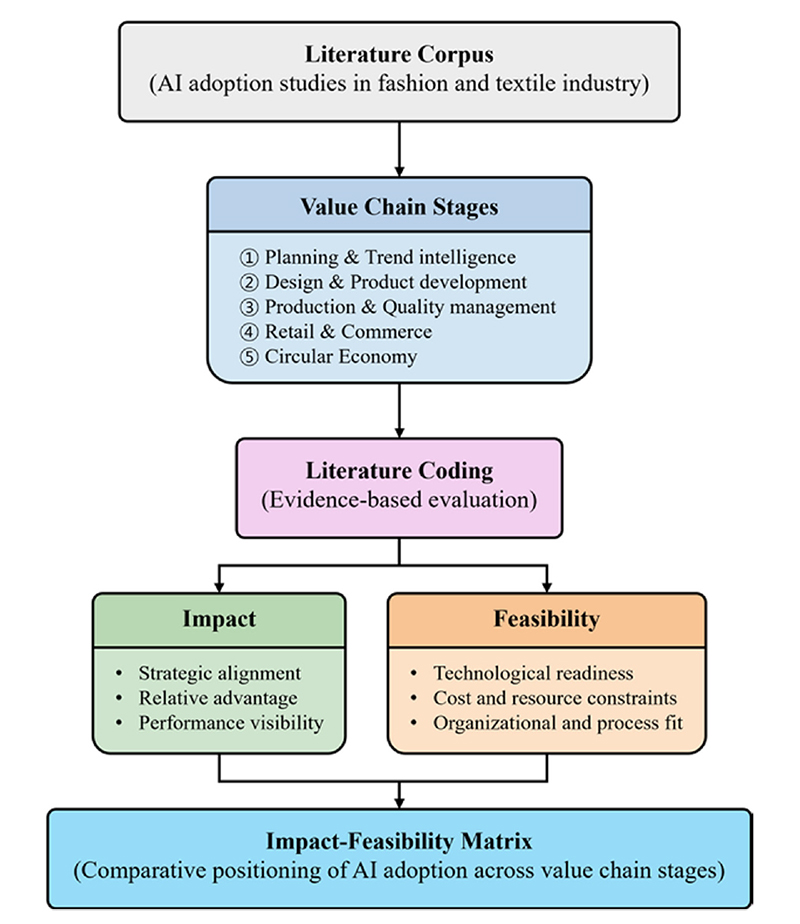
Analytical workflow for the impact-feasibility analysis of AI adoption in the fashion and textile value chain.
4. 연구 결과
4.1. 가치사슬 단계별 문헌 분포
최종 선정된 41편의 문헌을 검토한 결과 가치사슬 단계별 문헌 분포는 Table 4와 같이 나타났다.
Distribution of AI adoption studies across value chain stages
AI 도입 논의는 리테일·커머스 단계와 생산·품질관리 단계에서 가장 높은 빈도로 나타났다. 총 41편의 문헌 중 리테일·커머스 단계는 23편, 생산·품질관리 단계는 22편의 문헌에서 AI 활용이 논의되었다. 이는 고객 데이터와 판매 데이터가 대규모로 축적되는 리테일 환경과, 공정 효율 및 품질 관리 개선이 중요한 생산 단계에서 AI 활용 논의가 활발하게 이루어지고 있음을 보여준다. 즉, 데이터 접근성과 성과 가시성이 높은 단계에서 AI 활용 논의가 먼저 확산되는 산업 특성을 반영한 결과로 해석될 수 있다. 리테일·커머스 단계의 연구들은 주로 고객 행동 데이터를 활용하여 개인화 서비스 제공, 가격 최적화, 마케팅 전략을 고도화하는 사례를 제시하고 있었다. 생산·품질관리 단계에서의 연구는 공정 자동화, 품질 검사, 생산 공정 최적화 등 제조 효율성과 품질 안정성을 개선하기 위한 AI 활용 사례를 중심으로 전개되고 있었다. 순환경제 단계에서는 총 15편의 문헌에서 AI 활용이 논의되었으며, 주로 공급망 투명성 확보, 자원 순환 관리 등 지속가능성과 관련된 기술 적용 가능성이 제시되었다. 기획·트렌드 인텔리전스 단계와 디자인·상품 개발 단계는 각각 13편의 문헌에서 AI 활용이 확인되었다. 기획 단계에서는 수요 예측과 데이터 기반 의사결정 지원이 주요 연구 주제로 나타났으며, 디자인 단계에서는 최근 생성형 AI 기술의 확산과 함께 AI 기반 디자인 생성 도구나 디자인 지원 시스템에 관한 연구가 확인되었다.
4.2. 가치사슬 단계별 Impact와 Feasibility 비교
가치사슬 단계별 AI 도입 특성을 비교하기 위해 각 단계에서 Impact와 Feasibility 하위 기준의 평균값을 산출하였다 (Table 5).
Average impact and feasibility scores by value chain stage
Impact 점수는 모든 가치사슬 단계에서 비교적 높은 수준으로 나타났다. 단계별로 보면 디자인·상품 개발 단계가 가장 높은 평균값(2.77)을 보였으며, 순환경제 단계(2.72), 기획·트렌드 인텔리전스 단계(2.67), 리테일·커머스 단계(2.64), 생산·품질관리 단계(2.58)의 순으로 나타났다. 이러한 결과는 섬유·패션 산업 가치사슬 전반에서 AI 도입이 전반적으로 긍정적인 효과를 갖는 것으로 인식되고 있음을 보여준다.
디자인·상품 개발 단계의 높은 Impact 점수는 AI 기반 디자인 도구가 제품 개발 과정에서 아이디어 생성, 소재 활용 최적화, 디자인 탐색 효율성 향상 등 제품 개발 활동과 직접적으로 연결되는 경우가 많기 때문으로 볼 수 있다. 순환경제 단계 역시 비교적 높은 Impact 점수를 보였는데, AI 기반 추적 시스템이나 자원 관리 기술이 제품 생애주기 관리와 자원 순환 효율성 향상에 기여할 수 있는 기술로 제시되고 있기 때문이다. 기획·트렌드 인텔리전스 단계에서는 AI 기반 수요 예측과 시장 분석 기술이 가격 결정, 제품 기획 등 기업의 전략적 의사결정에 긍정적인 영향을 끼칠 수 있다고 논의되는 경우가 많았다. 리테일·커머스 단계에서의 다양한 AI 활용 사례는 주로 고객 경험 개선과 운영 효율성 향상과 연계되어 설명되고 있었다. 생산·품질관리 단계의 Impact 점수는 다섯 단계 중 상대적으로 가장 낮게 나타났으나, AI 기반 공정 최적화와 품질 관리 기술이 생산 효율성과 품질 안정성을 개선할 수 있다는 점은 여러 연구에서 제시되고 있었다.
반면 Feasibility 점수는 Impact 점수에 비해 전체적으로 낮게 나타났다. 가장 높은 Feasibility 점수는 기획·트렌드 인텔리전스 단계(2.38)에서 나타났으며, 그 다음으로 디자인·상품 개발 단계(2.33), 리테일·커머스 단계(2.26), 생산·품질관리 단계(2.21), 순환경제 단계(2.05)의 순으로 확인되었다. 기획·트렌드 인텔리전스 단계에서는 트렌드 분석, 수요 예측, 시장 분석 등 기획 단계의 AI 활용이 주로 외부 데이터와 분석 도구에 기반하고 있어 상대적으로 도입 장벽이 낮은 것으로 나타났다. 디자인·상품 개발 단계에서는 최근 생성형 AI 기술의 발전으로 디자인 아이디어 생성, 스타일 탐색, 소재 조합 제안 등 디자인 프로세스를 지원하는 다양한 AI 도구가 등장하면서 해당 단계에서의 기술 활용 가능성이 확대되는 경향을 보였다. 리테일·커머스 단계에서는 온라인 플랫폼 환경에서 고객 데이터와 판매 데이터가 축적되어 있어 AI 기반 추천 시스템이나 고객 행동 분석 기술의 도입 가능성이 비교적 높은 것으로 나타났다.
생산·품질관리 단계에서는 AI 기술을 도입하기 위해 센서 기반 데이터 수집, 공정 시스템 통합, 생산 설비 투자 등 다양한 기술적·조직적 조건이 요구되는 것으로 나타났다. 특히 섬유·의류 산업의 많은 중소기업들이 디지털 기술 도입을 위한 인프라와 전문 인력 확보에 어려움을 겪고 있다는 점이 여러 문헌에서 반복적으로 지적되고 있었다. 순환경제 단계는 가장 낮은 실행 가능성을 보였는데 제품 추적 시스템 구축, 공급망 데이터 공유, 기업 간 협력 구조 형성 등 산업 전반의 데이터 인프라와 조직 간 협력이 필요하기 때문으로 해석할 수 있다. 순환 공급망 구축을 위해서는 제품 설계, 소재 조달, 생산 및 유통 구조 전반에 걸친 구조적 변화가 요구된다는 점이 기존 연구에서 제기되고 있었다.
4.3. Impact-Feasibility 매트릭스 분석
앞선 분석 결과를 바탕으로 Impact-Feasibility 매트릭스를 도출하였다. 각 가치사슬 단계의 위치는 Table 5에서 산출된 평균 Impact와 Feasibility 값을 기준으로 설정하였으며, 이를 2차원 분석 공간에 시각화한 결과는 Fig. 2에 제시하였다. 매트릭스의 기준선은 다섯 가치사슬 단계의 평균값을 기준으로 설정하였다.
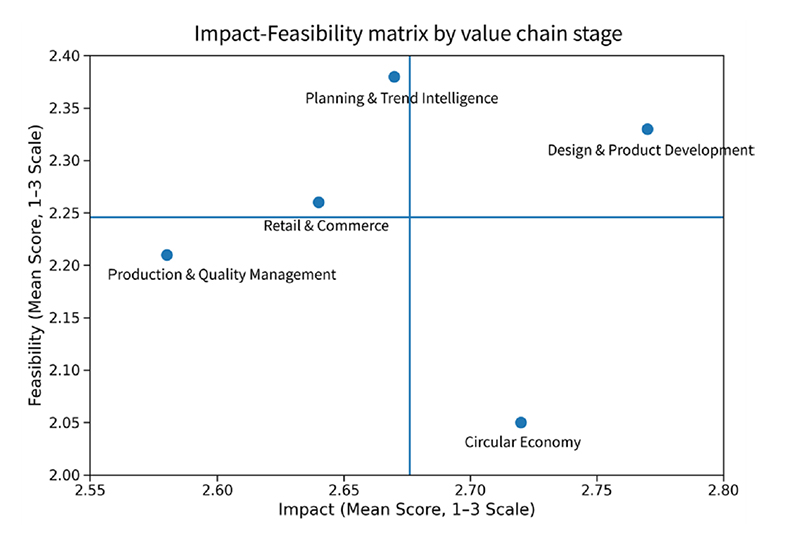
Impact-feasibility matrix of AI adoption across the fashion value chain.
섬유·패션 산업 가치사슬 단계들은 Impact와 Feasibility의 조합에 따라 서로 다른 위치에 분포함을 확인하였다. 기획·트렌드 인텔리전스 단계는 중간 수준의 Impact와 높은 Feasibility를 보이는 영역에 위치하였으며, 디자인·상품 개발 단계는 높은 Impact와 높은 Feasibility가 결합된 영역에 분포하였다. 반면 생산·품질관리 단계는 Impact와 Feasibility가 모두 상대적으로 낮은 영역에 나타났고, 리테일·커머스 단계는 두 지표가 모두 평균 수준에 가까운 위치를 보였다. 순환경제 단계는 높은 Impact와 낮은 Feasibility가 결합된 영역에 위치하였다. 다만 이러한 위치는 실제 산업 성과의 절대적 수준을 의미하는 것이 아니라 본 연구에서 분석한 문헌 코딩 결과를 바탕으로 산출된 상대적 평균값에 근거한 비교적 위치를 나타낸다.
이 결과는 섬유·패션 산업에서 AI 도입이 가치사슬 단계에 따라 서로 다른 도입 논리를 가진다는 점을 보여준다. 일부 단계에서는 AI 도입이 비교적 높은 실행 가능성과 함께 운영 효율성 개선을 가져오는 반면, 다른 단계에서는 잠재적 효과는 크지만 실제 도입을 위해 더 높은 수준의 기술적·조직적 준비가 요구되는 것으로 나타났다. 이 같은 Impact와 Feasibility의 조합은 가치사슬 단계별 AI 도입 전략을 이해하기 위한 분석 기준이 될 수 있다.
5. 논의 및 결론
5.1. 가치사슬 단계별 AI 도입 특성의 구조적 차이
본 연구는 섬유·패션 산업에서의 AI 도입을 산업 가치사슬 구조 속에서 해석하였다. 분석 결과, 가치사슬 단계에 따라 AI 도입의 Impact와 Feasibility가 서로 다른 패턴을 보이는 것으로 나타났다. 기획·트렌드 인텔리전스 단계와 디자인·상품 개발 단계는 상대적으로 높은 실행 가능성을 나타내는 영역에 위치하였다. 반면 생산·품질관리 단계는 실행 가능성과 영향력이 모두 상대적으로 낮은 경향을 보였으며, 순환경제 단계는 비교적 높은 잠재적 영향력을 가지지만 실행 가능성이 낮은 영역에 위치하는 것으로 나타났다. 이러한 차이는 섬유·패션 산업의 구조적 특성과 밀접하게 관련되어 있다. 패션 산업은 짧은 제품 생애주기와 높은 수요 불확실성을 특징으로 하기 때문에 제품 기획 단계에서 시장과 소비자 정보에 기반한 의사결정의 중요성이 크게 강조된다. 온라인 판매 채널과 소셜 미디어 등 다양한 디지털 채널을 통해 소비자 관련 데이터가 쉽게 축적되고 활용되면서 데이터 기반 AI 기술의 적용 가능성이 상대적으로 높게 나타난다. 반면 생산 단계에서는 설비 연동, 데이터 인프라 구축 등 물리적 생산 시스템과의 통합이 요구되기 때문에 높은 수준의 기술적 투자와 조직적 변화가 필요하며, 그 결과 실행 가능성이 상대적으로 낮게 나타날 수 있다. 디자인 단계에서 높은 Impact가 나타난 결과는 생성형 AI 기술이 단순한 생산 자동화 도구를 넘어 창의적 설계 과정에도 활용될 수 있음을 보여준다. 한편 순환경제 단계에서 높은 Impact에도 불구하고 실행 가능성이 낮게 나타난 것은 AI 활용이 산업 전반의 데이터 인프라와 기업 간 협력 체계에 크게 의존하기 때문으로 해석된다. 종합하면 AI 활용은 가치사슬 단계별로 상이한 도입 조건과 전략적 논리를 보이며, 이에 대한 비교적인 분석 접근이 요구된다.
5.2. 기존 연구와의 차별성
기존의 AI 도입 연구는 주로 조직 수준에서 기술 채택을 설명하는 이론적 틀을 중심으로 발전해 왔다. 반면 본 연구는 AI 도입을 조직 내부의 기술 수용 요인이 아니라 산업 가치사슬 구조 속에서 해석하려는 관점을 제시한다. 즉, 동일 산업 내에서도 가치사슬 단계에 따라 AI 도입의 조건과 기대 효과가 어떻게 달라지는지를 비교하여 분석하였다. 이를 통해 개별 기술 적용 사례 중심으로 분산되어 논의되던 AI 도입 연구를 산업 구조 관점에서 통합적으로 해석할 수 있는 분석 틀을 제시했다는 점에서 의의를 가진다. 특히 가치사슬 단계와 Impact-Feasibility 두 차원을 결합한 유형화를 통해 산업 내 AI 도입 전략의 차이를 구조적으로 해석하였다.
5.3. 섬유·패션 산업에서의 AI 도입 전략에 대한 시사점
본 연구의 결과는 가치사슬 단계별 AI 도입 특성의 상대적 비교와 해석적 위치화에 기반한 것으로, 이를 기업의 직접적인 의사결정 지침이나 일반화된 전략으로 해석하기보다는 산업 내 AI 도입 패턴을 이해하기 위한 개념적 기준으로 활용될 필요가 있다. 따라서 본 절에서 제시하는 시사점은 특정 전략을 규범적으로 제안하기보다는 가치사슬 단계별 AI 도입 특성을 해석하는 관점을 정리하는 데 목적이 있다.
먼저 AI 도입에 따른 효과는 가치사슬 단계별로 상이한 실행 조건과 기대 효과를 기반으로 차별적으로 나타나는 것으로 이해될 수 있다. 특히 기획 및 디자인 단계는 데이터 접근성과 기술 적용 가능성이 상대적으로 높은 영역으로 해석되며, 초기 도입이 이루어지는 경향을 보이는 단계로 위치화될 수 있다.
둘째, AI 도입을 위해선 일률적인 접근보다는 가치사슬 단계별 특성을 반영한 차별적 접근이 요구된다. 동일한 기술이라도 적용되는 단계에 따라 요구되는 인프라, 데이터 구조, 조직적 준비 수준이 달라질 수 있으며, 이러한 차이는 도입 결과의 차이로 이어질 가능성이 있다.
셋째, 생산 단계에서의 AI 도입은 기술 자체의 적용 가능성 뿐 아니라 물리적 생산 시스템과의 통합, 데이터 인프라 구축, 조직적 준비 수준과 같은 구조적 조건에 크게 의존하는 영역으로 이해될 수 있다. 이는 해당 단계에서의 AI 도입이 기술 선택의 문제가 아니라 산업 구조적 조건과 밀접하게 연관된 문제임을 시사한다.
마지막으로, 순환경제 단계에서의 AI 활용은 높은 잠재적 영향력을 가지는 동시에 데이터 공유와 공급망 협력과 같은 산업 수준의 조건에 크게 의존하는 영역으로 해석될 수 있다. 이는 해당 단계에서의 AI 도입이 산업 생태계 수준의 협력 구조와 연결된 문제로 이해될 필요가 있음을 보여준다.
5.4. 연구의 한계와 향후 연구 방향
본 연구는 문헌 코퍼스를 기반으로 한 유형화 연구로 실제 산업 현장에서의 AI 도입 수준이나 성과를 직접적으로 측정한 것은 아니다. 따라서 향후에 기업 사례 분석이나 산업 데이터 분석을 통해 AI 도입 효과를 실증적으로 검증할 필요가 있다. 또한 본 연구의 코딩 과정은 문헌에 명시적으로 제시된 도입 논의를 기준으로 수행되었는데 일부 연구에서는 관련 기준이 명확히 기술되지 않은 경우가 있다. 이 경우 해당 기준을 보수적으로 낮은 수준으로 평가하였다. 따라서 일부 AI 도입 특성은 실제 산업 적용 가능성에 비해 다소 낮게 반영되었을 가능성이 있다. 본 연구의 코딩은 2인의 연구자 간 공동 검토와 합의 과정을 통해 수행되었으나 독립적 평정자 간 일치도를 정량적으로 산출하지 않았다는 점에서 해석의 재현 가능성에 한계가 있다. 아울러 섬유·패션 산업에서 AI 도입 효과를 직접적으로 분석한 연구는 아직 제한적이고, 가치사슬 단계별로 연구 축적 정도에도 차이가 존재한다. 이러한 문헌 분포의 차이는 단계별 Impact와 Feasibility 결과 해석에 일정 수준의 편향 가능성을 포함할 수 있다. 따라서 향후에는 더 많은 문헌과 산업 사례 데이터를 포함한 후속 연구를 통해 분석 결과의 안정성을 보완할 필요가 있다.
Acknowledgments
본 논문은 2025년 한국섬유산업연합회의 연구용역(과제명: 지능형 패션 산업 구현을 위한 AI 전문인력 양성방안 조사) 지원을 받아 수행된 연구임.
References
-
Ayinaddis, S. G. (2025). Artificial intelligence adoption dynamics and knowledge in SMEs and large firms: A systematic review and bibliometric analysis. Journal of Innovation & Knowledge, 10(3), 100682.
[https://doi.org/10.1016/j.jik.2025.100682]

-
Chatterjee, S., Rana, N. P., Dwivedi, Y. K., & Baabdullah, A. M. (2021). Understanding AI adoption in manufacturing and production firms using an integrated TAM-TOE model. Technological Forecasting and Social Change, 170, 120880.
[https://doi.org/10.1016/j.techfore.2021.120880]
-
Cubric, M. (2020). Drivers, barriers and social considerations for AI adoption in business and management: A tertiary study. Technology in Society, 62, 101257.
[https://doi.org/10.1016/j.techsoc.2020.101257]
-
Diab, B. (2021). Using artificial intelligence for quantifying strategic business-IT alignment. Informatica Economica, 25(1), 61-69.
[https://doi.org/10.24818/issn14531305/25.1.2021.05]
-
Dong, W., Liang, J., & Suh, S. (2025). Effectiveness of AI technologies in reducing textile waste in the fashion industry. Textile Research Journal, 96(3-4), 428-451.
[https://doi.org/10.1177/00405175251357582]
-
Drakou, A., Papachristou, E., Tarnanidis, T., & Bilalis, N. (2024). Transforming fashion education: The impact of AI-driven 3D design on learning, creativity, and sustainability. Proceedings of the 13th Hellenic Conference on Artificial Intelligence (pp. 1-6). Piraeus, Greece: Association for Computing Machinery.
[https://doi.org/10.1145/3688671.3688794]
-
Giri, C., Jain, S., Zeng, X., & Bruniaux, P. (2019). A detailed review of artificial intelligence applied in the fashion and apparel industry. IEEE Access, 7, 95376-95396.
[https://doi.org/10.1109/access.2019.2928979]
-
Gökalp, E., & Martinez, V. (2022). Digital transformation maturity assessment: Development of the digital transformation capability maturity model. International Journal of Production Research, 60(20), 6282-6302.
[https://doi.org/10.1080/00207543.2021.1991020]
-
Goti, A., Querejeta-Lomas, L., Almeida, A., de la Puerta, J. G., & López-de-Ipiña, D. (2023). Artificial intelligence in business-to-customer fashion retail: A literature review. Mathematics, 11(13), 2943.
[https://doi.org/10.3390/math11132943]
-
Guo, Z., Zhu, Z., Li, Y., Cao, S., Chen, H., & Wang, G. (2023). AI-assisted fashion design: A review. IEEE Access, 11, 88403-88415.
[https://doi.org/10.1109/access.2023.3306235]
-
He, Z., Tran, K. P., Thomassey, S., Zeng, X., Xu, J., & Yi, C. (2022). Multi-objective optimization of the textile manufacturing process using deep-Q-network based multi-agent reinforcement learning. Journal of Manufacturing Systems, 62, 939-949.
[https://doi.org/10.1016/j.jmsy.2021.03.017]
-
Heimberger, H., Horvat, D., & Schultmann, F. (2026). Exploring the factors driving AI adoption in production: A systematic literature review and future research agenda. Information Technology and Management, 27, 53-69.
[https://doi.org/10.1007/s10799-024-00436-z]
-
Holmström, J. (2022). From AI to digital transformation: The AI readiness framework. Business Horizons, 65(3), 329-339.
[https://doi.org/10.1016/j.bushor.2021.03.006]
-
Horani, O. M., Al-Adwan, A. S., Yaseen, H., Hmoud, H., Al-Rahmi, W. M., & Alkhalifah, A. (2025). The critical determinants impacting artificial intelligence adoption at the organizational level. Information Development, 41(3), 1055-1079.
[https://doi.org/10.1177/02666669231166889]
-
Hossain, M. K., Srivastava, A., Oliver, G. C., Islam, M. E., Jahan, N. A., Karim, R., Kanij, T., & Mahdi, T. H. (2024). Adoption of artificial intelligence and big data analytics: An organizational readiness perspective of the textile and garment industry in Bangladesh. Business Process Management Journal, 30(7), 2665-2683.
[https://doi.org/10.1108/BPMJ-11-2023-0914]
-
Imtiaz, A., Pathirana, N., Saheel, S., Karunanayaka, K., & Trenado, C. (2024). A review on the influence of deep learning and generative AI in the fashion industry. Journal of Future Artificial Intelligence and Technologies, 1(3), 201-216.
[https://doi.org/10.62411/faith.3048-3719-29]
-
Jöhnk, J., Weißert, M., & Wyrtki, K. (2021). Ready or not, AI comes—An interview study of organizational AI readiness factors. Business & Information Systems Engineering, 63(1), 5-20.
[https://doi.org/10.1007/s12599-020-00676-7]
-
Karmali, I. M., & Valilai, O. F. (2025). Exploring the role of artificial intelligence for pattern recognition of textile sorting and recycling for circular economy. Procedia Computer Science, 253, 346-356.
[https://doi.org/10.1016/j.procs.2025.01.097]
-
Khan, S., & Yairi, T. (2018). A review on the application of deep learning in system health management. Mechanical Systems and Signal Processing, 107, 241-265.
[https://doi.org/10.1016/j.ymssp.2017.11.024]
-
Khanfar, A. A., Kiani Mavi, R., Iranmanesh, M., & Gengatharen, D. (2025). Factors influencing the adoption of artificial intelligence systems: A systematic literature review. Management Decision, 63(10), 3727-3755.
[https://doi.org/10.1108/MD-05-2023-0838]
-
Kırmızı, M., & Kocaoglu, B. (2022). Digital transformation maturity model development framework based on design science: Case studies in manufacturing industry. Journal of Manufacturing Technology Management, 33(7), 1319-1346.
[https://doi.org/10.1108/JMTM11-2021-0476]
-
Krzywonos, M., Piekara, A., Lasik-Kurdyś, M., Gumienna, M., Litwin, E. J., & Biadała, A. (2025). Assessment of the feasibility of implementing intelligent information management systems in business organizations. In M. Hernes, E. Walaszczyk, & A. Rot (Eds.), Emerging challenges in intelligent management information systems (pp. 162-174). Cham: Springer.
[https://doi.org/10.1007/978-9-032-06611-4_13]
-
Lund, A., Gattani, S., Mane, R., Mudras, S., & Chopra, S. (2023). AI-driven fashion: A new era of personalized virtual fitting and styling. In G. Ranganathan, Y. EL Allioui, & S. Piramuthu (Eds.), Soft computing for security applications (pp. 441-454). Singapore: Springer.
[https://doi.org/10.1007/978-981-99-3608-3_31]
-
Madanchian, M., & Taherdoost, H. (2025). Establishing Criteria for Effective AI Adoption in Industry. Procedia Computer Science, 263, 368-376.
[https://doi.org/10.1016/j.procs.2025.07.045]
-
Nasim, M., Mumtaz, R., Ahmad, M., & Ali, A. (2024). Fabric defect detection in real-world manufacturing using deep learning. Information, 15(8), 476.
[https://doi.org/10.3390/info15080476]
-
Nisa, H., Van Amber, R., English, J., Islam, S., McCorkill, G., & Alavi, A. (2025). A systematic review of reimagining fashion and textiles sustainability with AI: A circular economy approach. Applied Sciences, 15(10), 5691.
[https://doi.org/10.3390/app15105691]
-
Noor, A., Saeed, M. A., Ullah, T., Uddin, Z., & Ullah Khan, R. M. W. (2022). A review of artificial intelligence applications in apparel industry. The Journal of the Textile Institute, 113(3), 505-514.
[https://doi.org/10.1080/00405000.2021.1880088]
-
Nyamekeh, R., Yusuf, S. O., Afoakwah, B., Oluwadare, O. E., Yusuf, N., & Eyaru, J. (2025). Leveraging AI for real-time sustainable supply chain visibility: Benefits and implementation barriers. World Journal of Advanced Research and Reviews, 26(2), 422-434.
[https://doi.org/10.30574/wjarr.2025.26.2.1536]
-
OECD. (2025). AI adoption by small and medium-sized enterprises: OECD discussion paper for the G7. Paris: OECD Publishing.
[https://doi.org/10.1787/426399c1-en]
-
Oh, N., Ko, E., & Cho, M. (2025). Fashion AI across the value chain: A comprehensive literature review and future agenda. Journal of Global Scholars of Marketing Science, 35(4), 516-538.
[https://doi.org/10.1080/21639159.2025.2548816]
-
Pak, O. M., & Lee, W. Y. (2020). A case study of artificial intelligence (AI) reflected in the fashion industry: Focused on fashion consumers. Journal of the Korean Society of Design Culture, 26(4), 189-205.
[https://doi.org/10.18208/ksdc.2020.26.4.189]
-
Patrício, D. I., & Rieder, R. (2018). Computer vision and artificial intelligence in precision agriculture for grain crops: A systematic review. Computers and Electronics in Agriculture, 153, 69-81.
[https://doi.org/10.1016/j.compag.2018.08.001]
-
Pillarisetty, R., & Mishra, P. (2022). A review of AI (artificial intelligence) tools and customer experience in online fashion retail. International Journal of E-Business Research, 18(2), 1-12.
[https://doi.org/10.4018/IJEBR.294111]
-
Polisetty, A., Chakraborty, D., G, S., Kar, A. K., & Pahari, S. (2024). What determines AI adoption in companies? Mixed-method evidence. Journal of Computer Information Systems, 64(3), 370-387.
[https://doi.org/10.1080/08874417.2023.2219668]
-
Qu, C., & Kim, E. (2025). Investigating AI adoption, knowledge absorptive capacity, and open innovation in Chinese apparel MSMEs: An extended TAM-TOE model. Sustainability, 17(5), 1873.
[https://doi.org/10.3390/su17051873]
-
Ramos, L., Rivas-Echeverría, F., Pérez, A. G., & Casas, E. (2023). Artificial intelligence and sustainability in the fashion industry: A review from 2010 to 2022. SN Applied Sciences, 5(12), 387.
[https://doi.org/10.1007/s42452-023-05587-2]
-
Rieder, E. (2025). Strategic alignment and AI adoption: How organizational factors shape perceived productivity. International Journal of Management and Accounting, 7(4), 184-192.
[https://doi.org/10.34104/ijma.025.01840192]
-
Shahid, N., Rappon, T., & Berta, W. (2019). Applications of artificial neural networks in health care organizational decision-making: A scoping review. PloS One, 14(2), e0212356.
[https://doi.org/10.1371/journal.pone.0212356]
-
Son, M. Y., & Yoon, N. (2025). Trends in the application of artificial intelligence in the fashion industry: An approach by value chain stages. The Korean Journal of Community Living Science, 36(1), 27-46.
[https://doi.org/10.7856/kjcls.2025.36.1.27]
-
Shi, M., Chussid, C., Yang, P., Jia, M., Dyk Lewis, V., & Cao, W. (2021). The exploration of artificial intelligence application in fashion trend forecasting. Textile Research Journal, 91(19-20), 2357-2386.
[https://doi.org/10.1177/00405175211006212]
-
Uren, V., & Edwards, J. S. (2023). Technology readiness and the organizational journey towards AI adoption: An empirical study. International Journal of Information Management, 68, 102588.
[https://doi.org/10.1016/j.ijinfomgt.2022.102588]
-
Vial, G. (2021). Understanding digital transformation: A review and a research agenda. In A. Hinterhuber, T. Vescovi, & F. Checchinato (Eds.), Managing digital transformation: Understanding the strategic process (pp. 13-66). London: Routledge.
[https://doi.org/10.4324/9781003008637]
-
Wazarkar, S., & Keshavamurthy, B. N. (2020). Social image mining for fashion analysis and forecasting. Applied Soft Computing, 95, 106517.
[https://doi.org/10.1016/j.asoc.2020.106517]