Name Customization, Psychological Ownership, and Resale Penalty

©2026 The Korean Fashion and Textile Research Journal(KFTRJ). This is an open access journal. Articles are distributed under the terms of the Creative 52 Commons Attribution Non-Commercial License (http://creativecommons.org/licenses/by-nc/4.0), which permits unrestricted use, distribution, and reproduction in any medium, provided the original work is properly cited.
Abstract
As second-hand markets expand, firms increasingly confront how customization transfers into second-hand market evaluations. That is, although it can enhance preference fit and self-expression in primary markets, it may lower value in secondary markets. This study examines whether name customization (vs. aesthetic customization and original design) reduces resale price by weakening secondhand consumers’ psychological ownership, and whether contagion perception intensifies this effect. In a between-subjects experiment, we analyzed data from 185 U.S. participants who viewed a secondhand T-shirt listing. The T-shirt featured a letter of the alphabet that was framed as the prior owner’s initial (name customization), an element chosen purely for visual appeal (aesthetic customization), or part of the original branding (original design). Participants reported psychological ownership, contagion perception, and resale price evaluations. Results showed that name customization lowered psychological ownership relative to both aesthetic customization and original design, whereas the latter two did not differ. Moderation analyses further indicated that the negative effect of name customization on psychological ownership was stronger among participants higher in contagion perception and became non-significant among those lower in contagion perception. Overall, the findings identify a boundary condition for psychological ownership in resale settings and demonstrate how identity-based traces interact with contagion beliefs to shape secondhand value, offering guidance for managing customization strategies across a product’s lifecycle.
Keywords:
customization, resale value, contagion perception1. Introduction
The global second-hand market has expanded rapidly in recent years, propelled by digital platforms and increasing acceptance among younger consumer cohorts (thredUP, 2025). Online intermediation reduces search and transaction costs, supports assortative matching, and partially mitigates information asymmetries through ratings, reviews, and guarantees. As a result, re-commerce has become increasingly normalized across product categories (Hristova, 2019; Kim & Baek, 2026; Liao & Chu, 2013; thredUP, 2018). As products circulate beyond initial purchase, their value is no longer determined solely in primary markets but is repeatedly re-evaluated by new consumers across ownership transfers. This shift raises a critical yet underexplored question: How does owner-specific customization influence product evaluation when the product is resold? This question is especially consequential because customization is typically treated as a durable source of value that should travel with the product across market stages.
In primary-market settings, customization enhances preference fit and self-expression (Salonen & Karjaluoto, 2019), increases perceived uniqueness (Franke & Schreier, 2008), and can boost resale prices (Cheng et al., 2012; Pine, 1999). However, this literature largely assumes that the value created by customization travels with the product regardless of who owns it. Despite the rapid growth of second-hand exchange, research has seldom examined when and why customization’s primary-market benefits convert into penalties after ownership transfer. In particular, existing work on customization and psychological ownership has overwhelmingly focused on primary markets, leaving the mechanisms of re-appropriation in resale settings theoretically underspecified.
In resale contexts, however, ownership must be re-established by a new individual, which can create friction in re-appropriation. Customization often embeds traces of the prior owner into the product, and identity-bearing cues such as names or initials can make the former owner salient. Name customization directly signals prior personal investment and identity-based self-extension (Pierce et al., 2001; Shu & Peck, 2011), potentially strengthening perceived linkage to the previous owner. Such cues may heighten perceived ownership distance (Kim, 2017) and activate contamination-related inferences (Argo et al., 2006), constraining buyers’ ability to experience the product as “mine.” In contrast, aesthetic customization modifies surface design features without necessarily signaling identity-based self-extension, potentially leaving greater psychological space for re-appropriation. Accordingly, aesthetic customization may resemble the original design in resale contexts because it does not strongly anchor the product to a specific prior owner, allowing psychological ownership to form similarly.
To address this gap, the present research investigates how customization type shapes consumer responses in second-hand markets. Specifically, we test whether identity-based name customization depresses secondhand buyers’ willingness to pay and perceived resale value by undermining psychological ownership, and whether contagion perceptions magnify this indirect effect. We position psychological ownership as the central mechanism linking customization cues to downstream evaluations and treat perceived contagion as a boundary condition that intensifies the ownership friction created by identity cues, thereby worsening transaction value implications in resale markets. Across studies, we compare identity-based name customization with aesthetic customization and the original (non-customized) design, examining effects on prospective buyers’ psychological ownership, purchase intention, and perceived resale value. Across studies, we held the product image constant and manipulated customization type solely via listing-style textual descriptions. By theorizing customization across market stages, this research contributes to the literature on customization, psychological ownership, and second-hand consumption by identifying ownership transfer as a boundary condition, demonstrating when customization can indirectly constrain transaction value via psychological ownership, and offering actionable guidance for resale platforms and brands (e.g., de-personalization, refurbishment, and cleansing assurances) to facilitate re-appropriation while supporting value retention across recirculation.
2. Literature Review
2.1. Customization and resale context
Customization refers to the modification of a product to match individual preferences (Salonen & Karjaluoto, 2019; Song, 2021), often defined as “made at the request of the consumer” (Montgomery & Smith, 2009). It is widely adopted as a differentiation strategy (Ribeiro et al., 2017) and as the ability of firms to tailor products and experiences to customers (Srinivasan et al., 2002). A dominant approach is mass customization, which combines efficiency with individualized options, allowing firms to address heterogeneous consumer needs without compromising cost or quality (McCarthy, 2004; Pine, 1999; Salonen & Karjaluoto, 2019). By-attribute self-customization, where consumers act as co-designers via digital toolkits, exemplifies this approach (Held et al., 2024; Valenzuela et al., 2009; Von Hippel & Katz, 2002). Such strategies respond to consumers’ psychological need for uniqueness, as customized products help express and signal identity (Franke & Schreier, 2008; Snyder & Fromkin, 2012).
While the value of customized products in the second-hand market does not persist through a straightforward continuation of the evaluations formed in the primary market. In the primary market, customization derives its meaning from the buyer’s own choices and interventions, with value constructed around personally assigned meanings such as self-expression and psychological ownership (Kaiser et al., 2017). In the second-hand market, however, the agent who originally endowed the product with these meanings is no longer present. For subsequent buyers, customization is not experienced as the outcome of their own choice but is perceived as a residual trace of the previous owner’s identity, functioning less as a marker of personal value and more as an informational cue that signals the product’s history of use (Kapitan & Bhargave, 2013). Accordingly, these insights suggest that customized products entering resale markets may undergo a process of value re-evaluation, with their personalized attributes not always perceived positively by subsequent buyers.
2.2. Name customization
Name customization refers to a form of personalization in which a consumer’s name, initials, or full name is physically and visually inscribed on a product or service (Kou et al., 2021). Unlike aesthetic customization, which involves adjusting colors or decorative elements, name customization incorporates a linguistic marker that explicitly refers to a specific individual. A personal name is closely associated with the self. In addition, names serve as self-related cues that evoke automatic positive associations, as reflected in individuals’ preference for letters contained in their own names (Jones et al., 2002). Moreover, as a proper name, it uniquely identifies and directly refers to a particular person rather than serving as an anonymous or categorical symbol (Brédart, 2017; Kripke, 1980).
This characteristic is closely tied to the role of names as one of the most immediate and personal cues of identity. Consumer identity is commonly understood at three levels—personal, relational, and collective—which are directly mirrored in customization contexts (Brewer & Gardner, 1996). Personal identity concerns self-defining characteristics that distinguish an individual from others and is reflected in customization markers such as names, initials, nicknames, or birth years that directly refer to a specific person. Relational identity is defined through roles enacted within relationships with particular others and is activated in customization through role-based expressions such as “Best Mom,” “Bride to Be,” or “Team Coach.” Collective identity is grounded in perceived membership in broader social groups and is reflected in customization elements that signal group affiliation, such as university logos, team emblems, or company names (Brewer & Gardner, 1996).
Although identity-based customization encompasses a range of forms, the present research focuses on names because they reveal the mechanism through which value evaluations change in second-hand market contexts with particular clarity. Unlike other identity expressions, names leave very limited room for reinterpretation (Wang et al., 2013). For instance, apparel featuring a university logo or a team name can be worn without discomfort when subsequent buyers share that affiliation, or even when they accept the symbol for its established meaning. Names, however, uniquely and unambiguously identify a single person. As a result, a name engraved on a product evokes the specific presence of the previous owner, making it difficult for subsequent buyers to associate the item with their own identity.
3. Hypotheses Development
3.1. Effect of customization on psychological ownership and resale value
Psychological ownership is a core concept for understanding consumer behavior. Psychological ownership refers to a subjective psychological state in which individuals perceive a target as “mine,” regardless of legal ownership, and it systematically influences key consumer judgments such as value evaluation, choice, and willingness to pay (Huang et al., 2025; Pierce et al., 2001). Prior research explains that psychological ownership is formed through three routes: control, intimate knowing, and investing the self. When individuals feel that they can participate in a target’s use, modification, or decision-making, their sense of control is strengthened (Ju, 2025). As they repeatedly encounter the target and accumulate understanding of its characteristics and how it functions, intimate knowing is formed. As they invest time and effort, cognitive resources, or part of their identity into the target, the target is perceived as more closely connected to the self.
From this perspective, product customization in primary markets is understood as a mechanism that strengthens psychological ownership. The customization process, through consumer involvement, enables a sense of control; the time and effort invested promote self-investment; and, as a result, the customized product comes to be perceived as a self-reflective object (Pierce et al., 2003). The “I Designed It Myself” effect proposed by Franke et al. (2010) shows that consumers assign higher value and ownership to products when they participate in the design process.
In second-hand markets, however, the meaning of customization may differ. In second-hand transactions, customization is likely to be interpreted not as the outcome of the new buyer’s choices and investment, but as a trace left by the prior owner’s intervention (Kim, 2017; Kapitan & Bhargave, 2013). The more distinctive the customization, the more it can function as a cue that reveals the prior owner’s identity (Fuchs & Schreier, 2023). In this case, second-hand buyers may perceive that the product’s key attributes have already been determined by someone else, making it difficult to form a sufficient sense of control (Huang & Wong, 2024; Pierce et al., 2001), and their own self-investment may also be constrained by the perception that someone else’s investment has already occurred (Pierce et al., 2003). Moreover, when customization elements foreground the prior owner’s identity, the psychological space for the new buyer to project their own identity onto the product is reduced, weakening the overall routes through which psychological ownership is formed (Fuchs & Schreier, 2023; Pierce et al., 2003).
Kim (2017) demonstrates that in second-hand contexts, more salient and vivid traces of a prior owner (e.g., a name written on a book cover or family photos on a home wall) increase the “ownership distance” between prospective buyers and the product, which in turn depresses value evaluations. Extending this logic, name customization constitutes an identity-bearing cue: as a linguistic reference to a specific person, it is more likely than aesthetic elements such as colors or patterns to make the prior owner psychologically salient. The name-letter effect further clarifies why such cues matter by identifying self-relatedness as a key boundary condition (Hoorens, 2014; LeBel & Gawronski, 2009). People display an automatic positivity bias toward letters in their own names, and this bias hinges on self-relatedness. In second-hand settings, however, an engraved name that belongs to someone else is likely to function not as a self-relevant customization cue but as an “other-identity” marker, thereby hindering re-appropriation and weakening the psychological connection required to experience the product as “mine.” Accordingly, identity-based name marks can constrain psychological ownership in second-hand evaluations.
A weakening of psychological ownership ultimately leads to a decline in product value evaluation. Psychological ownership functions as a key mechanism that amplifies the subjective value assigned to a target by making it perceived as “mine.” Therefore, when consumers cannot sufficiently form psychological ownership of a particular product, it becomes difficult for them to evaluate the product as connected to the self, which in turn weakens their motivation to own the product through purchase and their willingness to pay monetary value for it (Lessard-Bonaventure & Chebat, 2015). Empirical research indicates that the more strongly a customized product reflects an individual’s preferences, the less likely it is to match subsequent consumers’ preferences, and as a result, it tends to be traded at lower prices in second-hand markets (Franke et al., 2010; Fuchs & Schreier, 2023). Therefore, we propose:
H1: Name customization (vs. aesthetic or original design) reduces psychological ownership toward secondhand products.
H2: The negative effect of name customization on consumer responses (purchase intention and resale price) is mediated by psychological ownership.
3.2. Moderating role of contagion perception
Contagion reflects the belief that objects carry an “invisible residue” from prior contact and that this residue can be transferred to the self (Rozin et al., 1986). Second-hand transactions are inherently grounded in a product’s usage history, which makes contagion concerns relatively easy to activate in this domain (Kapitan & Bhargava, 2013). When evaluating second-hand goods, consumers often construe the product not merely as a physical object but as one that has passed through a particular owner’s routines and everyday context, such that prior physical contact and life traces feel meaningfully attached to the item (Baxter et al., 2016). This representation can invite normative judgments related to hygiene, purity, and boundary maintenance, shaping downstream valuation (Bezançon et al., 2019; Hazée et al., 2019).
According to metaphysical contagion theory, others’ contact with an object can be perceived as altering its intrinsic and invisible essence, even without physical contamination (Held et al., 2024). A name/initial cue is a direct and unique identity marker that links the object to a specific prior owner (Brédart, 2017). Because such cues strongly signal personal identity, they can lead consumers to infer that the prior owner’s essence remains embedded in the object, thereby activating essence-based contagion inferences (Aglinskas & Fairhall, 2023). As a result, the item may feel less psychologically “available” for re-appropriation, not because its functional quality has changed, but because its perceived essence is still anchored to someone else (Held et al., 2024).
Importantly, contagion-related interpretations are not uniformly activated across consumers (Kapitan & Bhargava, 2013). Some readily encode prior-owner identity cues as residue, whereas others remain relatively insensitive to the same cues. Accordingly, individual differences in contagion perception should operate as a boundary condition that determines how strongly a name/initial cue disrupts psychological ownership formation (Baek & Oh, 2021; Hingston & Whelan, 2024). For consumers high in contagion perception, the heightened person-salience implied by a name/initial cue is more likely to be construed as evidence that “the other’s essence remains,” intensifying boundary concerns and making re-appropriation more difficult (Kapitan & Bhargava, 2013). Under these conditions, the cue should more strongly undermine psychological ownership because it anchors the product to another person’s residue and obstructs the psychological connection required to experience the item as “mine” (Kim, 2017; Kumar & Khandeparkar, 2025). By contrast, when contagion perception is low, the same cue may be noticed but is less likely to be interpreted through a contamination lens, thereby weakening its disruptive effect on psychological ownership (Baek & Oh, 2021). Building on this reasoning, we propose:
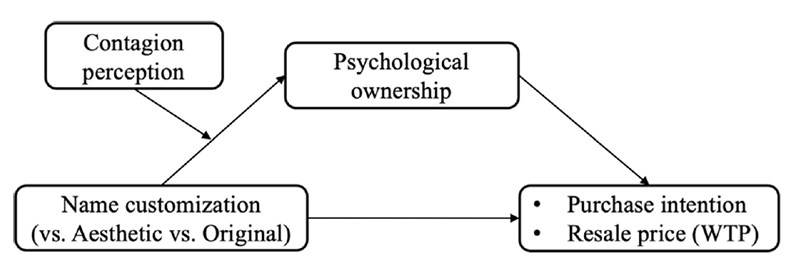
H3: Contagion perception moderates the indirect effect of name customization on consumer responses (purchase intention and resale price) via psychological ownership, such that the negative indirect effect emerges only when contagion perception is high, but disappears when contagion perception is low (i.e., the indirect effect becomes statistically nonsignificant).
The proposed conceptual framework is illustrated in Fig. 1.
Conceptual framework.
4. Method
The study aimed to examine three hypotheses derived from our conceptual framework. First, we tested the main effect of name customization on psychological ownership—specifically, whether name products elicit lower feelings of psychological ownership compared to aesthetic customization or original products. Second, we examined the mediating role of psychological ownership in the relationship between customization type and resale-related outcomes, including purchase intention and resale price. Third, we tested whether the contagion perception moderates this indirect relationship, such that the impact of name customization on resale outcomes via psychological ownership varies by contagion perception.
4.1. Sample, experimental design, and procedure
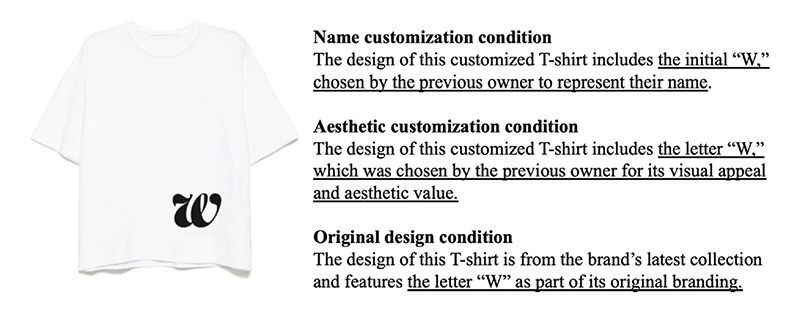
A total of 199 participants (98% female; Mage = 35.66 years) based in the United States were recruited via Prolific. Participants were randomly assigned to one of three between-subjects conditions (name customization vs. aesthetic customization vs. original design). Across all conditions, participants viewed an identical product image (i.e., the same visual stimulus “W” on the T-shirt), and customization type was manipulated only through accompanying listing-style textual descriptions.
We screened data quality using viewing time on the scenario and stimulus page. Respondents who spent more than two minutes on this page were excluded because the materials were brief and fixed, and substantially longer durations are more consistent with interruption (e.g., leaving the survey unattended) than with deeper processing. During revision, we verified that this rule aligned with distribution-based screening: when viewing time was standardized using the full sample (N = 199), all excluded cases met a conventional outlier criterion (|z| > 2). This resulted in a final sample of 185 participants (97.8% female; Mage = 35.95 years) used for analysis.
Participants were informed that they were taking part in an online product evaluation study. They were presented with a scenario in which they were browsing a secondhand online marketplace for a white T-shirt. Participants were then shown a product listing that varied according to the experimental condition and were instructed to carefully review the listing before completing a series of questions.
The stimulus materials consisted of a product image and a short description that manipulated the customization type of the T-shirt. To minimize potential confounds attributable to product design differences, we held the visual design constant across conditions by using the same printed letter (“W”) on the T-shirt in all three versions. What varied was the interpretation of the “W,” which was manipulated through the accompanying product description. In the name customization condition, the T-shirt featured a large “W” explained as representing the previous owner’s initial. In the aesthetic customization condition, the “W” was described as chosen by the previous owner purely for visual appeal and aesthetic value. In the original design condition, the identical “W” was framed as part of the T-shirt’s original branding (see Fig. 2). Thus, the visual presentation of the product remained identical across conditions, and only the textual framing differed to reflect the experimental manipulation.
Stimuli of the study.
After viewing the stimuli, participants completed measures of psychological ownership, contagion perception, perceived resale price, and purchase intention, followed by demographic questions and a brief open-ended feedback item. Participation ended after completion of the survey.
4.2. Measures
To assess the effectiveness of the customization manipulation, participants responded to three items: “The T-shirt was customized,” “The T-shirt was customized with the previous owner's initial,” and “The T-shirt was customized based on the previous owner's aesthetic style.”
Participants indicated the maximum price (in USD) they would be willing to pay for the secondhand T-shirt using a continuous slider. Purchase intention was measured using multiple items adapted from prior research (α=.97; Fuchs & Schreier, 2023; Kim et al., 2023).
Psychological ownership was assessed with three items adapted from prior research (Kim, 2017): “I would feel a high degree of personal ownership of this T-shirt,” “I would feel like I own this T-shirt,” and “I would feel like this is my T-shirt.” Responses were recorded on 7-point Likert scales (α=.95).
To measure contagion perception, participants completed four items adapted from existing contagion research (Held et al., 2024): “The essence of the product feels diluted,” “The essence of the product feels tainted,” “The product doesn’t retain its essential value in my eyes,” and “The product feels like it passes the other person’s essence to me” (α=.90). All items were measured using 7-point Likert scales ranging from 1 (strongly disagree) to 7 (strongly agree).
4.3 Measurements check: the convergent validity and discriminant validity
Prior to hypothesis testing, the validity and reliability of all measurement constructs were assessed. All average variance extracted (AVE) values exceeded the recommended threshold of 0.50, indicating satisfactory convergent validity (Fornell & Larcker, 1981). In addition, Composite reliability (CR) values were also above 0.70, indicating adequate internal consistency reliability (Hair et al., 2019, Table 1). Discriminant validity was also supported, as the square root of the AVE for each construct (purchase intention = .93, psychological ownership = .87, contagion perception = .69) was greater than the corresponding inter-construct correlations, consistent with the Fornell-Larcker criterion (Table 2).

Confirmatory factor analysis
Discriminant validity
4.4. Results and discussion
A series of one-way ANOVAs confirmed the effectiveness of the customization manipulations. Participants in the name (M = 6.43, SD = 1.06) and aesthetic (M = 6.24, SD = .97) conditions perceived the T-shirt designs as significantly more customized than those in the original condition (M = 3.86, SD = 2.14), F(2, 182) = 57.22, p < .001, ηp² = .39. In addition, participants in the name condition (M = 6.59, SD = .98) were significantly more likely to agree that the design included the previous owner’s initial compared to those in the aesthetic (M = 4.44, SD = 2.08) and original condition (M = 3.03, SD = 2.15), F(2, 182) = 61.66, p < .001, ηp² = .40. Perceptions of aesthetic-based customization also varied significantly across conditions, with participants in the aesthetic condition (M = 6.31, SD = .92) reporting greater alignment with the previous owner’s aesthetic style than those in the name (M = 5.92, SD = 1.53) and original condition (M = 3.52, SD = 2.26), F(2, 182) = 50.37, p < .001, ηp² = .36. Collectively, these findings validate the success of the manipulation across all three customization dimensions: name customization, aesthetic customization, original type.
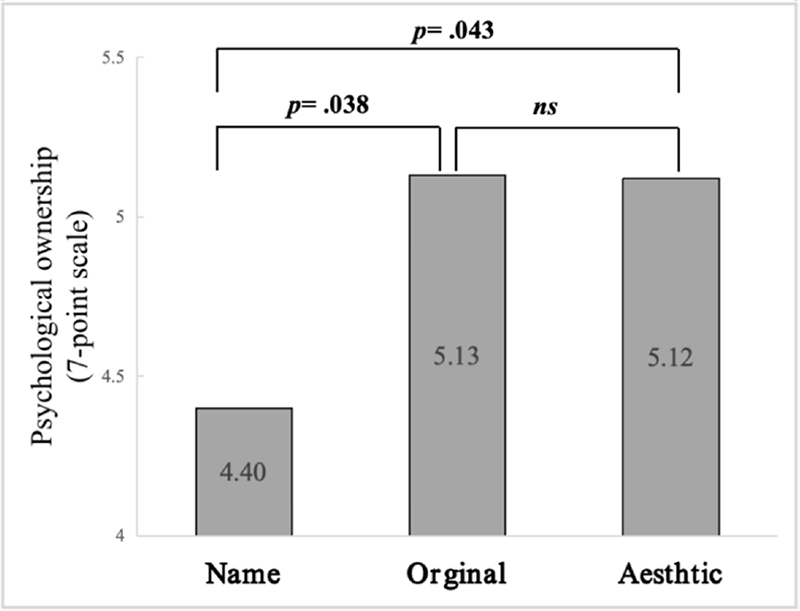
A one-way ANOVA revealed a significant effect of customization type on psychological ownership, F(2, 182) = 4.38, p = .014, ηp² = .04. Participants exposed to name customization reported significantly lower levels of psychological ownership (M = 4.40, SD = 1.73) compared to those in the original design condition (M = 5.13, SD = 1.62; p = .038) and the aesthetic customization condition (M = 5.12, SD = 1.37; p = .043). No significant difference was observed between the original and aesthetic conditions (see Fig. 3). These results provide support for H1, indicating that embedding name-specific cues in product customization undermines consumers’ psychological ownership toward secondhand goods.
Main effect of customization type on psychological ownership.
A one-way ANOVA revealed a significant effect of customization type on resale price for the secondhand T-shirt, F(2, 182) = 3.68, p = .027, ηp² = .04. Participants exposed to name customization reported a significantly lower resale price (M = 10.70, SD = 7.55) than those in the original design condition (M = 14.62, SD = 9.44; p = .027). However, resale price in the aesthetic customization condition (M = 12.86, SD = 7.14) did not differ significantly from either the original condition (p = .493) or the name condition (see Fig. 4). These results indicate that name-based customization reduces consumers’ monetary valuation of secondhand products.
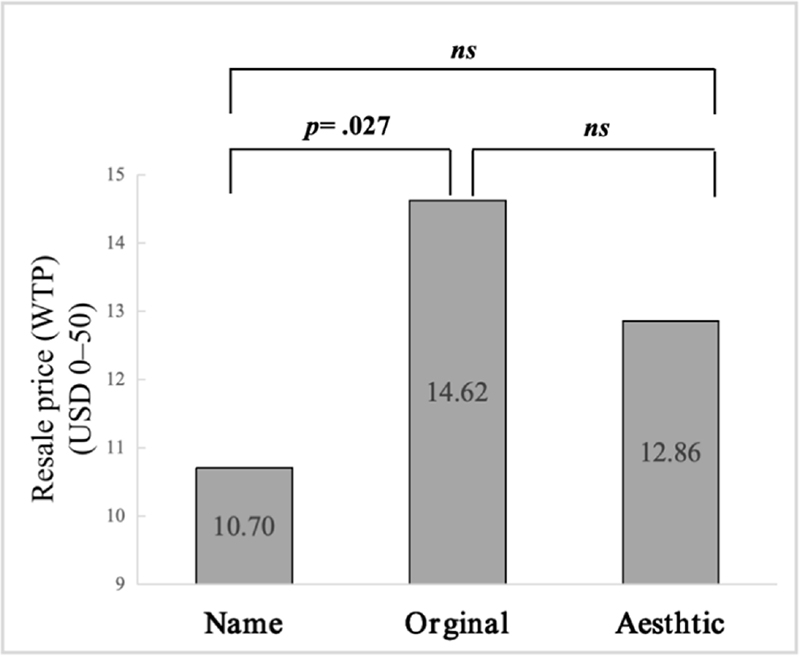
Main effect of customization type on resale price.
A one-way ANOVA revealed no significant effect of customization type on purchase intention, F(2, 182) = .94, p = .392. Purchase intention did not differ significantly across the original design condition (M = 4.01, SD = 2.00), the name customization condition (M = 3.93, SD = 1.89), and the aesthetic customization condition (M = 4.38, SD = 1.91). These results suggest that customization type did not directly influence consumers’ intention to purchase the secondhand product.
To test H2, we examined whether the effect of customization type on consumer responses was mediated by psychological ownership, using PROCESS Model 4 (Hayes, 2017) with 5,000 bootstrap resamples. The customization condition was dummy-coded, with the original design serving as the reference category. Results revealed a significant indirect effect of name customization (vs. original) on resale price (WTP) mediated through psychological ownership (β = −0.78, SE = .41, 95% CI = [−1.68, −.08]). In contrast, the indirect effect of aesthetic customization (vs. original) on resale price (WTP) via psychological ownership was not significant (95% CI = [−.62, .65], see Fig. 5). Similarly, name customization (vs. original) exhibited a significant indirect effect on purchase intention through psychological ownership (β = −0.34, SE = .15, 95% CI = [−.65, −.07]). In contrast, the indirect effect of aesthetic customization (vs. original) on purchase intention via psychological ownership was not significant (95% CI = [−.26, .25], see Fig. 5). This pattern is consistent with the notion that aesthetic customization is more likely to be construed as an anonymous design cue rather than an identity-bearing marker, thereby leaving sufficient psychological space for subsequent consumers to re-appropriate the product as their own. These findings support H2, suggesting that name customization reduces psychological ownership and indirectly lowers resale price (WTP) and purchase intention for secondhand products.
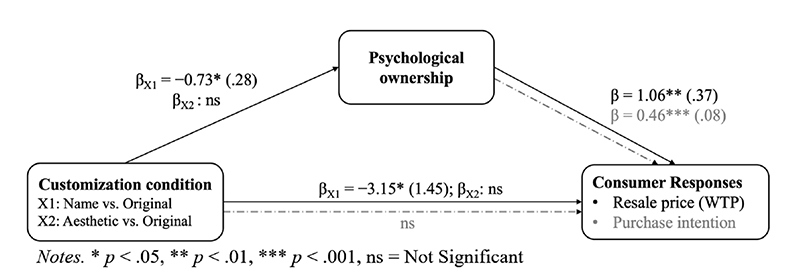
The effects of customization type (name vs. aesthetic vs. original) on resale price and purchase intention through psychological ownership.
Prior to the moderated mediation analysis, we examined whether contagion perception varied by customization type. The results of a one-way ANOVA indicated that contagion perception did not differ significantly across conditions, F(2, 182) = .16, p = .855. This result shows that customization type did not function as a stimulus that directly induced or determined contagion perception. Accordingly, the present research conceptualizes contagion perception as an interpretive response related to how consumers construe and assign meaning to the same customization cue. From this perspective, contagion perception is positioned as a moderating mechanism that explains when the effect of customization type on psychological ownership varies.
To test whether contagion perception moderates the indirect effect of customization type on resale price via psychological ownership, we estimated a moderated mediation model, using PROCESS Model 7 (Hayes, 2017). Results showed that the indirect effect of name customization (vs. original) resale price through psychological ownership varied as a function of contagion perception. The index of moderated mediation was statistically significant (β = −0.43, SE = .27, 95% CI = [−1.06, −.00]), indicating that contagion perception significantly moderated the indirect effect. Conditional indirect effects further revealed that the negative indirect effect of name customization on resale price became stronger as contagion perception increased (see Fig. 6). Specifically, the indirect effect was not significant at low levels of contagion perception (contagion perception = 2.00; 95% CI = [−.83, 1.09]), but became significant at higher levels of contagion perception (contagion perception = 3.75; β = −0.73, SE = .38, 95% CI = [−1.54, −.07]; contagion perception = 5.50; β = −1.49, SE = .73, 95% CI = [−3.04, −.25]). In contrast, the index of moderated mediation for Aesthetic customization (vs. original) was not significant (95% CI = [−.78, .15]), indicating that contagion perception did not moderate the indirect effect of aesthetic customization on resale price through psychological ownership.
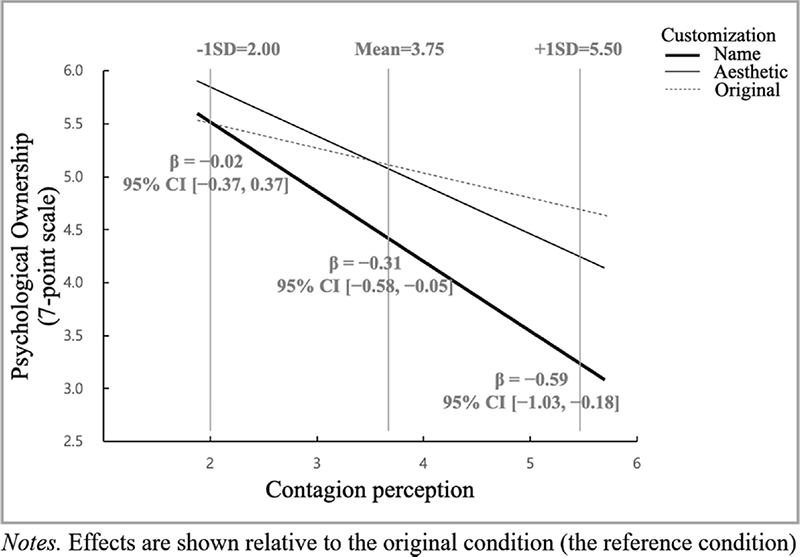
Interaction plot for name customization and contagion perception on psychological ownership.
Similarly, moderated mediation analyses indicated that contagion perception also conditioned the indirect effect of name customization (vs. original) on purchase intention via psychological ownership. The index of moderated mediation was statistically significant (β = −0.19, SE = .10, 95% CI = [−.40, −.01]), indicating that the strength of the indirect effect varied as a function of contagion perception. Examination of conditional indirect effects showed that the indirect effect of name customization on purchase intention was not significant at low levels of contagion perception (contagion perception = 2.00; 95% CI = [−.35, .44]), but became significant and increasingly negative at higher levels of contagion perception (contagion perception = 3.75; β = −0.32, SE = .14, 95% CI = [−.60, −.06]; contagion perception = 5.50; β = −0.65, SE = .24, 95% CI = [−1.15, −.21]). In contrast, the index of moderated mediation for Aesthetic customization (vs. original) was not significant (β = −0.10, SE = .09, 95% CI = [−.30, .07]), indicating that contagion perception did not moderate the indirect effect of aesthetic customization on purchase intention through psychological ownership. A comprehensive summary of all hypothesis tests and statistical results is presented in Table 3 and 4.
Summary of key ANOVA results
Summary of mediation and moderated mediation
5. General Discussion
The present study demonstrates that name customization, while previously shown to enhance ownership and attachment in primary markets, imposes a resale penalty in second-hand markets. Specifically, embedding prior-owner identity cues undermined prospective buyers’ psychological ownership, which in turn lowered purchase intention and reduced transaction value (e.g., willingness to pay / perceived resale value). Moreover, this effect was contingent on contagion perceptions, such that the negative indirect effect via psychological ownership emerged only under high contagion perception. These findings enrich our understanding of how personalization strategies may backfire in resale contexts, complementing prior work on psychological ownership (Kim, 2017) and contamination cues (Argo et al., 2006; Huang et al., 2017).
5.1. Theoretical implications
This research advances the literature on psychological ownership, and contagion perception in several ways. First, it extends psychological ownership theory by clarifying its boundary conditions. While personalization typically strengthens ownership and demand (Pierce et al., 2001; Shu & Peck, 2011), Kim (2017) demonstrates that traces left by previous owners create an “ownership distance effect,” which weakens evaluations of used goods via reduced psychological ownership. Our findings align with Kim (2017) by showing that when prior-owner traces are identity-based (i.e., name customization), the disruption of re-appropriation is especially pronounced.
Second, this study enriches contagion theory by identifying contagion perceptions as a key moderator in resale contexts. Prior work establishes that contagion perception persist even in the absence of objective risk and strongly shape consumer judgments (Huang et al., 2017). Moreover, Huang et al. (2017) provide direct evidence that pathogen threat reduces preferences for used products, while interventions such as familiarity cues or cleansing mitigate this effect. Our results add to this stream by showing that contagion perception interacts with name customization, exacerbating its negative impact on resale outcomes. This highlights how symbolic identity cues and contamination beliefs jointly shape consumer evaluations of secondhand products.
5.2. Managerial implications
The findings also offer several practical implications for firms, especially in fashion markets where customization and resale are both salient. First, the results of this study clearly demonstrate that the choice of customization type matters when products are likely to enter the second-hand market. Identity-based customization, such as name or initial engraving, reduced prospective buyers’ psychological ownership, which in turn lowered purchase intention and resale value in the resale context. In contrast, aesthetic customization did not produce a significant difference from the original design in terms of psychological ownership or second-hand evaluations, and no additional negative effects emerged even when contagion perceptions were high. These findings suggest that when firms seek to offer personalized value while minimizing the risk of value erosion in resale markets, aesthetic customization represents a more practical option than identity-based customization.
Second, name customization functions as a structural risk in second-hand market contexts. Because name engraving directly points to a prior owner’s identity, it interferes with prospective buyers’ re-appropriation of the product, thereby widening ownership distance and weakening psychological ownership (Kim, 2017). Accordingly, resale platforms and secondhand retailers must manage the negative spillovers of identity-based customization. Evidence shows that prior-owner traces widen ownership distance and reduce product evaluations (Kim, 2017). To mitigate this, platforms could: (a) reduce the salience of customization through redesign or refurbishment, (b) emphasize aesthetic customization over name-based customization, or (c) strategically reframe customized elements as signs of uniqueness or heritage.
Finally, our results indicate that the negative indirect effect of name customization on resale outcomes emerges only under high contagion perception. Considering this boundary condition, managers should recognize that consumer resistance to secondhand goods often stems from contagion concerns. Empirical work demonstrates that contagion reduces preferences for used goods but can be alleviated through interventions such as seller familiarity and cleansing rituals (Huang et al., 2017). Building on this, resale platforms should highlight professional cleaning, quality certification, and “renewal rituals” to help consumers overcome contamination concerns and restore psychological ownership of secondhand customized items.
5.3. Limitations and future research
Despite its contributions, this study is subject to several limitations that provide fruitful avenues for future research. First, the final analytical sample consisted predominantly of female participants (97.8%), which limits the generalizability of the findings. Gender differences in contamination sensitivity may shape how customization cues are interpreted. Prior research has shown that women tend to report higher disgust sensitivity than men (Curtis et al., 2004; Olatunji et al., 2007). Given that our proposed mechanism centers on contagion perceptions and identity-linked name cues, it is plausible that the magnitude of these effects may be more pronounced in this sample composition. However, the small number of male participants precludes a direct test of gender-based heterogeneity in the present data. Future research should examine whether similar patterns emerge in more gender-balanced samples and formally test gender as a potential boundary condition to clarify the robustness and scope of the proposed mechanisms.
Second, the current research focused on the negative consequences of name customization in resale markets, emphasizing reduced psychological ownership and heightened contagion perceptions. While this perspective captures the dominant consumer response to personalized identity cues, it does not account for potential conditions under which customization could elicit positive outcomes. For instance, research on positive contagion suggests that association with desirable individuals or groups can enhance product evaluations (Argo et al., 2008). Future studies could investigate whether name customization linked to celebrities, close friends, or aspirational figures may generate positive contagion effects, thereby offsetting or even reversing the resale penalty observed in our findings.
Third, the study relied on a single product category (T-shirts) within an online resale marketplace scenario. Although apparel is a relevant context for examining personalization and contagion perception, it remains unclear whether these effects generalize across other product categories, such as luxury accessories, digital goods, or durable items where resale considerations may differ. Future research should extend the scope of investigation to diverse product domains and explore whether the magnitude of personalization penalties varies by product type, symbolic value, or functional relevance.
And then, the experimental design manipulated customization in a controlled setting, but real-world resale platforms often involve additional contextual factors such as seller reputation, platform guarantees, or visual signs of wear and tear. These factors may interact with name customization and contagion perceptions in complex ways. Future research should incorporate more ecologically valid designs, including field experiments or second-hand data analyses from online resale platforms, to assess the robustness of these effects in naturalistic settings.
Finally, the study primarily examined the moderating role of negative contagion perceptions. However, consumer responses to name customization in secondhand contexts may also be shaped by broader cultural or individual differences, such as contamination sensitivity, need for uniqueness, or identity centrality. Future research could explore these boundary conditions and examine how marketing interventions—such as reframing personalization cues as uniqueness markers or offering decontamination rituals—can mitigate negative contagion perception and enhance consumer acceptance.
References
-
Aglinskas, A., & Fairhall, S. L. (2023). Similar representation of names and faces in the network for person perception. NeuroImage, 274, 120100.
[https://doi.org/10.1016/j.neuroimage.2023.120100]

-
Argo, J. J., Dahl, D. W., & Morales, A. C. (2006). Consumer contamination: How consumers react to products touched by others. Journal of Marketing, 70(2), 81-94.
[https://doi.org/10.1509/jmkg.70.2.081]
-
Argo, J. J., Dahl, D. W., & Morales, A. C. (2008). Positive consumer contagion: Responses to attractive others in a retail context. Journal of Marketing Research, 45(6), 690-701.
[https://doi.org/10.1509/jmkr.45.6.690]
-
Baek, E., & Oh, G.-E. G. (2021). Diverse values of fashion rental service and contamination concern of consumers. Journal of Business Research, 123, 165-175.
[https://doi.org/10.1016/j.jbusres.2020.09.061]
-
Baxter, W. L., Aurisicchio, M., & Childs, P. R. (2016). Materials, use and contaminated interaction. Materials & Design, 90, 1218-1227.
[https://doi.org/10.1016/j.matdes.2015.04.019]
-
Bezançon, M., Guiot, D., & Le Nagard, E. (2019). The role of negative physical contagion in the online purchase of second-hand products. Recherche et Applications en Marketing (English Edition), 34(4), 2-28.
[https://doi.org/10.1177/2051570719881944]
-
Brédart, S. (2017). The cognitive psychology and neuroscience of naming people. Neuroscience & Biobehavioral Reviews, 83, 145-154.
[https://doi.org/10.1016/j.neubiorev.2017.10.008]
-
Brewer, M. B., & Gardner, W. (1996). Who is this "We"? Levels of collective identity and self representations. Journal of Personality and Social Psychology, 71(1), 83.
[https://doi.org/10.1037/0022-3514.71.1.83]
-
Cheng, S. Y., White, T. B., & Chaplin, L. N. (2012). The effects of self-brand connections on responses to brand failure: A new look at the consumer-brand relationship. Journal of Consumer Psychology, 22(2), 280-288.
[https://doi.org/10.1016/j.jcps.2011.05.005]
-
Curtis, V., Aunger, R., & Rabie, T. (2004). Evidence that disgust evolved to protect from risk of disease. Proceedings of the Royal Society B: Biological Sciences, 271(Suppl. 4), S131-S133.
[https://doi.org/10.1098/rsbl.2003.0144]
-
Fornell, C., & Larcker, D. F. (1981). Evaluating structural equation models with unobservable variables and measurement error. Journal of Marketing Research, 18(1), 39-50.
[https://doi.org/10.1177/002224378101800104]
-
Franke, N., & Schreier, M. (2008). Product uniqueness as a driver of customer utility in mass customization. Marketing Letters, 19(2), 93-107.
[https://doi.org/10.1007/s11002-007-9029-7]
-
Franke, N., Schreier, M., & Kaiser, U. (2010). The “I designed it myself” effect in mass customization. Management Science, 56(1), 125-140.
[https://doi.org/10.1287/mnsc.1090.1077]
-
Fuchs, M., & Schreier, M. (2023). Paying twice for aesthetic customization? The negative effect of uniqueness on a product's resale value. Journal of Marketing Research, 60(3), 602-624.
[https://doi.org/10.1177/00222437221128576]
- Hair, J. F., Black, W. C., Babin, B. J., & Anderson, R. E. (2019). Multivariate data analysis. Andover: Cengage.
- Hayes, A. F. (2017). Introduction to mediation, moderation, and conditional process analysis: A regression-based approach. New York: The Guilford Press.
-
Hazée, S., Van Vaerenbergh, Y., Delcourt, C., & Warlop, L. (2019). Sharing goods? Yuck, no! An investigation of consumers’ contamination concerns about access-based services. Journal of Service Research, 22(3), 256-271.
[https://doi.org/10.1177/1094670519838622]
-
Held, I., Valenzuela, A., & Galli, M. (2024). Metaphysical deterrents to providers’ participation in the sharing economy: The role of peer‐to‐peer contagion. Psychology & Marketing, 41(11), 2874-2883.
[https://doi.org/10.1002/mar.22091]
-
Hingston, S. T., & Whelan, J. (2024). What’s mine is mine, what’s yours is yours: Contamination concerns enhance psychological ownership. Journal of Business Research, 178, 114680.
[https://doi.org/10.1016/j.jbusres.2024.114680]
-
Hoorens, V. (2014). What’s really in a name-letter effect? Name-letter preferences as indirect measures of self-esteem. European Review of Social Psychology, 25(1), 228-262.
[https://doi.org/10.1080/10463283.2014.980085]
-
Hristova, Y. (2019). The second-hand goods market: Trends and challenges. Izvestia Journal of the Union of Scientists-Varna. Economic Sciences Series, 8(3), 62-71.
[https://doi.org/10.36997/IJUSV-ESS/2019.8.3.62]
-
Huang, F., & Wong, V. C. (2024). From second-hand to third-hand: Reuse and resale cycle. Journal of Consumer Research, 51(1), 104-113.
[https://doi.org/10.1093/jcr/ucad042]
-
Huang, J. Y., Ackerman, J. M., & Newman, G. E. (2017). Catching (up with) magical contagion: A review of contagion effects in consumer contexts. Journal of the Association for Consumer Research, 2(4), 430-443.
[https://doi.org/10.1086/693533]
-
Huang, L., Feng, W., Zhao, Z., & Zhang, P. (2025). “What I customize is mine, so I take responsibility for it”: Customization enhances socially responsible consumer behaviour through psychological ownership in the sharing economy. Journal of Business Ethics, 1-21.
[https://doi.org/10.1007/s10551-025-06156-w]
-
Jones, J. T., Pelham, B. W., Mirenberg, M. C., & Hetts, J. J. (2002). Name letter preferences are not merely mere exposure: Implicit egotism as self-regulation. Journal of Experimental Social Psychology, 38(2), 170-177.
[https://doi.org/10.1006/jesp.2001.1497]
-
Ju, N. (2025). Exploratory study of consumer craft consumption: Psychological and emotional experiences in shoe and bag decoration. The Korean Fashion and Textile Research Journal, 27(2), 169-179.
[https://doi.org/10.5805/SFTI.2025.27.2.169]
-
Kaiser, U., Schreier, M., & Janiszewski, C. (2017). The self-expressive customization of a product can improve performance. Journal of Marketing Research, 54(5), 816-831.
[https://doi.org/10.1509/jmr.14.0293]
-
Kapitan, S., & Bhargave, R. (2013). Navigating residue sensitivity in the used goods marketplace. Psychology & Marketing, 30(4), 305-317.
[https://doi.org/10.1002/mar.20607]
-
Kim, E., & Baek, E. (2026). When access creates threat: Core customers’ responses to in-house rental services. Journal of Retailing and Consumer Services, 91, 104751.
[https://doi.org/10.1016/j.jretconser.2026.104751]
-
Kim, J. (2017). The ownership distance effect: The impact of traces left by previous owners on the evaluation of used goods. Marketing Letters, 28(4), 591-605.
[https://doi.org/10.1007/s11002-017-9432-7]
-
Kim, N. L., Jin, B. E., & Kim, T. H. (2023). Negative and positive contamination in secondhand fashion consumption: Does culture matter? International Marketing Review, 40(6), 1509-1530.
[https://doi.org/10.1108/IMR-01-2022-0014]
-
Kou, Y., Shuai, Z., & Powpaka, S. (2021). The name effect in customization service: The role of psychological ownership and self-threat. Journal of Service Theory and Practice, 31(4), 493-511.
[https://doi.org/10.1108/JSTP-08-2019-0181]
- Kripke, S. (1980). Naming and necessity. Cambridge: Harvard University Press.
-
Kumar, S., & Khandeparkar, K. (2025). Is it really mine? Contamination concerns for second-hand goods. Journal of Product & Brand Management, 34(8), 1137-1149.
[https://doi.org/10.1108/JPBM-10-2024-5514]
-
LeBel, E. P., & Gawronski, B. (2009). How to find what's in a name: Scrutinizing the optimality of five scoring algorithms for the name‐letter task. European Journal of Personality, 23(2), 85-106.
[https://doi.org/10.1002/per.705]
-
Lessard-Bonaventure, S., & Chebat, J.-C. (2015). Psychological ownership, touch, and willingness to pay for an extended warranty. Journal of Marketing Theory and Practice, 23(2), 224-234.
[https://doi.org/10.1080/10696679.2015.1002341]
-
Liao, S., & Chu, H. (2013). Influence of consumer online resale awareness on purchase decisions: A mental accounting perspective. European Journal of Marketing, 47(10), 1576-1597.
[https://doi.org/10.1108/EJM-12-2010-0665]
-
McCarthy, I. P. (2004). Special issue editorial: The what, why and how of mass customization. Production Planning & Control, 15(4), 347-351.
[https://doi.org/10.1080/0953728042000238854]
-
Montgomery, A. L., & Smith, M. D. (2009). Prospects for personalization on the internet. Journal of Interactive Marketing, 23(2), 130-137.
[https://doi.org/10.1016/j.intmar.2009.02.001]
-
Olatunji, B. O., Williams, N. L., Tolin, D. F., Abramowitz, J. S., Sawchuk, C. N., Lohr, J. M., & Elwood, L. S. (2007). The disgust scale: Item analysis, factor structure, and suggestions for refinement. Psychological Assessment, 19(3), 281-297.
[https://doi.org/10.1037/1040-3590.19.3.281]
-
Pierce, J. L., Kostova, T., & Dirks, K. T. (2001). Toward a theory of psychological ownership in organizations. Academy of Management Review, 26(2), 298-310.
[https://doi.org/10.5465/amr.2001.4378028]
-
Pierce, J. L., Kostova, T., & Dirks, K. T. (2003). The state of psychological ownership: Integrating and extending a century of research. Review of General Psychology, 7(1), 84-107.
[https://doi.org/10.1037/1089-2680.7.1.84]
- Pine, B. J. (1999). Mass customization: The new frontier in business competition. Cambridge: Harvard Business Press.
-
Ribeiro, L. S., Duarte, P. A. O., & Miguel, R. (2017). Online consumer behaviour of mass-customised apparel products: A hierarchy of traits approach. Journal of Fashion Marketing and Management, 21(2), 158-171.
[https://doi.org/10.1108/JFMM-07-2016-0068]
-
Rozin, P., Millman, L., & Nemeroff, C. (1986). Operation of the laws of sympathetic magic in disgust and other domains. Journal of Personality and Social Psychology, 50(4), 703-712.
[https://doi.org/10.1037/0022-3514.50.4.703]
-
Salonen, V., & Karjaluoto, H. (2019). About time: A motivation-based complementary framework for temporal dynamics in Web personalization. Journal of Systems and Information Technology, 21(2), 236-254.
[https://doi.org/10.1108/JSIT-06-2017-0042]
-
Shu, S. B., & Peck, J. (2011). Psychological ownership and affective reaction: Emotional attachment process variables and the endowment effect. Journal of Consumer Psychology, 21(4), 439-452.
[https://doi.org/10.1016/j.jcps.2011.01.002]
- Snyder, C. R., & Fromkin, H. L. (2012). Uniqueness: The human pursuit of difference. New York: Springer Science & Business Media.
-
Song, E. (2021). Digital customized automation technology trends. The Korean Fashion and Textile Research Journal, 23(6), 790-798.
[https://doi.org/10.5805/SFTI.2021.23.6.790]
-
Srinivasan, S. S., Anderson, R., & Ponnavolu, K. (2002). Customer loyalty in e-commerce: An exploration of its antecedents and consequences. Journal of Retailing, 78(1), 41-50.
[https://doi.org/10.1016/S0022-4359(01)00065-3]
- thredUP. (2018). 2018 resale report. thredUP. Retrieved January 9, 2026, from https://cf-assets-tup.thredup.com/resale_report/2018/2018-resaleReport.pdf
- thredUP. (2025). 2025 resale report. thredUP. Retrieved January 9, 2026, from https://cf-assets-tup.thredup.com/resale_report/2025/ThredUp_Resale_Report_2025.pdf
-
Valenzuela, A., Dhar, R., & Zettelmeyer, F. (2009). Contingent response to self-customization procedures: Implications for decision satisfaction and choice. Journal of Marketing Research, 46(6), 754-763.
[https://doi.org/10.1509/jmkr.46.6.754_JMR6D]
-
Von Hippel, E., & Katz, R. (2002). Shifting innovation to users via toolkits. Management Science, 48(7), 821-833.
[https://doi.org/10.1287/mnsc.48.7.821.2817]
-
Wang, L., Zhu, Z., Bastiaansen, M., Hagoort, P., & Yang, Y. (2013). Recognizing the emotional valence of names: An ERP study. Brain and Language, 125(1), 118-127.
[https://doi.org/10.1016/j.bandl.2013.01.006]