
Artificial Intelligence-Based Image-to-Text Extraction and Big Data Analysis of Fashion Brand Design Archives : Focusing on the Louis Vuitton 2022–2024 Collections

©2026 The Korean Fashion and Textile Research Journal(KFTRJ). This is an open access journal. Articles are distributed under the terms of the Creative Commons Attribution Non-Commercial License (http://creativecommons.org/licenses/by-nc/4.0), which permits unrestricted use, distribution, and reproduction in any medium, provided the original work is properly cited.
Abstract
This empirical study extracts brand design archives using big data analysis of designer collections, aiming to review the applicability of artificial intelligence (AI) technology in the fashion design process and related basic data. We collected collection images of Louis Vuitton from Vogue Runway for the S/S and F/W seasons of the last three years (2022, 2023, and 2024). Additionally, we used Describe Picture, an image-to-text AI generation model, to generate text descriptions for each image. Text mining techniques were then applied to derive key co-occurrence and TF-IDF words related to design elements. Network visualization and CONCOR analysis were performed using UCINET-6 to derive the brand design archive. Using Describe Picture, the research identified core features such as silhouette, color, material, pattern, and mood across each brand’s images. Big data analysis revealed that frequently extracted keywords aligned with the brands’ overarching design directions. CONCOR analysis identified four major style clusters, facilitating the derivation of a brand-specific design archive. A comparison between the Louis Vuitton archive and official Vogue Runway descriptions confirmed that the AI-derived elements accurately reflected seasonal characteristics. These findings demonstrate the potential of prompt-based generative AI as a practical tool for effectively analyzing fashion collections and supporting future design development.
Keywords:
collection analysis, big data, design archive prompt clusters, describe picture, generative AI1. Introduction
Artificial intelligence (AI) has emerged as one of the fastest-developing scientific methods for real-world applications in recent years (Anantrasirichai & Bull, 2022). According to a research paper, AI-powered digital transformation is not just a buzzword but a powerful force that fuels innovation, creativity, efficiency, and competitiveness across sectors (Aldoseri et al., 2024). Within this broader context, the fashion industry has increasingly adopted AI technologies, particularly in areas related to design development, trend analysis, and digital content generation.
Recent research suggests that AI technologies are beginning to reshape fashion design practices by supporting designers’ creative workflows rather than replacing human creativity. O’Connell (2024) argues that AI tools in fashion design function as assistive systems that enhance productivity and ideation by processing large volumes of visual and textual data. Among these technologies, generative AI—capable of producing new images, text, and design outputs has gained particular attention for its potential to support early-stage concept development through pattern generation, visual exploration, and stylistic variation.
The creative directors of luxury brands and mass-market fashion retailers can use generative AI to analyze various types of unstructured data in real time, rather than depending solely on market analysis and trend reports to inform designs for the upcoming season's collection, according to an article by McKinsey & Company titled Generative AI: Unlocking the Future of Fashion (Harreis et al., 2023). By leveraging AI-based analytical tools, fashion brands may complement intuition and experience-driven design processes with data-informed insights, allowing for more systematic engagement with historical design elements and stylistic continuity. However, while such reports highlight the practical potential of AI, they often lack methodological transparency and academic validation.
Traditionally, fashion design has relied heavily on designers’ knowledge, visual sensitivity, and accumulated experience. Although recent studies have explored AI as a creative support tool, existing research largely focuses on image generation techniques or prompt engineering strategies, with limited attention given to how fashion brand archives themselves can be analytically extracted, structured, and reused as a resource for design development. As a result, there remains a gap between the growing technical capabilities of generative AI and a systematic understanding of how brand-specific design characteristics can be operationalized within AI-assisted design processes.
Against this background, the present study aims to explore an AI-assisted framework for fashion design development through the analysis of brand collection archives.
This study explores the potential use of artificial intelligence to enhance creativity and efficiency in the field of fashion design by employing image-to-text extraction and big-data analysis to identify recurring brand design elements and to propose an exploratory methodological approach. Through this approach, the study aims to provide designers and brands with insights into the potential of AI as a tool for strategic analysis and creative decision-making.
2. Literature review
Big data is a powerful tool that offers new and exciting opportunities for fashion designers. It is used for different purposes such as understanding consumer behavior, predicting trends, and creating more personalized products (Çetiner, 2024). Fashion design can better meet market demands and brand characteristics while greatly improving the efficiency and quality of fashion design by doing big data analysis (Zhao et al., 2021).
According to Jain et al. (2017), Big data has gained significant importance in the fashion world in the last decade. They further state that the Fashion industry generates and creates various sources of data. All this data comes in various forms, like words, images, etc. Since it is the era of fast fashion, the data is rapidly growing and changing. Hence, this data can be termed as fashion big data as it portrays all the features of big data. An and Park (2020) explore the potential of big data analysis in fashion by applying text mining and semantic network analysis to 29,436 blog posts on jackets, identifying style, color, fabric, and pattern trends, and categorizing them into increasing, decreasing, evergreen, and seasonal clusters. Their study highlights how consumer text data can streamline fashion forecasting and provide practical, consumer-driven design insights. An and Park (2023) developed and applied an AI-based clothing design process within a collaborative industry-university fashion design class, demonstrating that AI tools can support data-driven convergent thinking by enabling students to construct fashion product databases, analyze trending design elements quantitatively, and integrate computational insights into the design development process. Their findings suggest that AI-assisted workflows offer a structured and reproducible approach to the design process that extends beyond the limitations of traditional methods. Song and Lim (2021) investigated perceptions and trends of digital fashion technology through big data analysis of 8,144 online texts collected between April 2019 and April 2021. Using text mining, network analysis, and visualization methods such as word clouds, N-grams, and dendrograms, they identified frequent keywords including fashion, digital, and technology, along with emerging topics such as platforms, digital transformation, and start-ups. Their clustering revealed four thematic groups—fashion, digital technology, start-ups, and AR/VR—emphasizing the growing integration of digital technologies in fashion. The study contributes to understanding consumer and industry perspectives on digital fashion technology and provides a foundation for future research in areas like smart factories and platform-based innovations.
Kim and Lee (2019) examine consumer perceptions of fashion shows by applying big data analysis, text mining, and semantic network analysis to online data collected from Naver and Daum between 2015 and 2018. Their results reveal that while consumer interest initially centered on visual aspects such as models and clothing, it later shifted toward recognizing the value of designers and brands. The study highlights the evolving role of fashion shows as both marketing tools and indicators of brand image, providing a theoretical framework for applying big data in fashion industry research and strategy. Lee et al. (2021) applied semantic network analysis and CONCOR to over 15,000 news articles to examine discourse surrounding smart fashion factories. Their big data approach revealed key themes such as automation, unmanned and intelligent operations, and public concerns regarding job loss, hacking, and machine malfunction. By analyzing large-scale media data, the study demonstrated how public perception shapes the direction of digital transformation in the fashion industry. This highlights how big data text analysis can capture societal narratives and industry challenges, providing a model for applying similar methods to fashion trends and design studies. An and Park (2018) applied big data text analysis and semantic network analysis to over 38,225 blog posts to evaluate fashion design elements and emotional responses. By mapping the relationships between design elements (e.g., pattern, color, style, fit) and sentiment terms (e.g., trendy, casual, slim), the study demonstrated how big data can systematically capture consumer perceptions and inform design evaluation in fashion. Kim and Lee (2018) examined fashion industry trends shaped by the convergence of big data and artificial intelligence during the Fourth Industrial Revolution. Their study highlighted applications such as data-driven decision-making tools (e.g., Edited, Stylumia), personalized services (e.g., StitchFix, Thread), AI-powered retail platforms (e.g., Botshop, Lyst), and digital fashion design (e.g., Ivyrevel). The findings demonstrate how big data combined with AI enhances personalization, retail innovation, and design processes, underscoring its central role in the rapidly evolving fashion industry. DuBreuil and Lu (2020) compared traditional human-based forecasting (WGSN) with big-data-driven forecasting (EDITED) by analyzing 20 paired womenswear trend forecasts in the U.S. market. The findings suggest the overall feasibility and the great potential of using big data tools to aid the fashion creation of new products.
A brand archive in fashion is a collection of a brand's past work, including garments, sketches, photographs, fabric samples, and other materials that record the brand's design history over time. These archives are not simply storage spaces, they are actively used as creative and strategic resources within fashion companies (Vacca & Vandi, 2023). The concept of brand heritage helps explain why archives matter: a brand's history, when consistently communicated, adds meaning and value to its current identity (Urde et al., 2007). In this sense, archives serve both as reference tools for designers and as storytelling assets that communicate a brand's cultural value and authenticity to consumers (Petrov, 2021), reinforcing the kind of heritage-driven identity that Crewe (2017) identifies as central to how fashion brands construct meaning and distinction.
Looking back at past collections for design inspiration is a well-established practice in the fashion industry. Many major fashion houses, including Chanel and Dior, have built formal archive systems where designers regularly study historical pieces to develop new collections that remain consistent with the brand's visual identity (Pecorari, 2021). At Gucci, for example, creative director Alessandro Michele drew extensively from the brand's archive from the 1960s to 1980s, reinterpreting past silhouettes and prints into a commercially successful and critically recognized aesthetic direction (Pecorari, 2019). Beyond design, archives have also become important marketing tools. Brands such as Dior and Chanel have used their archives to develop exhibitions and heritage campaigns that communicate exclusivity and cultural authority to consumers (Martin & Vacca, 2018; Pecorari, 2019).
With the growth of digital technology, brand archives have become more accessible and more widely used. The digitization of archival content has made it easier to search, share, and apply historical design knowledge — not only within companies but also for researchers and the public (Pecorari, 2019). More recently, artificial intelligence has begun to be applied to fashion archives, offering new ways to extract, classify, and reinterpret design elements from large image collections (Al-Ghamdi & Yusuf, 2026). However, while AI shows strong potential in identifying visual patterns, it does not always accurately capture the cultural meaning embedded in specific design details, highlighting the need for more systematic and methodologically transparent approaches (Al-Ghamdi & Yusuf, 2026).
Recent studies have further shown that design elements embedded in fashion images can also be computationally extracted and analyzed in a structured way. Kiapour and Piramuthu (2019) demonstrated that deep convolutional neural networks can capture brand-specific visual features beyond logos, including color patterns, textures, and silhouettes, identifying the visual cues that define brand identity. Hsiao and Grauman (2017) proposed an unsupervised method to discover stylistic patterns directly from large fashion image collections without manual labelling, revealing recurring structures in silhouette, color, and composition. Meng (2025) similarly applied multi-view image fusion to automatically classify core garment elements such as shape, texture, and color across collections at scale. Collectively, these studies demonstrate that visual fashion data, when processed computationally, can yield structured, brand-specific design patterns, pointing to the potential of fashion brand image archives as a meaningful resource for AI-assisted design analysis.
Despite growing interest in both text-based computational analysis of fashion data and AI-based visual feature extraction from collection imagery, a systematic investigation into the integration of brand archives as a source for generating text prompts, subsequently analyzed through computational text mining techniques, has remained unexplored. The present study addresses this gap by proposing a methodological pipeline that combines AI-based image-to-text extraction with text mining analysis to systematically build and analyze fashion brand design archives, offering a structured and reproducible approach to identifying brand-specific design characteristics.
3. Research methodology
The purpose of this study is to analyze fashion design big data of designer collections, and examine AI utilization technology in the fashion design process, and provide related basic data. By integrating AI-powered tools with Big Data analysis, this study investigates how AI can extract and interpret fashion design elements, ultimately contributing to a more efficient and innovative design process. This research seeks to establish AI as a creative collaborator rather than merely a technological tool, demonstrating its capacity to enhance ideation, streamline workflows, and introduce new approaches to fashion design processes.
The overall framework of the study is presented in Fig. 1, which outlines the sequential research procedure adopted in this research. In this study, data were collected from the spring/summer (S/S) and fall/winter (F/W) collections of Louis Vuitton, covering the years 2022, 2023, and 2024.
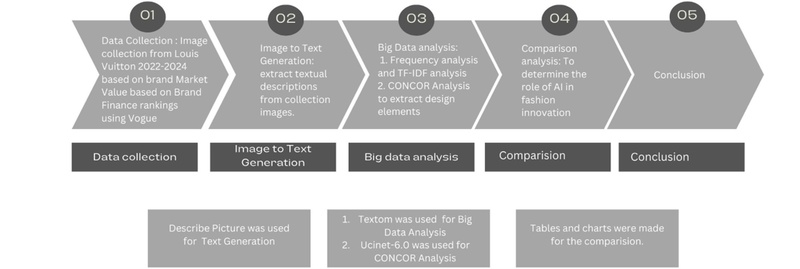
Research flowchart.
The brands were selected based on the 2024 "Top 10 Most Valuable Apparel Brands 2024" ranking published by Brand Finance, a globally recognized consultancy specializing in brand valuation and strategy. Brand Finance is known for its rigorous and objective methodology in assessing brand market value, financial performance, and consumer perception. Their reports are based on empirical data and market analysis, ensuring that the rankings are both accurate and trustworthy. (Brand Finance, 2024b)
While Louis Vuitton's top ranking in the Brand Finance 2024 report confirms its global market standing (Brand Finance, 2024a), the brand was selected for its deeply archival approach to design. Founded in Paris in 1854, Louis Vuitton has accumulated over 170 years of documented design history, with its signature Monogram canvas continuously reinterpreted across successive creative directors — including Marc Jacobs, Nicolas Ghesquière, Virgil Abloh, and Pharrell Williams — each adapting archival codes while retaining the brand's core visual structure (Don-Alvin Adegeest, 2025; Louis Vuitton, 2024a). This archival orientation is central to the brand's design identity; upon joining the house, Ghesquière drew directly on historical details from vintage trunks, quilting patterns, and trunk hardware, translating these into contemporary collections (WWD, 2014).
As Ghesquière has stated, his work at Louis Vuitton is built on "extraordinary heritage and a constant focus on innovation" (Louis Vuitton, 2024b, para. 3). Louis Vuitton is therefore selected not only for its commercial prominence, but because its design practice is consistently and demonstrably grounded in archival reference, making it a highly appropriate case for a study focused on extracting and analyzing brand design characteristics through AI-based methods.
The Collection images from Designer collections were selected because they follow a consistent structure—Spring/Summer (S/S) and Fall/Winter (F/W)—providing seasonally organized data. These collections emphasize brand identity, making them suitable for extracting meaningful prompts for generative AI. Designer brands typically release full runway collections that are concept-driven and professionally documented, offering high-quality visual references.
Collection images were obtained from Vogue Runway, a globally renowned fashion platform. Vogue's reputation for providing up-to-date, accurate, and curated content ensures the authenticity and reliability of the images selected for this study. A total of 384 images were ultimately collected from Louis Vuitton S/S and F/W, 2 seasons, over 3 years.
Images were then processed using AI Describe Picture, which extracts textual descriptions from images based on object recognition, mood analysis, and contextual interpretation. Describe Picture was selected for Image-to-prompt generation due to its rapid responses and the advantage of being freely accessible at the time of the experiment, making it efficient for generating descriptive prompts. An AI-powered tool at the time of the experiment. Article by SaaS AI Tools suggests that Describe Picture allows users to explore details and narratives within Images, offering insights into elements and visuals, such as styles, symbols, and themes (SaaS AI, 2024).
According to the AI Describe Picture website, its image-to-text feature includes AI deep analysis of image content, precise extraction of visual features, and artistic styles (Describe Picture 2024). A total of 1991 prompts were produced using the fashion images. Fig. 2 shows Describe AI, image to generation. Only images were uploaded into the AI Describe Picture in the image to prompt feature. The output prompts were generated in a descriptive format in natural language. No input instructions were needed for prompt generation because of its prompt-to-image generation feature, making it easier to use the application.
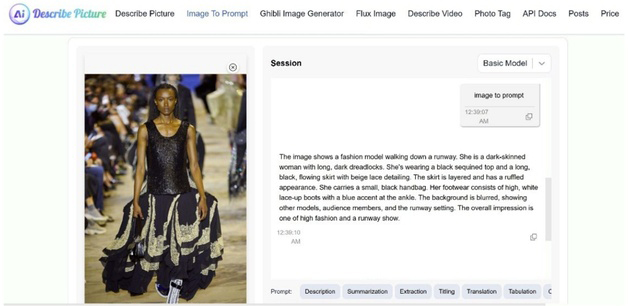
AI describe picture. https://describepicture.org
In this study, Textom (The IMC, 2023) was used for big data analysis. With the development of information and communicationtion, the spread of high-performance IT devices and mobile devices is increasing, and a myriad of data is being generated and shared in real-time. As a result, the use of big data is being expanded in various fields, and data from website search statistics and social media are analyzed for market forecasting and product development, and economic value-creation effects are expected (Eom & Oh, 2017).
Each season was uploaded separately, including all 3 years: 2022, 2023, and 2024. These three years were selected due to being the most recent years with both S/S and F/W collections at the time of data collection. Each seasonal collection typically consists of approximately 50 to 70 images per season, resulting in a combined total of around 170 to 200 images from 3 years of a single brand. This volume of visual data was deemed sufficient to conduct an analysis. Therefore, limiting the scope to three years ensured a manageable yet representative dataset. Data cleaning and morphological analysis were conducted to derive meaningful words for research analysis. For data cleaning, morpheme analysis, and data pre-processing were conducted. In the morpheme analysis stage, the analysis column was selected, and morphological analysis based on the CoreNLP library was applied. Part-of-speech tagging criteria were set to extract meaningful linguistic elements such as nouns, verbs, and adjectives. As a result, non-essential connecting words—such as “is,” “and,” and “are”—were automatically filtered out. In the data pre-processing phase, cleansing options such as duplicate removal were applied. Using the content-based deduplication feature, exact duplicate entries in the selected column were removed. This ensured that repeated text entries did not distort the keyword frequency analysis, thereby enhancing the clarity and accuracy of the results. The collected data was analyzed to identify the frequency of keywords, which were then compared using TF-IDF, a metric that highlights the significance of specific terms within the text. CONCOR analysis was performed using Ucinet-6 (Borgatti et al., 2002) to detect structural patterns and clusters within the network, offering a comprehensive understanding of the relationships between significant terms. In this study, CONCOR analysis was conducted using the top 100 words from the matrix analysis.
4. Analyzing and discussing the result
4.1. S/S collection
The top 100 words that appear with the highest frequency in Louis Vuitton S/S collection data are shown in Table 1. In the frequency analysis of the Louis Vuitton Spring/Summer (S/S) collection, the top ten most commonly occurring words were: black (203), white (103), light (81), orange (69), texture (61), boot (56), beige (56), skirt (55), color (55), and style (48). These terms highlight the most visible components in the dataset, reflecting dominant color usage, materials, garment types, and stylistic features within the visual data.

Frequency analysis and TF-IDF of Louis Vuitton S/S
When comparing these results to the TF-IDF analysis—which identifies words that are not only frequent but also uniquely significant to the dataset—the top-ranked terms included: orange (68), white (66), light (57), brown (57), lace (57), beige (55), leather (55), style (54), texture (54), and color (54). The presence of both frequent and distinctive terms like white, light, orange, beige, style, texture, and color in both analyses suggests that these elements are not only widely used but also central to the identity of the S/S collection. In contrast, terms such as black, boot, and skirt, though appearing in the top frequency list, were absent from the top TF-IDF list. On the other hand, terms like lace, leather, and brown ranked highly in TF-IDF but did not appear in the frequency top ten.
To identify the interconnected structure among key terms, the top 100 most frequent words were selected. This study applied CONCOR analysis to these words to explore the relationships within the overall trends observed in the seasonal collections of the brands.
The results of network analysis using Ucinet-6 (Borgatti et al., 2002 for Louis Vuitton S/S are shown in the Fig. 3. The network visualization analysis represents text as individual nodes, with node size indicating text frequency. The thickness of the connecting lines between nodes reflects the strength of their relationship, whereas thicker lines signify a higher co-occurrence frequency between texts.
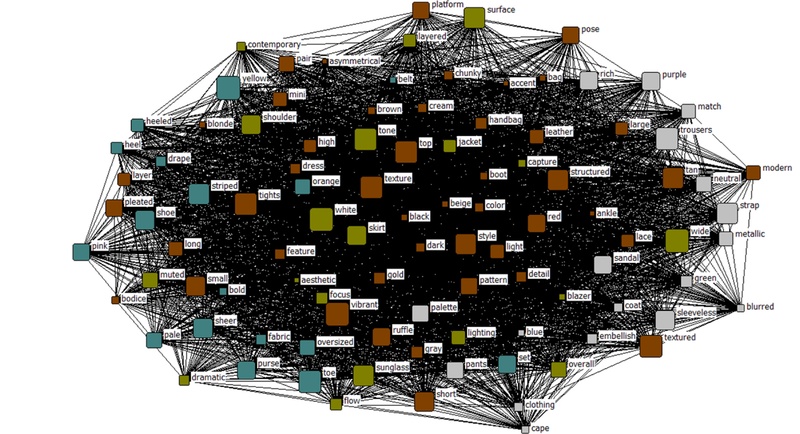
Network visualization of top appearance words for Louis Vuitton S/S.
The CONCOR visualization of the Louis Vuitton S/S collection, as shown in Fig. 4, reveals distinct four groups of keywords, each representing different aspects of the collection. The clusters are named Style A, B, C, and D because the components of each cluster represent the design elements that define each style. Style A contains words like (pink, bold, fabric, heel, drape, striped, set, yellow, heeled, sheer, pale, shoe, orange, belt, oversized). Style B revolves around words like (textured, vibrant, pose, pattern, pleated, modern, handbag, structured, color, small, dark, gray, bodice, feature, leather, light, beige, detail, large, asymmetrical, high, tan, boots, platform, pose, accent, ankle, brown, gold, dress, detail, red, chunky). Style C consists of words (purple, sandal, neutral, trousers, clothing, sleeveless, rich, metallic, green, cape, embellish, palette, blue, blurred, coat, strap, pants, match) and Style D contains words (wide, lighting, mute, layered, focus, sunglasses, shoulder, flow, contemporary, blazer, white, dramatic, jacket, overall, tone, aesthetic, skirt, aesthetic, capture).
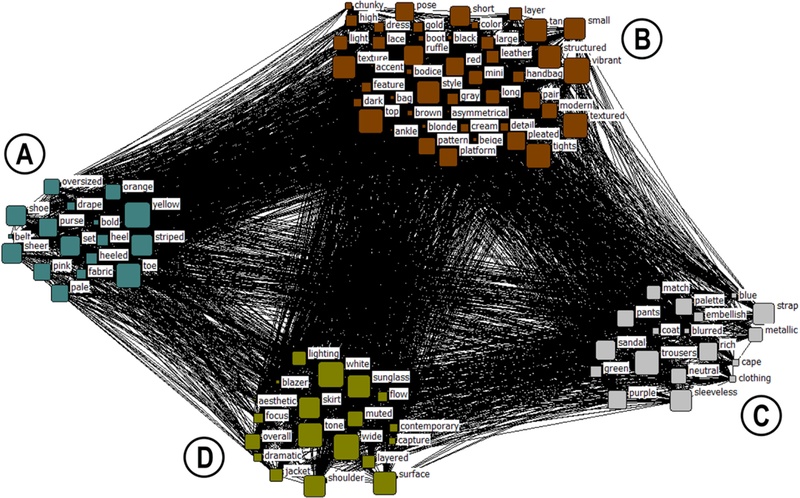
Visualize the CONCOR analysis of top appearance words for Louis Vuitton S/S.
Following the CONCOR analysis, the resulting Styles A, B, C, and D were systematically organized into a structured tables of design elements to facilitate further interpretation. The classification of design elements was conducted and reviewed manually by three fashion practitioners, including a Master’s degree and two doctoral degrees, to ensure the accuracy, consistency, and relevance. The overlapping terms between the style clusters and the top 10 words derived from frequency and TF-IDF analyses were highlighted using block marking.
Word category for Louis Vuitton S/S shown in Table 2 reveals that, in terms of silhouettes, Style A mentions oversized silhouette. Style B has silhouette-related words like asymmetrical and short. In contrast, silhouette-related words were not identified in Style C. Style D features a wide overall. Style A places the strongest emphasis on color. It includes colors such as pink, yellow, orange, pale, and yellow, indicating a vibrant and playful palette. Style B, in contrast, contains dark, gray, beige, red, vibrant, light, brown, and tan, showing a heavier use of darker and neutral tones with occasional brightness. Style C features purple, neutral, green, and blue, suggesting a mix of soft and rich tones. Style D focuses on more muted shades with white, muted, and tone, emphasizing minimalism and softness. When it comes to texture, all the styles seem to have limited words. Style A contains the word sheer for texture. Style B has words, texture, and textured. Style C contains the word metallic for texture. All the styles also have limited words for patterns. Style A contains the word striped. For textiles, Style A contains the word fabric whereas Style B contains words like leather. When it comes to items, Style B includes dress and tights, Style C, which has more words compared to others, lists cape, trousers, coat, and pants, and Style D mentions blazer, jacket, and skirt. Accessories in Style A include belt, shoe, heel, heeled, and purse. Style B by handbag, boots, gold, and ankle. Style C contains sandals, and Style D has sunglasses.
Louis Vuitton S/S word category
Overall, Style A is characterized by key material and pattern elements, primarily centered on the categories of color and accessories. Style B demonstrates a broad distribution across multiple categories, including silhouette, color, texture, textile, item, detail, accessory, mood, and others. Style C shows concentration in color and item words, while Style D presents a relatively balanced distribution across silhouette, color, item, detail, accessory, mood, and others. These results reflect the differentiated lexical composition of the four clusters identified through CONCOR analysis.
Based on the design elements derived from each style cluster, an exploratory comparison was conducted with the seasonal collection reviews provided by Vogue Runway.
According to Vogue’s review, the 2022 S/S collection for Louis Vuitton was rich in contrasts: beaded slip dresses worn with jeans, tailcoat-style denim jackets, and playful capes ranging from vampiric elegance to club-ready flair. A bias-cut slip dress paired with jeans, or a denim jacket cut with the proportions of a tailcoat. Capes were another motif throughout the season. One cape in polka dots came with a jaunty jabot; others cut diagonally across the body leaned toward going-out tops suitable for a club, not a ball; and a few appearing at the “threshold of couture” shimmered from what looked like feathery, frayed chiffon. The designs reflected the blurry lines between past, present, and future, artifice and authenticity.
Louis Vuitton 2023 S/S, designers experimented with scale and size, enlarging everyday fashion details like zippers, key holders, wallet chains, and leather tags. Clothes featured oversized elements, such as giant zipper pulls, exaggerated necklines, padded hips, and straps resembling sporty panniers. Materials and fabric techniques were also important in this collection. Easy-walking boots, external utility pockets, and playful yet commanding details were the highlights. Embroidered Tweed, wavy texture were seen. Some pants were woven with elastic to create a wavy, 3D texture before being printed.
Louis Vuitton 2024 S/S collection emphasized fluid silhouettes and material experimentation. Flowing skirts in mousseline and charmeuse were paired with silk blouses, bomber jackets, and wide leather belts, creating a contrast between softness and structure. The collection introduced new shapes, including off-the-shoulder corseted tops with high-waisted pants, sail-like shirts with trailing trains, and a beaded jumpsuit designed with the relaxed movement of a slip dress. Additionally, jackets that appeared to be traditional tweed were revealed to be crafted from laser-cut fine materials, highlighting technical innovation and refined surface treatment.
Comparing each Style cluster with Louis Vuitton collections from Vogue Runway overviews reveals several alignments. Each cluster reflected some design elements that were specific to the season. For the S/S collections, garment items such as capes, jackets, pants, and skirts appeared consistently across both analyses. For example, the prominence of capes in Style C directly corresponds to the 2022 S/S collection, where capes were described as a recurring motif ranging from polka-dot versions with jabots to chiffon styles at the “threshold of couture.” Similarly, jackets and structured tailoring identified in Style D align with the 2024 S/S collection’s refined laser-cut jackets and bomber silhouettes. The inclusion of pants in Styles B and C reflects the 2023 S/S experimentation with three-dimensional textured party pants and structured forms, while long sweeping skirts in 2024 correspond with Style D’s wide silhouettes and layered detailing. The orange, yellow, and pale colors in Cluster A, along with accessories like belts and purses, were key colors and items that were featured in the Vogue S/S 2024 runway article. The striped pattern in cluster A was a prominent design feature in the 2024 S/S collection. Leather with asymmetrical silhouettes from Cluster B seemed to be prominent in the S/S 2023 Collection featured in the Vogue article. Black, grey, red, and brown were frequently seen in S/S 2023, along with items such as dresses and tights. Metallic Texture with embellished detail from Cluster C was a design element seen in S/S 2022. Cluster D with white, muted tones and items such as blazer, jacket, and skirt were in the S/S 2022 Collection. Sunglasses as accessories were also prominent in the S/S 2022 collection.
Together, the four clusters capture the range of design characteristics present across Louis Vuitton's S/S collections from material-driven construction and garment variety to color expression and tailored refinement. Each cluster represents a distinct but recurring design direction, and their consistent appearance across three seasons suggests that these groupings reflect stable characteristics of the brand's design identity. Notably, Style B, centered on leather, asymmetrical silhouettes, and dark textured materials — appeared as the most structurally consistent cluster, suggesting that material richness and construction are the most stable dimensions of Louis Vuitton's S/S identity, while color and accessory expression in Style A functions as the more variable, season-specific layer.
4.2. F/W collection
The top 100 words that appear with the highest frequency in Louis Vuitton F/W collection data are shown in Table 3. black (142), light (102), white (102), gray (96), texture (78), pattern (75), color (72), dark (72), wear (68), and boot (64). These results suggest a visual dominance of core color tones and recurring material/textural elements, reflecting key design components in the collections.
Frequency analysis and TF-IDF of Louis Vuitton F/W
The TF-IDF analysis, which highlights words that are not just frequent but also uniquely significant within this specific dataset, offered a slight difference. The top-ranked terms by TF-IDF were: gray (82), light (79), dark (73), black (70), pattern (68), white (64), beige (64), color (63), high (63), and texture (62). While some overlap with the frequency list exists (e.g., black, light, gray, pattern, texture, white, color), TF-IDF highlights terms like beige and high that are more distinctive within this dataset, indicating their specific importance in defining the identity of the F/W collection. By comparing both analyses, certain core words (black, white, light, gray, texture, pattern) are both frequent and distinctive, others such as boot and wear, were highly frequent. Words like beige, high, and style stood out more prominently in the TF-IDF, suggesting a crucial role in F/W collection.
The results of the network analysis and CONCOR visualization for Louis Vuitton's F/W collection are shown in Fig. 5 and 6. It reveals several distinct groups of keywords that represent key themes in the collection. In Style A, words like (vibrant, winter, silver, architectural, minimalist, embellished, print, exhibit, top, white, mini, mood, jacket, overall, bright, accent, emphasize, asymmetric, texture, bag, look, bright, fur, long, drape, aesthetic, fall, shoe, bad, skirt, aesthetic). The most prominent Style B has words (muted, sophisticated, silhouette, focus, match, color, taupe, sandal, gold, rich, coat, palette, handbag, subtle, stone, red, structured, belt, blazer, knit, oversized). Style C contained (crop, wide, layer, pants, scarf, floral, leg, neutral, trousers, shirt) and Style D contains words like (sweater, detail, gray, leather, boot, lighting, light, high, pleated, beige, texture, dark, length, dark, brown, geometric, knee, small, length, cream, dress, black, blue, midi, navy, contemporary, dramatic, carry, sleeve, ankle, glove, pair, style, contrast, sleeve, style).
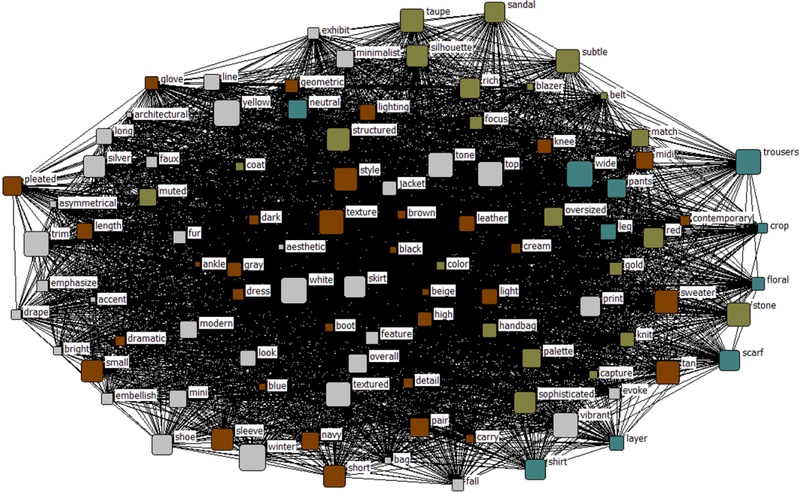
Network visualization of top appearance words for Louis Vuitton F/W.
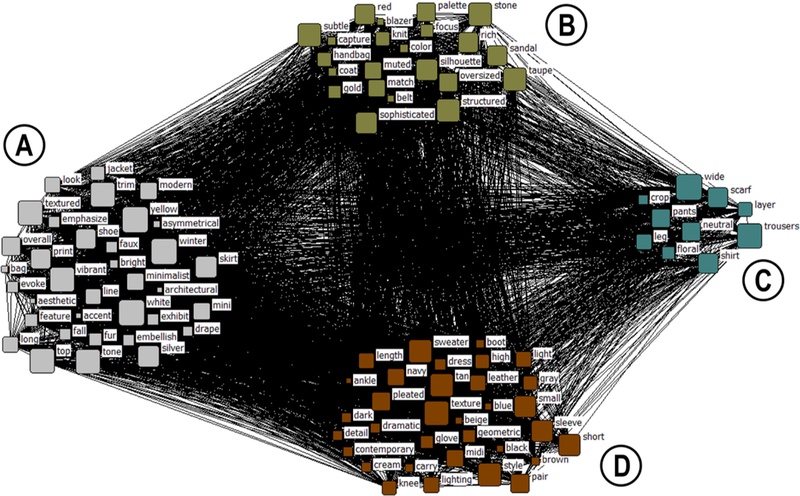
Visualize the CONCOR analysis of top appearance words for Louis Vuitton F/W.
Word category for Louis Vuitton F/W shown in Table 4 reveals that, for silhouettes, Style A contains words such as mini, long, asymmetrical, and overall. Style B, for silhouette, contains words like oversized and silhouette. Style D contains midi and short. Style C contains the words crop and wide. Most of the Styles have an emphasis on colors. For Style A, we see words such as vibrant, white, silver, and bright. Style B, on the other hand, contains words like taupe, red, color, palette, and muted. Style D also has prominent words in color, such as gray, dark, brown, black, blue, navy, cream, and beige. Style C only contains one word for a color that is neutral. All the Styles lack words for texture, pattern, and textiles. the only few words seen are Style A contains textile such as fur. Style B contains textiles such as knit. Style D contains the word leather for textile. for pattern Style A contains print and Style D contains geometric, and Style C contains word floral for patterns. For Details, Style A contains words like embellished and drape, while Style B lacks any words. Style D contains words like detail, pleated, and sleeve. Style C, such as a layer. For items, Style A contains a few words like top, jacket, and skirt. Style B contains the words coat and blazer. Style D contains words such as sweater and dress. Style C contains the words pants, trousers, and shirt. For accessories, Style A contains words such as bag and shoe. Style B, on the other hand, has more words compared to other styles; it contains words such as sandal, handbag, belt, and gold. Style D also contains a few words, such as boot, glove, and ankle. whereas Style C contains a single word, scarf. When it comes to Mood, Styles A, B, and D contain few words. Style A has words like mood, minimalist, and aesthetic. On the other hand, Style B has words like sophisticated, rich, and subtle. Style D has words like dramatic and contemporary. other words such as exhibit, look, bad, winter in Style A, focus, match, structure, etc. in Style B, lighting, carry, style in Style D.
Louis Vuitton F/W word category
Overall, it is observed that Style A demonstrates a wide distribution across silhouette, color, item, detail, accessory, mood, and others. Style B shows concentration in color, item, accessory, and mood words. Style D presents the most extensive range of color words and includes consistent representation across silhouette, textile, item, detail, accessory, mood, and others. Style C displays a more limited distribution, primarily centered on silhouette and item words. These findings indicate differentiated lexical characteristics across the four F/W clusters identified through CONCOR analysis.
Based on the design elements derived from each style cluster, an exploratory comparison was conducted with the seasonal collection reviews provided by Vogue Runway.
According to Vogue review, Louis Vuitton F/W 2022, rugby shirts and chunky sweaters casually thrown over elegant eveningwear, androgynous oversized tailoring, and playful mix-and-match styling was seen.
Structured jackets, elongated coats, and strong shoulders, at the same time, softer counterpoints like fluid skirts, lace insets, and decorative detailing were the highlight. Cropped jackets were paired with longer hemlines or high-waisted trousers, and shorter dresses were styled with oversized outerwear, producing dynamic proportion play. Tweeds, jacquards, leather, metallic finishes, and lace were seen. The color palette leaned toward darker neutrals, black, charcoal, navy, punctuated by jewel tones. Sculptural coats and tailored blazers framed the collection. Accessories, including structured leather bags and substantial boots, were seen. Some silhouettes were softened in knits and tweeds, making them more wearable.
For the Fall/Winter 2023, Structured tailoring, defined shoulders, and elongated proportions signaled authority were seen. Coats and jackets were sharply cut, sometimes cinched at the waist, sometimes left to fall cleanly and straight. Fluid skirts, delicate blouses, and subtle draping. Cropped tops were paired with high-waisted skirts or trousers; mini lengths were offset by tall boots; and slim silhouettes were contrasted with broader outerwear. Tweeds, leather, jacquards, and technical fabrics appeared throughout, sometimes combined within a single look. The palette leaned toward autumnal neutrals like black, gray, brown, deep navy. Materials like camel coat that looked like wool was actually embossed leather, and leather jeans had hand-painted pinstripes decorated with sequins. Dresses with three-dimensional metal embroidery, were seen.
Louis Vuitton 2024 presented its design characterized by a blend of futuristic elements and subtle deconstruction. Silhouettes referenced historical dress without feeling costume-like. Medieval and Renaissance influences appeared in structured bodices, elongated lines, and decorative details, yet they were rendered in technical fabrics and modern constructions. Outerwear was a major focus. Tailored coats with sculptural shoulders, abbreviated capes, and precisely cut jackets demonstrated strong architectural control. Metallic threads, embroidery, and textured fabrics added depth and dimension. Boots and accessories grounded the collection, reinforcing wearability despite its theatrical references. The A-line leather jacket, round-collar blouse and sweater vest, and black patent pants were instantly recognizable.
Comparing each Style cluster with Louis Vuitton collections from Vogue Runway overviews reveals several alignments. Each cluster reflected some design elements that were specific to the season. For the F/W collections, garment items such as coats, blazers, dresses, sweaters, trousers, and jackets appeared consistently across both analyses. For example, the prominence of coat and blazer in Style B directly corresponds to the F/W 2022 and F/W 2023 collections, where structured jackets, elongated coats, and tailored blazers were central. The keywords oversized and silhouette in Style B align with Vogue’s references to oversized tailoring and sharply cut outerwear. Similarly, the dominance of dark and neutral tones in Style D, including gray, dark, brown, black, blue, navy, cream, and beige, corresponds directly to the darker neutral palettes emphasized across F/W 2022 and F/W 2023. Leather, identified in Style D, was repeatedly mentioned in the Vogue reviews, including leather coats and leather jeans. Accessories such as boot and glove in Style D align with the substantial boots described in F/W 2022 and the grounding accessories noted in F/W 2024.
The keywords embellished and drape directly correspond to Vogue’s references to embroidery, metallic threads, and textured fabrics. The presence of fur in Style A aligns with faux fur elements mentioned in F/W 2023. Accessories such as bag and shoe correspond to structured leather bags and footwear highlighted in the reviews. Style C, which includes crop, wide, neutral, pants, trousers, shirt, and layer, reflects the layered constructions and proportion contrasts described in F/W 2022 and F/W 2023. The term neutral aligns with the repeated emphasis on dark and restrained seasonal palettes.
Overall, coats and blazers from Style B were strongly visible in F/W 2022 and F/W 2023; dark neutral color terms and leather from Style D were consistently present across all F/W seasons; embellished and bright elements from Style A appeared in decorative and metallic detailing; and layered construction from Style C aligned with the structural styling emphasized throughout the F/W collections.
Together, the four clusters capture the range of design characteristics present across Louis Vuitton's F/W collections from structured outerwear and material grounding to embellished expression and proportion play. Each cluster represents a distinct but recurring design direction, and their consistent appearance across three seasons suggests that these groupings reflect stable characteristics of the brand's cold-weather design identity. Notably, Style D, centered on dark neutral colors, leather, and structural details such as pleating and sleeve construction, appeared as the most consistently populated cluster, suggesting that material depth and color restraint form the most stable dimensions of Louis Vuitton's F/W identity, while the theatrical and embellished vocabulary of Style A functions as the more variable, season-specific layer.
5. Conclusion
This study explored the extraction of brand design archives through fashion design big data analysis of designer collections and examined the applicability of AI technology within the fashion design process.
To address this question, we collected collection images of Louis Vuitton from Vogue Runway for the S/S and F/W seasons of the last three years (2022, 2023, and 2024) and used Describe Picture, an image-to-text-based AI generation model, to generate text descriptions for each image. Text mining techniques were then applied to derive key co-occurrence and TF-IDF words related to design elements, and network visualization and CONCOR analysis were performed using UCINET-6 to derive the brand design archive.
The conclusions of the study are as follows:
Describe AI was shown to effectively extract keywords related to design elements such as silhouette, color, material, pattern, and mood from each brand collection fashion image. Through big data analysis, it was confirmed that design elements related to the color, silhouette, mood, and items that the brand pursues as a whole were ranked high. This suggests that the Image-to-Text generative AI model tends to preferentially analyze the corresponding design elements from the presented images. As a result of CONCOR analysis of the top-appearing words, four meaningful style clusters were derived for each brand, and brand design archives corresponding to each style could be extracted. As a result of comparing each design element of the Louis Vuitton design archive, which was selected as a representative search brand, with the official collection overview provided by Vogue Runway, it was confirmed that design elements specialized for the corresponding season were included. This confirms the reliability of the analysis in capturing key seasonal themes reflected in expert fashion overviews. Through this, it was possible to effectively analyze the characteristics of brand design from brand collection fashion images using the generative AI program and to examine the possibility of utilizing it for continuous creative design development.
Beyond its methodological contribution, this study extends important theoretical conversations. It advances the concept of the brand design archive from a passive repository to an active, computationally accessible resource. While prior scholarship has positioned brand archives primarily as tools for heritage communication and marketing (Pecorari, 2019; Urde et al., 2007), this study proposes that archives can be disaggregated into design constants — elements that recur consistently across seasons — and seasonal variables — elements that shift with each collection. This distinction offers a new conceptual framework for understanding how brand identity operates across time, complementing existing models of brand heritage (Urde et al., 2007) and brand DNA (Koh & Kim, 2024). Furthermore, the study contributes to the growing literature on AI as a creative support tool in fashion design (Jin et al., 2024; O'Connell, 2024). While existing research has explored AI primarily for image generation and trend prediction, this study demonstrates a distinct application — using AI not to generate new designs, but to read and structure existing ones — positioning generative AI as an analytical instrument for capturing and preserving design knowledge within fashion organizations.
This study has several limitations that should be considered when interpreting the findings. First, the analysis focused on a single luxury fashion brand, Louis Vuitton, which limits the generalizability of the results to brands with different design identities. In addition, the use of only the top 100 frequently occurring words derived from big-data analysis narrowed the vocabulary available for representing design elements and may have excluded less frequent yet conceptually significant design features. Second, the image-to-text extraction relied on a single generative AI model (Describe Picture), and the role of AI in this study was primarily limited to descriptive data generation rather than autonomous analytical interpretation. Third, fashion collection images were collected exclusively from Vogue Runway. Although Vogue Runway is a widely recognized and authoritative archive, reliance on a single platform may have limited curatorial perspectives and excluded alternative visual interpretations. Furthermore, the validation of AI-generated outputs relied primarily on qualitative comparison with Vogue Runway editorial reviews rather than quantitative evaluation measures such as inter-rater reliability or classification accuracy metrics. Future research may further strengthen methodological rigor by incorporating structured expert evaluation protocols, multiple archival sources, and diverse AI models, thereby enhancing analytical reliability and broadening interpretative perspectives.
Additionally, while AI-extracted design elements can provide structured archival references, designers should treat such findings as a source of inspiration rather than prescriptive guidelines, as over-reliance on recurring patterns risks limiting creative experimentation rather than supporting it.
This study exploratorily verified that the systematic use of AI tools can provide practical support for designers in the analysis, extraction, and interpretation of collection data, thereby confirming the potential for generating fashion design ideas. These findings suggest that AI can function not merely as an auxiliary tool but as a catalyst for creative ideation. Furthermore, the results highlight the potential for developing AI service systems that analyze the design characteristics of individual fashion brands and propose ideas accordingly, offering practical applications in professional design settings.
Acknowledgments
This is part of a master’s thesis.
References
-
Aldoseri, A., Al-Khalifa, K. N., & Hamouda, A. M. (2024). AI-powered innovation in digital transformation: Key pillars and industry impact. Sustainability, 16(5), 1790.
[https://doi.org/10.3390/su16051790]

-
Al-Ghamdi, S. M., & Yusuf, N. (2026). Digital heritage and fashion: Preserving cultural identity through AI and virtual archives. Digital Scholarship in the Humanities, 41(2), 581-593.
[https://doi.org/10.1093/llc/fqag008]
-
Anantrasirichai, N., & Bull, D. (2022). Artificial intelligence in the creative industries: A review. Artificial Intelligence Review, 55, 589-656.
[https://doi.org/10.1007/s10462-021-10039-7]
-
An, H., & Park, M. (2018). A study on the evaluation of fashion design based on big data text analysis: Focus on semantic network analysis of design elements and emotional terms. Journal of the Korean Society of Clothing and Textiles, 42(3), 428-437.
[https://doi.org/10.5850/JKSCT.2018.42.3.428]
-
An, H., & Park, M. (2020). Approaching fashion design trend applications using text mining and semantic network analysis. Fashion and Textiles, 7, 34.
[https://doi.org/10.1186/s40691-020-00221-w]
-
An, H., & Park, M. (2023). An AI-based clothing design process applied to an industry-university fashion design class. Journal of the Korean Society of Clothing and Textiles, 47(4), 666-683.
[https://doi.org/10.5850/JKSCT.2023.47.4.666]
- Borgatti, S. P., Everett, M. G., & Freeman, L. C. (2002). Ucinet for Windows: Software for social network analysis. Harvard, MA: Analytic Technologies. https://sites.google.com/site/ucinetsoftware/home
- Brand Finance. (2024a, September 9). Resilience and innovation drive double-digit brand value growth in the apparel sector. Brand Finance. Retrieved March 10, 2025, from https://brandfinance.com/press-releases/resilience-and-innovation-drive-double-digit-brand-value-growth-in-the-apparel-sector
- Brand Finance. (2024b, June). Luxury & premium brands 2024. Brandirectory. Retrieved March 10, 2025, from https://brandirectory.com/reports/luxury-and-premium/2024
-
Çetiner, M. (2024). The role of big data analysis in fashion design. Sanat ve Tasarım Dergisi, 34, 97-119.
[https://doi.org/10.18603/sanatvetasarim.1515756]
-
Crewe, L. (2017). The geographies of fashion: Consumption, space, and value. London: Bloomsbury Academic.
[https://doi.org/10.5040/9781474286091]
- Describe Picture. (2024). AI image-to-text generation tool. Describe Picture. Retrieved April 25, 2025, from https://describepicture.org
-
DuBreuil, M., & Lu, S. (2020). Traditional vs. big-data fashion trend forecasting: An examination using WGSN and EDITED. International Journal of Fashion Design, Technology and Education, 13(1), 68-77.
[https://doi.org/10.1080/17543266.2020.1732482]
-
Eom, K. H., & Oh, R. K. (2017). A study on the importance of fashion curation service design based on big data: Mainly with Korean male life style in their 30s-40s. Journal of the Korean Society of Design Culture, 23(4), 559–570.
[https://doi.org/10.18208/ksdc.2017.23.4.559]
- Don-Alvin Adegeest. (2025, December 30). Louis Vuitton marks 130 years of its Monogram with heritage-led collections. FashionUnited. Retrieved March 10, 2025, from https://fashionunited.uk/news/fashion/louis-vuitton-marks-130-years-of-its-monogram-with-heritage-led-collections/2025123085513
- Harreis, H., Roberts, R., Te, K., & Koullias, T. (2023). Generative AI: Unlocking the future of fashion. New York: McKinsey & Company.
-
Hsiao, W.-L., & Grauman, K. (2017). Learning the latent "look": Unsupervised discovery of a style-coherent embedding from fashion images. 2017 IEEE International Conference on Computer Vision (ICCV) (pp. 4213-4222). Venice, Italy: IEEE.
[https://doi.org/10.1109/ICCV.2017.451]
-
Jain, S., Bruniaux, J., Zeng, X., & Bruniaux, P. (2017). Big data in fashion industry. IOP Conference Series: Materials Science and Engineering, 254(15), 152005.
[https://doi.org/10.1088/1757-899X/254/15/152005]
-
Jin, Y., Yoon, J., Self, J. A., & Lee, K. (2024). AI as a catalyst for creativity: Exploring the use of generative approach in fashion design for improving their inspiration. In C. Gray, E. Ciliotta Chehade, P. Hekkert, L. Forlano, P. Ciuccarelli, & P. Lloyd (Eds.), Design research society conference 2024 proceedings (pp. 1-16). Boston, USA: Design Research Society.
[https://doi.org/10.21606/drs.2024.680]
-
Kiapour, M. H., & Piramuthu, R. (2019). Brand > logo: Visual analysis of fashion brands. In H. L. Roediger III, & F. I. M. Craik (Eds.), Lecture notes in computer science: Computer vision – ECCV 2018 workshops (pp. 12-20). Cham: Springer International Publishing.
[https://doi.org/10.1007/978-3-030-11015-4_2]
-
Kim, H., & Lee, J. (2018). Fashion industry trends in the era of big data and artificial intelligence. Fashion Business, 22(5), 45-57.
[https://doi.org/10.12940/jfb.2018.22.5.45]
-
Kim, H., & Lee, J. (2019). Consumer perception of fashion shows using big data analysis and semantic network analysis. Journal of the Korean Society of Clothing and Textiles, 43(4), 525-538.
[https://doi.org/10.5850/JKSCT.2019.43.4.525]
-
Koh, S., & Kim, J. (2024). A study on fashion communication methodology for building fashion brand identity. Fashion Business, 28(1), 68–82.
[https://doi.org/10.12940/jfb.2024.28.1.68]
-
Lee, S.-E., Ju, N., & Lee, K.-H. (2021). Visioning the future of smart fashion factories based on media big data analysis. Applied Sciences, 11(16), 7549.
[https://doi.org/10.3390/app11167549]
- Louis Vuitton. (2024a). A legendary history. Louis Vuitton. Retrieved March 10, 2025, from https://us.louisvuitton.com/eng-us/magazine/articles/a-legendary-history
- Louis Vuitton. (2024b). Nicolas Ghesquière. Louis Vuitton. Retrieved March 10, 2025, from https://us.louisvuitton.com/eng-us/magazine/articles/nicolas-ghesquiere
- Martin, M., & Vacca, F. (2018). Heritage, archives, and knowledge development in fashion retail. In F. Vacca, & P. Bertola (Eds.), Fashion futures (pp. 45-62). London: Routledge.
-
Meng, F. (2025). Visual design element recognition of garment based on multi-view image fusion. International Journal for Simulation and Multidisciplinary Design Optimization, 16, 5.
[https://doi.org/10.1051/smdo/2025003]
-
O'Connell, M. (2024, September 21). The role of Open AI in fashion design: Transforming creativity through innovation?. Zenodo.
[https://doi.org/10.5281/zenodo.13823922]
-
Pecorari, M. (2019). Fashion archives, museums and collections in the age of the digital. Critical Studies in Fashion & Beauty, 10(1), 3-29.
[https://doi.org/10.1386/csfb.10.1.3_7]
-
Pecorari, M. (2021). Fashion remains. London: Bloomsbury Academic.
[https://doi.org/10.5040/9781350074798]
-
Petrov, J. (2021). Fashion, history, museums: Inventing the display of dress. London: Bloomsbury Visual Arts.
[https://doi.org/10.1080/03612112.2020.1787588]
- SaaS AI. (2024). Describe Picture: AI image-to-text generation tool. SaaS AI. https://describe.pictures/
-
Song, E., & Lim, H. (2021). Perceptions and trends of digital fashion technology: A big data analysis. The Korean Fashion and Textile Research Journal, 23(3), 380-389.
[https://doi.org/10.5805/SFTI.2021.23.3.380]
- The IMC. (2023). TEXTOM: Big data analysis solution (Version 6.0). The IMC Co., Ltd. https://textom.global/
-
Urde, M., Greyser, S. A., & Balmer, J. M. T. (2007). Corporate brands with a heritage. Journal of Brand Management, 15, 4-19.
[https://doi.org/10.1057/palgrave.bm.2550106]
-
Vacca, F., & Vandi, A. (2023). Fashion archive as metamedium: Unfolding design knowledge through digital technologies. Connectivity and creativity in times of conflict: Cumulus Antwerp 2023 conference proceedings (pp. 379-382). Antwerp, Belgium: Cumulus Association.
[https://doi.org/10.26530/9789401496476-074]
- Socha, M., & Iredale, J. (2014, April 14). The Ghesquière effect. WWD. Retrieved March 20, 2025, from https://wwd.com/fashion-news/designer-luxury/the-ghesquire-effect-7632573/
-
Zhao, L., Liu, S., & Zhao, X. (2021). Big data and digital design models for fashion design. Journal of Engineered Fibers and Fabrics, 16.
[https://doi.org/10.1177/15589250211019023]