
All-at-Once vs. One-by-One: Exploring Consumer Responses to Different Modes of Presenting Color Options in Online Fashion Retailing

©2025 The Korean Fashion and Textile Research Journal(KFTRJ). This is an open access journal. Articles are distributed under the terms of the Creative 52 Commons Attribution Non-Commercial License (http://creativecommons.org/licenses/by-nc/4.0), which permits unrestricted use, distribution, and reproduction in any medium, provided the original work is properly cited.
Abstract
In online fashion retailing, effectively presenting product information significantly influences consumer perceptions and behaviors. This research explored how different modes of presenting color options, specifically one-by-one versus all-at-once, affect consumer responses. Through two experimental studies employing a between-subjects design, this research investigated the mechanisms by which presentation modes influence consumers’ approach intentions, focusing on the mediating roles of processing fluency and perceived variety, and examining the moderating role of the need for uniqueness (NFU). Study 1 shows that simultaneously presenting color options (all-at-once) significantly increases perceived variety, subsequently enhancing consumers' approach intentions toward the retailer. Study 2 further revealed a sequential mediation process in which the all-at-once presentation facilitated higher processing fluency, thereby enhancing perceived variety and ultimately strengthening approach intentions. Importantly, this effect is moderated by NFU: Consumers with lower NFU benefit more from the fluent processing of simultaneous presentations, whereas those with higher NFU exhibit no significant differences between presentation modes. Theoretically, this study extends existing knowledge on visual merchandising by clarifying the cognitive mechanisms (processing fluency and perceived variety) underlying consumers’ reactions to product displays while highlighting the influence of individual differences (individaul differences in NFU.). Practically, these findings provide valuable insights for online fashion retailers to strategically choose presentation modes tailored to their target customers and optimize visual merchandising to enhance consumer engagement and purchase behaviors.
Keywords:
product presentation, processing fluency, perceived variety, need for uniqueness (NFU), approach intentions1. Introduction
Online shopping has become an indispensable part of daily life, serving as a primary consumption channel for many individuals. Unlike traditional brick-and-mortar retail, however, online environments prevent consumers from physically examining products, creating a heightened reliance on digital cues for decision-making. As a result, effectively communicating product information in clear and engaging ways has become a critical task for online retailers (Yang & Choi, 2013; Qu & Baek, 2024). Every aspect of the online shopping interface must be deliberately designed to guide consumer attention and facilitate the decision-making process that leads to purchase. This is especially true in the domain of online fashion retailing, where visual presentation significantly influences consumers’ purchase intentions and overall evaluations (Baek et al., 2021; Kim & Lennon, 2008).
This research focuses on how color options for a single fashion products are displayed in online retail environments. In practice, there are largely three types of presentation formats for product color options, each differing in visual clarity and navigational structure. First, in the separate-page format without a color chart, each color variation is listed as an individual product page with no visual indicator (e.g., color swatches) of alternative options. Users must manually browse or search to discover other colors (see Fig. 1a). Second, the chart-guided format with redirect, while offering a visual chart of color options (e.g., swatches), redirects users to a separate image for the selected variation (see Fig. 1b). Third, the all-at-once format presents all color variations simultaneously on a single screen, typically arranged side by side or in a grid, enabling direct visual comparison (see Fig. 1c).
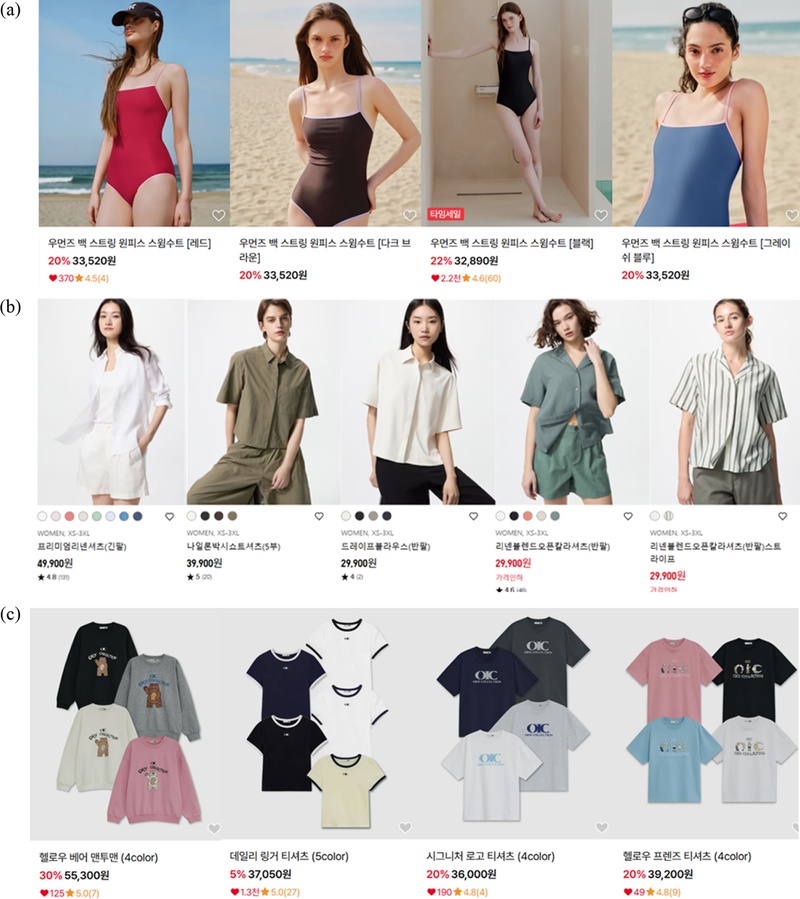
Three common color presentation modes in online fashion retailing. (a) separate pages without a color chart: each color option appears on a distinct product page with no visual indication of other available colors; (b) chart-guided format with redirect: a color selector is provided, but choosing a color opens a separate page for details; (c) all-at-once color display: all color variations are shown simultaneously on a single screen, allowing immediate visual comparison. Source: Musinsa, search results for “우먼즈 백스트링”, https://www.musinsa.com/search/goods?keyword=우먼즈+백스트링 (accessed Oct 22, 2025).
While all three formats are commonly used in online fashion retail, our research compares only the second and third presentation modes. The first mode, in which no visual indication of alternative colors is provided, offers limited visibility into the full product assortment and is generally regarded as suboptimal from a user experience perspective. In contrast, the second and third formats both provide access to the same information (i.e., the full range of color options) but differ in terms of visual accessibility and cognitive processing load. Thus, comparing these two formats allows us to isolate the effects of presentation structure (sequential vs. simultaneous) while holding informational content constant. This distinction is especially relevant given that color plays a critical role in fashion purchases, where consumers are particularly sensitive to visual detail (Wilson et al., 2001).
Previous research has explored the presentation of multiple products on a single screen from various perspectives. Notably, Deng et al. (2016) demonstrated that horizontally displaying product assortment enhances consumers' processing fluency and perceived variety, influencing product choices as horizontal layouts are generally easier to process than vertical ones. Lee et al. (2024) found that presenting images that stimulate high mental imagery processing at the beginning of the shopping experience is more effective in increasing mental imagery processing and purchase intentions than presenting these images at the end. However, prior studies have largely overlooked how different presentation modes for color options, particularly within the context of a single product, may affect consumers’ perceptions and decision-making processes. Addressing this gap, the present study investigates how color presentation formats influence cognitive and behavioral responses in online fashion shopping.
Meanwhile, it is essential to consider individual differences in how visual stimuli are processed. This research therefore examines the moderating role of Need for Uniqueness (NFU), defined as an individual's desire for unique products or designs (e.g., Simonson & Nowlis, 2000). This trait is particularly relevant because a consumer's NFU level influences their product choices (Zaggl et al., 2019). From a cognitive perspective of processing fluency, when consumers pursue uniqueness, they may prefer products presented in unique environments. Furthermore, when unique products are associated with familiarity or predictability, they tend to be processed more smoothly and are perceived as even more unique, which may drive consumers to seek out such products (Winkielman et al., 2003).
Taken together, the research raises the following questions:
- 1. Do presentation modes of color options (one-by-one vs. all-at-once) influence perceived variety?
- 2. How do presentation modes of color options (one-by-one vs. all-at-once) influence consumers’ perceptions and approach intentions?
- 3. How does NFU influence the effect of presenting color options (one-by-one vs. all-at-once) on consumers’ perceptions and approach intentions?
The following section is structured to address the research questions outlined above. First, a comprehensive literature review will be conducted to develop the study's hypotheses and construct a research model. Subsequently, two experiments will be performed to test the hypotheses and provide empirical evidence. Finally, the study concludes with a discussion of the results and offers suggestions for future research.
2. Literature review
2.1. Product presentation modes of product options in online shopping environments
Visual merchandising in online fashion platforms plays a pivotal role in influencing consumer perceptions and behaviors, particularly given the absence of physical product interaction (Baek et al., 2021; Kim & Lennon, 2008). The visual arrangement of product options serves not only as a communication tool but also as a perceptual cue that influences cognitive fluency and aesthetic appreciation. Among the many visual attributes that retailers manipulate, color is a particularly salient dimension in fashion consumption (Wilson et al., 2001), as it conveys both functional and symbolic meanings. Consumers often use color to express individuality, evoke emotions, and make associative judgments about brand identity and product quality (Labrecque & Milne, 2013).
To accommodate diverse consumer preferences, online retailers frequently offer multiple color options for a single product. These options are typically presented in varying formats: simultaneously (all-at-once) or sequentially (one-by-one). Despite the prevalence of these practices, few studies have examined how presentation modes shape consumer perceptions and decision-making within a single product context. Most prior work has concentrated on category-level assortment, such as cross-product variety or shelf arrangements (e.g., Sarantopoulos et al., 2019; Townsend & Kahn, 2014; Vanbergen et al., 2020), rather than on intra-product variation. This leaves an important gap in understanding how consumers process information when viewing multiple color variants of the same product.
From a managerial standpoint, understanding consumer response to color presentation modes is particularly relevant as online retailers strive to optimize user experience and visual merchandising strategies. As consumers browse online catalogs, their ability to process and compare color options efficiently may influence key outcomes such as perceived variety, product attractiveness, and purchase intention. Therefore, the structure and clarity of color presentation become critical levers in shaping consumer engagement. As retailers increasingly experiment with different formats to showcase available options, research is needed to investigate which presentation strategies are most effective, and for whom. The current study addresses this gap by examining how presentation format (one-by-one vs. all-at-once) affects consumers’ psychological and behavioral responses.
2.2. Perceived variety and its impact on approach intentions
For the product assortment, perceived variety refers to consumers’ subjective perception of diversity within the set of offered items, which may not necessarily correspond to the actual number of products presented (Rooderkerk & Lehmann, 2021). Even with the same number of options, their presentation can significantly shape perceived variety. Showing all color alternatives at once expands the perceptual field, reduces cognitive effort, and facilitates comparison, thereby heightening the perception of variety (Cowan, 2010; Goodman & Malkoc, 2012).
Information integration theory supports this view, suggesting that simultaneous exposure facilitates holistic processing of information, enabling consumers to consider multiple attributes at once (e.g., Anderson, 1981; Jiang et al., 2024). In fashion contexts, this mechanism is particularly relevant, as consumers rely heavily on visual comparison. Structured and coherent displays—such as horizontally aligned assortments—have been shown to enhance perceived variety and increase product engagement (Deng et al., 2016; Ye et al., 2018).
Higher perceived variety has been associated with more favorable consumer responses. When perceived variety is high, consumers report greater satisfaction, stronger purchase intentions, and a higher likelihood of approaching the retailer (Kahn & Louie, 1990; Townsend & Kahn, 2014). Even subtle layout changes, such as visual grouping, can shape perceptions of assortment richness and satisfaction with the decision process. Thus, perceived variety functions as both a cognitive and affective cue that strengthens approach motivation.
Based on these theoretical foundations, we hypothesize:
H1. The all-at-once presentation of color options (vs. one-by-one) will increase perceived variety.
H2. Perceived variety will increase approach intentions toward the retailer.
2.4. The mediating role of processing fluency
Processing fluency refers to the ease with which consumers process external stimuli, particularly in terms of metacognitive mental effort (Novemsky et al., 2007; Schwarz, 2004). It significantly shapes consumer judgments, brand attitudes, and product evaluations (Lee & Labroo, 2004; Winkielman et al., 2003). In online shopping environments—where physical interaction with products is absent—visual fluency becomes especially important, as it influences how effortlessly consumers can evaluate and compare product information (Mosteller et al., 2014).
Visual fluency is closely tied to how product options are presented. Drawing from Gestalt theory, consumers tend to process visual elements holistically rather than in isolation (Holbrook & Moore, 1981; Veryzer & Hutchinson, 1998), enabling quick recognition of patterns and facilitating fluent processing. Horizontally structured assortments, for instance, support parallel scanning and reduce mental load, thereby improving fluency and contributing to more efficient decision-making (Deng et al., 2016). Importantly, recent research suggests that processing fluency and perceived variety are interrelated rather than independent.
Moreover, Pieters et al. (2010) did not directly measure processing fluency, their findings suggest that design complexity—which refers to the organization of visual elements in an aesthetically pleasing and structured manner—can enhances both attention to the ad and its comprehensibility. From a processing fluency perspective, such an organization could potentially enhance the ease with which information is processed, even in visually dense displays. Fluent visual experiences make it easier for consumers to compare options and simulate choice scenarios, thereby enhancing perceived variety (Deng et al., 2016; Reber et al., 2004).
While previous research, such as Deng et al. (2016), highlights the influence of display orientation (horizontal vs. vertical) on processing fluency, their manipulation primarily addresses spatial layout differences that affect eye movement patterns during visual search. In contrast, our study focuses on the mode of item presentation within a consistent horizontal layout, specifically comparing simultaneous presentation of all products at once (all-at-once) with sequential, individual presentation (one-by-one), such as showing one product alongside its color options one at a time. Recent empirical research has demonstrated that the verbal simultaneous presentation improves working memory efficiency and recall performance compared to that of sequential presentation (Ordonez et al., 2022). Although this study did not directly measure processing fluency, these findings suggest that all-at-once presentation may facilitate smoother cognitive processing, which aligns with our focus on processing fluency in consumer product display.
By examining these different presentation modes, our study aims to deepen understanding of how presentation style influences processing fluency and perceived product variety. In contrast, disfluent presentations—such as sequential or cluttered displays—may increase perceived complexity and hinder the perception of variety. In the context of online fashion retailing, enhancing processing fluency through optimized product presentation not only leads to more favorable evaluations but also amplifies the perception of variety. This sequential effect supports our hypothesis that fluency mediates the impact of color presentation mode on perceived variety, which subsequently drives approach intentions.
H3: Processing fluency will mediate the effect of the presentation modes of color options on perceived variety, leading to approach intentions.
2.5. The moderating effect of need for uniqueness (NFU)
NFU refers to individuals’ motivation to express their identity by acquiring products that differentiate them from others (Tian et al., 2001). High-NFU consumers actively seek uncommon or distinctively designed products, often avoiding options that are widely adopted or perceived as mainstream (e.g., Simonson & Nowlis, 2000; Zaggl et al., 2019).
NFU also shapes how consumers interpret and process visual information. While the prior sections described how processing fluency enhances perceived variety and approach behavior, these effects may not be universal. Consumers with high NFU may not favor fluent or visually efficient presentations if they perceive them as too common or lacking uniqueness cues. Conversely, low-NFU individuals may benefit more from fluent visual layouts that allow for easy comparison and reduced cognitive effort (Winkielman et al., 2003).
An essential point is considering the relationship between NFU and subjective processing fluency. The consciously experienced aspect of processing fluency allows individuals to observe their fluency through internal metacognitive feedback mechanisms (Winkielman et al., 2003; Wurtz et al., 2008). From the mechanism of processing fluency from the cognitive perspective, Winkielman et al. (2003) explained that high processing fluency is often associated with positive environmental traits, such as familiarity, safety, predictability, or prototypicality, and reflects successful cognitive activity, such as the ease of processing stimuli.
From this perspective, a “one-by-one” presentation may signal exclusivity by requiring more mental effort and allowing for more focused attention on each option, appealing to high-NFU consumers. In contrast, an “all-at-once” presentation offers fluency and clarity that align with the preferences of low-NFU consumers. Thus, NFU is expected to moderate the effects of presentation mode on processing fluency, and in turn, on perceived variety and approach intentions.
H4. NFU will moderate the relationship between the presentation modes of color options and processing fluency, which will sequentially affect approach intentions.
3. Study 1
3.1. Stimuli development
The stimuli were created using a product image (the green hoodie’s image was made by generative AI from the internet). The author edited the colors of the hoodies and the online shopping images. A hoodie was chosen for its gender-neutral and basic design. Photos of the two presentation modes (one-by-one vs. all-at-once) were constructed. In the “one-by-one” condition, only a black-colored product image with a color chart was provided, accompanied by a sign with red text stating, “Detailed information for each color option can be found on separate product pages”, to indicate to participants that only the black-colored option was being presented out of the five colors. In the “all-at-once” condition, product flat images with five colors were used. The stimuli are provided in Fig. 2.
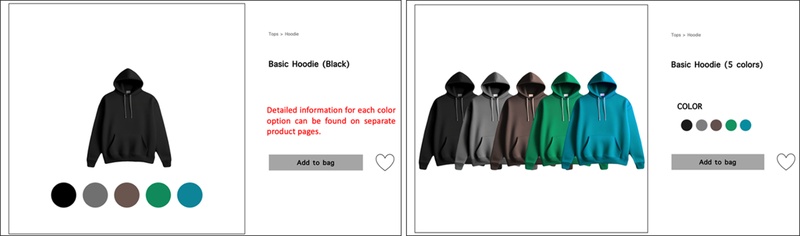
Stimuli (Left: the “one-by-one” presentation mode; right: the “all-at-once” presentation mode). Image generated by AI with Fotor/Factor (Everimaging Science and Technology Co., Ltd.), 2024, using the prompt: “A green simple hoodie without any logo hoodie only. There is not any human who wearing a hoodie, a flat image hoodie with a white background.” Source: https://www.fotor.com/images/create (accessed Oct 22, 2025).
3.2. Design and procedures
The aim of Study 1 was to demonstrate the effect of presentation modes of color options on perceived variety and the mediation effect of perceived variety on approach intentions. Study 1 utilized a one-factor (one-by-one vs. all-at-once) between-subject experiment design. A total of 202 US participants were recruited via Prolific, and 189 valid responses were used (52% males, Mage = 36.00, SD = 8.11). Upon the consent form, participants were randomly assigned to one of the two experimental conditions. After viewing the image of the presentation modes of color options, participants completed the questionnaires. Detailed demographic information is presented in Table 1.

Demographic information of respondents
3.3. Measurements
Perceived variety was measured with a single item, adapted from Kahn and Wansink (2004) on a 7-point Likert scale, ranging from 1 (not at all) to 7 (very much). Approach intentions were measured with 3 items, adopted from Mattila and Wirtz (2001) and Orth and Wirtz (2014) on a 7-point Likert scale, ranging from 1 (strongly disagree) to 7 ( strongly agree). Detailed measurement items are presented in Table 2.
Measurement items used in Study 1
3.4. Result
Manipulation check. The manipulation check was successful showing that participants in the “all-at-once” condition perceived the display as having more color options (M = 6.87, SD = .70) than those in the “one-by-one” condition (M = 1.81, SD = 1.82; t(187) = -25.09, p < .001).
The effect of presentation mode on perceived variety. One-way ANOVA revealed that the effect of presentation modes (one-by-one vs. all-at-once) on perceived variety was significant (Mall-at-once = 4.95, SD = 1.16; Mone-by-one = 4.38, SD = 1.20; t(187) = -3.32; p = .001). It indicated that the “all-at-once” presentation mode led to higher perceived variety than the “one-by-one” mode, supporting H1.
Mediation effect on approach intentions. To explore the mechanism, a mediation analysis (SPSS PROCESS Macro Model 4) (Hayes, 2017) using 5,000 bootstrap samples was conducted. Results revealed that perceived variety mediated the relationship between presentation modes and approach intentions (indirect effect = .27, CI95% = [.10, .46]), supporting H2. Specifically, the presentation modes had a significantly positive effect on perceived variety (B = .57, p < .01), and the perceived variety had a positive effect on approach intentions (B = .46, p < .01). The direct effect was not significant (p = .69).
3.5. Discussion
Study 1 revealed that the “all-at-once” presentation mode (vs. one-by-one) increased perceived variety, mediating the effect of the presentation modes of color options and approach intentions. Study 2 will examine the mechanism and the moderating effect of NFU on the approach intentions to develop an understanding of the effect of the presentation modes of color options.
4. Study 2
4.1. Design and procedures
The aim of Study 2 was to replicate the effect of presentation modes of color options on perceived variety in Study 1 and investigate the mechanism underlying the effect of presentation modes (one-by-one vs. all-at-once) on perceived variety and the moderating role of individuals’ NFU on the abovementioned effect. Thus, Study 2 utilized a one-factor between-subject experiment design with a continuous measured variable, NFU. The stimuli and procedure of Study 2 were the same as in Study 1. The final analysis included 180 US participants, recruited via Prolific (50% males, Mage = 35.75, SD = 8.10). Detailed demographic information is presented in Table 1.
4.2. Measurements
Perceived variety and approach intentions were the same as Study 1. Processing fluency was measured using two items adapted from Lee and Aaker (2004) and Deng et al. (2016), and NFU was measured using 12 items adapted from Ruvio et al. (2008), all based on a 7-point Likert scale (1 = strongly disagree to 7 = strongly agree).
4.3. Results
Manipulation check. The manipulation was successful showing that that participants in the “all-at-once” condition perceived the display as having more color options (M = 6.65, SD = 1.03) than those in the “one-by-one” condition (M = 2.21, SD = 2.18; t(178) = -17.55, p < .001).
The effect of presentation modes on perceived variety. One-way ANOVA revealed that the effect of presentation modes (one-by-one vs. all-at-once) on perceived variety was marginally significant (Mall-at-once = 4.95, SD = 1.35; Mone-by-one = 4.54, SD = 1.57; t(178) = -1.86; p = .064), providing partial support for H2.
Moderated mediation on approach intentions. A moderated mediation analysis (SPSS PROCESS Macro Model 83; Hayes, 2017) using 5,000 bootstrap samples was conducted, with the presentation modes (0 =one-by-one, 1 = all-at-once) as the independent variable, processing fluency and perceived variety as the serial mediators, the NFU as the moderator, and approach intention as the dependent variable. The results revealed a significant moderated mediation effect (index of moderated mediation = –0.04, BootSE = 0.02, CI95% = [–0.09, –0.00]), supporting H3 and H4 (see Fig. 3). Specifically, the effect of presentation mode on approach intention was significant at low levels of NFU (e.g., -1SD of NFU = 2.16, effect = 0.60, t = 2.52, p = .012), but not at average or high levels (ps > .228). Johnson–Neyman analysis identified a threshold at NFU = 3.42, above which the effect became non-significant (see Fig. 4). This suggests the all-at-once format is particularly effective for consumers low in need for uniqueness.
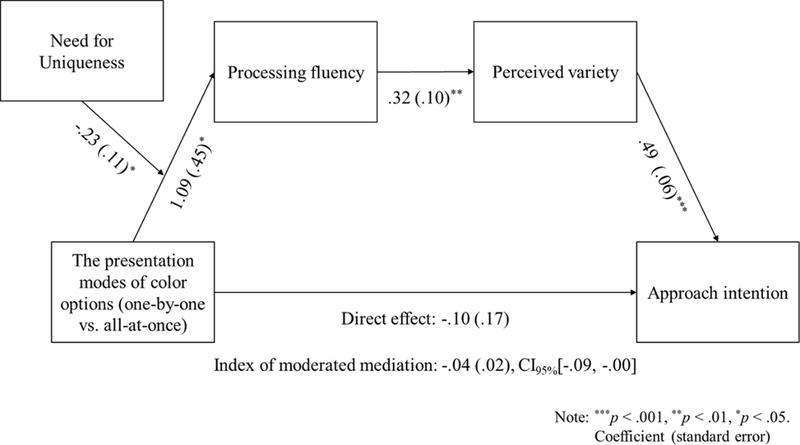
The indirect effect of presentation modes on approach intention through serial mediation effect of processing fluency and perceived variety and the moderating effect of NFU.
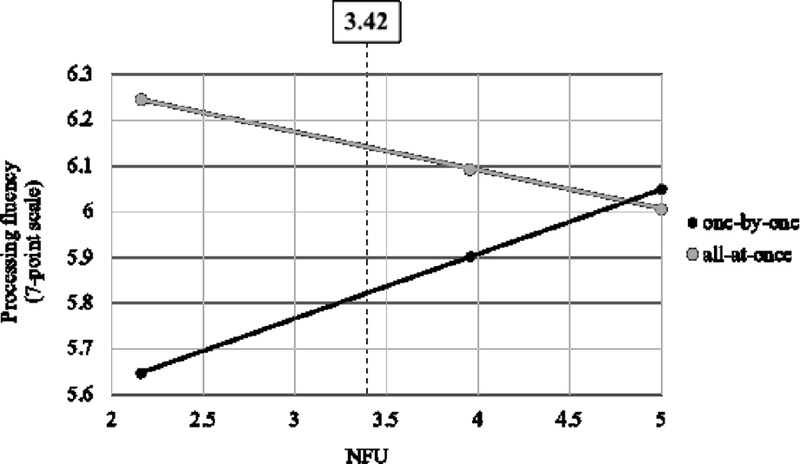
The moderating effect of NFU on the effect of presentation modes on processing fluency.
4.4. Discussion
Study 2 replicated the effect of presentation modes on perceived variety and confirmed the psychological process through which presentation mode influences approach intentions. The serial mediation via processing fluency and perceived variety was supported, indicating that the all-at-once display promotes easier cognitive processing and enhances variety perceptions. Furthermore, this effect was moderated by NFU. Specifically, the positive effect of all-at-once presentation on approach intentions emerged only for consumers with low NFU, but not for those with average or high NFU levels. This suggests that consumers less motivated by uniqueness are more influenced by presentation fluency and visual completeness in online retail settings.
5. General Discussion
This research examined how different presentation modes of available color options affect consumers' perceptions and approach intentions in online fashion retailing, focusing specifically on the mediating roles of processing fluency and perceived variety, and the moderating role of consumers' NFU. Study 1 found that the “all-at-once” presentation mode led to higher perceived variety than the “one-by-one” mode, with perceived variety significantly mediating the effect of presentation modes on consumers' approach intentions. Extending these findings, Study 2 demonstrated that the “all-at-once” mode not only enhanced perceived variety but also facilitated more fluent processing of color options compared to the “one-by-one” mode. Importantly, NFU moderated these effects: consumers with relatively low NFU experienced significantly enhanced processing fluency in the “all-at-once” condition, whereas those with high NFU did not show notable differences between the two presentation modes. This suggests that high-NFU consumers prioritize uniqueness over ease of processing.
Theoretically, this research contributes significantly to the literature on visual merchandising and consumer perception in online retail environments. While prior studies (e.g., Deng et al., 2016; Yu et al., 2024) have primarily focused on overall product arrangements, this study applies the logic of display structure specifically to within-product assortments, notably color variants. It thereby expands the theoretical scope by demonstrating that visual structure impacts consumers' perceived variety and processing fluency even within minimal assortments (e.g., one vs. five options).
Moreover, the study contributes to the discourse on perceived product complexity. Prior research has often linked product complexity to the number and heterogeneity of items, associating excessive variety with cognitive overload and diminished satisfaction (Townsend & Kahn, 2014). However, this research highlights that perceived complexity and cognitive load can also be influenced by the visual structure of presentations, underscoring that visual presentation effects operate at even smaller assortment scales than previously considered.
Additionally, this research deepens the understanding of the cognitive mechanisms involved by identifying processing fluency and perceived variety as serial mediators of the relationship between presentation modes and consumer approach intentions. This mediation aligns and extends earlier findings on visual fluency and variety perception (Deng et al., 2016; Tuch et al., 2011), offering nuanced insights into the sequential cognitive processes underlying visual evaluations.
Furthermore, by incorporating NFU as a moderating factor, the study highlights the importance of individual differences in consumer decision-making processes. Given that NFU reflects consumers' preferences for unique or distinctively designed products (Tian et al., 2001), the findings provide valuable insights into how consumer uniqueness needs can shape their processing preferences and visual product evaluations. High-NFU consumers likely respond better to visually complex or distinctive displays emphasizing uniqueness, whereas low-NFU consumers prefer clearer and more fluent presentations.
Practically, these findings offer actionable guidance for online fashion retailers. Presenting all available color options simultaneously can enhance perceived variety and processing fluency, thereby increasing consumers' approach intentions. Since visual fluency significantly influences consumer decision-making in e-commerce, retailers should ensure clear, easily processable product visuals. Retailers may further optimize product displays by customizing visual arrangements according to product type, platform capabilities, and target audience preferences. Moreover, marketers can leverage insights on NFU to segment their audiences and design personalized visual merchandising strategies. Simplifying product presentations not only reduces cognitive load but also improves overall shopping efficiency and customer satisfaction, ultimately fostering a more user-friendly shopping experience.
Despite these contributions, the study has several limitations that future research should address. Firstly, the stimuli were limited to hoodies with basic designs, limiting the generalizability across different apparel categories. Future studies should investigate whether similar effects hold across diverse product categories, such as bottoms, dresses, accessories, and shoes. Secondly, the current study featured only five color options; future research should explore the boundary conditions by examining how varying the number of color options influences consumer perceptions. Thirdly, this study primarily focused on NFU as a moderating trait. Future research could consider other consumer characteristics, such as product involvement (Franke et al., 2009) or online shopping experience (Trevinal & Stenger, 2014), to further enrich our understanding of individual differences in consumer responses. Methodologically, incorporating eye-tracking techniques in future research could provide valuable insights into the visual attention patterns underlying consumer processing fluency and perceived variety (Deng et al., 2016). By addressing these gaps, future studies can further refine the theoretical framework and practical implications regarding visual presentations in online retailing, enhancing both academic understanding and industry application.
Acknowledgments
This work was supported by the National Research Foundation of Korea (NRF) grant funded by the Korean government (MSIT) (No. RS-2022-00166652) and is based on the first author’s master’s thesis.
References
- Anderson, N. H. (1981). Foundations of information integration theory. New York: Academic Press.
-
Baek, E., Huang, Z., & Lee, S. H. M. (2021). More than what meets the eye: Understanding the effects of poly-contextual cues in online fashion retailing. Journal of Retailing and Consumer Services, 60, 102504.
[https://doi.org/10.1016/j.jretconser.2021.102504]

-
Cowan, N. (2010). The magical mystery four: How is working memory capacity limited, and why?. Current Directions in Psychological Science, 19(1), 51-57.
[https://doi.org/10.1177/0963721409359277]
-
Deng, X., Kahn, B. E., Unnava, H. R., & Lee, H. (2016). A “wide” variety: Effects of horizontal versus vertical display on assortment processing, perceived variety, and choice. Journal of Marketing Research, 53(5), 682-698.
[https://doi.org/10.1509/jmr.13.0151]
- Everimaging Science and Technology Co., Ltd, Factor, 2024. from https://www.fotor.com/images/create, . The prompt is “A green simple hoodie without any logo hoodie only. There is not any human who wearing a hoodie, a flat image hoodie with a white background.”
-
Franke, N., Keinz, P., & Steger, C. J. (2009). Testing the value of customization: When do customers really prefer products tailored to their preferences?. Journal of Marketing, 73(5), 103-121.
[https://doi.org/10.1509/jmkg.73.5.103]
-
Goodman, J. K., & Malkoc, S. A. (2012). Choosing here and now versus there and later: The moderating role of psychological distance on assortment size preferences. Journal of Consumer Research, 39(4), 751-768.
[https://doi.org/10.1086/665047]
- Hayes, A. F. (2017). Introduction to mediation, moderation, and conditional process analysis: A regression-based approach. Guilford Publications.
-
Holbrook, M. B., & Moore, W. L. (1981). Feature interactions in consumer judgments of verbal versus pictorial presentations. Journal of Consumer Research, 8(1), 103-113.
[https://doi.org/10.1086/208846]
-
Jiang, Y., Feng, T., & Huang, Y. (2024). Antecedent configurations toward supply chain resilience: he joint impact of supply chain integration and big data analytics capability. Journal of Operations Management, 70(2), 257-284.
[https://doi.org/10.1002/joom.1282]
-
Kahn, B. E., & Louie, T. A. (1990). Effects of retraction of price promotions on brand choice behavior for variety-seeking and last-purchase-loyal consumers. Journal of Marketing Research, 27(3), 279-289.
[https://doi.org/10.2307/3172586]
-
Kahn, B. E., & Wansink, B. (2004). The influence of assortment structure on perceived variety and consumption quantities. Journal of Consumer Research, 30(4), 519-533.
[https://doi.org/10.1086/380286]
-
Kim, M., & Lennon, S. (2008). The effects of visual and verbal information on attitudes and purchase intentions in internet shopping. Psychology & Marketing, 25(2), 146-178.
[https://doi.org/10.1002/mar.20204]
-
Labrecque, L. I., & Milne, G. R. (2013). To be or not to be different: Exploration of norms and benefits of color differentiation in the marketplace. Marketing Letters, 24(2), 165-176. https://www.jstor.org/stable/24571180
[https://doi.org/10.1007/s11002-012-9210-5]
-
Lee, A. Y., & Aaker, J. L. (2004). Bringing the frame into focus: the influence of regulatory fit on processing fluency and persuasion. Journal of Personality and Social Psychology, 86(2), 205.
[https://doi.org/10.1037/0022-3514.86.2.205]
-
Lee, A. Y., & Labroo, A. A. (2004). The effect of conceptual and perceptual fluency on brand evaluation. Journal of Marketing Research, 41(2), 151-165.
[https://doi.org/10.1509/jmkr.41.2.151.28665]
-
Lee, J. E., Shin, E., & Kincade, D. H. (2024). Presentation-order effect of product images on consumers’ mental imagery processing and purchase intentions. Journal of Product & Brand Management, 33(5), 604-617.
[https://doi.org/10.1108/JPBM-08-2023-4655]
-
Mattila, A. S., & Wirtz, J. (2001). Congruency of scent and music as a driver of in-store evaluations and behavior. Journal of Retailing, 77(2), 273-289.
[https://doi.org/10.1016/S0022-4359(01)00042-2]
-
Mosteller, J., Donthu, N., & Eroglu, S. (2014). The fluent online shopping experience. Journal of Business Research, 67(11), 2486-2493.
[https://doi.org/10.1016/j.jbusres.2014.03.009]
- Musinsa Standard Women. (2025). Product images of Women’s back-string one-piece swimsuit in Red, Dark Brown, Black, and Grayish Blue [Product images]. Retrieved from https://www.musinsa.com/search/goods?keyword=%EC%9A%B0%EB%A8%BC%EC%A6%88+%EB%B0%B1%EC%8A%A4%ED%8A%B8%EB%A7%81&keywordType=keyword&gf=A
-
Novemsky, N., Dhar, R., Schwarz, N., & Simonson, I. (2007). Preference fluency in choice. Journal of Marketing Research, 44(3), 347-356.
[https://doi.org/10.1509/jmkr.44.3.347]
- OIOI Collection. (2025). Product images of Hello Bear sweatshirt (4 colors), Daily ringer T-shirt (5 colors), Signature logo T-shirt (4 colors), and Hello Friends T-shirt (4 colors) [Product images]. Retrieved from https://www.musinsa.com/brand/5252byoioi/products?categoryCode=001&gf=A
-
Ordonez Magro, L., Mirault, J., Grainger, J., & Majerus, S. (2022). Sequential versus simultaneous presentation of memoranda in verbal working memory:(How) does it matter?. Memory & Cognition, 50(8), 1756-1771.
[https://doi.org/10.3758/s13421-022-01284-4]
-
Orth, U. R., & Wirtz, J. (2014). Consumer processing of interior service environments: The interplay among visual complexity, processing fluency, and attractiveness. Journal of Service Research, 17(3), 296-309.
[https://doi.org/10.1177/1094670514529606]
-
Pieters, R., Wedel, M., & Batra, R. (2010). The stopping power of advertising: Measures and effects of visual complexity. Journal of Marketing, 74(5), 48-60.
[https://doi.org/10.1509/jmkg.74.5.048]
-
Qu, Y., & Baek, E. (2024). Assembled or unassembled? Different types of outfit coordination presentations in online fashion retailing. Fashion and Textiles, 11(1), 8.
[https://doi.org/10.1186/s40691-024-00371-1]
-
Reber, R., Schwarz, N., & Winkielman, P. (2004). Processing fluency and aesthetic pleasure: Is beauty in the perceiver's processing experience?. Personality and Social Psychology Review, 8(4), 364-382.
[https://doi.org/10.1207/s15327957pspr0804_3]
-
Rooderkerk, R. P., & Lehmann, D. R. (2021). Incorporating consumer product categorizations into shelf layout design. Journal of Marketing Research, 58(1), 50-73.
[https://doi.org/10.1177/0022243720964127]
-
Ruvio, A., Shoham, A., & Brenčič, M. M. (2008). Consumers' need for uniqueness: short-form scale development and cross-cultural validation. International Marketing Review, 25(1), 33-53.
[https://doi.org/10.1108/02651330810851872]
-
Sarantopoulos, P., Theotokis, A., Pramatari, K., & Roggeveen, A. L. (2019). The impact of a complement-based assortment organization on purchases. Journal of Marketing Research, 56(3), 459-478.
[https://doi.org/10.1177/0022243718823698]
-
Schwarz, N. (2004). Metacognitive experiences in consumer judgment and decision making. Journal of Consumer Psychology, 14(4), 332-348.
[https://doi.org/10.1207/s15327663jcp1404_2]
-
Simonson, I., & Nowlis, S. M. (2000). The role of explanations and need for uniqueness in consumer decision making: Unconventional choices based on reasons. Journal of Consumer Research, 27(1), 49-68.
[https://doi.org/10.1086/314308]
-
Tian, K. T., Bearden, W. O., & Hunter, G. L. (2001). Consumers' need for uniqueness: Scale development and validation. Journal of Consumer Research, 28(1), 50-66.
[https://doi.org/10.1086/321947]
-
Townsend, C., & Kahn, B. E. (2014). The “visual preference heuristic”: The influence of visual versus verbal depiction on assortment processing, perceived variety, and choice overload. Journal of Consumer Research, 40(5), 993-1015.
[https://doi.org/10.1086/673521]
-
Trevinal, A. M., & Stenger, T. (2014). Toward a conceptualization of the online shopping experience. Journal of Retailing and Consumer Services, 21(3), 314-326.
[https://doi.org/10.1016/j.jretconser.2014.02.009]
-
Tuch, A., Kreibig, S., Roth, S., Bargas-Avila, J., Opwis, K., & Wilhelm, F. (2011). The role of visual complexity in affective reactions to webpages: Subjective, eye movement, and cardiovascular responses. IEEE transactions on affective computing, 2(4), 230-236.
[https://doi.org/10.1109/T-AFFC.2011.18]
- Uniqlo. (2025). Product images of Nylon boxy short-sleeve shirt, Drape short-sleeve blouse, Linen-blend open-collar short-sleeve shirt, and Linen-blend open-collar short-sleeve shirt (striped) [Product images]. Retrieved from https://www.uniqlo.com/kr/ko/women/shirts-and-blouses/shirts-and-blouses?path=%2C%2C95362%2C
-
Vanbergen, N., Irmak, C., & Sevilla, J. (2020). Product entitativity: How the presence of product replicates increases perceived and actual product efficacy. Journal of Consumer Research, 47(2), 192-214.
[https://doi.org/10.1093/jcr/ucaa006]
-
Veryzer Jr, R. W., & Hutchinson, J. W. (1998). The influence of unity and prototypicality on aesthetic responses to new product designs. Journal of Consumer Research, 24(4), 374-394.
[https://doi.org/10.1086/209516]
-
Wilson, J. A. C. Q. U. I. E., Benson, L., Bruce, M., Hogg, M. K., & Oulton, D. (2001). Predicting the future: An overview of the colour forecasting industry. The Design Journal, 4(1), 15-31.
[https://doi.org/10.2752/146069201789378450]
- Winkielman, P., Schwarz, N., Fazendeiro, T., & Reber, R. (2003). The hedonic marking of processing fluency: Implications for evaluative judgment. The Psychology of Evaluation: Affective Processes in Cognition and Emotion, 189, 217.
-
Wurtz, P., Reber, R., & Zimmermann, T. D. (2008). The feeling of fluent perception: A single experience from multiple asynchronous sources. Consciousness and Cognition, 17(1), 171-184.
[https://doi.org/10.1016/j.concog.2007.07.001]
-
Yang, H. S., & Choi, Y. L. (2013). The effect of presentation of apparel products on consumers' approach behavior using 3D avatar model. Fashion & Textile Research Journal, 15(1), 65-72.
[https://doi.org/10.5805/SFTI.2013.15.1.065]
-
Ye, W., Huang, R., & Zhang, Z. (2018). Pictorial effect in product layout: How does the layout orderliness influence the consumer’s product evaluation, mechanism, and condition. Journal of Contemporary Marketing Science, 1(1), 94-116.
[https://doi.org/10.1108/JCMARS-08-2018-0010]
-
Yu, Z., Ponomarenko, V., & Liska, L. I. (2024). How to allocate white space in ad design? The impact of product layouts on perceived entitativity and advertising performance. Journal of Advertising, 53(2), 215-229.
[https://doi.org/10.1080/00913367.2023.2175280]
-
Zaggl, M. A., Hagenmaier, M. A., & Raasch, C. (2019). The choice between uniqueness and conformity in mass customization. R&d Management, 49(2), 204-221.
[https://doi.org/10.1111/radm.12327]