미용 전공대학생의 창업자기효능감과 창업 의지 간의 관계에서 창업 마인드의 조절효과

©2024 The Korean Fashion and Textile Research Journal(KFTRJ). This is an open access journal. Articles are distributed under the terms of the Creative 52 Commons Attribution Non-Commercial License (http://creativecommons.org/licenses/by-nc/4.0), which permits unrestricted use, distribution, and reproduction in any medium, provided the original work is properly cited.
Abstract
This study sought to verify the impact of entrepreneurial self-efficacy on the will to start a beauty shop among university students majoring in beauty and subsequently empirically verify the moderating effect of the entrepreneurial mindset in the influence relationship between them. The research method was to conduct a survey targeting university students majoring in beauty, and a total of 283 copies were finally analyzed using SPSS 25.0. The results are as follows: First, among the entrepreneurial self-efficacy, self-regulatory efficacy and task challenge were found to have a significant impact on the will to start a business. Second, as a result of verifying the moderating effect of entrepreneurial mind on the effect of entrepreneurial self-efficacy on the will to start a business, it was confirmed that models I, II, and III all had a significant effect. Therefore, through this study, it was confirmed that the higher the entrepreneurial self-efficacy of university students majoring in beauty, the higher the will to start a beauty shop. Therefore, it is believed that research is needed on programs to improve the entrepreneurial self-efficacy and entrepreneurial mindset to increase the will to start a business.
Keywords:
entrepreneurial self-efficacy, entrepreneurship, entrepreneurship mind, entrepreneurship intention키워드:
창업자기효능감, 창업, 창업 마인드, 창업 의지1. 서 론
최근 4차산업에 따른 산업구조의 변화와 함께 경제적 불황으로 청년실업이 가속화되고 있다. 이에 청년실업 문제를 해결하고자 창업을 촉진하고 지원하는 국가적인 노력이 진행 중이다. 또한 대학들도 창업의 중요성을 인식하고, 대학 내의 창업관련 특강이나 동아리 등의 다양한 비교과 프로그램 운영을 통하여 창업을 독려하고 있다.
미래 유망사업 중 하나인 미용 서비스 산업 역시 학생들이 창업할 수 있는 대표적 산업이라 할 수 있다. 다른 산업에 비해 특성상 점포 임대, 설비나 시설 등 창업비용이 비교적 소액이므로 소자본 창업이 가능하다. 또한 창업을 위한 자격은 미용 전공학과 학생들은 미용학과를 졸업하여 면허를 획득하거나 자격증 취득을 통해 재학 중에도 창업조건을 갖출 수 있어 창업은 가능하다(Um, 2019). 따라서 현재 미용학과 학생이 창업에 대한 열망만 있다면 창업을 계획하고, 실질적으로 창업하기도 한다. 이는 최근 들어 미용샵이 대형샵이나 프랜차이즈 형태에서 프라이빗한 공간을 좋아하는 고객의 니즈에 맞춰 소형규모나 1인 형태로 창업 규모나 형태가 다양화됨에 따라 학생창업이나 청년 창업의 가능성이 더욱 높아지고 있기 때문이다(Park & Oh, 2020).
미용샵 창업은 개인이 미용실, 피부관리실 또는 메이크업샵, 네일샵, 왁싱샵 등 과 같은 미용 서비스를 제공하는 업소를 설립하는 것을 의미한다. 최근 들어 K-Beauty 열풍과 남녀노소 모두 미적 욕구가 높아지면서, 미용샵 창업은 양적으로 증가하고 있으며 경쟁 또한 치열하다. 따라서 창업 후의 성공적인 미용샵을 운영하기 위해서는 고객이 만족할 만한 기술적 노하우를 포함하여 전문성 및 자신만의 경영 노하우 등도 필요하며, 특히 창업자는 창업 후 창업을 유지하고 성공시키고자 하는 신념, 믿음 또는 자신감이 매우 필요하다 할 것이다(Cox et al., 2002; Krueger et al., 2000). 그러나 대부분의 창업 관련 연구로는 미용샵 결정요인과 관련한 연구나 창업 성공과 관련된 연구가 이루어졌을 뿐 미용 전공 학생들을 대상으로 창업과 관련한 연구는 미흡하다 할 수 있다. 따라서 대학이나 학과 차원에서 창업 활동을 수행할 수 있도록 창업자기효능감이나 창업 마인드를 높일 수 있는 창업 관련 활동들에 대한 전략적 모색이 필요하다(Lee & Chang, 2018).
이에 본 연구에서는 미용를 전공하고 있는 대학생들의 창업자기효능감이 창업 의지(미용샵)에 미치는 영향을 검증하고 후속하여 이들 간의 영향관계에서 창업 마인드의 조절 효과를 실증적으로 검증함으로써 실질적 창업지원 전략을 모색하는 기초자료를 제공하고자 한다.
2. 이론적 배경
2.1. 창업자기효능감
자기효능감은 Bandura가 처음 제안한 개념으로 자기 스스로가 목표 달성을 위해 필요한 직무나 행동을 스스로가 해낼 수 있을 것이라는 확신으로(Bandura, 1993), 창업자의 창업 성공을 위한 일련의 업무수행 과정에 대한 확신이며, 창업 성공에 대한 심리적 자신감이라고 할 수 있다(Zhao & Hills, 2005). 창업자기효능감의 구성요소로 자신감, 자기조절효능감, 과업 도전감 세 가지 요인으로 설명할 수 있다. 자신감은 자신의 창업 능력에 대한 확신의 정도를 의미하고, 자기조절효능감은 창업 목표를 달성하기 위해 다양한 위험에 능숙하게 대처하고 문제를 통제할 수 있다는 믿음이며, 과업 도전감은 창업 목표를 달성하기 위한 다양한 과업에 대한 도전 정신을 의미한다(Bandura, 1997; Wilson et al., 2007). 즉 창업자기효능감이 높은 사람일수록 창업에 관심이 높고, 창업 과정에서 어려움을 극복하고 성공시킬 수 있다는 의욕이 높다 할 수 있다. 따라서 창업자기효능감은 창업 결정이나 창업 의도와 행동에 결정적 요인이 되기 때문에 창업 가능성을 예측해 볼 수 있는 중요한 변수라 할수 있다(Lee, 2019). Yoo(2015) 연구에 따르면 창업의지에 긍정적 영향을 위해서는 창업자기효능감을 높이는 대책이 선행되어야 한다고 밝히고 있으며, An and Lee(2017) 연구에서도 창업자기효능감은 창업 멘토링과 창업 의지와의 관계에게 매개역할을 하는 것으로 나타난바 있다. 따라서 창업자기효능감은 개인적 특성보다는 창업에 대한 교육이나 경험 등 환경적 요인에 영향을 받는 것으로 나타나고 있어, 창업 교육이나 멘토링, 인큐베이팅 프로그램과 같은 창업지원을 높이면 창업에 대한 긍정적 태도를 유도하고 창업 의지를 높여 실질적 창업을 유도할 수 있을 것으로 판단된다(Cho et al, 2020).
2.2. 창업 마인드
마인드라는 개념은 생각이나 관점, 사고방식이라는 뜻으로 개인적 성향이나 능력에 대한 신념을 의미하며 행동에 대한 성공 또는 실패에 대한 관점에서 중요한 요인이 된다(Dweck, 2006). 즉 창업 마인드는 개인의 창업에 대한 마음가짐이나 사고방식을 의미하는데, 창업 마인드의 수준이 높을수록 어려운 환경에서도 쉽게 포기하지 않고 문제를 해결함으로써 회복 탄력성을 높여 긍정적인 결과를 기대할 수 있수 있다(Duckworth & Seligman, 2005). 이러한 창업 마인드는 지속적인 창업과 관련된 교육이나 프로그램을 통해 향상을 촉진할 수 있으며, 더 높은 수준의 도전을 감당할 수 있도록 도와주기 때문에 창업 마인드는 개인이나 조직의 성공에 영향을 미친다고 할 수 있다(Maing & Kim, 2023). 따라서 창업 마인드는 창업 시작과 창업을 지속적으로 유지하려는 것으로 창업자의 경영관이라 조작적 정의하였다.
2.3. 창업 의지
창업 의지는 사업이나 회사를 시작하려는 열망이나 의지로, Kim(2017)은 미래에 창업하고자 하는 의지라고 정의한 바 있다. 창업 의지는 창업 행동에 있어서 실행의 출발점이며(Bird, 1988), 창업 이후 창업 성공에도 영향을 미치는 중대한 요인이 되므로 잠재적 창업자의 창업 의지를 파악하는 것도 중요하다 할 수 있다(Ko et al., 2022). 이에 본 연구에서는 창업 의지를 미용 전공 대학생이 미래에 창업하고자 하는 자신의 의지라고 조작적 정의하고 연구를 진행하였다.
3. 연구방법
3.1. 연구모형 및 연구가설
연구모형은 Fig. 1과 같다.
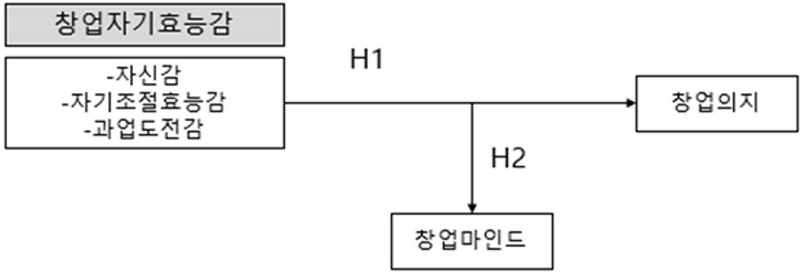
Research model.
가설은 다음과 같다.
- H1. 창업자기효능감(자신감, 자기조절효능감, 과업 도전감)은 창업 의지의 정(+)의 영향을 미칠 것이다.
- H2. 창업마인드는 창업자기효능감(자신감, 자기조절효능감, 과업도전감)이 창업 의지에 미치는 영향을 조절할 것이다.
3.2. 측정 도구
측정 도구로 창업자기효능감은 Youn and Hyun(2019)와 Wilson et al.(2007), 창업 마인드는 Dess and Lumpkin(2005), 창업 의지는 Sequerira et al.(2007)을 참고하여 연구의 취지에 맞도록 수정, 보완하여 Likert 5점 척도로 구성하였다.
3.3. 자료수집 및 분석
본 연구는 창업 관련 활동을 경험한 광주 전남지역 4년제 미용 전공 대학생을 대상으로 2022년 11월 1일부터 4주간 설문조사를 실시하였다. 총 300부를 배포하고 회수하였으며 설문지의 빈칸을 남기거나 내용과 관련 없이 무작위로 응답한 불성실한 응답을 제외한 283부를 최종 분석하였다. 분석은 SPSS 25.0 통계프로그램을 이용하였으며 빈도분석, 탐색적 요인분석, 다중회귀분석, 위계적 회귀분석을 사용하였다.
4. 연구 결과 및 고찰
4.1. 조사대상자의 일반적 특성
조사대상자의 일반적 특성을 분석한 결과 성별은 남성 27명(10.4%), 여성 232명(89.6%)으로 나타났다. 지역으로 광주는 215명(83.4%), 전남은 43명(16.6%), 학년은 1학년 91명(35.1%), 2학년 75명(29.0%), 3학년 54명(20.8%), 4학년 39명(15.1%)으로 나타났고, 창업 예상 시기는 대학 재학 중 15명(5.8%), 졸업 후 1년 이내 24명(9.3%), 졸업 후 1-3년 미만 44명(17.0%), 졸업 후 3-5년 미만 62명(23.9%), 졸업 후 5-10년 미만 76명(29.3%), 졸업 후 10년 이상 38명(14.7%)으로 나타났다. 국가미용 관련 자격증 개수는 0개 98명(37.8%), 1개 108명(41.7%), 2개 38명(14.7%), 3개 이상 15명(5.8%)으로 나타났고, 민간 미용 관련 자격증 개수는 0개 156명(60.2%), 1개 47명(18.1%), 2개 18명(6.9%), 3개 이상 38명(14.7%)으로 나타났다.
4.2. 측정 도구의 타당성 및 신뢰도 검증
창업자기효능감에 대한 타당성 및 신뢰도 검증 결과 KMO 값은 0.861로 요인분석에 가능한 표본으로 적합한 결과를 보였으며, Bartlett 검증 결과 1934.075 (df=91, p=.000)로 유의미한 수준을 나타냈다(Table 1). 분석 결과 고유값 1이상인 요인이 3개가 추출되었으며, 전체 설명력은 66.261%로 나타났다. 각 하위요인별 자신감은 22.947%, 자기조절효능감은 21.836%, 과업도전감은 21.478%로 나타났다. 또한 Cronbach‘s α 계수를 분석한 결과 0.824~0.877로 나타나 매우 신뢰도 있는 측정 항목으로 분석되었다.

Verification of validity and reliability of of entrepreneurship self-efficacy
창업 마인드에 대한 타당성 및 신뢰도 검증 결과 KMO 값은 0.864로 요인분석에 가능한 표본으로 적합한 결과를 보였으며, Bartlett 검증결과 1010.593(df=21, p=.000)로 유의미한 수준을 나타냈다(Table 2). 분석 결과 고유값 1이상인 요인이 1개가 추출되었으며, 1개 요인인 창업 마인드는 61.925%로 나타났다. 또한 Cronbach‘s α 계수를 분석한 결과 0.896으로 나타나 매우 신뢰도 있는 측정 항목으로 분석되었다.
Verification of validity and reliability of entrepreneurship mind
창업 의지에 대한 타당성 및 신뢰도 검증 결과 KMO 값은 0.896으로 요인분석에 가능한 표본으로 적합한 결과를 보였으며, Bartlett 검증결과 1181.854(df=21, p=.000)로 유의미한 수준을 나타냈다(Table 3). 분석 결과 고유값 1이상인 요인이 1개가 추출되었으며, 1개 요인인 창업 의지는 65.479%로 나타났다. 또한 Cronbach‘s α 계수를 분석한 결과 0.911로 나타나 매우 신뢰도 있는 측정 항목으로 분석되었다.
Verification of validity and reliability of entrepreneurship intention
주요 변수의 기술통계 및 상관관계를 분석한 결과는 Table 4와 같다. 기술통계 분석 결과 창업자기효능감은 하위요인별 자기조절효능감이 평균 3.48점, 과업도전감이 평균 3.20점, 자신감이 평균 2.98점 순으로 나타났고, 창업 마인드는 평균 3.69점, 창업 의지는 평균 3.69점으로 나타났다.
Descriptive statistics and correlation verification
상관관계 분석 결과 창업자기효능감의 하위요인별 자신감, 자기조절효능감, 과업 도전감은 창업 마인드와 통계적으로 유의미한 정(+)의 상관관계가 있는 것으로 나타났고(p<.05), 창업 의지와도 통계적으로 유의미한 정(+)의 상관관계가 있는 것으로 나타났다(p<.01). 또한 창업 마인드는 창업 의지와 통계적으로 유의미한 정(+)의 상관관계가 있는 것으로 나타났다(p<.001).
4.2. 가설 검증
창업자기효능감이 창업 의지에 미치는 영향을 검증한 결과는 Table 5와 같다. 분석결과 회귀모형의 설명력은 11.3%이고, 회귀식은 통계적으로 유의미한 것으로 분석되었다(F=10.873, p<.001). 독립변수별로는 과업 도전감(β=.237, p<.01), 자기조절효능감(β=.171, p<.05)이 창업 의지에 통계적으로 유의미한 정(+)의 영향을 미치는 것으로 나타나 가설은 부분 채택되었다. 따라서 창업자기효능감의 하위요인별 과업 도전감, 자기조절효능감이 높을수록 창업 의지는 높아지는 것으로 볼 수 있었다. 선행연구인 Kim(2022)의 예비창업자 대상 연구에서는 과업도전감과 자기조절효능감 요인이 창업 의지에 영향을 미치는 것으로 나타나 본 연구결과와 일치하였다. 그러나 Joung(2018) 연구에서는 창업자기효능감이 창업 의지에 영향을 미치지 않는 것으로 나타나 다른 결과가 나타나기도 하였다. 이는 연구결과들을 종합해 볼 때 창업자기효능감은 창업 의지에 선행변수이기는 하지만 창업자의 창업에 대한 의지의 고저에 따라 다른 결과를 초래할 수 있음을 보여주는 결과라 해석할 수 있으며 더 많은 연구가 필요할 것으로 사료된다.
The effect of entrepreneurial self-efficacy on the entrepreneurial intention
창업자기효능감이 창업 의지와의 관계에 있어 창업 마인드의 조절 효과 분석을 위해 먼저 독립변수로 창업자기효능감(자신감, 자기조절효능감, 과업 도전감)을 모델 I에, 조절 변수로 창업 마인드를 모델 II에, 창업자기효능감(자신감, 자기조절효능감, 과업 도전감)과 창업 마인드의 상호작용 변수를 모델 III에 차례로 투입하여 위계적 회귀분석을 실시한 결과는 Table 6과 같다.
The moderating effect of entrepreneurial mindset in the relationship between entrepreneurial self-efficacy and entrepreneurial intention
모델Ⅰ의 설명력은 11.3%였고, 통계적으로 유의미한 것으로 분석되었다(F=10.873, p<.001). 독립변수별로는 과업도전감(β=.237, p<.01), 자기조절효능감(β=.171, p<.05)이 창업의지에 통계적으로 유의미한 정(+)의 영향을 미치는 것으로 나타났다.
창업 마인드가 추가적으로 투입된 모델Ⅱ의 설명력은 40.1%로 28.8%가 추가적으로 증가하였고, 통계적으로 유의미한 것으로 분석되었다(F=42.541, p<.001). 이는 추가적으로 투입된 창업마인드(β=.574, p<.001)가 창업의지에 유의미한 변수임을 의미한다.
창업 마인드가 가지는 조절효과를 검증하기 위해 창업자기효능감(자신감, 자기조절효능감, 과업도전감)과 창업 마인드의 상호작용 변수를 추가적으로 투입한 모델 III의 설명력은 45.8%로 5.7%가 추가적으로 증가하였고, 통계적으로 유의미한 것으로 분석되었다(F=30.260, p<.001). 즉, 추가적으로 투입된 상호작용 변수 중에는 과업도전감와 창업 마인드의 상호작용 변수(β=129, p<.05)가 통계적으로 유의미한 것으로 나타나, 창업마인드는 창업자기효능감의 하위요인별 과업도전감과 창업 의지 간의 관계를 조절하는 것으로 나타나 가설은 부분 채택되었다.
5. 결 론
본 연구는 창업 관련 활동을 경험한 광주 전남지역 4년제 뷰티 전공대학생을 대상으로 창업자기효능감이 창업 의지에 미치는 영향과 후속하여 이들 간의 영향관계에서 창업 마인드의 조절 효과를 실증적으로 검증하였으며 결과 요약은 다음과 같다.
첫째, 창업자기효능감이 창업의지에 미치는 영향을 검증한 결과 과업도전감과 자기조절효능감 요인이 창업 의지에 유의한 영향을 미치는 것으로 나타났다. 이는 Kim and Kim(2021)의 연구 결과와 일치한 결과로 대학생들이 창업에 도전하고, 어려운 환경에서도 극복해 나갈 수 있는 능력에 대한 의지가 강할 때 창업 의지에 긍정적 영향을 미치는 것으로 보여진다. 다만 학생 창업을 현실화하고 적극적으로 지원하기 위해서는 자기조절효능감이나 과업도전감을 높일 수 있는 실질적 프로그램을 설계하는 것이 필요하다. 이는 창업 교육에 있어 과업을 성공적으로 수행할 수 있다는 개인의 믿음을 높일 수 있도록 성공사례 등을 공유하는 프로그램을 계획한다거나, 성공한 창업자들의 창업을 위해 계획에서부터 실행되는 단계까지 경험해 보는 모의 창업 프로그램 등 창업자기효능감을 높일 수 있는 전략을 세우고 일회성이 아닌 지속성이 보증된 프로그램 지원이 필요할 것으로 사료된다.
둘째, 창업자기효능감과 창업 의지와의 관계에 있어 창업 마인드의 조절효과를 분석한 결과 모델Ⅰ,Ⅱ, Ⅲ 모두 유미의한 영향을 미치는 것으로 나타났다. 즉 창업자기효능감과 창업 의지와의 관계에 있어 창업 마인드의 조절효과가 높을수록 창업 의지 역시 높아지는 것을 확인할 수 있었다. 이는 Maing and Kim(2023)의 연구결과와 유사한 것으로 창업자가 창업 마인드 교육을 통해서 긍정적 창업 마인드를 갖추게 된다면 창업 의지를 더욱 고취 시킬 수 있을 것으로 판단된다. 이에 정책적으로 단순히 창업강좌나 교육보다는 창업 마인드 역량을 높일 수 있도록 다양한 지원 정책이 필요할 것으로 보여진다.
따라서 연구 결과를 볼 때 미용 전공대학생들의 창업자기효능감이 높을수록 창업 의지가 높아지며, 창업 마인드는 창업자기효능감과 창업 의지간의 관계에서 조절 효과가 있음을 확인하였다. 그러나 연구가 광주, 전남지역으로만 이루어진바 지역적 한계로 일반화하는데 무리가 있다고 판단되며 후속하여 창업 의지를 높이는데 필요한 심층적 역량연구도 함께 각 헤어전공, 피부전공, 메이크업이나 네일 전공 등 각 세부전공에 따른 연구도 이루어져야 할 것으로 보인다.
Acknowledgments
본 연구는 2024학년도 송원대학교 학술연구비 지원을 받아 연구되었음(A2024-18).
References
-
An, T. U., & Lee, In. A. (2017). The effects of mentoring education on self-efficacy and entrepreneurial intention: focusing on college start-up clubs activity moderating effects. Journal of Local Government & Administration Studies, 31(3), 141-161.
[https://doi.org/10.18398/kjlgas.2017.31.3.141]

-
Bandura, A. (1993). Perceived self-efficacy in cognitive development and funding. Educational Psychologist, 28(2), 117-148.
[https://doi.org/10.1207/s15326985ep2802_3]
-
Bandura, A. (1977). Self-efficacy: toward a unifying theory of behavioral change. Psychological Review, 84(2), 191-215.
[https://doi.org/10.1037/0033-295X.84.2.191]
-
Bird, B. (1988). Implementing entrepreneurial ideas: The case for intention. Academy of management Review, 13(3), 442-453.
[https://doi.org/10.2307/258091]
-
Cho, H. J., Choi, D. S., & Sung, C. S. (2020). A study on the effect of entrepreneurial mentoring on entrepreneurial intention: mediating effects of social support and entrepreneurial self-efficacy. Asia-Pacific Journal of Business Venturing and Entrepreneurship, 15(2), 81-96.
[https://doi.org/10.16972/apjbve.15.2.202004.81]
- Cox, L., Mueller, S., & Moss, S. (2002). The impact of entrepreneurship education on entrepreneurial self-efficacy. International Journal of Entrepreneurship Education, 1(2), 286-299. http://hdl.handle.net/2262/104266
-
Dess, G. G., & Lumpkin, T. (2005). The role of entrepreneurial orientation in simulating effective corporate entrepreneurship. Academy of Management Executive, 19(1), 147-156.
[https://doi.org/10.5465/ame.2005.15841975]
-
Duckworth, A. L., & Seligman, M. E. P. (2005). Self-discipline outdoes IQ in predicting academic performance in adolescents. Psychological Science, 16(12), 939-944.
[https://doi.org/10.1111/j.1467-9280.2005.01641.x]
- Dweck, C. S. (2006). Mindset: The new psychology of success. New York, NY: Random House.
-
Joung, J. S. (2018). The effects of entrepreneurship on self-efficacy and entrepreneurial intention to start a cosmetology service business: focusing on the moderating effects of social media activities, Journal of The Korean Society of Beauty And Art, 19(4), 157-174.
[https://doi.org/10.18693/jksba.2018.19.4.157]
- Kim, B. H. (2022). The effect of startup mentoring on entrepreneurial self-Efficacy and entrepreneurial intention : moderating effect of opportunity recognition [Doctoral dissertation, Keimyung University]. Riss. https://www.riss.kr/link?id=T16532950
-
Kim, B. H., & Kim, C. O. (2021). The relationship between entrepreneurial self-effectiveness and entrepreneurial intention: focusing on mediating effect of problem-solving skills. Journal of the Korean Entrepreneurship Society, 16(4), 185-201.
[https://doi.org/10.24878/tkes.2021.16.4.185]
- Kim J. K. (2017). An empirical study on relationship between entrepreneurship and entrepreneurial Intention: Focused on Mediating Effect of Participating in the Venture Contest, Moderating Effect of Entrepreneurial Supporting Policy [Doctoral dissertation, Hoseo University]. Riss. https://www.riss.kr/link?id=T14339547
-
Ko, S. H., Park, W. J., & Bae, B. Y. (2022). An influence of intolerance of uncertainty on entrepreneurial intention of college students: focused on start-up support system perception. Asia-Pacific Journal of Business Venturing and Entrepreneurship, 17(5), 95-104.
[https://doi.org/10.16972/apjbve.17.5.202210.95]
-
Krueger, N. F., Reilly, M. D., & Carsrud, A. (2000). Competing models of entrepreneurial intentions. Journal of Business Venturing, 15, 411-432.
[https://doi.org/10.1016/S0883-9026(98)00033-0]
-
Lee, J. R., & Chang, G. S. (2018). Impact of Startup Support Program on Entrepreneurial Self-efficacy, Opportunity Recognition·Startup Intention of Undergraduate Students. Asia-Pacific Journal of Business Venturing and Entrepreneurship, 13(1), 43-60.
[https://doi.org/10.16972/apjbve.13.1.201802.43]
- Lee, S. A. (2019). Analysis of entrepreneurship, social capital and entrepreneurial intentions of young pre-entrepreneurs : focusing on mediating effects of entrepreneurial self-efficacy and moderating effects of entrepreneurship education [Doctoral dissertation, Kyonggi University]. Riss. https://www.riss.kr/link?id=T15386702
-
Maing, J. S., & Kim, S. H. (2023). Analysis of the Influence of Role Models on College Students' Entrepreneurial Intentions. Asia-Pacific Journal of Business Venturing and Entrepreneurship, 18(5), 17-32.
[https://doi.org/10.16972/apjbve.18.5.202310.17]
-
Park. Y. M., Oh, Y. K. (2020). Effects of a one-person beauty company entrepreneur’s competence on management performance. The Korean Society Of Beauty And Art, 21(4), 147-160.
[https://doi.org/10.18693/jksba.2020.21.4.147]
-
Sequerira, J., Muller, S., & MaGee, J. E. (2007). The influence of social ties and self-efficacy in forming entrepreneurial intention and motivating nascent behavior. Journal of Developmental Entrepreneurship, 12(3), 275-293.
[https://doi.org/10.1142/S108494670700068X]
- Um, J. C. (2019). A study on the effect of university students' entrepreneurial self-efficacy levels on the characteristics of entrepreneur and willingness to Start-up [Master’s thesis, Gwangju National Education University]. Riss. https://gnue.dcollection.net/public_resource/pdf/200000226913_20240903105413.pdf
-
Wilson, F., Kickul, J. & Marlino, D. (2007). Gender, entrepreneurial self-efficacy, and entrepreneurial career intentions: Implications for entrepreneurship education. Entrepreneurship Theory and Practice, 31(3), 387-406.
[https://doi.org/10.1111/j.1540-6520.2007.00179.x]
- Yoo, B. H. (2015). The effect of self-efficacy and autonomy on the possibility of start-up success: focus on mediation role of intrinsic motivation and risk taking. Asia Pacific Journal of Small Business, 37(2), 87-105.
-
Youn, J. S., & Hyun, B. H. (2019). A study on effect of the entrepreneurship on entrepreneurial self-efficacy and entrepreneurial intention-focusing on mediating effect of career decision-making self-efficacy -. Management & Information Systems Review, 38(3), 171-186
[https://doi.org/10.29214/damis.2019.38.3.011]
-
Zhao, H., Seibert, S. E., & Hills, G. E. (2005). The mediating role of self-efficacy in the development of entrepreneurial intentions. Journal of applied psychology, 90(6), 1265.
[https://doi.org/10.1037/0021-9010.90.6.1265]