
Chinese Consumers’ Intention to Use Re-Commerce Platforms : Perspective Based on the Extended Unified Theory of Acceptance and Use of Technology (UTAUT2)

©2023 Fashion and Textile Research Journal (FTRJ). This is an open access journal. Articles are distributed under the terms of the Creative 52 Commons Attribution Non-Commercial License (http://creativecommons.org/licenses/by-nc/4.0), which permits unrestricted use, distribution, and reproduction in any medium, provided the original work is properly cited.
Abstract
Contemporary consumers’ acceptance of second-hand products has been increasingly improving worldwide, especially in China. Based on the Extended Unified Theory of Acceptance and Use of Technology, we developed and empirically validated a research framework to predict consumers’ motivation to use re-commerce platforms. We explored the diverse factors influencing mobile commerce usage through re-commerce platforms. Furthermore, this study investigated the role of gender differences as a factor moderating the association between several constructs and the intention to use re-commerce platforms. A total of 226 consumer responses were collected. The results indicated that hedonic motivation, performance expectancy, consumer habits, social influence, and price value affect consumers’ attitudes toward re-commerce platforms. The effects of the attitude toward re-commerce platforms on the intention to use these platforms were also statistically significant. When effort expectancy, hedonic motivation, and consumer habits in re-commerce platform usage increase, male consumers’ attitude toward its usage, in particular, also increases. Meanwhile, when performance expectancy, hedonic motivation, and consumer habits in re-commerce platform usage increase, the attitude toward its usage increases among female consumers. Moreover, our results indicate that the two gender groups present different characteristics regarding re-commerce platform usage. Therefore, this study offers a theoretical basis for future analyses of second-hand trade.
Keywords:
re-commerce platforms, second-hand shopping, pre-owned goods, gender gap, UTAUT21. Introduction
With the depletion of the Earth’s natural resources, encouraging self-restrictive behaviors, including product reuse, is essential in contemporary society. Second-hand consumption has become increasingly popular worldwide, particularly in China. Chinese re-commerce has grown significantly on platforms such as Hong Bu Lin, Xian Yu, and Zhuan Zhuan. This phenomenon is reflected in the the “re-commerce market”, which has increased by 70%, from CNY 742 billion in 2018 to CNY 1.25 trillion(approximately $178 billion) in 2020(Weinswig, 2020). Second-hand products were primarily purchased by customers born after 1985, who are influenced by perceived economic value. This trend is also attributed to the continuous emphasis on reuse and recycling(Liang & Xu, 2018).
Owing to its growing popularity, the concept and motivation underlying second-hand consumption through pre-owned goods platforms have been redefined(Ferraro et al., 2016). As Ginsburg (1980) stated, nineteenth-century consumers purchased used products primarily for economic reasons, and most transactions were conducted offline. However, modern re-commerce platforms are more convenient and diverse, and used goods are more valuable now than earlier(Wang et al., 2022). Therefore, researchers worldwide have attempted to explain the rapid growth of second-hand commerce(Hur, 2020; Mohammad et al., 2021; Peña-Vinces et al., 2020).
China’s pre-owned goods market has received scarce research attention. Previous studies have investigated re-commerce across different contexts and countries(Isla, 2013; Park, 2021; Park & Cheon, 2020; Park & Kim, 2021; Xu et al., 2014). However, they have primarily focused on the context of second-hand luxury fashion platforms(Boardman et al., 2022) and second-hand university goods platforms in China(Liu et al., 2022b). Therefore, current re-commerce studies cannot explain the rapid growth among Chinese consumers. Owing to the limitations of such literature, the use intention of second-hand luxury goods and campus goods platforms may not fully reflect Chinese users’ behavior, necessitating further research on this phenomenon. It is also critical to explore an integrated model evaluating the factors affecting the adoption of re-commerce platforms to determine how their application is affected in this context.
Many studies have used the Unified Theory of Acceptance and Use of Technology (UTAUT)as a basic model. Other studies have extended the UTAUT model by integrating existing theories to explain technology usage in specific contexts. The UTAUT mainly includes three types of extended applications: application to new environments(e.g., new technologies, users, and cultures); addition of structures to improve the quality of the endogenous theoretical mechanisms described in the UTAUT; and introduction of new elements and expansion of the UTAUT’s theoretical boundaries to enhance its explanatory ability. Venkatesh et al.(2012) introduced the Extended UTAUT (UTAUT2) to expand the model’s applicable scope and interpretability. They proposed three new constructs (price value, hedonic motivation, and habit) that directly influence behavioral intentions. The two models fundamentally differ in the creation of new structures and relationships. The UTAUT2 thus provides a more comprehensive view of the factors influencing behavioral intentions, ultimately leading to an improved understanding of individuals’ technology acceptance and use(Nikolopoulos & Likothanassi, 2017). Furthermore, the UTAUT2 is an effective model for studying users’ technology acceptance behavior(Oliveira et al., 2016).
The UTAUT2 is considered appropriate for this study as it integrates seven constructs (i.e., price value, effort expectancy, social context, performance expectancy, consumer habit, facilitating situations, and hedonic tendency) that are highly related to mobile commerce adoption (Venkatesh et al., 2012). Furthermore, it has been widely adopted to explain m-commerce user behavior (Chopdar et al., 2018; Teo et al., 2015). This study investigates attitudes and intentions toward using mobile or online second-hand shopping platforms while considering gender differences using the UTAUT2 (Venkatesh et al., 2012). It examines intention-to-use behavior using variables such as social influence, hedonic motivation, facilitating conditions, effort expectancy, consumer habits, performance expectations, and price value.
Specifically, this study explores potential motivations for and barriers to Chinese consumers’ use of re-commerce platforms. Furthermore, it analyzes whether gender differences can contribute to differences in these platforms’ usage behavior. In addition to filling a research gap on re-commerce platforms in China, this study provides valuable insights into how platform managers can better develop successful marketing strategies to attract customers and improve second-hand industry development.
2. Theoretical background
2.1. Online re-commerce market
In recent years, sustainable living has become a trend in response to concerns about global climate change and environmental risks. Shopping for second-hand goods enables consumers to feel more responsible and eco-conscious while enjoying various products at lower prices. Similarly, second-hand e-commerce—also known as re-commerce or resale e-commerce—encompasses the second-hand shopping process on the Internet(Statista Research Department, 2022). Digital transformation has also affected the second-hand goods market. Traditionally offline platforms have transformed into online platforms accessible through websites and mobile devices. These online platforms facilitate consumer-to-consumer (C2C) transactions, which have increased dramatically. Notably, for Millennials (born 1981–1995) and Generation Z (born 1996-2005) (MZ generation), who have a high digital utilization rate, second-hand goods buyers are described as “third consumers,” changing people’s perception of pre-owned goods. The MZ generation recognizes that new goods will also become second-hand at the moment of purchase; therefore, they are not attached to the notion of “new” but choose to consume second-hand goods at reasonable prices(Kim, 2021). Moreover, research on Chinese consumers has also indicated that compared to older people, younger consumers(born after 1990) presented a higher motivation to purchase pre-owned products(Liang & Xu, 2018). Moreover, in September 2021, the “2021 China Idle Second-hand Trading Carbon Emission Reduction Report,” published by an international consulting firm and the Institute of Energy and Environmental Economics, Tsinghua University, showed that pre-owned merchandise transactions in China increased from CNY 300 billion in 2015 to CNY 1 trillion in 2020(Observation, 2021). This study focuses on the MZ generation of Chinese consumers considering the popularity of re-commerce among younger consumers (Arman & Mark-Herbert, 2022).
Previous research has investigated mobile second-hand purchasing intentions and motivations to reveal that pre-owned goods consumption is motivated by several factors, including critical, economic, hedonic(Guiot & Roux, 2010; Roux & Guiot, 2008), and fashion preferences(Ferraro et al., 2016). Moreover, in addition to auction and retail websites, the re-commerce platform is a widely chosen business model supporting the transaction of previously used products via the Internet. With current research investigating the use of re-commerce platforms as a driver of mobile commerce usage, this study investigates seven constructs of platform usage, focusing on used product commerce apps and the factors that influence their use.
2.2. The UTAUT2 and intention to use re-commerce platforms
Prior to the UTAUT, the academic community mainly used eight theoretical models—the Innovation Diffusion Theory(IDT), Technology Acceptance Model(TAM), Model of Personal Computer Utilization(MPCU), Theory of Planned Behavior(TPB), Social Cognitive Theory (SCT), Theory of Reasoned Action(TRA), Combined TAM and Theory of Planned Behavior(C-TAM-TPB), and Motivational Model(MM)—to explain users’ technology use intentions and behaviors(Chang, 2012). However, in terms of application, these eight models have different emphases. They are also limited by a single perspective and incomplete data regarding intentions and behaviors (Chang, 2012). To address these limitations, the UTAUT model of Venkatesh et al. (2003) considered factors affecting users’ behavior, including facilitating conditions, social influence, effort expectancy, and performance expectancy. It also incorporated moderating factors such as gender, voluntariness, age, and experience, which may further modify users‘ behavior. The UTAUT was initially proposed for organizational use and explained employees’ technology use intentions and behaviors. To explore users’ technology use intentions and behaviors in non-organizational contexts, Venkatesh et al.(2012) adjusted the UTAUT model structure to incorporate the consumer use perspective, thus proposing the UTAUT2, which added three elements: price value, hedonic motivation, and consumer habit as determinants of technology use intention and behavior, while retaining three moderators: gender, experience, and age.
When emotions such as enjoyment are involved in technology acceptance, hedonic motivation becomes an important predictor (Tamilmani et al., 2019). Moreover, customers’ consumption experiences determine their attitudes toward hedonic items. Furthermore, individuals may become more accustomed to commerce platforms with frequent use(Tak & Panwar, 2017). Research findings also prove consumer addiction to online commerce. The availability of “app-only discounts” in most commerce apps attracts many value-driven customers to shop via apps instead of other channels(Tak & Panwar, 2017). Price value plays an important role in second-hand shopping platforms, thereby determining consumers’ technology acceptance and use. Although re-commerce platforms are practical, consumer acceptance and use are still determined by habitual, hedonic, and price-related consumer motivations. Therefore, we adopted the UTAUT2 model because it more comprehensively explains re-commerce platforms' usage.
In communication technology, a consumer’s performance expectancy refers to their perception that an app will help them achieve their goals(Venkatesh et al., 2003). It highlights the technology’s likely utility, which is considered an essential predictor of technology adoption in major technology acceptance theories. Based on the original TAM specification, performance expectancy further enriches the understanding of perceived technology usefulness(Chopdar et al., 2018). It is necessary to assess how consumers appraise the benefits that they reap from the app, which helps them perform online commerce activities. Several performance expectancy constructs are perceived measures: comparative advantage, job fit, extrinsic motivation, usefulness, and outcome expectations. Perceived usefulness is a major factor influencing consumers’ platform decisions(Venkatesh et al., 2003). Alalwan et al.(2016, 2017) showed that consumers are more likely to adopt specific technologies that they consider useful in their daily lives. Therefore, the higher the perceived utility of an application, the more likely are consumers to use it(Taiwo & Downe, 2013). Furthermore, various researchers have investigated social media adoption(Zolkepli & Kamarulzaman, 2015), online purchases(Jusoh & Ling, 2012), and shopping apps(Chopdar et al., 2018). Recommendations for re-commerce platforms, such as their time efficiency and affordability of pre-owned goods that meet consumer expectations, motivate adoption. Thus, the following hypothesis is proposed:
H1-1. Performance expectancy positively impacts consumers’ attitude toward re-commerce platforms.
Effort expectancy refers to the “degree of ease associated with consumers’ use of technology,” determined by the perceived ease of use(PEOU) from TAM(Chopdar et al., 2018; Venkatesh et al., 2012). New technology adoption is influenced by the effort required to use it(Davis et al., 1989). Therefore, the easier a technology is to use, the more likely will consumers be to use it. The positive impact of PEOU on m-commerce platforms has been validated in Wei et al.(2009)’s research. Effort expectancy has demonstrated a strong relationship with customer attitudes toward apps(Jeong, 2019). According to Sharma et al.(2020), effort expectancy affects consumer attitudes toward online services. Previous studies have shown that effort expectancy positively affects behavioral intentions in the context of mobile payments(Dennehy & Sammon, 2015) and online channels(Zhang et al., 2017). This study identifies consumers’ expectations of ease of use when using re-commerce platforms. Thus, the following hypothesis is proposed:
H1-2. Consumers' effort expectations positively impact their attitude toward re-commerce platforms.
Venkatesh et al. (2012) proposed that social influence refers to “the degree to which others think the user should adopt a particular technology.” Eastman et al.(1999) defined status demand as “the tendency to buy services or products to obtain the status or social influence conferred on the owner of goods and services.” Consumers with a high need for social influence or status tend to prioritize goods that procure influence and status(Eastman et al., 1999). People with a high need for social impact are inclined to choose products or brands that indicate their affiliation to a particular status or a wealthy group(Johnson et al., 2018). Hence, people who care about social impact have a negative perception toward buying used products(Silva et al., 2021) and are not keen on the use of second-hand platforms. Moreover, Styvén and Mariani (2020) revealed that societal motivations influence consumers’ behavior. Consumers are usually worried about the embarrassment and stigma related to people with lower socioeconomic status(Lo et al., 2019). Second-hand goods acquired via e-commerce apps may cause consumers to express anxiety and fear about their self-image. Thus, despite gaining satisfaction, hedonic or ethical benefits, shoppers remain self-conscious when using second-hand shopping apps(Hur, 2020). Studies have shown that consumers are reluctant to reveal that they shop on second-hand shopping platforms because of financial difficulties. In particular, Cervellon et al. (2012) proved that high demand for social influence had a negative effect on attitudes toward using re-commerce platforms and willingness to pay. Moreover, social embarrassment negatively influences second-hand platforms’ usage and the purchase of second-hand products(Silva et al., 2021). In this study, social influence represents consumers’ perceptions of themselves as affected by the people around them when using re-commerce platforms. Thus, the following hypothesis is proposed:
H1-3. Social influence negatively impacts consumers’ attitudes toward re-commerce platforms.
According to Venkatesh et al.(2011), facilitating conditions are users’ perceptions of the skills available to conduct certain behaviors. This perception can affect the motivation to engage with technology and determine whether a user has the confidence to complete a task. Facilitating conditions influence customers’ attitudes toward re-commerce platforms and also positively affect their attitudes toward mobile apps(Jeong, 2019). Therefore, convenience and the speed of adoption are crucial indicators promoting the use of second-hand shopping platforms, especially for consumers who are learning to use such technology. A facilitating condition encompasses the knowledge and skills needed to influence consumer attitudes toward re-commerce platforms. It is hypothesized that re-commerce platforms will be well received by consumers when the right facilitating conditions exist. Alalwan et al.(2017) encouraged consumers to adopt technologies through support and resources, suggesting that these technologies should be compatible with previously used technologies. Theoretically, the significant impact of convenience on behavioral intent and usage behavior has been revealed by online shopping(Tandon, 2021) and mobile app shopping(Thusi & Maduku, 2020) research. Numerous studies have found that facilitating conditions affects consumers’ attitudes based on the UTAUT2(Alalwan et al., 2017; Chang et al., 2019; Jeong, 2019; Nikolopoulos & Likothanassis, 2017).
Thus, the following hypothesis is proposed:
H1-4. Facilitating conditions positively impact consumers’ attitudes toward re-commerce platforms.
Hedonic motive refers to the value and pleasure that consumers derive from purchased goods or the services offered by platforms, mobile payment methods, and social networking sites (Dennehy & Sammon, 2015; Herrero et al., 2017; Tamilmani et al., 2019). To an extent, consumers’ attitude toward hedonic products is determined by their exceptional intrinsic consumption experience(Holsapple & Wu, 2007). The UTAUT2 has confirmed that hedonic motivation is an important predictor of online purchases(Hew et al., 2015) and second-hand clothing shopping(Xu et al., 2014). The characterization of used goods has shifted from being a cheap, functional commodity that satisfies the needs of the “poor” to being desirable and actively pursued across classes and spaces(Milgram, 2004). Furthermore, hedonic motivation is another elementary factor in second-hand shopping(Roux & Guiot, 2008). As pre-owned merchandise offers consumers the chance to obtain unique items at affordable prices via second-hand platforms, buying them is also associated with the excitement of finding a good deal(Weil, 1999). Moreover, hedonic motivation has also positively influenced consumers’ attitudes toward mobile apps (Jeong, 2019). In this study, hedonic motivation is measured through the pleasure gained from re-commerce platform usage, and the following hypothesis is proposed.
H1-5. Hedonic motivation positively impacts consumers’ attitudes toward re-commerce platforms.
Price value refers to “users’ cognitive trade-offs among beneficial and valuable cost” (Venkatesh et al., 2012). Monetary cost is often related to product quality or service conceptualization to determine perceived product or service value in marketing research (Zeithaml, 1988). Venkatesh et al.(2012) followed prior research and defined price value, which is vital in consumers’ beneficial perceptions(Dodds et al., 1991). Consumers assess various product-related factors when purchasing a new product(Silva et al., 2021). However, when they use second-hand shopping platforms to buy second-hand products, several elements, such as price value(Laitala & Klepp, 2018), are added to consumers’ attitudes toward second-hand platforms and the buying decision equation. Fundamentally, in their designed framework for understanding second-hand buying motivations, Guiot and Roux(2010) stated that economic factors are one of three motivations (i.e., critical, economic and recreational motivations). Styvén and Mariani (2020) observed that re-commerce platform users are revealed as “highly economically-oriented bargain hunters,” essentially motivated to use and buy second-hand products. Most commerce apps offer “app-only discounts,” which may attract value-driven customers to shop via apps as opposed to other channels(Tak & Panwar, 2017). Moreover, price-saving is considered an essential element of purchase intention for e-commerce websites(Escobar-Rodríguez & Carvajal-Trujillo, 2014). Compared to traditional thrift stores, consumers can find detailed and intuitive product features, realtime interactions (such as live streaming), and opportunities to bargain on second-hand shopping platforms(Hur, 2020). Previous studies have added price value to theoretical models as a critical determinant of consumers’ adoption of new technologies(Chang et al., 2019; Venkatesh et al., 2012). Price and cost are the most relevant aspects for users, determining buyers’ evaluation and perception of the value of goods or services(Xu et al., 2014). Therefore, we hypothesize the following:
H1-6. Price value positively impacts consumers’ attitude toward re-commerce platforms.
Habits represent the degree to which individuals automatically perform certain behaviors after learning, as a result of previous behaviors(Venkatesh et al., 2012). This implies that when consumers become accustomed to using certain technologies, they are more likely to stick with them, and such habits affect their decisions regarding using innovative technologies(Chang et al., 2019; Jeong, 2019). Habit is related to automaticity and the belief that consumers would want to engage in a particular behavior based on previous knowledge(Isa & Wong, 2015). Moreover, habit plays an important role in technology use(Venkatesh et al., 2012). Continuous commerce systems tend to get individuals accustomed to using them, and a considerable number of consumers habitually prefer to remain online(Tak & Panwar, 2017). Furthermore, habit is claimed to positively influence consumer attitudes toward mobile apps(Jeong, 2019). As second-hand shopping platforms in China diversify, they are becoming increasingly popular and have become habitual for young users(Wang et al., 2022). Habit has a significant effect on online platform shopping(Nasidi et al., 2022), second-hand shopping(Wang et al., 2022), and mobile shopping platform usage(Tak & Panwar, 2017). Thus, the following hypothesis is proposed:
H1-7. Consumer habit positively impacts their attitude toward re-commerce platforms.
Previous research(Taylor & Todd, 1995) has highlighted the essential role that consumers’ attitudes play in revealing individuals’ technology acceptance(Dwivedi et al., 2017). Different technology adoption models, such as the TAM and UTAUT(Davis et al., 1989; Venkatesh et al., 2003), have revealed that behavioral intention affects usage behavior. The TAM indicates that consumers with a more positive attitude to usage behavior are more likely to engage in such behavior. Evidence suggests a significant correlation between consumers’ attitude and use behavior (Ajzen, 2002; Padmavathy et al., 2019; Sung, 2013; Tak & Panwar, 2017). Ajzen(2002) also showed that consumers’ attitudes significantly determine use behavior. Tak and Panwar(2017) and Padmavathy et al.(2019) studied MZ generation consumers who shop online based on the UTAUT2 model. They found that consumers’ positive attitudes impacted their buying decisions. Additionally, Sung (2013) revealed that attitudes positively influenced fashion app usage. According to this study, consumers’ attitudes toward re-commerce platforms are expected to impact the use of re-commerce platforms positively. Thus, the following hypothesis is proposed:
H2. Consumers’ attitude toward re-commerce platforms positively impacts the intention to use re-commerce platforms.
2.3. Gender differences based on the UTAUT2
Previous studies have amply demonstrated that the “gender gap” in information technology (IT) acceptance, technology acceptance, and mobile application adoption makes a difference (Ameen et al., 2018; Chang et al., 2019; Kwateng et al., 2018). A study on online hotel booking showed that the relationship between performance expectancy and behavioral intention, and the relationship between social influence and behavioral intention was moderated by gender gap (Chang et al., 2019). The results showed that performance expectancy influenced behavioral intention higher for men than women, as women were more likely to express technological anxiety(Todman, 2000). Social influences influenced behavioral intention more significantly for men than for women. This is because men pay more attention to “saving face” in society(Lang & Zhang, 2019). Kwateng et al.(2018) indicated that there is a significant difference in the use of mobile banking between men and women. The price value, effort expectancy, and facilitating conditions have a higher impact on behavioral intention among women than men. However, habit and performance expectancy have a more substantial influence on behavioral intentions among men than women. This is because women tend to focus more on the magnitude of the effort involved and the process of achieving goals. In contrast, men focus more on overcoming different constraints and challenges to achieve their goals(Kwateng et al., 2018; Venkatesh & Morris, 2000). The research of Ameen et al.(2018) reveals the differences in the use of smartphones and applications between male and female consumers in the United Arab Emirates(UAE) and Jordan due to culture and stereotypes. Regarding Jordanian, the performance expectancy and price value have a higher impact on behavioral intentions among men than women. In the UAE sample, the effect of price value and habit on behavioral intentions was higher in men. This is related to the low usage of smartphones and mobile applications among females in Arab countries, so they know less about the benefits of smartphones(Ameen et al., 2018). In both countries, the price value perception of smartphones and mobile applications was higher among men than women. This is because women are economically dependent on men, and men bear the primary financial responsibility in the family(Kelly & Breslin, 2010).
Gender can moderate the effects of seven behavioral intention constructs based on the UTAUT and UTAUT2 models(Ameen et al., 2018; Chang et al., 2019; Kwateng et al., 2018). However, past studies have ignored the moderating effect of gender on the relationship between attitude and intention to use (Venkatesh et al., 2003, 2012). Venkatesh et al. (2012) investigated how gender moderates the effect of price value, hedonic motivation, facilitating conditions, and consumer habit on behavioral intention. A defining feature of this study is that it examined how all the factors (except the relationship between price value and attitude) are moderated by gender. This is because, in terms of consumers’ shopping behavior, gender differences are a significant predictor of consumer motivation, psychographics, and purchase behavior (Hou & Elliott, 2010). For example, research reports that men are more likely to be motivated by convenience-seeking and an efficient shopping experience, whereas women are more likely to be motivated by hedonic and a desire for uniqueness when shopping (Noble et al., 2006). Influenced by China’s cultural background, men generally pay more attention to social influence than women (Lang & Zhang, 2019). In addition, the fields of psychology and economics have revealed many types of gender differences, such as the differences in generation gaps, attitudes, and social preferences caused by gender differences (Croson & Gneezy, 2009; Jackson et al., 2001; Liang & Xu., 2018; Noble et al., 2006). The prominence of gender differences can be observed in how marketers and advertisers target specific genders (Mehta, 2020). Understanding these differences may help researchers effectively determine the individual needs of the two gender groups (Kim et al., 2007). Thus, in this study, we expect that gender is a moderating variable in re-commerce platform research. Based on prior research, the following hypothesis is proposed:
H3. Depending on consumers’ gender, the six constructs of re-commerce platforms are mediated by consumer attitudes, which have different effects on the willingness to use the platform.
Women rate perceived usefulness higher than men(Gefen & Straub, 1997). Moreover, women were more likely to express technological anxiety(Todman, 2000). In addition, gender seems to moderate the relationship between performance expectancy and behavioral intentions (Chang et al., 2019; Merhi et al., 2021). Performance expectations on consumer attitudes may be moderated by gender. The following hypothesis is thus proposed:
H3-1. The relationship between consumers’ perceived performance expectancy and attitude toward re-commerce platforms is moderated by gender.
Several studies have confirmed that gender moderates the effect of effort expectancy on attitudes. The relationship between effort expectancy and consumer attitudes toward using mobile learning and mobile banking is influenced by gender(Merhi et al., 2021; Wang et al., 2009). In line with previous research, our study asserts that when consumers use re-commerce platforms, the perceived effort expectancy of second-hand shopping apps may vary substantially between the two genders. The following hypothesis is proposed:
H3-2. The relationship between consumers’ perceived effort expectancy and attitude toward re-commerce platforms is moderated by gender.
Morris and Venkatesh(2000) showed a moderating effect of gender on the relationship between social influence and attitudes. Specifically, gender significantly moderates the relationship among these variables when examining employee acceptance of information systems in financial institutions. The impact of this relationship is more significant for men. Likewise, Chang et al.(2019) reported that social influence’s impact on attitudes was moderated by gender in online hotel booking, and the effect was more significant for men. Merhi et al. (2021) showed that gender differences influence the relationship between social influence and behavioral intentions. Our study hypothesizes that this effect is also present in re-commerce platforms. Thus, the following hypothesis is proposed:
H3-3. The relationship between consumers’ perceived social influence and attitudes to re-commerce platforms is moderated by gender.
According to Dittmar et al.(2004), technology and e-commerce acceptance research addresses gender differences in buying behavior. Venkatesh et al.(2003) and Venkatesh et al. (2012) reported that the effect of facilitation on behavioral intentions was higher in women than in men. Therefore, when online shopping provides conducive conditions for users, women will increase their goodwill toward the platform and likely increase their use (Dittmar et al., 2004). Accordingly, if the platform provides convenient conditions for women users, they may have a more favorable impression of the platform compared to men who are good at technology use. We theorize that this effect is also present in re-commerce platforms research. Thus, the following hypothesis is proposed:
H3-4. The relationship between consumers’ perceived facilitating conditions and attitudes to re-commerce platforms is moderated by gender.
Previous research has shown that online shopping appears to have psychologically and emotionally inclusive effects on female adolescents compared to their male peers(Yang & Wu, 2006), who focus on results and obtaining actual goods with minimal effort. When shopping online, women are more involved in the purchase and more motivated by emotional factors (hedonic motivation, pleasure, and well-being) than men(Huang & Yang, 2010). In other words, when female consumers use re-commerce platforms, they pay more attention to the hedonic motive than men and have more vital goodwill toward the platform. Moreover, based on the UTAUT2, Merhi et al.(2021) showed that the effect of hedonic motivation on behavioral intentions was moderated by gender. From this, it can be hypothesized that:
H3-5. The relationship between consumers’ perceived hedonic motivation and attitude toward re-commerce platforms is moderated by gender.
The effect of habit on behavioral intentions can be moderated by gender(Merhi et al., 2021; Venkatesh et al., 2012). Re-commerce platforms’ usage is becoming a popular activity among younger consumers, and the pursuit of leisure has become an essential driving factor for young female users compared to their male counterparts(Wang et al., 2022). When women habitually use second-hand shopping apps for shopping or browsing, they have a better attitude toward such apps and continue to use second-hand shopping platforms. We hypothesized that female consumers’ habits would reflect different attitudes toward second-hand shopping platforms (compared to male consumers).
H3-6. The relationship between consumers’ habits and attitudes to re-commerce platforms is moderated by gender.
Chang et al.(2005) proposed a reference model for adopting online shopping and showed that gender affects attitudes toward users’ willingness to shop online. Meanwhile, Zhou et al.(2007) proposed a similar model, the “Online Shopping Acceptance Model,” which indicates that consumer demographics influence attitudes toward online shopping usage intention. Specifically, several prior studies have revealed the effect of gender differences(Fan & Miao, 2012). Moreover, Merhi et al.(2021) and Chang et al.(2019) showed that the relationship between behavioral intentions for mobile apps and usage intentions was moderated by gender. Similarly, when consumers use re-commerce platforms, men’s attitudes toward second-hand shopping apps may influence their intentions differently compared to women. The following hypothesis is thus proposed:
H3-7. The relationship between consumers’ attitude toward re-commerce platforms and usage intention is moderated by gender.
Many studies show that consumers shop on re-commerce platforms primarily because of low prices(Huang & Yang, 2010; Padmavathy et al., 2019). This is applicable to men as well as women, as the low price of used products tends to drive second-hand consumers’ purchasing decisions. Frugal buyers spend less on goods as a lifestyle option(Todd & Lawson, 2003). Moreover, it has been demonstrated that frugality is the main factor in second-hand shopping for consumers (Cervellon et al., 2012). These findings are associated with those of Roux and Guiot(2008), which reveal that frugality and price sensitivity are essential for second-hand purchases. Today, many young people with limited budgets—both men and women—cannot invest in what they are enthusiastic about and may tend to spend less than the actual price of products and services (“Three Tips for living”, 2013). Regardless of gender, young people have a favorable attitude toward second-hand platforms owing to price sensitivity and financial constraints(Yan et al., 2015). Chang et al.(2019) and Merhi et al.(2021) revealed that gender has no impact on the effect of price value on attitudes in the UTAUT2. As price value is critical for both male and female consumers, the moderating effect of gender is unlikely to exist. Therefore, to simplify the model, the moderating effect of gender between price value and attitude was removed from our research model.
The research hypotheses and research model are shown in Fig. 1.
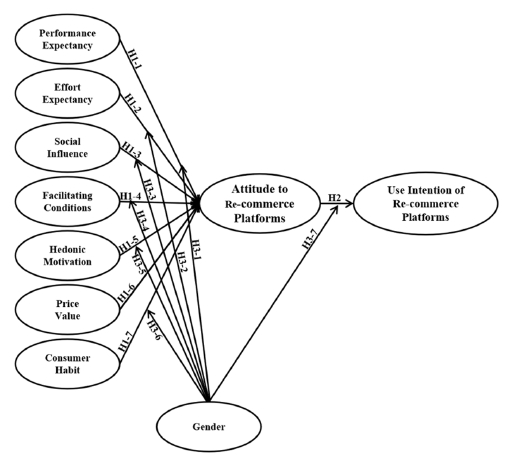
Structural model based on the UTAUT2.
3. Methods
3.1. Instrument development
This study’s measurement approach is based on prior research. Each measure was adapted from the literature to suit our research context by changing the research object to re-commerce platforms. As the measurement items were originally written in English, our study adopted a forward-backward translation approach to develop the measurement items in the Chinese context. We tested the suitability of the questionnaire in four steps. First, the English items were translated into Chinese. Second, two researchers with experience in second-hand trading helped us evaluate the questionnaire. Third, two scholars confirmed the accuracy of the Chinese questionnaire and translated it back to the English version to assess translation accuracy. Finally, to ensure that no differences remained between the two versions, we invited experts to check these questionnaires.
3.2. Measurements
This study’s objective was to understand the influence of re-commerce factors (i.e., hedonic motivation, price value, social influence, performance expectancy, effort expectancy, consumer habit, and facilitating conditions) on re-commerce platforms’ usage intention, mediated by the attitude toward re-commerce platforms and moderated by gender differences (male versus female). Prior to answering the questions, the respondents viewed a detailed explanation of a re-commerce platform, along with simple examples, on the first page of the questionnaire. This was followed by a screening question to determine whether the respondent had experience with re-commerce platforms. All items were measured by a seven-point Likert scale (1= “strongly disagree,” 7= “strongly agree”). Venkatesh et al.(2012) derived 25 items related to re-commerce platforms (four items each related to effort expectancy, consumer habit, performance expectancy, and facilitating conditions; three items each related to social influence, hedonic motivation, and price value). Attitude toward re-commerce platforms was measured using two items proposed by Davis(1989) and Shin(2010). Furthermore, two items related to the use intention of re-commerce platforms were adapted from Venkatesh et al.(2012). We supplemented and modified the scales verified for reliability and validity in previous research to fit the items in our study.
3.3. Sampling and data collection
We received Institutional Review Board (IRB) approval (No. 2204/003-011) to conduct a quantitative analysis of our research. The WJX research institute in China handled the recruitment of participants. The company (https://www.wjx.cn/) professionally collects data from Chinese websites.
Survey participants comprised re-commerce platform users who had purchased more than one second-hand item via the platform. Considering the recent growth of the re-commerce market in China, Chinese consumers constitute a suitable sample for this study. The survey began with a screening question regarding the experience of purchasing second-hand goods online or through mobile applications. Those who passed the screening question were asked to recall their most recent experience of second-hand trade. The survey was conducted during April 15–29, 2022. A total of 226 consumer responses were collected and used for analysis. We used SPSS 24.0 to conduct a descriptive statistics analysis and frequency and reliability tests. Confirmatory factor analysis (CFA) and structural equation model (SEM) were conducted using AMOS 24.0. Table 1 presents the demographic information of the survey participants. The total sample comprised 51.8% (117) women and 48.2% (109) men. Approximately 61.5% of respondents were in their 20s and 38.5% were in their 30s. In terms of the purchase frequency (times per year) of second-hand products, participants were evenly assigned to three groups, including less than once a year (35.0%), two to three times a year (30.5%), and more than four times a year (34.5%). For the sales frequency (times per year) of second-hand products, most respondents sold products less than once a year (39.8%), followed by two to three times a year (32.3%), and more than four times a year (27.9%). In addition, the usage period was documented. Most respondents had been using re-commerce platforms for less than 10 months (31.0%), followed by 11-20 months (27.4%), more than 31 months (24.3%), and 21-30 months (17.3%).

Respondents’ demographics
4. Results
4.1. Measurement validity and reliability
The Cronbach’s alpha was calculated to test reliability, and CFA was conducted to check the convergent and discriminant validity. According to Nunnally and Bernstein’s(1994) study, the Cronbach’s alpha must exceed 0.70. Based on Bagozzi and Yi(1988), we used CFA to check if the standard factor loadings exceeded 0.70. We also verified whether the average variance extracted values exceeded 0.50, indicating satisfactory composite reliability (Table 2).
Confirmatory factor analysis results
As shown in Table 3, the discriminant validity was also acceptable. Moreover, we used the measurement model test, and the goodness-of-fit indexes of the structural equation model indicate suitable model fit (χ2 = 511.092, df =339, p < .001, GF I= .874, NFI = .891, CFI = .960, TLI = .952, RMSEA = .047).
Model correlation matrix
4.2. Hypothesis testing
Our study used SEM to determine the association between the seven explanatory variables (i.e., facilitating conditions, effort expectancy, consumer habit, social influence, performance expectancy, hedonic motivation, and price value), attitudes, and usage intention toward re-commerce apps. The results revealed satisfactory model fit (χ2 = 516.332, df = 344, p < .001, CFI = .960, IFI = .960, TLI = .953, NIF = .890, RMSEA = .047). As illustrated in Fig. 2, the SEM test results showed that social influence (β = −.218, p < .05), hedonic motivation (β = .370, p<.001), price value (β = .225, p < .01), performance expectancy (β = .211, p < .1), and consumer habit (β = .194, p < .05) demonstrated a significant effect on the attitude toward re-commerce apps, whereas effort expectancy (β = .093, p = .233) and facilitating conditions (β = .023, p = .722) showed no association with attitude. In addition, the effects of attitude toward re-commerce apps on the intention to use the apps were statistically significant (β = .422, p < .001). Therefore, H1-1, H1-3, H1-5, H1-6, H1-7, and H2 were supported, whereas H1-2 and H1-4 were not supported. Consumers’ effort expectancy measures how easy it is for them to use re-commerce platforms. Nevertheless, our results showed that it is not associated with users’ attitudes toward the platform. Effort expectancy is significant in the early adoption phase and becomes insignificant in the later phase (Szajna, 1996; Venkatesh, 1999). Skoumpopoulou et al.(2018) argued that modern users exhibit high self-efficacy; they firmly believe that they can successfully use new technology, although they have to work hard to learn new techniques and become proficient. The same is true for the younger generation of Chinese users(Meissel & Rubie-Davies, 2016), and this result is consistent with Yang’s(2010) study on mobile shopping. In addition, facilitating conditions refer to the consumers’ perceptions of resources and support when using a second-hand shopping platform. However, it did not improve consumers’ attitudes toward the platform in our study. Facilitating conditions have no significant impact on behavioral intentions, similar to the findings of Crabbe et al.(2009) and Venkatesh et al.(2012). If users do not have the necessary resources and support, they will not use mobile applications(Fadzil, 2017). Moreover, express delivery was unavailable in some regions owing to China’s preventive policies during the COVID-19 pandemic. Furthermore, the pandemic made consumers wary of the used goods’ hygiene, their effect on health, and other related issues(Liu et al., 2022a). Yang and Lee(2022) demonstrated that perceived physical risks affect shared services adoption. Therefore, despite the convenience and diversity of China’s mobile second-hand shopping platforms, users hesitated to buy second-hand products(Xu et al., 2022).
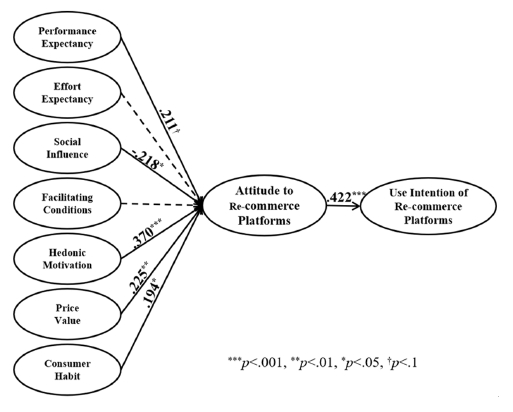
Structural equation modeling results.
4.3. Moderating effect of gender
Multi-group CFA was used in this study to assess gender differences (male, N = 109; female, N = 117). The configural invariance analysis was conducted to determine the measurement structures’ similarity of gender groups. The model’s goodness-of-fit was satisfactory (χ2 = 998.404, df = 708, p < .001/CFI = 934, IFI = .936, TLI = .924, RMSEA = .043), and all factor loadings exceeded .700. Additionally, measurement invariance was verified by comparing the constrained and unconstrained models. The results revealed that the variance of the chi-square was insignificant, validating the measurement invariance (Δχ2 =26.527, df = 20, p= .149). All potential variables among the gender groups showed identical measurements. Moreover, the multi-group SEM test presented a model with full measurement invariance. As shown in Fig. 3, social influence (β =−.310, p < .05), effort expectancy (β = .318, p < .05), consumer habit (β = .191, p<.1), and hedonic motivation (β = .269, p < .1) had significant effects on attitudes in the male group. Attitudes were strongly associated with the intention to use the platforms (β = .575, p < .001). For women, hedonic motivation (β = .348, p < .05), performance expectancy (β = .436, p < .1), and consumer habit increased (β = .208, p <.05), significantly affecting attitudes, which were associated with the use intention of re-commerce apps (β = .298, p<.01).
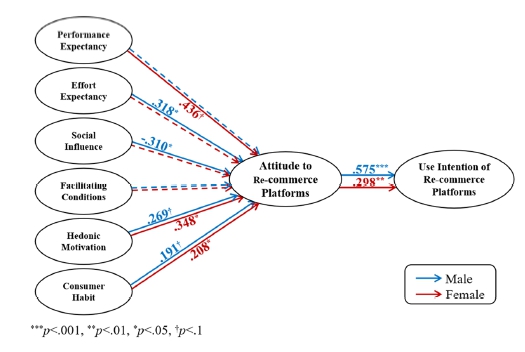
Structural equation modeling results by gender.
To further investigate the differences between the two groups, each coefficient was compared between the constrained and unconstrained models(Table 4). In terms of the effect of effort expectancy on attitude toward re-commerce platforms, the path differences among gender groups were significant (Δχ2 = 4.017, df = 1, p = .045), and the path coefficient of the male group (β = .318, p < .05) was higher than that of the female group (β=−.062, n.s). Gender is also associated with consumers’ technical efforts (Lee et al., 2010a; Lee et al., 2010b). Chau and Hui(1998) showed that men have a greater tendency to seek novelty and innovation during the early stages of using new technology. This study found that men are more concerned about the technical effort spent on second-hand shopping platforms. Our results are consistent with those of Tsourela and Roumeliotis(2015).
Comparison of path coefficients
Moreover, the path differences among gender groups regarding the relationship between attitude toward re-commerce platforms and use intention were also significant (Δχ2 = 4.693, df = 1, p = .030), and the path coefficient of the male group (β = .575, p < .001) was higher than that of the female group (β = .298, p < .01). Nysveen et al.(2005) pointed out that attitudes toward mobile services and other technologies are mainly instrumental. Moreover, compared to women, men are generally considered more instrumental, goal-oriented, and driven by extrinsic motivation. Our results are consistent with those of Nysveen et al.(2005), who found that attitudes more strongly affect the intentions of male users.
Regarding the effect of facilitating conditions, performance expectancy, consumer habit, social influence, and hedonic motivation on attitudes toward re-commerce platform usage, the path differences among gender groups were insignificant.
This study revealed that performance expectancy significantly influenced platform attitudes; however, no gender differences were found. Regardless of gender, those with high-performance expectations of platform use are more willing to use the platform than those with lower performance expectations. Previous researchers have argued that individuals enjoy challenges and have positive attitudes when challenges and skills are aligned(Woszczynski et al., 2002). In addition, social influence had a negative impact on attitudes; however, no gender differences were found. This is related to China’s cultural characteristics. Regardless of gender, young Chinese people pay more attention to “face-related issues” (shame, embarrassment, etc.) in society(Lang & Zhang, 2019). Although hedonic motivation and habit significantly impacted attitudes, no gender differences were found. This implies that both men and women have better attitudes toward platforms as long as they perceive higher hedonic motivation and higher levels of habituation. Users with more experience believe that using second-hand platforms should be associated with hedonic motivation(Jain et al., 2022). The accumulation of experience facilitates a harmonious relationship between the user’s habits and attitude toward the platform. Accordingly, users are more likely to have Internet access and spend more time online(Chang et al., 2019). Facilitating conditions did not affect consumers' attitudes, and no gender differences were found. Moreover, our survey was conducted during the COVID-19 pandemic, and consumers tended to worry about hygiene and other health-related issues (Liu et al., 2022a).
5. Discussion and Conclusions
Our study determined how the influence of different factors (i.e., effort expectancy, facilitating conditions, price value, consumer habit, hedonic motivation, performance expectancy, and social influence) is mediated by consumer attitudes toward re-commerce platform usage. Moreover, it explored the moderating effect of gender in platform usage. Our findings showed that second-hand online shopping attitudes are positively influenced by price value, hedonic motivation, performance expectancy, and consumer habit. In contrast, social influence has a negative impact on attitude. The results of attitude toward re-commerce platforms on the intention of using these platforms were statistically significant. When users perceive higher performance expectations, their attitudes toward second-hand shopping platforms also improve because of higher shopping efficiency(Tak & Panwar, 2017). Consumers tend to use re-commerce platforms when they perceive a high degree of price value, consumer habit, and hedonic motivation. For hedonic motivation, using re-commerce platforms can be considered fun. Consumers pay more attention to their perceived emotions during usage, and this feeling motivates them to use this platform to buy or sell goods more frequently(Zhou & Tong, 2022).
Regarding price value, used goods marketplace platforms are reasonably priced and offer good value for users’ money. Consumers use re-commerce platforms for excellent value and time efficiency(Zanzalari, 2022). Regarding consumer habits, re-commerce platform usage is habitual for some customers. They are also addicted to using these apps. Thus, using re-commerce platforms comes naturally to them(“How online marketplaces”, 2021). Finally, the attitude toward re-commerce platforms influences the use intention of said platforms, leading consumers to develop positive feelings toward their continuous use. Moreover, social influence negatively affects consumers’ attitudes. This perspective supports the results of Silva et al.(2021), and Cervellon et al. (2012); when consumers use second-hand platforms to buy pre-owned goods, they do not want the people around them to focus on their purchase mechanism. On the contrary, if the people close to them want them to use the second-hand platform, they reject this behavior. Therefore, when they obtain second-hand goods through e-commerce platforms, they express anxiety and fear about the image being conveyed to those around them(Boardman et al., 2022). This study’s results confirmed these views. Contrary to our expectations, effort expectancy did not affect consumer attitudes toward the use of second-hand shopping apps. These findings are consistent with the results of Yang(2010) and Skoumpopoulou et al.(2018). This may be because the young Chinese generation believes that they can successfully use new technology and maintain high self-efficacy. Facilitating conditions also did not significantly affect attitudes toward using second-hand shopping apps. Moreover, as our survey was conducted during the COVID-19 outbreak, consumers were concerned about hygiene and aspects of China’s pandemic prevention policy (Liu et al., 2022a). In this case, users did not have a positive attitude toward re-commerce platforms (Xu et al., 2022).
Regarding the moderating effect of gender differences, this study demonstrated the impact of effort expectancy on attitude and that of attitude on use intention; Only two paths showed different characteristics between the two gender groups. Men are more inclined to use second-hand platforms than women(Crobox Team, 2019). The study reveals two reasons for the same. First, men’s consumption has become more rational, and high-quality and inexpensive products have become popular(Sladek et al., 2010); because re-commerce platforms provide quality inspection, quality assurance, and after-sales services, men have become more accepting of second-hand transactions than women. This study found that men are more concerned about the technical effort spent on second-hand shopping platforms. Our results are consistent with those of Tsourela and Roumeliotis(2015). Therefore, second-hand shopping platform developers should provide user-friendly interfaces, voice recognition, and other functions(Tsourela & Roumeliotis, 2015). Our study demonstrated the significant effect of social influence, hedonic motivation, consumer habit, and performance expectancy on attitudes; however, no gender differences were observed. Woszczynski et al.(2002) argued that individuals enjoy challenges and perceived positive attitudes when challenges and skills are matched. Regardless of gender, social influence was found to be related to China’s cultural characteristics. Young Chinese people pay more attention to “face-related issues” in society. Furthermore, consumers with more experience tend to believe that using second-hand platforms should be associated with hedonic motivation (Jain et al., 2022). Moreover, as platform users gain experience, they are more likely to access and spend time online(Chang et al., 2019). Facilitating conditions did not affect consumers’ attitudes, and no gender differences were observed.
This study contributes to the literature by providing three critical insights regarding used goods marketplace platforms. First, our study explains why the seven constructs of re-commerce platforms influence attitudes toward used goods marketplace platforms and usage intention based on the UTAUT2 perspective. Compared to traditional social commerce, many aspects of second-hand trade have changed and remain unexplained. Based on prior research, we examined the technical features and customers’ perceptions based on the UTAUT2 model. In addition, our study defined the attitude toward second-hand shopping platforms as the mediating influence for customer usage intention. As a result, we found that several features (including consumer habit, hedonic motivation, and price value) can affect usage intention through attitudes toward these platforms. Therefore, this study offers a theoretical basis for future analyses of second-hand trade. Second, this study adopts the lens of the UTAUT2 model and considers re-commerce platforms in second-hand commerce, which is a novel perspective. Our study provides seven attributes based on the UTAUT2 model in used goods marketplace platform usage. This perspective can help readers develop a deeper understanding of MZ generation consumers’ attitudes and actions toward second-hand commerce, an aspect that differs from previous studies(Liang & Xu, 2018). Third, our study highlights some key insights derived from the comparisons between women and men, which contribute to understanding how different gender groups use re-commerce platforms and why these differences exist.
Re-commerce platforms in China are convenient and improve transactional efficiency. They also enable people to exchange products. By allowing users to easily buy and sell used goods, they encourage a more circular economy and reduce the need for new products(Wang et al., 2022). They also allow buyers and sellers to connect more easily. Online retailers and platform managers can use this study’s findings to create better marketing strategies that emphasize the features and services that their customers most value. Consumers are influenced by hedonic attributes, prices, platform technology, and their habits. Re-commerce platforms should be designed to enhance users’ enjoyment. Developers can connect social networking sites with their platforms, facilitating mobile word-of-mouth marketing(Tak & Panwar, 2017). Additionally, marketers can promote users’ app use habits by offering various coupon deals and better benefits than other platforms. Our study reveals that MZ generation users are driven to use re-commerce platforms because of the associated benefits. Technology-driven innovations can make user interfaces more user-friendly, resulting in higher profits for marketers and developers as usage increases.
However, this study has two limitations that must be noted. First, it mainly focuses on consumers’ unique experiences in China, making it difficult to generalize the findings to other countries. Second, as a general analysis of used goods marketplace platforms, our study did not determine different factors or product-related aspects as essential insights. Thus, to gain a more comprehensive view of the used goods market, future research should explore the factors that influence consumers’ behavior and their usage of used goods marketplace platforms.
Acknowledgments
This work was supported by The Research Institute of Human Ecology, Seoul National University.
References
-
Ajzen, I. (2002). Perceived behavioral control, self-efficacy, locus of control, and the theory of planned behavior. Journal of Applied Social Psychology, 32(4), 665-683.
[https://doi.org/10.1111/j.1559-1816.2002.tb00236.x]

-
Alalwan, A. A., Dwivedi, Y. K., & Rana, N. P. (2017). Factors influencing adoption of mobile banking by Jordanian bank customers: Extending UTAUT2 with trust. International Journal of Information Management, 37(3), 99-110.
[https://doi.org/10.1016/j.ijinfomgt.2017.01.002]
-
Alalwan, A. A., Dwivedi, Y. K., Rana, N. P. P., & Williams, M. D. (2016). Consumer adoption of mobile banking in Jordan: Examining the role of usefulness, ease of use, perceived risk and self-efficacy. Journal of Enterprise Information Management, 29(1), 118-139.
[https://doi.org/10.1108/JEIM-04-2015-0035]
-
Ameen, N., Willis, R., & Shah, M. H. (2018). An examination of the gender gap in smartphone adoption and use in Arab countries - A cross-national study. Computers in Human Behavior, 89, 148-162.
[https://doi.org/10.1016/j.chb.2018.07.045]
-
Arman, S. M., & Mark-Herbert, C. (2022). Ethical pro-environmental self-identity practice - The case of second-hand products. Sustainability, 14(4), 2154.
[https://doi.org/10.3390/su14042154]
-
Bagozzi, R. P., & Yi, Y. (1988). On the evaluation of structural equation models. Journal of the Academy of Marketing Science, 16(1), 74–94.
[https://doi.org/10.1007/BF02723327]
-
Boardman, R., Zhou, Y., & Guo, Y. (2022). Chinese consumer attitudes towards second-hand luxury fashion and how social media eWoM affects decision-making. In C. E. Henninger & N. K. Athwal (Eds.), Sustainable luxury (pp. 241-269). Cham: Palgrave MacMillan.
[https://doi.org/10.1007/978-3-031-06928-4_12]
-
Cervellon, M. C., Carey, L., & Harms, T. (2012). Something old, something used - Determinants of women’s purchase of vintage fashion vs second-hand fashion. International Journal of Retail and Distribution Management, 40(12), 956-974.
[https://doi.org/10.1108/09590551211274946]
-
Chang, A. (2012). UTAUT and UTAUT 2 - A review and agenda for future research. Winners, 13(2), 10-114.
[https://doi.org/10.21512/tw.v13i2.656]
-
Chang, C. M., Liu, L. W., Huang, H. C., & Hsieh, H. H. (2019). Factors influencing online hotel booking - Extending UTAUT2 with age, gender, and experience as moderators. Information, 10(9), 281.
[https://doi.org/10.3390/info10090281]
-
Chang, M. K., Cheung, W., & Lai, V. S. (2005). Literature derived reference models for the adoption of online shopping. Information and Management, 42(4), 543-559.
[https://doi.org/10.1016/S0378-7206(04)00051-5]
-
Chau, P. Y., & Hui, K. L. (1998). Identifying early adopters of new IT products - A case of Windows 95. Information & management, 33(5), 225-230.
[https://doi.org/10.1016/S0378-7206(98)00031-7]
-
Chopdar, P. K., Korfiatis, N., Sivakumar, V. J., & Lytras, M. D. (2018). Mobile shopping apps adoption and perceived risks - A cross-country perspective utilizing the Unified Theory of Acceptance and Use of Technology. Computers in Human Behavior, 86, 109-128.
[https://doi.org/10.1016/j.chb.2018.04.017]
-
Crabbe, M., Standing, C., Standing, S., & Karjaluoto, H. (2009). An adoption model for mobile banking in Ghana. International Journal of Mobile Communications, 7(5), 515-543.
[https://doi.org/10.1504/IJMC.2009.024391]
- Crobox Team. (2019, June 11). Men and women shopping differences - What the experts say. Crobox. Retrieved November 22, 2022, from https://blog.crobox.com/article/men-women-shopping-differences
-
Croson, R., & Gneezy, U. (2009). Gender differences in preferences. Journal of Economic Literature, 47(2), 448-474.
[https://doi.org/10.1257/jel.47.2.448]
-
Davis, F. D. (1989). Perceived usefulness, perceived ease of use, and user acceptance of information technology. MIS Quarterly, 13(3), 319-340.
[https://doi.org/10.2307/249008]
-
Davis, F. D., Bagozzi, R. P., & Warshaw, P. R. (1989). User acceptance of computer technology - A comparison of two theoretical models. Management Science, 35(8), 982-1003.
[https://doi.org/10.1287/mnsc.35.8.982]
-
Dennehy, D., & Sammon, D. (2015). Trends in mobile payments research - A literature review. Journal of Innovation Management, 3(1), 49-61.
[https://doi.org/10.24840/2183-0606_003.001_0006]
-
Dittmar, H., Long, K., & Meek, R. (2004). Buying on the Internet: Gender differences in on-line and conventional buying motivations. Sex Roles, 50(5/6), 423-444.
[https://doi.org/10.1023/B:SERS.0000018896.35251.c7]
-
Dodds, W. B., Monroe, K. B., & Grewal, D. (1991). Effects of price, brand, and store information on buyers’ product evaluations. Journal of Marketing Research, 28(3), 307-319.
[https://doi.org/10.1177/002224379102800305]
-
Dwivedi, Y. K., Rana, N. P., Jeyaraj, A., Clement, M., & Williams, M. D. (2017). Re-examining the unified theory of acceptance and use of technology (UTAUT) - Towards a revised theoretical model. Information Systems Frontiers, 3(21), 719-734.
[https://doi.org/10.1007/s10796-017-9774-y]
-
Eastman, J. K., Goldsmith, R. E., & Flynn, L. R. (1999). Status consumption in consumer behavior - Scale development and validation. Journal of Marketing Theory and Practice, 7(3), 41-52.
[https://doi.org/10.1080/10696679.1999.11501839]
-
Escobar-Rodríguez, T., & Carvajal-Trujillo, E. (2014). Online purchasing tickets for low cost carriers - An application of the unified theory of acceptance and use of technology (UTAUT) model. Tourism Management, 43, 70-88.
[https://doi.org/10.1016/j.tourman.2014.01.017]
-
Fadzil, F. (2017). A study on factors affecting the behavioral intention to use mobile apps in Malaysia. SSRN Electronic Journal.
[https://doi.org/10.2139/ssrn.3090753]
- Fan, Y. W., & Miao, Y. F. (2012). Effect of electronic word-of-mouth on consumer purchase intention - The perspective of gender differences. International Journal of Electronic Business Management, 10(3), 175-181. https://www.ttcenter.ir/ArticleFiles/ENARTICLE/3218.pdf
-
Ferraro, C., Sands, S., & Brace-Govan, J. (2016). The role of fashionability in second-hand shopping motivations. Journal of Retailing and Consumer Services, 32, 262-268.
[https://doi.org/10.1016/j.jretconser.2016.07.006]
-
Gefen, D., & Straub, D. W. (1997). Gender differences in the perception and use of e-mail: An extension to the technology acceptance model. MIS Quarterly, 21(4), 389-400.
[https://doi.org/10.2307/249720]
-
Ginsburg, M. (1980). Rags to riches - The second-hand clothes trade 1700-1978. Costume, 14(1), 121-135.
[https://doi.org/10.1179/cos.1980.14.1.121]
-
Guiot, D., & Roux, D. (2010). A second-hand shoppers’ motivation scale - Antecedents, consequences, and implications for retailers. Journal of Retailing, 86(4), 355-371.
[https://doi.org/10.1016/j.jretai.2010.08.002]
-
Herrero, Á., San Martín, H., & Garcia-De los Salmones, M. D. M. (2017). Explaining the adoption of social networks sites for sharing user-generated content - A revision of the UTAUT2. Computers in Human Behavior, 71, 209-217.
[https://doi.org/10.1016/j.chb.2017.02.007]
-
Hew, J. J., Lee, V. H., Ooi, K. B., & Wei, J. (2015). What catalyses mobile apps usage intention - An empirical analysis. Industrial Management and Data Systems, 115(7), 1269-1291.
[https://doi.org/10.1108/IMDS-01-2015-0028]
-
Holsapple, C. W., & Wu, J. (2007). User acceptance of virtual worlds - The hedonic framework. ACM SIGMIS Database, 38(4), 86-89.
[https://doi.org/10.1145/1314234.1314250]
-
Hou, J., & Elliott, K. (2010). Profiling online bidders. Journal of Marketing Theory and Practice, 18(2), 109-126.
[https://doi.org/10.2753/MTP1069-6679180201]
- ‘How online marketplaces are making secondhand fashion a first choice.’ (2021, November 12). McKinsey & Company. Retrieved November 22, 2022, from https://www.mckinsey.com/industries/technology-media-and-telecommunications/our-insights/how-online-marketplaces-are-making-secondhand-fashion-a-first-choice
- Huang, J., & Yang, Y. (2010). Gender differences in adolescents’ online shopping motivations. African Journal of Business Management, 4(6), 849-857.
-
Hur, E. (2020). Rebirth fashion - Secondhand clothing consumption values and perceived risks. Journal of Cleaner Production, 273, 122951.
[https://doi.org/10.1016/j.jclepro.2020.122951]
-
Isa, S. M., & Wong, K. Y. (2015). Age differences in behavioral intention to use internet marketing - A comparative study between Malaysian and Taiwanese. International Journal of Business and Society, 16(3).
[https://doi.org/10.33736/ijbs.574.2015]
-
Isla, V. L. (2013). Investigating second-hand fashion trade and consumption in the Philippines: Expanding existing discourses. Journal of Consumer Culture, 13(3), 221-240.
[https://doi.org/10.1177/1469540513480167]
-
Jackson, L. A., Ervin, K. S., Gardner, P. D., & Schmitt, N. (2001). Gender and the Internet - Women communicating and men searching. Sex Roles, 44(5/6), 363-379.
[https://doi.org/10.1023/A:1010937901821]
-
Jain, G., Kamble, S. S., Ndubisi, N. O., Shrivastava, A., Belhadi, A., & Venkatesh, M. (2022). Antecedents of Blockchain-Enabled E-commerce Platforms (BEEP) adoption by customers–A study of second-hand small and medium apparel retailers. Journal of Business Research, 149, 576-588.
[https://doi.org/10.1016/j.jbusres.2022.05.041]
-
Jeong, E. Y. (2019). A study on the intention to reuse mobile airline application - An application of the unified theory of acceptance and use of technology 2 (UTAUT2) model. Journal of Tourism Management Research, 23(2), 719-735.
[https://doi.org/10.18604/tmro.2019.23.2.34]
-
Johnson, C. M., Tariq, A., & Baker, T. L. (2018). From Gucci to green bags - Conspicuous consumption as a signal for pro-social behavior. Journal of Marketing Theory and Practice, 26(4), 339-356.
[https://doi.org/10.1080/10696679.2018.1487769]
- Jusoh, Z. M., & Ling, G. H. (2012). Factors influencing consumers’ attitude towards e-commerce purchases through online shopping. International Journal of Humanities and Social Science, 2(4), 223-230
- Kelly, S., & Breslin, J.(2010). Women’s rights in the Middle East and North Africa - progress amid resistance. New York: Freedom House
-
Kim, D. Y., Lehto, X. Y., & Morrison, A. M. (2007). Gender differences in online travel information search: Implications for marketing communications on the internet. Tourism Management, 28(2), 423-433.
[https://doi.org/10.1016/j.tourman.2006.04.001]
-
Kim, S. P. (2021). A study on the user structure analysis of secondhand market apps - Focusing on Joongonara, Bungaejangter, Danggeunmarket. Journal of the Korea Academia-Industrial Cooperation Society, 22(7), 449-458.
[https://doi.org/10.5762/KAIS.2021.22.7.449]
-
Kwateng, K. O., Atiemo, K. A. O., & Appiah, C. (2018). Acceptance and use of mobile banking - An application of UTAUT2. Journal of Enterprise Information Management, 32(1), 118-151.
[https://doi.org/10.1108/JEIM-03-2018-0055]
-
Laitala, K., & Klepp, I. G. (2018). Motivations for and against second-hand clothing acquisition. Clothing Cultures, 5(2), 247-262.
[https://doi.org/10.1386/cc.5.2.247_1]
-
Lang, C., & Zhang, R. (2019). Second-hand clothing acquisition - The motivations and barriers to clothing swaps for Chinese consumers. Sustainable Production and Consumption, 18, 156-164.
[https://doi.org/10.1016/j.spc.2019.02.002]
-
Lee, H. J., Cho, H. J., Xu, W., & Fairhurst, A. (2010a). The influence of consumer traits and demographics on intention to use retail self-service checkouts. Marketing Intelligence & Planning, 28(1), 46-58.
[https://doi.org/10.1108/02634501011014606]
-
Lee, S., Park, G., Yoon, B., & Park, J. (2010b). Open innovation in SMEs—An intermediated network model. Research Policy, 39(2), 290-300.
[https://doi.org/10.1016/j.respol.2009.12.009]
-
Liang, J., & Xu, Y. (2018). Second-hand clothing consumption - A generational cohort analysis of the Chinese market. International Journal of Consumer Studies, 42(1), 120-130.
[https://doi.org/10.1111/ijcs.12393]
-
Liu, C., Huang, J., Chen, S., Wang, D., Zhang, L., Liu, X., & Lian, X. (2022a). The impact of crowd gatherings on the spread of COVID-19. Environmental Research, 213, 113604.
[https://doi.org/10.1016/j.envres.2022.113604]
- Liu, Q., Yang, Z., Li, Y., Qiao, X., & Wei, C. (2022b). Study of reputation mechanism of second-hand university platform based on E-sporas model. IAENG International Journal of Computer Science, 49(2).
-
Lo, C. J., Tsarenko, Y., & Tojib, D. (2019). To tell or not to tell? The roles of perceived norms and self-consciousness in understanding consumers’ willingness to recommend online secondhand apparel shopping. Psychology and Marketing, 36(4), 287-304.
[https://doi.org/10.1002/mar.21179]
-
Mehta, R. (2020). Gender-based differences in consumer decision-making styles - Implications for marketers. Decision, 47(3), 319-329.
[https://doi.org/10.1007/s40622-020-00252-8]
-
Meissel, K., & Rubie-Davies, C. M. (2016). Cultural invariance of goal orientation and self-efficacy in New Zealand - Relations with achievement. British Journal of Educational Psychology, 86(1), 92-111.
[https://doi.org/10.1111/bjep.12103]
-
Merhi, M., Hone, K., Tarhini, A., & Ameen, N. (2021). An empirical examination of the moderating role of age and gender in consumer mobile banking use - A cross-national, quantitative study. Journal of Enterprise Information Management, 34(4), 1144-1168.
[https://doi.org/10.1108/JEIM-03-2020-0092]
-
Milgram, B. L. (2004). Refashioning commodities - Women and the sourcing of secondhand clothing in the Philippines. Anthropologica, 46(2), 189-202.
[https://doi.org/10.2307/25606194]
-
Mohammad, J., Quoquab, F., & Mohamed Sadom, N. Z. (2021). Mindful consumption of second-hand clothing - The role of eWOM, attitude and consumer engagement. Journal of Fashion Marketing and Management, 25(3), 482-510.
[https://doi.org/10.1108/JFMM-05-2020-0080]
-
Morris, M. G., & Venkatesh, V. (2000). Age differences in technology adoption decisions - Implications for a changing work force. Personnel Psychology, 53(2), 375-403.
[https://doi.org/10.1111/j.1744-6570.2000.tb00206.x]
- Nasidi, Q. Y., Ahmad, M. F., Garba, M., Hafiz, U. A., & Hassan, I. (2022). The mediating role of advertisement in the relationship between social media and online risk and its effect on online shopping habits. Iranian Journal of Management Studies, 15(4), 743-758.
-
Nikolopoulos, F., & Likothanassis, S. (2017). Using UTAUT2 for cloud computing technology acceptance modeling. Proceedings of the Second International Conference on Internet of Things, Data and Cloud Computing (pp. 1-6). Cambridge, United Kingdom: Association for Computing Machinery.
[https://doi.org/10.1145/3018896.3025153]
-
Noble, S. M., Griffith, D. A., & Adjei, M. T. (2006). Drivers of local merchant loyalty - Understanding the influence of gender and shopping motives. Journal of Retailing, 82(3), 177-188.
[https://doi.org/10.1016/j.jretai.2006.05.002]
- Nunnally, J. C., & Bernstein, I. H. (1994). Psychometric theory (3rd edn.). New York: McGraw-Hill.
-
Nysveen, H., Pedersen, P. E., & Thorbjørnsen, H. (2005). Explaining intention to use mobile chat services - Moderating effects of gender. Journal of Consumer Marketing, 22(5), 247-256.
[https://doi.org/10.1108/07363760510611671]
- Observation. (2021, December 10). The scale of China’s second-hand trading market breaks trillions? Why do young people like to buy second-hand goods so much? Baidu. Retrieved November 22, 2022, from https://baijiahao.baidu.com/s?id=1718683707490236279&wfr=spider&for=pc
-
Oliveira, T., Thomas, M., Baptista, G., & Campos, F. (2016). Mobile payment - Understanding the determinants of customer adoption and intention to recommend the technology. Computers in Human Behavior, 61, 404-414.
[https://doi.org/10.1016/j.chb.2016.03.030]
-
Padmavathy, C., Swapana, M., & Paul, J. (2019). Online second-hand shopping motivation–Conceptualization, scale development, and validation. Journal of Retailing and Consumer Services, 51, 19-32.
[https://doi.org/10.1016/j.jretconser.2019.05.014]
- Park, E., & Kim, E. C. (2021). Why do they buy used products?: Comparison between adolescents and adults. EWHA Journal of Social Sciences, 37(1), 5-31.
-
Park, H. H. (2021). Analysis of sales information of second-hand clothing goods on the c2c secondhand trading platform-Focusing on content analysis using NVivo. Fashion & Textile Research Journal, 23(3), 358-369.
[https://doi.org/10.16935/ejss.2021.37.1.001]
-
Park, K., & Cheon, H. (2020). A study on consumers’ experience in C2C secondhand goods transaction. Journal of Consumer Policy Studies, 51(3), 81-108.
[https://doi.org/10.15723/jcps.51.3.202012.81]
-
Peña-Vinces, J., Solakis, K., & Guillen, J. (2020). Environmental knowledge, the collaborative economy and responsible consumption in the context of second-hand perinatal and infant clothes in Spain. Resources, Conservation and Recycling, 159, 104840.
[https://doi.org/10.1016/j.resconrec.2020.104840]
-
Roux, D., & Guiot, D. (2008). Measuring second-hand shopping motives, antecedents and consequences. Recherche et Applications en Marketing (English Edition), 23(4), 63-91.
[https://doi.org/10.1177/205157070802300404]
-
Sharma, S., Singh, G., & Pratt, S. (2020). Does consumers’ intention to purchase travel online differ across generations? Australasian Journal of Information Systems, 24.
[https://doi.org/10.3127/ajis.v24i0.2751]
-
Shin, D. H. (2010). The effects of trust, security and privacy in social networking - A security-based approach to understand the pattern of adoption. Interacting with Computers, 22(5), 428-438.
[https://doi.org/10.1016/j.intcom.2010.05.001]
-
Silva, S. C., Santos, A., Duarte, P., & Vlačić, B. (2021). The role of social embarrassment, sustainability, familiarity and perception of hygiene in second-hand clothing purchase experience. International Journal of Retail and Distribution Management, 49(6), 717-734.
[https://doi.org/10.1108/IJRDM-09-2020-0356]
- Skoumpopoulou, D., Wong, A., Ng, P., & Lo, M. (2018). Factors that affect the acceptance of new technologies in the workplace - A cross case analysis between two universities. International Journal of Education and Development Using ICT, 14(3), 209-222.
-
Sladek, R. M., Bond, M. J., & Phillips, P. A. (2010). Age and gender differences in preferences for rational and experiential thinking. Personality and Individual Differences, 49(8), 907-911.
[https://doi.org/10.1016/j.paid.2010.07.028]
- Statista Research Department. (2022, May 24). Second-hand e-commerce - Statistics and facts. Statista. Retrieved October 20, 2022, from https://www.statista.com/topics/9448/second-hand-e-commerce/#topicHeader__wrapper
-
Styvén, M. E., & Mariani, M. M. (2020). Understanding the intention to buy secondhand clothing on sharing economy platforms - The influence of sustainability, distance from the consumption system, and economic motivations. Psychology and Marketing, 37(5), 724-739.
[https://doi.org/10.1002/mar.21334]
-
Sung, H. (2013). A study on the determinants of attitude toward and intention to use mobile shopping through fashion apps-Comparisons of gender and age group differences. Journal of the Korean Society of Clothing and Textiles, 37(7), 1000-1014.
[https://doi.org/10.5850/JKSCT.2013.37.7.1000]
-
Szajna, B. (1996). Empirical evaluation of the revised technology acceptance model. Management Science, 42(1), 85-92.
[https://doi.org/10.1287/mnsc.42.1.85]
- Taiwo, A. A., & Downe, A. G. (2013). The theory of user acceptance and use of technology (UTAUT) - A meta-analytic review of empirical findings. Journal of Theoretical and Applied Information Technology, 49(1), 48-58.
-
Tak, P., & Panwar, S. (2017). Using UTAUT 2 model to predict mobile app based shopping - Evidences from India. Journal of Indian Business Research, 9(3), 248-264.
[https://doi.org/10.1108/JIBR-11-2016-0132]
-
Tamilmani, K., Rana, N. P., Prakasam, N., & Dwivedi, Y. K. (2019). The battle of Brain vs. Heart - A literature review and meta-analysis of “hedonic motivation” use in UTAUT2. International Journal of Information Management, 46, 222-235.
[https://doi.org/10.1016/j.ijinfomgt.2019.01.008]
-
Tandon, U. (2021). Predictors of online shopping in India: An empirical investigation. Journal of Marketing Analytics, 9(1), 65-79.
[https://doi.org/10.1057/s41270-020-00084-6]
-
Taylor, S., & Todd, P. A. (1995). Understanding information technology usage - A test of competing models. Information Systems Research, 6(2), 144-176.
[https://doi.org/10.1287/isre.6.2.144]
-
Teo, A. C., Tan, G. W. H., Ooi, K. B., Hew, T. S., & Yew, K. T. (2015). The effects of convenience and speed in m-payment. Industrial Management and Data Systems, 115(2), 311-331.
[https://doi.org/10.1108/IMDS-08-2014-0231]
- ‘Three Tips for living frugally in college.’ (2013, August 23). Yahoo! News. Retrieved October 20, 2022, from https://news.yahoo.com/3-tips-living-frugally-college-204634227.html
-
Thusi, P., & Maduku, D. K. (2020). South African millennials’ acceptance and use of retail mobile banking apps - An integrated perspective. Computers in Human Behavior, 111, 106405.
[https://doi.org/10.1016/j.chb.2020.106405]
-
Todd, S., & Lawson, R. (2003). Towards an understanding of frugal consumers. Australasian Marketing Journal, 11(3), 8-18.
[https://doi.org/10.1016/S1441-3582(03)70131-1]
-
Todman, J. (2000). Gender differences in computer anxiety among university entrants since 1992. Computers and Education, 34(1), 27-35.
[https://doi.org/10.1016/S0360-1315(99)00036-6]
-
Tsourela, M., & Roumeliotis, M. (2015). The moderating role of technology readiness, gender, and sex in consumer acceptance and actual use of technology-based services. Journal of High Technology Management Research, 26(2), 124-136.
[https://doi.org/10.1016/j.hitech.2015.09.003]
-
Venkatesh, V. (1999). Creation of favorable user perceptions - Exploring the role of intrinsic motivation. MIS Quarterly, 23(2), 239-260.
[https://doi.org/10.2307/249753]
-
Venkatesh, V., & Morris, M. G. (2000). Why don’t men ever stop to ask for directions? Gender, social influence, and their role in technology acceptance and usage behavior. MIS quarterly, 24(1), 115-139.
[https://doi.org/10.2307/3250981]
-
Venkatesh, V., Morris, M. G., Davis, G. B., & Davis, F. D. (2003). User acceptance of information technology: Toward a unified view. MIS Quarterly, 27(3), 425-478.
[https://doi.org/10.2307/30036540]
-
Venkatesh, V., Thong, J. Y. L., Chan, F. K. Y., Hu, P. J. H., & Brown, S. A. (2011). Extending the two?stage information systems continuance model - Incorporating UTAUT predictors and the role of context. Information Systems Journal, 21(6), 527-555.
[https://doi.org/10.1111/j.1365-2575.2011.00373.x]
-
Venkatesh, V., Thong, J. Y., & Xu, X. (2012). Consumer acceptance and use of information technology - Extending the unified theory of acceptance and use of technology. MIS Quarterly, 36(1), 157-178.
[https://doi.org/10.2307/41410412]
-
Wang, B., Fu, Y., & Li, Y. (2022). Young consumers’ motivations and barriers to the purchase of second-hand clothes - An empirical study of China. Waste Management, 143, 157-167.
[https://doi.org/10.1016/j.wasman.2022.02.019]
-
Wang, Y. S., Wu, M. C., & Wang, H. Y. (2009). Investigating the determinants and age and gender differences in the acceptance of mobile learning. British Journal of Educational Technology, 40(1), 92-118.
[https://doi.org/10.1111/j.1467-8535.2007.00809.x]
-
Wei, T. T., Marthandan, G., Chong, A., Ooi, K., & Arumugam, S. (2009). What drives Malaysian mcommerce adoption? An empirical analysis. Industrial Management and Data Systems, 109(3), 370-388.
[https://doi.org/10.1108/02635570910939399]
- Weil, C. (1999). Secondhand chic: Finding fabulous fashion at consignment, vintage, and thrift stores. New York: Pocket Books.
- Weinswig, D. (2020, February 21). Second-hand shopping takes off on Chinese apps. Technode. Retrieved November 22, 2022, from https://technode.com/2020/02/21/second-hand-shopping-takes-off-on-chinese-apps/
-
Woszczynski, A. B., Roth, P. L., & Segars, A. H. (2002). Exploring the theoretical foundations of playfulness in computer interactions. Computers in Human Behavior, 18(4), 369-388.
[https://doi.org/10.1016/S0747-5632(01)00058-9]
-
Xu, J., Zhou, Y., Jiang, L., & Shen, L. (2022). Exploring sustainable fashion consumption behavior in the post-pandemic era - Changes in the antecedents of second-hand clothing-sharing in China. Sustainability, 14(15), 9566.
[https://doi.org/10.3390/su14159566]
-
Xu, Y., Chen, Y., Burman, R., & Zhao, H. (2014). Second-hand clothing consumption - A cross-cultural comparison between American and Chinese young consumers. International Journal of Consumer Studies, 38(6), 670-677.
[https://doi.org/10.1111/ijcs.12139]
-
Yan, R. N., Bae, S. Y., & Xu, H. (2015). Second-hand clothing shopping among college students - The role of psychographic characteristics. Young Consumers, 16(1), 85-98.
[https://doi.org/10.1108/YC-02-2014-00429]
-
Yang, C., & Wu, C. C. (2006). Gender differences in online shoppers’ decision-making styles. E-business and Telecommunication Networks, 2, 99-106.
[https://doi.org/10.1007/1-4020-4761-4_6]
-
Yang, H., & Lee, H. (2022). How does the perceived physical risk of COVID-19 affect sharing economy services? Current Issues in Tourism, 25(7), 1046-1062.
[https://doi.org/10.1080/13683500.2022.2035700]
-
Yang, K. (2010). Determinants of US consumer mobile shopping services adoption - Implications for designing mobile shopping services. Journal of Consumer Marketing, 27(3), 262-270.
[https://doi.org/10.1108/07363761011038338]
- Zanzalari, D. (2022, September 13). Advantages of e-commerce, e-commerce can work for businesses and customers. The Balance. Retrieved November 21, 2022, from https://www.thebalancemoney.com/advantages-of-ecommerce-1141610
-
Zeithaml, V. A. (1988). Consumer perceptions of price, quality, and value - A means-end model and synthesis of evidence. Journal of Marketing, 52(3), 2-22.
[https://doi.org/10.1177/002224298805200302]
-
Zhang, P., He, Y., & Shi, C. V. (2017). Retailer’s channel structure choice - Online channel, offline channel, or dual channels? International Journal of Production Economics, 191, 37-50.
[https://doi.org/10.1016/j.ijpe.2017.05.013]
- Zhou, L., Dai, L., & Zhang, D. (2007). Online shopping acceptance model-A critical survey of consumer factors in online shopping. Journal of Electronic Commerce Research, 8(1), 41-62.
-
Zhou, R., & Tong, L. (2022). A study on the influencing factors of consumers’ purchase intention during livestreaming e-commerce: The mediating effect of emotion. Frontiers in Psychology, 13, 903023.
[https://doi.org/10.3389/fpsyg.2022.903023]
-
Zolkepli, I. A., & Kamarulzaman, Y. (2015). Social media adoption - The role of media needs and innovation characteristics. Computers in Human Behavior, 43, 189-209.
[https://doi.org/10.1016/j.chb.2014.10.050]