
Effect of Chinese Consumers’ Ethnocentrism and Cultural Affinity on Purchase Intentions for Local Fashion Brands in the Context of “Guochao” Consumption

©2022 Fashion and Textile Research Journal (FTRJ). This is an open access journal. Articles are distributed under the terms of the Creative 52 Commons Attribution Non-Commercial License (http://creativecommons.org/licenses/by-nc/4.0), which permits unrestricted use, distribution, and reproduction in any medium, provided the original work is properly cited.
Abstract
This study developed a structural model to examine the relationships among consumer traits, self-brand connections, and purchase intentions for local fashion brands under “Guochao” consumption in China. An online survey with a self-administered questionnaire was undertaken through Chinese SNS tools to collect the data. A total of 276 usable responses were obtained from Chinese consumers who are residents in China. More females(n=174, +63%) than males(n=102, 37%) participated, and they were aged from 18 to 45 years old. The measurement model was confirmed to be reliable and valid. In the estimated structural model, the consumer traits of ethnocentrism and cultural affinity positively affected the self-brand connection, leading to purchase intentions for the local fashion brands. Specifically, the ethnocentrism factor indirectly affected the purchase intentions by mediating the self-brand connection, while the cultural affinity factor had significant direct effects on purchase intentions. Thus, a partial mediating effect of self-brand connection was found in the relationship between the consumer traits(ethnocentrism and cultural affinity) and purchase intentions of local fashion brands in the cultural “Guochao” consumption context. This study provides insights into extending the cultural theory of ethnocentrism relevant to self-brand connections and discusses the managerial implications for developing strategic global branding in the Chinese fashion markets.
Keywords:
cultural affinity, ethnocentrism, self-brand connection, Guochao, China1. Introduction
With the development of advanced technology, the rapid spread of information on mass media continues to accelerate globalization over the world. Meanwhile, a sense of crisis on cultural homogeneity across countries or cultures caused an emerging cultural consumption of local products or brands with their own cultural identity and image in the marketplace. As a new buzzword on the Internet, “Guochao”(Chinese fad) reflects the appreciation of Chinese consumers for the products that are rich in Chinese culture. Chinese consumers have an enthusiasm for buying “Guochao” products, especially in the fashion industry. Of the “Guochao” fashion brands, it is reported that local brands are dominant in the fashion consumption of “Guochao”(Huaxia, 2022). From a phenomenon, it is derived a subcategory of trendy brands infused with Chinese cultural elements, leading to a key selling point in the fashion retail venue. It is notable that the local fashion brands are emerging to compete with strong global brands led in the Chinese international business.
Previous researches on national identity or ethnocentrism have discussed the importance of the countries of origin on consumer perception and behavioral outcome(Fischer & Zeugner-Roth, 2017). A framework proposed by Wongtada et al.(2012) identifies four categories of national(cultural) sentiments, such as ethnocentrism, cosmopolitanism, animosity and affinity. The ethnocentrism is a general negative sentiment, while cosmopolitanism is a general positive one. As a specific sentiment, animosity is negative while affinity is positive. Relevant studies suggested that a positive cultural sentiment such as ethnocentrism was important to predict consumer attitude or purchase behavior toward the domestic products or brands(He & Wang, 2015; Jin et al., 2015; Shimp & Sharma, 1987). For instance, Shimp and Sharma(1987) found that ethnocentric consumers avoided buying foreign-made products and preferred to domestic products. Also, supportive researches indicated that consumers with high ethnocentrism preferred the products made in their home country(Jin et al., 2015; Spillan & Harcar, 2012). There are several studies that examined the effect of consumer ethnocentrism on Chinese consumers' biases of buying behavior in seven product categories such as televisions, mobile phones, cameras, refrigerators, DVDs, shampoos, bottled water, and athletic shoes(Ishii, 2009; He & Wang, 2015; Wang & Chen, 2004). However, there is little study focusing on domestic fashion products from a cultural perspective for Chinese consumers.
It is no doubt that marketers spend considerable resources promoting their brands in both domestic and international markets. Consumer ethnocentrism might be used as a driving force of the cognitive economy for a growth in the domestic market. Also, consumer beliefs or behavior of local brands can be influenced by emotions or feelings about his/her country and culture(Pharr, 2005). On the other hand, social identity is defined as the part of an individual's self-concept related to a feeling of belonging to social groups(Tajfel & Tumer, 2004; Zeugner-Roth et al., 2015). Based on the social identity concept, therefore, it is possible to assume that consumer traits, including ethnocentrism or cultural affinity, are key antecedents to determine a self and local brand connection, leading to behavioral outcomes. Therefore, researchers and practitioners need to pay a special attention to consumer traits relevant to cultural identity(e.g., ethnocentrism and cultural affinity) to predict cultural consumption behavior toward a local brand in a cultural marketing practice.
By focusing on the “Guochao” cultural consumption in China, this study is to examine a structural model for predicting relationships among consumer ethnocentrism, cultural affinity, self and brand connection and purchase intentions for local fashion brands. In the following section, we framed conceptual and theoretical backgrounds for developing hypotheses, and then indicated empirical results for testing hypotheses. In the last section, we discussed the findings in light of their theoretical contributions and managerial insights.
2. Theoretical background
2.1. Focal constructs: consumer ethnocentrism and cultural affinity
Traditionally, ethnocentrism is rooted in a belief in the inherent superiority of one's own ethnic group or culture(El Banna et al., 2018; Shimp & Sharma, 1987). Based on the social identity theory (Tajfel, 1978) Individual has both oneself and social identities that reflect a wider range of membership in groups. In this point of view, the ethnocentrism has been defined as people's identification and sense of belonging to either a specific group, or their own nation(Feather, 1981; Tajfel, 1978). In a social context, individuals’ level of self-awareness is triggered, which can change their thinking, feeling, or acting. Particularly, in a business context, the ethnocentrism also played a prominent part in the magnification of people’s in-group favoritism(Nes et al., 2014).
In the marketing field, consumer ethnocentrism is defined as an individual's tendency to reject other cultures or out-groups(Shimp & Sharman, 1987). Also, Sharma et al.(1995) argued that consumer ethnocentrism was positively correlated with their cultural values, such as collectivism, patriotism or conservatism. Due to the belief that buying products imported from other countries are not appropriate, immoral or patriotic, ethnocentric consumers may opt to make a decision to purchase domestic products. Likewise, Dmitrovic et al.(2009) claimed that consumer ethnocentrism had a significant effect on the purchase behavior for domestic products. Moreover, consumer ethnocentrism encompasses not only purchasing domestic products but also behavioral biases that affect consumers' willingness to try and repurchase, and recommend the products to their friends and family(Sharma, 2015; Shimp & Sharma, 1987).
With regard to local brands, consumer behavior depends on more emotions about the culture of a country than just cognitive beliefs about the country(Pharr, 2005). In addition to ethnocentrism, consumer affinity toward culture is an important variable in predicting consumer behavioral preferences for domestic or local products. According to Oberecker and colleagues(2008), “consumer affinity” is defined as a feeling of liking, sympathy, and attachment to a particular country. Consumer affinity is affected by the similarities in the cultural, linguistic, political, and economic aspects(Josiassen, 2011). In this view, cultural affinity(CA hereafter), which is viewed as a positive emotional aspect of nationalism, refers to being attracted to sympathizing with or even attaching to a country's culture(Josiassen, 2011). Specifically, the ethnocentrism is more dependent on a positive cognition of external social norms, the CA is associated with internal positive feelings toward the culture of a country(Verlegh, 2007).
On the other hand, China has been seen as a collective culture, which is a highly interdependent society, in that individuals tend to identify the self in relation to others rather than in an individual (Markus & Kitayama, 1991; Wang et al., 2014). Moreover, due to China's long history and rich cultural heritage, CA is more likely to be essential to understand consumer behavior in China, than in Western societies with a high level of individualism(Wang & Lin, 2009; Yau, 1988). Hence, it is assumed that ethnocentrism and CA play an important role in predicting consumer behavioral preferences relevant to local brands in the Chinese market.
2.2. Self-Brand connection
Generally, consumers have a desire for self-expression in the process of consuming products or brands. That is, consumers tend to choose a particular brand or product as a way to display the “self,” or “personality,” and express their desired self-image to others(Escalas, 2004; Schmitt, 2012; Swaminathan et al., 2007). According to Goldsmith et al.(1996), consumers’ self-concept is linked to a specific brand, so that they psychologically have a subjective relationship with the brand. The kind of relationship is defined as the extent to which individuals have incorporated brands into their self-concept(Escalas & Bettman, 2003), which is often called self-brand connection(SBC hereafter) from a self-concept perspective. It is well established that a perceived fit or similarity between brand image and themselves induced a more favorable perception of the brand(Grohmann, 2009; Sirgy, 1982). Also, Niedenthal et al.(1985) and Setterlund and Niedenthal (1993) discussed that consumers made a decision about a brand through the imagination of the brand with a great degree of similarity to the user.
In several consumer researches on local brands, the SCB was identified to be related to the ethnocentric concept or cultural backgrounds across countries(Fazli-Salehi et al., 2020). For instance, they suggested that ethnocentrism was a significant predictor of SBC for domestic local brands, leading to a power of the domestic market. Supportive research found that consumer ethnocentrism had a great impact on behavioral outcomes towards local brands through brand appraisal(Dmitrovic et al., 2009). Thus, we posited the following hypothesis:
H1: Consumer ethnocentrism will have a positive effect on the SBC for local fashion brands in the Chinese market.
Individuals within the same culture have a common set of traditions and values when defining their group(He & Wang, 2015). In Escalas and Bettman(2005)’s study, brand linked to one's country had a positive effect on the SBCs, suggesting the importance of emotional CA in SBCs. In the context of different origins of country, Fazli-Salehi et al.(2020) identified the SBC of domestic brands to be higher when consumers had a higher affinity to their nation and culture. Therefore, we posited the following hypothesis:
H2: Cultural affinity (CA) will have a positive effect on the SBC for local fashion brands in the Chinese market.
2.3. Purchase intention
In the marketing area, purchase intention is one of the predictable variables as a proxy of consumption behavior(Chandon et al., 2005). In a cultural view, there is a difference in the mechanisms between ethnocentrism and CA. As an emotional sentiment of nationalism, CA plays an important role in purchase intentions for domestic products or brands that are linked to their own culture. Several studies demonstrated that a positive impression of one's culture influenced behavioral outcomes, such as purchases(Laroche et al., 2005; Wang et al., 2012). In addition, Oberecker and Diamantopoulos(2011) found that affinity was positively related to willingness to buy a product. The literatures imply that one's actual purchase habits are more likely to reflect such preference of culture. Thus, it is possibly assumed that individual's identity of own culture can affect a decision to buy local brands. We posited the hypothesis as the following:
H3: Cultural affinity(CA) will have a positive effect on the purchase intentions for local fashion brands in the Chinese market.
As aforementioned, the ethnocentrism is fairly related to self-concept. In this view, congruity between a person's self-conception and the brands had a positive effect on purchase intentions(Aaker, 1997; Aguirre-Rodriguez et al.,2012; Fazli-Salehi et al., 2021). Accordingly, it is possible that the ethnocentrism might influence the SBC, but not evident to have a direct effect on behavioral intentions. Although ethnocentric consumers have a bias to prefer and buy domestic products or brands, it is less predictable and lacks support for the direct effect of ethnocentrism on purchase behavioral intentions. Therefore, this study cannot postulate a hypothesis regarding the direct effect on purchase intention. Rather, we have a glance that the SBC has significant and direct effects on consumer behavior. Escalas(2004) indicated that ads eliciting self-brand connections led to favorable brand evaluations and purchase decisions. Lin et al.(2017) also suggested that the SBC played an important role in increasing repurchases or brand loyalty. For fashion brands, Chand and Fei(2020) found that SBC was positively related to purchase intentions for luxury products. Likewise, there are supportive findings to assume that the SBC had a positive effect on purchase intention. Based on the aforementioned hypotheses, we also expect that ethnocentrism and CA have indirect effects on purchase intentions by mediating the effect of SBC for local fashion brands in the Chinses market. Therefore, the hypotheses were posited as the followings:
H4: SBC will have a positive effect on the purchase intentions for local fashion brands in Chinese market. H5: The SBC will mediate the effects of ethnocentrism and CA on purchase intentions for local fashion brands in Chinese market.
3. Methods
3.1. Research model and hypotheses
By focusing on the “Guochao” consumption in China, this study developed a conceptual research model and hypotheses to predict structural relationships among research variables based on the literatures. In the research model shown in Fig. 1, there are two exogenous variables—ethnocentrism and cultural affinity—and two endogenous variables—self-brand connection and purchase intentions. It is assumed that the two focal constructs of cultural traits(e.g., ethnocentrism and CA) positively influence the SBC (H1-H2), which ultimately leads to purchase intentions(H3-H4) for local fashion brands in the Chinese market. This study also hypothesized a mediating effect of SBC in the relationship between the cultural traits and the purchase intentions for local fashion brands(H5).
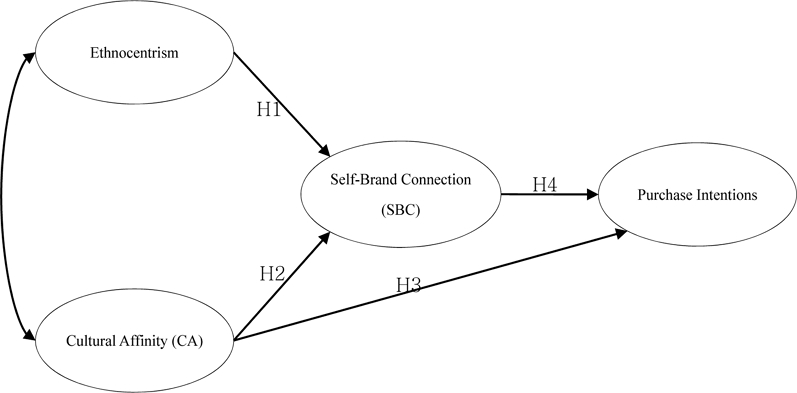
A Conceptual model for research hypotheses.
3.2. Measurement
For this study, a self-administered questionnaire was developed based on the literatures and a pilot test, and mainly consisted of questions about ethnocentrism, CA, SBC and purchase intentions. To measure consumer ethnocentrism, four items were adopted from the existing scale(Ouellet, 2007), which was revised in the context of purchasing Chinese fashion brands. Three items of consumers’ CA were adapted from Bernard and Zarrouk-Karoui (2014), which encompasses the emotional aspect of culture. Seven items capturing SBC toward fashion local brands were developed based on the Escalas and Bettman(2003)’s scale. For consumers’ purchase intention(PI), three items were developed(Riefler, 2012) to measure behavioral intention to buy this kind of brands. All items were measured on 7-point rating scales (1 = “strongly disagree” and 7 = “strongly agree”) The measurement items were translated from English to Chinese version, and ensured the meaning of cultural nuance was the same as the original one. The items are presented in Table 1. Additionally, demographic variables (e.g., gender, age, education, disposable income) were included for descriptive purposes.

Measurement scales
As brand stimulus in this study, nine of the most popular “Guochao” fashion local brands which were real-time ranked in hot-selling brands on the e-commerce platform (e.g., Taobao) on August, 2021 in China, were selected. The selected brands comprised the representative local brands in the Chinese fashion market, including three brands in men's wear(YISHU, LINING, 原尉), three of women's wear(EXCEPTION, MUKZF, SHIATZY CHEN) and bag and accessories brands (CUUD, The PALACE MUSEUM, 晚江亭). The selected brands were replaced with “Brand X” in the survey questionnaire. One of the examples is a question “Brand X reflects who I am.” (Table 1.).
3.3. Sample and data collection
The sample in this study consisted of Chinese consumers who are residents of China. For collecting data, an online survey with a self-administered questionnaire was conducted by using popular instant messenger tools(e.g., WeChat and QQ) in China. A total of 276 usable responses were randomly obtained from Chinese aged 18 to 45 years old. Participants represents more females (n = 174, 63%) than males(n = 102, 37%). Most of the respondents were aged from 18 to 25 years old (80.4%). Above half of respondents had a bachelor's degree(53.3%), followed by college degree (21.0%), and postgraduate graduate(19.2%). For disposable income, 40.7% of them earned ¥900 -¥2700 per month, and 25% earned more than ¥4500 per month. Descriptive statistics of sample demographics are summarized in Table 2.
Sample characteristics
4. Results & Discussions
4.1. Exploratory factor analysis
An exploratory factor analysis of the Principal Axis with Varimax(Kaiser Normalization) rotation was performed to determine the constructs of measurement items. From Kline(2014) and Nunnally et al.(1967), constructs with the loading of items exceeding .55 and not exceeding .30 on other factors were considered valid. The two items(SBC2 and SBC7) were eliminated due to lower factor loading(less than .60) and cross-loading to other constructs. After data pruning, factor analysis revealed to be four unidimensional constructs(CE, CA, SBC, and PI), accounted for 76.78% of the total variance. The factor loadings ranged from .73 to .89, and Cronbach's standardized alpha values were within an acceptable range(.85-.93). It is deemed that the measures were valid and reliable for further analysis.
4.2. Measurement model result
To verify the underlying dimensions of four constructs derived from the EFA, confirmation factor analysis(CFA) was conducted by using AMOS 21.0. In the measurement model, all observed indicators of four latent variables were analyzed by fitting the first item per construct. The overall fit of the model was assessed by various statistic indexes: Chi-square statistics, Chi-square/df, goodness-of-fit index(GFI), adjusted goodness-of-fit index(AGFI), normed fit index(NFI), incremental fit index(IFI), standardized root mean square residual(SRMR), and root mean square error of approximation(RMSEA).
The estimated measurement model is presented in Table 3. Overall, the Chi-square value was 163.60 with 84 degrees of freedom(χ2/df = 1.95). Other model fit indices were within the acceptable ranges(GFI = .93, CFI = .97, NFI = .95, IFI = .97, SRMR = .06, RMSEA = .06). This result indicated good fit between the model and the data. The standardized factor loadings were ranged from .62 to .93, which were statistically significant(p < .001). Based on Fornell and Larcker(1981), we calculated composite reliability(CR) for the four constructs. The CR values were ranged from .85 to .92, which is higher than the standard value (above .70) recommended by Hair et al.(2006). Average variance extracted (AVE) is used to confirm convergent and discriminant validity. The AVE of four constructs ranged from .60 to .80, which is higher than a threshold value of .50(Fornell & Larcker, 1981). For discriminant validity, the AVE values of four constructs were greater than the squared correlation values between the construct and the other constructs(Table 4). Therefore, the measurement model was confirmed to be valid and reliable.
The measurement model result
Correlation matrix of latent constructs
4.3. Estimation of structural model for hypotheses testing
For hypotheses testing, the proposed structural model was estimated by using maximum likelihood estimation via the AMOS 21.0. The structural model tested causative relationships among two exogenous constructs(ethnocentrism and CA) and two endogenous constructs(SBC and PI). Overall fit statistics of the estimated model suggested that the Chi-square value of 163.73 was significant (df = 85, p < .001). Moreover, other indexes were within the ranges to accept the proposed model (GFI = .93, AGFI = .90, CFI = .97, NFI = 95, IFI = .97, and SRMR = .06). The estimated structural model illustrated in Fig. 2 includes significant standardized path coefficients.
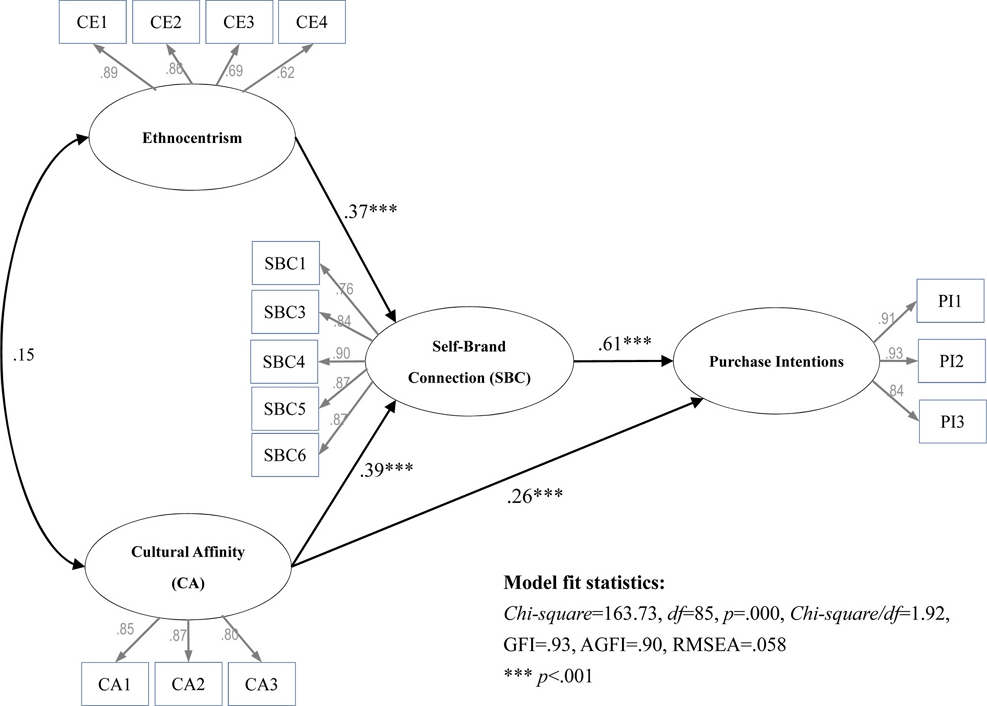
Estimated structural model.
With respect to hypothesis 1, two exogenous constructs were significantly related to the SBC. Specifically, the ethnocentrism had positive effects on the SBC for local fashion brands(path coefficient=. 37, p < .001). This implies that Chinese consumers with a higher level of ethnocentrism were likely to have a deeper connection with the local fashion brands in terms of the “Guochao” consumption, and thus H1 was supported.
As expected, the CA had a positive effect on the SBC for local fashion brands (path coefficient = .39, p < .001), suggesting the importance of Chinese consumers’ affinity toward their own culture in strongly bonding self to the local fashion brand. This is consistent with a notion that the emotional aspect of cultural traits plays an important role in the self-concept-based connection with domestic brands(Escalas, 2004; Fazli-Salehi et al., 2020; Schmitt, 2012; Swaminathan et al., 2007). Thus, the H2 was supported.
For predicting behavioral intentions, the SBC had a positive effect on the intentions to purchase(path coefficient = .61, p < .001). That is, Chinese consumers’ SBC were more likely to encourage intentions to purchase the local fashion brands, thus supporting the H5. Also, the CA was a significant predictor of the purchase intentions for the local fashion brands in the Chinese market, supporting H3 regarding the direct effect of CA on the purchase intention.
In the estimated structural model, indirect effects were also found between ethnocentrism and purchase intention(Indirect effect = .22) and between the CA and purchase intentions (Indirect effect = .23). This implies that the SBC was important mediator paths from the two cultural traits(e.g., ethnocentrism and CA) to purchase intentions. Especially, the SBC fully mediated the relationship between ethnocentrism and purchase intentions for the local fashion brands. In contrast, by considering the direct effect of CA on purchase intention, the SBC partially mediated the relationship between CA and purchase intentions for the local fashion brands. Thus, the H5 was supported.
5. Discussions and Conclusions
This study predicted the structural relationships between Chinese ethnocentrism, cultural affinity, self-brand connection, and purchase intentions of local fashion brands for the cultural consumption “Guochao” in China. The findings indicated that ethnocentrism and cultural affinity were significant antecedents of self-brand connection, ultimately leading to purchase intentions for the local fashion brands among Chinese consumers. Results support the related cultural studies(Fazli-Salehi et al., 2020), suggesting that Chinese cultural consumption is driven by the two traits of national sentiments: ethnocentrism and cultural affinity. This study provides an insight into extending social identity theory and developing a strategic fashion marketing for the Chinese market from a cultural perspective.
As a cultural trait of national sentiments, Chinese ethnocentrism relevant to the high level of collectivism was positively related to the SBC, indicating that Chinese consumers’ ethnocentrism, can be a good predictor of the connections between consumers and local fashion brands in the domestic market. Also, the CA factor increased not only consumer’s SBC, but also encouraged the purchase intentions for local fashion brands.
Unlike to the CA, the ethnocentrism identified to be not predictable for purchase intentions of local fashion brands. The findings demonstrated a cultural mechanism in two distinct aspects: ethnocentrism in positive cognition and affinity in positive feelings toward the country. Since statements about kind of country preference are often cognitively motivated by moral concerns or normative response to foreign threats rather than an emotional attachment to a particular brand, they may not translate directly into purchase behavior. Particularly, as a part of specific and positive sentiments to the nation(Oberecker & Diamantopoulos, 2011), the CA is essential to not only build tightly emotional bonding to brands, but also directly contributes into buying local fashion brands.
Also, this study provides practical implications into fashion marketers for developing brand strategies in the Chinese market. Fashion marketers should take an inherent advantage of consumer ethnocentrism for maintaining a long-term connection between customer and local brands. In today's Chinese fashion market, where the “Guochao” is prevalent, marketing managers can effectively promote brand campaigns with an emphasis on the symbolic meanings of the culture, which strongly appeals to consumers' sense of belonging. Also, as a marketing theme, the cultural affinity, incorporating Chinese elements into product design, can encourage consumers' affective responses toward domestic or local brands, which can increase retail sales.
From a cultural marketing perspective, by emphasizing Chinese people's feelings of pride in their own culture, a local fashion brand image can be differentiated from competing foreign brands. For local consumers, global fashion brands should recognize a cultural bias derived from ethnocentrism, or cultural affinity to success global marketing practice in the Chinese markets.
The findings of this study should be interpreted with a caution due to several limitations. The sampling was limited to several regions and one country(i.e., China). In addition, this study dealt with two constructs of consumer cultural tendencies for understanding “Guochao” cultural consumption in China. A Cross cultural study could focus on a need for an extended theoretical frame by comparing the relationship between cultural traits and the purchase decision process across different countries from a global perspective. Also, it is also recommended that cultural constructs relevant to self-brand connection, such as cultural value(collectivism vs. individualism) and psychological variables(self-image vs. social identity) should be considered as antecedents for modeling cultural consumption behavior in the future.
References
-
Aaker, J. L. (1997). Dimensions of brand personality. Journal of marketing research, 34(3), 347-356.
[https://doi.org/10.1177/002224379703400304]

-
Aguirre-Rodriguez, A., Bosnjak, M., & Sirgy, M. J. (2012). Moderators of the self-congruity effect on consumer decision-making - A meta-analysis. Journal of Business Research, 65(8), 1179-1188.
[https://doi.org/10.1016/j.jbusres.2011.07.031]
- Bernard, Y., & Zarrouk-Karoui, S. (2014). Reinforcing willingness to buy and to pay due to consumer affinity towards a foreign country. International Management Review, 10(2), 57-67.
-
Chandon, P., Morwitz, V. G., & Reinartz, W. J. (2005). Do intentions really predict behavior? Self-generated validity effects in survey research. Journal of Marketing, 69(2), 1-14.
[https://doi.org/10.1509/jmkg.69.2.1.60755]
-
Chand, V. S., & Fei, C. (2021). Self - brand connection and intention to purchase a counterfeit luxury brand in emerging economies. Journal of Consumer Behaviour, 20(2), 399-411.
[https://doi.org/10.1002/cb.1871]
-
Dmitrovic, T., Vida, I., & Reardon, J. (2009). Purchase behavior in favor of domestic products in the West Balkans. International Business Review, 18(5), 523-535.
[https://doi.org/10.1016/j.ibusrev.2009.05.003]
-
El Banna, A., Papadopoulos, N., Murphy, S. A., Rod, M., & Rojas-Méndez, J. I. (2018). Ethnic identity, consumer ethnocentrism, and purchase intentions among bi-cultural ethnic consumers - “Divided loyalties” or “dual allegiance”?. Journal of Business Research, 82, 310-319.
[https://doi.org/10.1016/j.jbusres.2017.09.010]
-
Escalas, J. E. (2004). Narrative processing - Building consumer connections to brands. Journal of Consumer Psychology, 14(1-2), 168-180.
[https://doi.org/10.1207/s15327663jcp1401&2_19]
-
Escalas, J. E., & Bettman, J. R. (2003). You are what they eat - The influence of reference groups on consumers’ connections to brands. Journal of Consumer Psychology, 13(3), 339-348
[https://doi.org/10.1207/S15327663JCP1303_14]
-
Fazli-Salehi, R., Torres, I. M., Madadi, R., & Zúniga, M. A. (2020). Is country affinity applicable for domestic brands? The role of nation sentiment on consumers' self-brand connection with domestic vs foreign brands. Asia Pacific Journal of Marketing and Logistics, 33(3), 731-754.
[https://doi.org/10.1108/APJML-11-2019-0656]
-
Fazli-Salehi, R., Torres, I. M., Madadi, R., & Zúñiga, M. Á. (2021). Multicultural advertising - The impact of consumers’ self-concept clarity and materialism on self-brand connection and communal-brand connection. Journal of Business Research, 137, 46-57.
[https://doi.org/10.1016/j.jbusres.2021.08.006]
-
Feather, N. T. (1981). National sentiment in a newly independent nation. Journal of Personality and Social Psychology, 40(6), 1017.
[https://doi.org/10.1037/0022-3514.40.6.1017]
-
Fischer, P. M., & Zeugner-Roth, K. P. (2017). Disentangling country-of-origin effects - The interplay of product ethnicity, national identity, and consumer ethnocentrism. Marketing Letters, 28(2), 189-204.
[https://doi.org/10.1007/s11002-016-9400-7]
-
Fornell, C., & Larcker, D. F. (1981). Evaluating structural equation models with unobservable variables and measurement error. Journal of Marketing Research, 18(1), 39-50.
[https://doi.org/10.1177/002224378101800104]
-
Goldsmith, R. E., Flynn, L. R., & Moore, M. A. (1996). The self-concept of fashion leaders. Clothing and Textiles Research Journal, 14(4), 242-248.
[https://doi.org/10.1177/0887302X9601400403]
-
Grohmann, B. (2009). Gender dimensions of brand personality. Journal of Marketing Research, 46(1), 105-119.
[https://doi.org/10.1509/jmkr.46.1.105]
- Hair, J. F., Black, W. C., Babin, B. J., Anderson, R. E., & Tatham, R. L. (2006). Multivariate data analysis (6th ed.). New Jersey: Pearson Prentice Hall.
-
He, J., & Wang, C. L. (2015). Cultural identity and consumer ethnocentrism impacts on preference and purchase of domestic versus import brands: An empirical study in China. Journal of Business Research, 68(6), 1225-1233.
[https://doi.org/10.1016/j.jbusres.2014.11.017]
- Huaxia. (2022, April 3). Xinhua headlines - Gen Z's love of Guochao bodes well for Chinese economy. Xinhua. Retrieved April 1, 2022, from https://english.news.cn/20220403/611140b123744b8fae97ae3770f9a6a7/c.html
-
Ishii, K. (2009). Nationalistic sentiments of Chinese consumers - The effects and determinants of animosity and consumer ethnocentrism. Journal of International Consumer Marketing, 21(4), 299-308.
[https://doi.org/10.1080/08961530802282232]
-
Jin, Z., Lynch, R., Attia, S., Chansarkar, B., Gülsoy, T., Lapoule, P., ... & Ungerer, M. (2015). The relationship between consumer ethnocentrism, cosmopolitanism and product country image among younger generation consumers - The moderating role of country development status. International Business Review, 24(3), 380-393.
[https://doi.org/10.1016/j.ibusrev.2014.08.010]
-
Josiassen, A. (2011). Consumer disidentification and its effects on domestic product purchases - An empirical investigation in the Netherlands. Journal of Marketing, 75(2), 124-140.
[https://doi.org/10.1509/jm.75.2.125]
-
Kline, P. (2014). An easy guide to factor analysis. New York: Routledge.
[https://doi.org/10.4324/9781315788135]
-
Laroche, M., Papadopoulos, N., Heslop, L. A., & Mourali, M. (2005). The influence of country image structure on consumer evaluations of foreign products. International Marketing Review, 22(1),96-115.
[https://doi.org/10.1108/02651330510581190]
-
Lin, J., Lobo, A., & Leckie, C. (2017). The role of benefits and transparency in shaping consumers’ green perceived value, self-brand connection and brand loyalty. Journal of Retailing and Consumer Services, 35, 133-141.
[https://doi.org/10.1016/j.jretconser.2016.12.011]
-
Markus, H. R., & Kitayama, S. (1991). Culture and the self - Implications for cognition, emotion, and motivation. Psychological review, 98(2), 224.
[https://doi.org/10.1037/0033-295X.98.2.224]
-
Nes, E. B., Yelkur, R., & Silkoset, R. (2014). Consumer affinity for foreign countries - Construct development, buying behavior consequences and animosity contrasts. International Business Review, 23(4), 774-784.
[https://doi.org/10.1016/j.ibusrev.2013.11.009]
-
Niedenthal, P. M., Cantor, N., & Kihlstrom, J. F. (1985). Prototype matching - A strategy for social decision making. Journal of Personality and Social Psychology, 48(3), 575.
[https://doi.org/10.1037/0022-3514.48.3.575]
- Nunnally, J. C., Bernstein, I. H., & Berge, J. M. T. (1967). Psychometric theory (Vol. 226). New York: McGraw-Hill.
-
Oberecker, E. M., & Diamantopoulos, A. (2011). Consumers’ emotional bonds with foreign countries - Does consumer affinity affect behavioral intentions?. Journal of International Marketing, 19(2), 45-72.
[https://doi.org/10.1509/jimk.19.2.45]
-
Oberecker, E.M., Riefler, P., & Diamantopoulos, A. (2008), “The consumer affinity construct: conceptualization, qualitative investigation, and research agenda”. Journal of International Marketing, 16(3),23-56.
[https://doi.org/10.1509/jimk.16.3.23]
-
Ouellet, J. F. (2007). Consumer racism and its effects on domestic cross-ethnic product purchase - An empirical test in the United States, Canada, and France. Journal of Marketing, 71(1), 113-128.
[https://doi.org/10.1509/jmkg.71.1.113]
-
Pharr, J. M. (2005). Synthesizing country-of-origin research from the last decade - Is the concept still salient in an era of global brands?. Journal of Marketing Theory and Practice, 13(4), 34-45.
[https://doi.org/10.1080/10696679.2005.11658557]
-
Riefler, P. (2012). Why consumers do (not) like global brands - The role of globalization attitude, GCO and global brand origin. International Journal of Research in Marketing, 29(1), 25-34.
[https://doi.org/10.1016/j.ijresmar.2011.11.001]
-
Schmitt, B. (2012). The consumer psychology of brands. Journal of Consumer Psychology, 22(1), 7-17.
[https://doi.org/10.1016/j.jcps.2011.09.005]
-
Setterlund, M. B., & Niedenthal, P. M. (1993). “Who am I? Why am I here?” self-esteem, self-clarity, and prototype matching. Journal of Personality and Social Psychology, 65(4), 769.
[https://doi.org/10.1037/0022-3514.65.4.769]
-
Sirgy, M. J. (1982). Self-concept in consumer behavior - A critical review. Journal of Consumer Research, 9(3), 287-300.
[https://doi.org/10.1086/208924]
-
Sharma, P. (2015). Consumer ethnocentrism - Reconceptualization and cross-cultural validation. Journal of International Business Studies, 46(3), 381-389.
[https://doi.org/10.1057/jibs.2014.42]
-
Sharma, S., Shimp, T. A., & Shin, J. (1995). Consumer ethnocentrism - A test of antecedents and moderators. Journal of the Academy of Marketing Science, 23(1), 26-37.
[https://doi.org/10.1177/0092070395231004]
-
Shimp, T. A., & Sharma, S. (1987). Consumer ethnocentrism - Construction and validation of the CETSCALE. Journal of marketing research, 24(3), 280-289.
[https://doi.org/10.1177/002224378702400304]
- Spillan, J. E., & Harcar, T. (2012). Chilean consumers ethnocentrism factors and their perception regarding foreign countries products. Journal of Marketing Development and Competitiveness, 6(1), 34-55.
-
Swaminathan, V., Page, K. L., & Gürhan-Canli, Z. (2007). “My” brand or “our” brand - The effects of brand relationship dimensions and self-construal on brand evaluations. Journal of Consumer Research, 34(2), 248-259.
[https://doi.org/10.1086/518539]
- Tajfel, H. E. (1978). Differentiation between social groups - Studies in the social psychology of intergroup relations. London: Academic Press.
-
Tajfel, H., & Turner, J. C. (2004). The social identity theory of intergroup behavior. In J.T. Jost & J. Sidanius (Eds.), Political psychology: Key readings (1st ed.). (pp. 276-293). London: Psychology Press.
[https://doi.org/10.4324/9780203505984]
-
Verlegh, P. W. (2007). Home country bias in product evaluation - The complementary roles of economic and socio-psychological motives. Journal of International Business Studies, 38(3), 361-373.
[https://doi.org/10.1057/palgrave.jibs.8400269]
-
Wang, C. L., Bristol, T., Mowen, J. C., & Chakraborty, G. (2014). Alternative modes of self-construal - dimensions of connectedness–separateness and advertising appeals to the cultural and gender-specific self. In D. Maheswaran & S. Shavitt (Eds.), Cultural psychology (1st ed.) (pp. 107-116). London: Psychology Press.
[https://doi.org/10.4324/9780203764947]
-
Wang, C. L., & Chen, Z. X. (2004). Consumer ethnocentrism and willingness to buy domestic products in a developing country setting - Testing moderating effects. Journal of Consumer Marketing, 21(6), 391-400.
[https://doi.org/10.1108/07363760410558663]
-
Wang, C. L., Li, D., Barnes, B. R., & Ahn, J. (2012). Country image, product image and consumer purchase intention - Evidence from an emerging economy. International Business Review, 21(6), 1041-1051.
[https://doi.org/10.1016/j.ibusrev.2011.11.010]
-
Wang, C. L., & Lin, X. (2009). Migration of Chinese consumption values - Traditions, modernization, and cultural renaissance. Journal of Business Ethics, 88(3), 399-409.
[https://doi.org/10.1007/s10551-009-0308-5]
-
Wongtada, N., Rice, G., & Bandyopadhyay, S. K. (2012). Developing and validating affinity - A new scale to measure consumer affinity toward foreign countries. Journal of International Consumer Marketing, 24(3), 147-167.
[https://doi.org/10.1080/08961530.2012.682037]
-
Yau, O. H. (1988). Chinese cultural values - Their dimensions and marketing implications. European Journal of Marketing, 22(5), 44-57.
[https://doi.org/10.1108/EUM0000000005285]
-
Zeugner-Roth, K. P., Žabkar, V., & Diamantopoulos, A. (2015). Consumer ethnocentrism, national identity, and consumer cosmopolitanism as drivers of consumer behavior - A social identity theory perspective. Journal of International Marketing, 23(2), 25-54.
[https://doi.org/10.1509/jim.14.0038]