
Moisture Management Properties and Antibacterial Activity · Deodorization of Chitosan Microcapsule Finished Fabric

© 2021 Fashion and Textile Research Journal (FTRJ). This is an open access journal. Articles are distributed under the terms of the Creative Commons Attribution Non-Commercial License (http://creativecommons.org/licenses/by-nc/4.0), which permits unrestricted use, distribution, and reproduction in any medium, provided the original work is properly cited.
Abstract
Recently, with an increase of interest in hygiene of textile products, research related to finishing technology to impart various functionalities, such as antibacterial and deodorizing properties, has also required. Therefore, in this study, the improvement of comfort was examined by analyzing the change of moisture characteristics and antibacterial and deodorizing properties of underwear fabric by chitosan microcapsule(CH-M) finishing. The results revealed that moisture absorption time of the fabric shortened, diffusion rate increased, while absorption rate slightly increased because of microcapsule finishing. In addition, the one-way transfer capacity of the microcapsule finished fabric was 17.69, which improved moisture transfer to one side, while OMMC showed the values of 0.32 and 0.37 for untreated and finished fabrics, respectively, which slightly increased after finishing. In the case of untreated fabric, antibacterial activity was 89.0% against Staphylococcus aureus and 70.3% against Klebsiella pneumoniae; however, both strains showed 99.9% antibacterial activity by CH-M finishing. An excellent bacterial reduction rate was also observed. In the case of the CH-M finished fabric, there was a deodorization effect exceeding 99% up to 120 minutes, and it showed an excellent deodorization effect of more than 99% even after 10 repeated washings.
Keywords:
crosslinked chitosan microcapsule, moisture management property, antibacterial activity, deodorization1. Introduction
Recently, with the growth of interest in hygiene of textile products, research on finishing technology to impart various functionalities, such as antibacterial and deodorizing properties, has been actively conducted. In particular, in underwear and sportswear, human secretions such as sweat do not evaporate and are trapped in the fibers, so there is a high possibility of odor and bacterial propagation. Therefore, sweat-absorbing and quick-drying are required for fabrics that come in direct contact with the skin, and functional fabrics that improve hygienic performance are in the spotlight. However, if a functional material is applied to the fabric or encapsulated and fixed with a binder in order to impart functionality to the fabric, it may adversely affect hygiene by inhibiting air permeation or moisture movement of the fabric.
Yet, even if the body temperature is not high, water is constantly released due to insensible perspiration. Furthermore, when the body temperature rises due to an increase in the outside temperature or exercise, the body temperature is controlled by sweating. Moisture due to this insensible perspiration and sweating moves through the clothes(Na & Kim, 1990). Therefore, the moisture management properties of the clothing in direct contact with the human skin to transfer sweat absorbed from the skin to the surface of the clothing is a very important factor for the wearer's comfort(Go, 2009). Said differently, it is the ability of a fabric to move and evaporate moisture. The moisture transfer properties of fabrics include wicking, wetting, drying, and water-absorbency and quick-dry (Kim & Kim, 2016). Moisture transfer of clothing appears in a variety of aspects, such as the drying state of the fabric, the flow and diffusion of liquid moving through the sample in a wet state during liquid initial contact, and water evaporation. Furthermore, it can be divided into wettability and wickability(Korean Agency for Technology and Standards [KATS], 2016). While wettability refers to the initial reaction of fibers, yarns, and fabrics upon contact with liquid, a wicking refers to the ability to sustain capillary flow(Yoo, 2001).
Previous studies using MMT analyzed the moisture transfer properties of cotton/polypropylene knit materials(Supuren et al., 2011), the moisture control properties of wool/PET and wool/bamboo materials as basic materials for active sportswear(Troynikov & Wardiningsih, 2011), moisture control characteristics of PET knitted fabrics for cycling, and improvement of cold sensitivity evaluation methods of cold-sensitive fabric(Kwon, 2016).
On the other hand, since antibacterial agents used in textiles get in direct contact with the human body, the use of synthetic antibacterial agents should be avoided during fabric finishing. To this end, chitosan has frequently been used as a wall material of the microcapsules. Chitosan, a natural product that can be expected to provide sufficient functional expression, is a cationic polymer having an amino group(Goo et al., 2012). In combination with the anion of the components that make up the cell wall of the microorganism, it drops the degree of freedom of the microorganism, thereby growth and acquiring antimicrobial activities. However, when chitosan is applied to a fabric, it can be easily removed by washing. In the case of deodorization, it can be significantly reduced when washed more than once(Kim & Song, 2003). In this study, chitosan microcapsules were manufactured in an eco-friendly method by adding natural essential oil with strong deodorization, and washing durability of its functionalities also confirmed.
Among the essential oils used as the core material of microcapsule, basil has antibacterial, antifungal, antioxidant activity, and anti-inflammatory effects, and is used in various fields such as flavoring, medicine, and food(Mehdizadeh et al., 2016). Strong antibacterial activity can be expected when used with chitosan(Kim et al., 2020), which has excellent antibacterial activity and biocompatibility to promote wound healing. In addition, peppermint has menthol as its main ingredient, and because of its unique refreshing feeling, it is used in various fields such as decoration of dishes and desserts, fragrances, cosmetics, detergents, and so forth. Peppermint also has excellent antibacterial activity and odor removal effects(Park & Yoon, 2018). Therefore, it would be possible to develop susceptible and functional material that can be expected to express various performances by finishing fabric with microcapsules based on crosslinked chitosan.
Currently, manufacturing microcapsule has mostly been studied using chemicals to give durability and functionality. However chemicals may cause problems for the human body and the environment. In addition, previous research related to finished fabrics with microcapsule has been conducted only on the release of core material from microcapsule attached to the fabric and the physical properties and functionality of microcapsule and finished fabrics with microcapsule. However, in the case of underwear or sportswear material that emphasizes hygiene, the movement of moisture may be affected by microcapsules attached to the surface of the fabric.
Therefore, in this study, the fabric was finished with microcapsules and the applicability of microcapsule finishing for imparting functionality to improve comfort was evaluated by analyzing changes in moisture characteristics of finished underwear fabric. To this end, we examined moisture control characteristics of the finishing fabric with chitosan microcapsules(CH-M) using a mixed essential oil of basil and peppermint as a heart material. In addition, the suitability as an underwear fabric was reviewed by evaluating the antibacterial and deodorizing properties and the durability of these performances after repeated washing was assessed. In addition, in order to examine the possibility of replacing microcapsule finishing using natural products, we performed a functional comparison with microcapsule finished fabric made of melamine formaldehyde resin, which is reported to have excellent durability of functionality.
2. Methods
2.1. Materials
Microcapsules were manufactured by the o/w/o multi-emulsion method using basil and peppermint as the core material and chitosan as the wall material with a molecular weight of 8.0 × 10⁴. During the manufacturing process, Triton X-100(Samchun, Korea) and Span 80(Junsei, Japan) were used as emulsifiers, sodium carbonate(Samchun, Korea) was used as the pH adjuster, and glutaraldehyde as the crosslinking agent(Sigma, USA); all reagents were grade 1. The manufactured 5%(o.w.f.) chitosan microcapsules having an average particle size of 5.83 μm are finished by immersing it with a 10%(o.w.f.) aqueous acrylic binder for 20 minutes. Table 1 shows the specifications of fabrics for underwear used in the study.

Characteristics of fabric
2.2. Functionality of finished fabrics with chitosan microcapsule
In order to examine the moisture control properties affecting the comfort of microcapsule finished fabric, moisture control properties by MMT(M290, SDL Atlas, USA) were evaluated in accordance with AATCC 195(American Association of Textile Chemists and Colorists [AATCC], 2020). At this time, the dynamic liquid transfer characteristics were measured simultaneously with absorption and drying. After the simulated sweat solution was automatically sprayed on the surface of the central part of the conditioned sample, the electrical resistance value that changed according to the amount of absorbed moisture was measured. After measuring the wetting time, the max wetted radius, max adsorption rate, spreading speed, one-way transport capability, and grade were calculated using a regression equation; the overall moisture management capacity(OMMC) was also evaluated(Kwon, 2016).
The antibacterial activity of chitosan microcapsule finished fabrics were evaluated according to KS K 0693(KATS, 2016). At this time, two strains of Staphylococcus aureus(ATCC 6538) (American Type Culture Collection [ATCC], 2018b) and Klebsiella pneumoniae(ATCC 4352) (ATCC, 2018a) were used as test bacteria. The bacteriostatic rate (%) was measured as the bacteriostatic rate, and the bacterial reduction rate was calculated according to Eq. (1), which is a relative decrease rate for the average of each viable cell number after 18 hours of incubation for the 3 samples of the control and test specimens. The finishing effect was compared CH-M finished fabric with melamine formaldehyde microcapsules (MF-M) finished fabric.
| (1) |
- Where, Mb : the number of microbe in blank specimen incubated for 18 hours
- Mc : the number of microbe in test specimen incubated for 18 hours
The deodorization of the chitosan microcapsule finished fabric was evaluated using the gas detection tube method for measuring the rate of disappearance of ammonia(NH3) gas. After putting a 10 cm × 10 cm size fabric and ammonia aqueous solution(in the concentration of 500 μg/mL) into a 1,000mL container, the rate of disappearance of ammonia(NH3) gas was measured at 30 minutes, 60 minutes, 90 minutes, and 120 minutes. Next, the ammonia gas concentration was measured, and the deodorization rate was calculated using Eq. (2). In addition, in order to check whether the microcapsule finished fabric maintained continuous functionality after repeated washing, antibacterial and deodorizing properties were evaluated after repeated washing 1, 5, and 10 times in accordance with KS K ISO 6330(KATS, 2011). The finishing effects of the CH-M finished fabric and the MF-M finished fabric were compared.
| (2) |
- where, A : Gas concentration in a sealed jar of the blank
- where, B : Gas concentration in a sealed jar of the sample
3. Results and discussions
3.1 Moisture management properties of fabrics treated with chitosan microcapsule
MMT is a method of measurement that simulates the absorption and removal of sweat from the skin surface. As it measures absorption and drying simultaneously, MMT is also a major method for the evaluation of comfort of clothing(Özkan & Meriç, 2015). In addition, it is possible to measure the absorbency, dryness, moisture transferability, and similar waterproofing function of each side by dividing the front and back sides of the fabric. This method predicts the comfort of sports clothing in advance, so that it can be usefully used for the development of ideal materials(Go, 2009). However, when a functional material is applied to a fabric or microencapsulated and is fixed with an excessive amount of binder in order to impart functionality to textile products, it may adversely affect clothing hygiene by inhibiting air permeation or moisture movement of the fabric. Therefore, in order to examine the factors affecting the comfort of the CH-M finished fabric, the absorption time, absorption rate, maximum absorption radius, diffusion rate, and one-way transport capacity of the surface and back side of the fabric were measured using MMT according to AATCC 195(AATCC, 2020). Finally, OMMC was compared by quantifying the magnitude of the water transfer between the front and back sides from 0 to 1.
Fig. 1 shows the absorption time and spreading speed of the untreated fabric and the CH-M finished fabric. Absorption time is the time during which the sprayed water droplets are initially absorbed and wetted, indicating the horizontal absorptivity of the sample. The spreading speed refers to the rate at which water diffusion is maximized on the surface and back of the sample. If the spreading speed is fast, the absorption performance is excellent. According to the results, absorption times on the surface and back of the untreated fabric were 3.37 sec and 3.46 sec, respectively, and the absorption times on the surface and back of the finished fabric were 3.22 sec and 3.28 sec. This indicates that the finished fabric gets wet faster than the untreated fabric and absorbs more quickly. In the case of untreated fabric, the spreading speeds of the surface and the back were 3.25 mm/sec and 3.24 mm/sec, respectively. In the case of finished fabric, spreading speeds of the surface and the back amounted to 3.49 mm/sec and 3.44 mm/sec, showing almost similar patterns. The lyocell fiber has a activity of swelling in a wet state, so it has an excellent moisture control ability(“Tencel”, 2016). However, it can be seen that the CH-M finished fabric has good water absorption and high spreading speed, so diffusion occurs more quickly. The microcapsule and the binder are attached between the pores of fabric, which promotes the capillary phenomenon. Accordingly, microcapsule finishing is effective in increasing comfort because the faster is the spreading speed of the fabric, the faster it absorbs sweat from the body, which makes the wearer feel more comfortable.
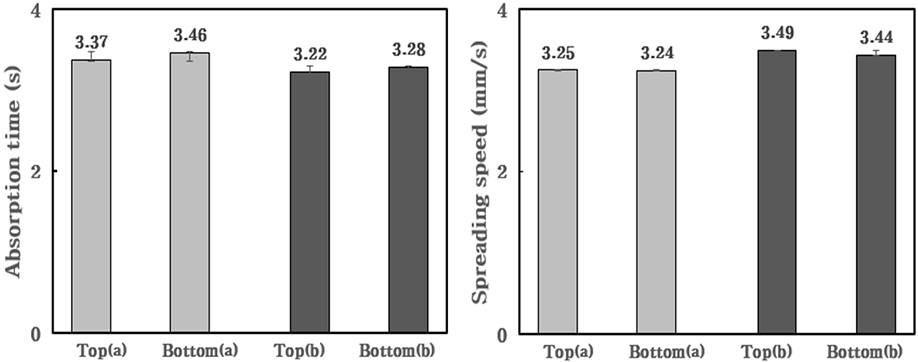
Absorption time and spreading speed of fabrics treated with microcapsule; (a) Untreated fabric, (b) Treated fabric.
The absorption rate and max wetted radius, which are the moisture control properties of the fabric, are shown in Fig. 2. The absorption rate indicates the water absorption rate on the surface and back side of the sample. In the case of untreated fabric, it was 58.92% and 54.42%, respectively, while, in the case of finished fabric, it was 60.06% and 57.25%, respectively. The results revealed that the absorption rate of the finished fabric was rather high. The absorbency of the fabric slightly improved because of increasing the thickness of the fabric due to microcapsule finishing. The maximum wetting radius is the maximum diffusion distance of moisture between the surface and the back of the sample, and the maximum wetting radius is measured at the first time elapsed. The higher is the value, the better are the drying characteristics. It can measure up to 30 mm; however, in our experiment, 20mm was set as the maximum measurement value. Both the untreated fabric and the finished fabric showed a maximum wetting radius of 20 mm, which is the maximum measured value, so there was no difference between two fabrics. As compared to cotton, lyocell has few crystalline parts and many amorphous parts, so it has excellent hygroscopicity; furthermore, when wet, it adheres to the fibers and causes capillary action, thereby helping water movement. With an increase of the maximum wetting radius, the drying time becomes shorter, and the shorter are the absorption time and drying time, the better sweat absorption and quick-drying properties the fabric has.
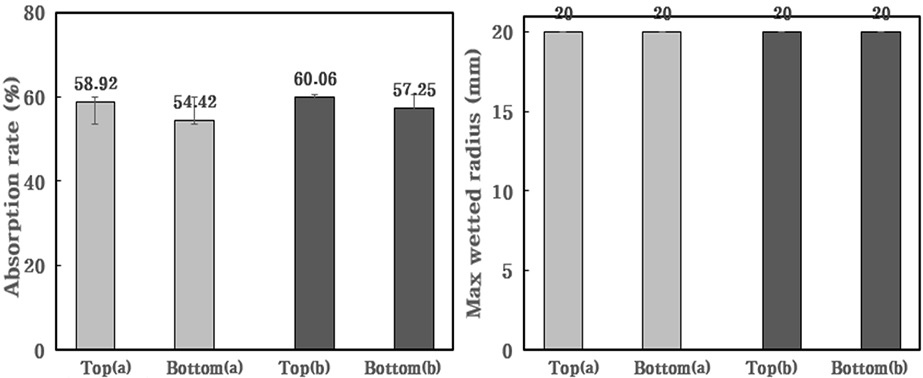
Absorption rate and max wetted radius of fabrics treated with microcapsule; (a) Untreated fabric, (b) Treated fabric.
Meanwhile, one-way transport capacity is a value measured as an average per hour of the difference in the accumulated moisture content between the fabric surface and the back side within the measurement time. Furthermore, OMMC, the MMT value, indicates the moisture control performance from the back surface to the surface of the sample. Fig. 3 shows that the one-way transport capacity was −40.46 and 17.69 for the untreated fabric and the CH-M finished fabric, respectively. This means that the water transfer performance to one side was better for the finished fabric. OMMC represents the overall moisture control performance of clothing. The corresponding values were 0.32 and 0.37 in the untreated fabric and the CH-M finished fabric, respectively, so the OMMC of the microcapsule-finished fabric was slightly better. Accordingly, the greater is the OMMC, the faster is the moisture transfer from the back to the surface and the quicker is drying on the surface during wearing. As compared to the untreated fabric, the OMMC of the microcapsule-finished fabric slightly increased. Therefore, it can be seen that chitosan microcapsule finishing is effective for the development of materials with excellent comfort due to the smooth moisture control.
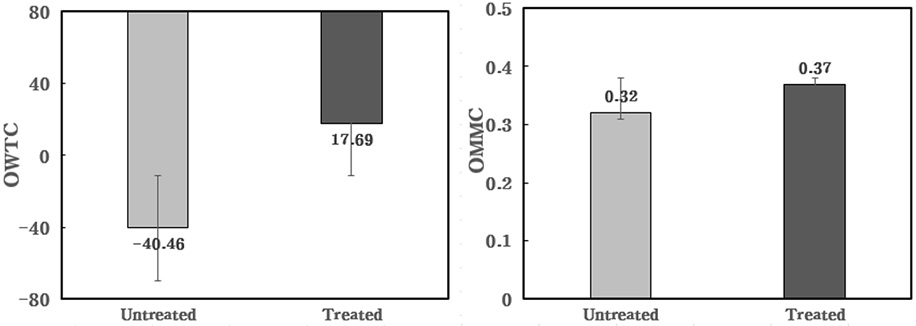
One way transport capacity and OMMC of fabrics treated with microcapsule.
Table 2 presents the grades in order to increase the understanding of the MMT measurement results. With regard to absorption time, absorption rate, maximum absorption radius, and diffusion rate, no significant differences between the untreated fabric and the microcapsule-finished fabric were observed. On the other hand, in the case of one-way transport capacity and OMMC, the microcapsule-finished fabric showed good grade 3, while the untreated fabric was grade 2. This suggests that the overall moisture control performance of the fabric somewhat improved by microcapsule finishing.
Moisture management properties of fabrics treated with microcapsule
3.2. Antibacterial activity of fabrics treated with chitosan microcapsule
With the growth of the interest in a comfortable environment and hygiene, consumers are willing suppression of the reproduction of microorganisms such as bacteria and viruses. Textiles are the most closely related to the human body in daily life. When the human body is active while wearing them, human secretions can reach the garments. Then, microorganisms inhabit clothes, making it easier for bacteria to reproduce. This can cause odor, fungal growth, and skin eczema. In order to prevent this, it is very important to finish the textile products to impart antibacterial activity. Chitosan used in this study is a human-friendly natural polymer that is known to have an antibacterial function due to the cationized amine (−NH3) group in the molecule(Lee & Lee, 2017).
Therefore, using a knit fabric of lyocell and polyurethane blend woven for underwear, we examined the antibacterial activity of CH-M finished fabric using basil and peppermint as core materials. In addition, the MF-M finished fabric containing phytoncide was compared to CH-M finished fabric.
According to the results reported in Table 3, in the case of untreated fabric, the bacteria reduction rate of Staphylococcus aureus was 89.0%, while that of Klebsiella pneumoniae was 70.3%, which was better than the antibacterial activity of untreated cotton or wool fabrics(Ryu & Bae, 2018). However, since the material for underwear is frequently washed in direct contact with the skin, antibacterial finishing is absolutely necessary in order to use it comfortably as underwear even after repeated washing. In order to compare the antibacterial activity of the CH-M finished fabrics used in the present study, first, looking at the antibacterial activity of the MF-M finished fabrics, both strains of Staphylococcus aureus and Klebsiella pneumoniae showed a bacteria reduction rate of 99.9%. Even after washing up to 10 times, an excellent bacteria reduction rate of 99.9% was observed; this finding could be attributed to the effect of Phytoncide. In the case of the CH-M finished fabric, both strains of Staphylococcus aureus and Klebsiella pneumoniae showed 99.9% antibacterial activity, and excellent bacteria reduction of 99.9% was observed even after repeated washing up to 10 times. Chitosan, a wall material, is known to have strong antibacterial activity(Kim et al., 2012; Park & Nah, 2011). Accordingly, it has excellent antibacterial activity which presumably can to some extent be maintained even after repeated washing.
Antibacterial activity of fabrics treated with microcapsule
3.3. Deodorization of finished fabrics treated with chitosan microcapsule
The bad smell is perceived by humans through olfactory cells(Lee & Lee, 2017). Recently, as awareness of hygienic textile products has grown, consumer demands for textile products with improved comfort and functionality have also increased. In particular, underwear is a textile product that comes into direct contact with the human body, and human secretions such as sweat come into direct contact with it. Therefore, deodorization finishing is performed to remove the unpleasant odor remaining in textile products. However, if a chemical reaction is used, a secondary problem may be caused by chemicals. Therefore, it is thought that deodorization can be imparted by finishing microcapsule using natural essential oils with aromatic properties.
Therefore, we examined the deodorization properties of the CH-M finished fabric containing basil and peppermint and evaluated the persistence of the deodorization function by measuring the deodorization activity after repeated washing. Table 4 shows the results of our examination of the CH-M finishing effect as compared to that of the MF-M finished fabric. As can be seen in Table 4, both the CH-M and MF-M finished fabrics had over 99% deodorization at 120 minutes. In order to compare how much this deodorizing effect was expressed even after repeated washing, we considered the results after washing up to 10 times(Fig. 4).
Deodorization rate of fabrics treated with microcapsule according to time
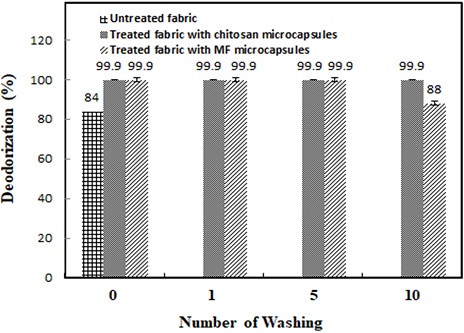
Deodorization rate of fabrics treated with microcapsule according to repeated washing.
As can be seen in the results, both the CH-M and the MF-M finished fabric exhibited more than 99% deodorization when washed once and 5 times. On the other hand, when repeatedly washed 10 times, the CH-M finished fabric showed excellent deodorization of 99% or higher, while the MF-M finished fabric had 88% of deodorization after washing 10 times, i.e. a reduced deodorization was observed. Therefore, considering the use of textile products and repeated washing, the CH-M finishing that contains basil and peppermint is more effective in improving the deodorization of fabrics than the MF-M finishing. Accordingly, through appropriately selecting functional substances suitable for use and finishing microcapsule, it may be possible to develop susceptible and functional materials that can express various performances.
4. Conclusion
In this study, the improvement of comfort was reviewed by analyzing the change of moisture characteristics, antibacterial activity and deodorization of underwear material by the CH-M finishing. CH-M were manufactured in an eco-friendly method by adding natural essential oil with strong deodorization, and washing durability of its functionalities also confirmed. The results can be summarized as follows.
First, it can be said that the moisture absorption time of the fabric decreased by CH-M finishing, while the diffusion rate increased, and the comfort improved by slightly increasing the absorption rate. Second, the unidirectional movement performance of the finished fabric was 17.69, which suggests an excellent moisture transfer to one side, and the OMMC was 0.32 and 0.37 in the untreated and finished fabrics, respectively, which shows a slight increase after finishing. Third, in the case of the untreated fabric, the bacteria reduction rate of Staphylococcus aureus was 89.0%, while that of Klebsiella pneumoniae was 70.3%. However, in the case of CH-M finished fabric, both strains showed 99.9% antibacterial activity, and the effect persisted top up to 10 times washing. Even after repeated washing, it showed an excellent bacteriostatic reduction rate of 99.9%. Fourth, in the case of the CH-M finished fabric, it was confirmed that deodorization was imparted through finishing, because it had a deodorizing effect exceeding 99% up to 120 minutes, and it exhibited excellent deodorization of over 99% even after repeated washing 10 times.
Even after microcapsule finishing, the absorbency of the lyocell fabric was not impaired, so the moisture control ability was excellent. Finally, functionality was maintained even after washing, which suggests promising possibilities to develop a natural product-based functional material that can replace the MF-M finished fabric.
Acknowledgments
This article is part of a doctoral dissertation.
This research is financially supported by Changwon National University in 2021~2022.
References
- American Association of Textile Chemists and Colorists. (2020). AATCC 195. Liquid Moisture Management Properties of Textile Fabrics. Retrieved July 28, 2021, from https://members.aatcc.org/store/tm195/591/
- American Type Culture Collection. (2018a). Klebsiella Pneumonia Subsp. Pneumoniae (Schroeter) Trevisan (ATCC® 4352™). ATCC. Retrieved July 28, 2021, from https://www.atcc.org/products/all/4352.aspx
- American Type Culture Collection. (2018b). Staphylococcus Aureus Subsp. Aureus Rosenbach (ATCC® 6538™). ATCC. Retrieved July 29, 2021, from https://www.atcc.org/products/all/6538.aspx
- Go, K. C. (2009). A study for fiber structure containing ideal moisture control functionality. Unpublished doctoral dissertation, Sungkyunkwan University, Seoul.
- Goo, K., Kim, S. D., Kim, Y. H., Ryou, D. I., Min, B. G., Park, W. H., Shin, Y. S., Oh, K. H., Lee, M. S., & Jang, J. H. (2012). Functional Finish. Paju: Gyomoon Publisher.
-
Kim, H., Janarthanan, G., & Noh, I. (2020). Current status of characteristics and applications of chitosan-polysaccharide composite hydrogels. Journal of Chitin Chitosan, 25(1), 1-12.
[https://doi.org/10.17642/jcc.25.1.1]

-
Kim, H. A., & Kim, S. J. (2016). Moisture and thermal permeability of the hollow textured PET imbedded woven fabrics for high emotional garment. Fibers and Polymers, 17(3), 427-438.
[https://doi.org/10.1007/s12221-016-5942-9]
- Kim, H. S., Jung, B. O., Lee, S. B., & Chung, S. J. (2012). Antioxidant and antibacterial activities of pinus koraiensis extracts with chitosan. Journal of Chitin and Chitosan, 17(4), 221-228.
- Kim, S. M., & Song, W. S. (2003). Antimicrobial activity and physical properties of acrylic acid grafted cotton knitted fabrics added with chitosan. Jounal of Korean Society of Clothing and Textiles, 27(11), 1252-1259.
- Korean Agency for Technology and Standards (2016). KS K 0693 Test method for antibacterial activity of textile materials. Korean Standards & Certifications. Seoul: Korean Standards Association. Retrieved July 29, 2021, from https://standard.go.kr/KSCI/standardIntro/getStandardSearchView.do?menuId=919&topMenuId=502&upperMenuId=503&ksNo=KSK0693&tmprKsNo=KSK0693&reformNo=05
- Korean Agency for Technology and Standards. (2011). KS K ISO 6330 Textiles - Domestic washing and drying procedures for textile testing. Korean Standards & Certifications. Seoul: Korean Standards Association. Retrieved July 29, 2021, from https://e-ks.kr/streamdocs/view/sd;streamdocsId=72059221478018672
- Kwon, S. J. (2016). An improvement of coolness assessment and analysis of knitted fabric's properties influencing coolness. Unpublished master’s thesis, Chonnam National University, Gwangju.
- Lee, H. M., & Lee, H. H. (2017). Fusion textile products finishing. Paju: Hyungseul Publisher.
- Mehdizadeh, T., Hashemzadeh, M. S., Nazarizadeh, A., Neyriz-Naghadehi, M., Tat, M., Ghalavand, M., & Dorostkar, R. (2016). Chemical composition and antibacterial properties of Ocimum basilicum, Salvia officinalis and Trachyspermum ammi essential oils alone and in combination with Nisin. Research Journal of Pharmacognosy, 3(4), 51-58.
- Na, M. H., & Kim, E. A. (1990). A study on the effect of fiber type on the water vapor transport properties. Journal of the Korean Society of Clothing and Textiles, 14(3), 229-240.
-
Özkan, E. T., & Meriç, B. (2015). Thermophysiological comfort properties of different knitted fabrics used in cycling clothes. Textile Research Journal, 85(1), 62-70.
[https://doi.org/10.1177/0040517514530033]
-
Park, C. M., & Yoon, H. S. (2018). Anti-bacterial effects of lavender and peppermint oils on Streptococcus mutans. The Journal of the Korean Academy of Dental Health, 42(4), 210-216.
[https://doi.org/10.11149/jkaoh.2018.42.4.210]
-
Park, Y. K., & Nah, J. W. (2011). Antibacterial activity of low molecular weight water-soluble chitosan. Polymer, 35(5), 419-423.
[https://doi.org/10.7317/pk.2011.35.5.419]
-
Ryu, S. J., & Bae, H. S. (2018). Effect of chitosan and tannin treatment on the functional manifestation of Coptidis Rhizoma Dyed Fabrics. Journal of the Korean Society of Clothing and Textiles, 42(6), 1016-1024.
[https://doi.org/10.5850/JKSCT.2018.42.6.1016]
-
Supuren, G., Oglakcioglu, N., Ozdil, N., & Marmarali, A. (2011). Moisture management and thermal absorptivity properties of double-face knitted fabrics. Textile Research Journal, 81(13), 1320-1330.
[https://doi.org/10.1177/0040517511402122]
- ‘Tencel’. (2016). Samil Spinning Co., Ltd. Retrived November 29, 2016, from http://www.samil-sp.co.kr/product/04_tencel.php?left=7
-
Troynikov, O., & Wardiningsih, W. (2011). Moisture management properties of wool/polyester and wool/bamboo knitted fabrics for the sportswear base layer. Textile Research Journal, 81(6), 621-631.
[https://doi.org/10.1177/0040517510392461]
- Yoo, S. J. (2001). Liquid moisture managament and surface properties of the fabric in transient condition. Journal of the Korean Society of Clothing and Textiles, 25(1), 61-70.