
Designing Flexible Curricula for the 21stCentury : Case of a Digital Merchandising Course

© 2021 Fashion and Textile Research Journal(FTRJ). This is an open access journal. Articles are distributed under the terms of the Creative Commons Attribution Non-Commercial License(http://creativecommons.org/licenses/by-nc/4.0), which permits unrestricted use, distribution, and reproduction in any medium, provided the original work is properly cited.
Abstract
The emerging Fourth Industrial Revolution has triggered fundamental shifts in the fashion industry. Advanced digital technologies are not only reshaping how the fashion supply chains function, but also requisitioning new skill sets for jobs in this industry. A mismatch in required skills between current and future jobs is a critical issue that needs to be addressed in the fashion industry. Similarly, it is imperative that fashion programs in higher education keep pace with the rapid changes disrupting the fashion sector. Nevertheless, the increasing speed and the magnitude of digital transformation make it challenging to keep fashion curricula up to date. This paper presents the case of a Digital Merchandising course. Using the principles of designing flexible curricula and backward design, this Digital Merchandising course was developed to be flexible and responsive to the changing business environment. Building digital intelligence was the central learning goal for students to accomplish. The paper discusses the conceptual development processes for the course and provides, visual examples of major learning assignments, and a variety of digital tools. Fashion educators are encouraged to consider backward design and flexible curricula design guides as complementary tools to the widely used Bloom’s taxonomy.
Keywords:
backward design, digital intelligence, digital merchandising, flexible curricula1. Introduction
Higher education is facing challenges to meet the needs of the fast-changing economy associated with the global, digital, and knowledge economy of the 21st century(Levine & Pelt, 2021). The undercurrent of emerging changes in higher education is digital transformation. Whether higher education will face incremental changes versus disruptive changes remains debatable(Levine & Pelt, 2021; Selingo, 2013). Nonetheless, if disruptions in other industries during the fourth industrial revolution(also called Industry 4.0) give any clues(Rüßmann et al., 2015), higher education of the 21st century is likely to undergo a major transformation.
There is a growing consensus that the current model of higher education is no longer relevant and needs to be disrupted(Chamorro-Premuzic & Frankiewicz, 2019; Christensen, 2009). Higher education has been criticized for failing to support personal and professional development for college graduates(Busteed, 2019). One of the main objectives of higher education is to prepare students not only for immediate employment upon graduation, but also for careers using the acquired skills and qualifications from college education(“Re-Imagining”, 2019). However, there is a significant mismatch between what employers need and what college graduates can do(Selingo, 2013; Selingo, 2015). Selingo(2016) found that 2 out of 3 young adults surveyed struggled to launch their careers, while 1 in 5 employers worldwide cannot fill positions despite persistent unemployment(White, 2013). Furthermore, a disconnect between university qualifications and graduates’ job-readiness continues to increase(Chamorro-Premuzic & Frankiewicz, 2019; Selingo, 2015). An analysis of millions of job ads conducted by a workforce analytics firm revealed that for the positions that require a bachelor’s degree, the set of requirements included more soft skills than technical skills(Selingo, 2016). Yet, employers find college graduates significantly lacking in soft skills such as critical thinking, creativity, collaboration, and communication skills(White, 2013). Furthermore, the issue of a disconnect between education and employment is exacerbated as future jobs are increasingly hard to predict with rapid technological advancement and disruptions(Rüßmann et al., 2015).
The fashion industry and education are not exempt from digital disruptions. Digital disruption refers to “the effect of digital technologies and business models on a company’s current value proposition and its resulting market position”(International Institute for Management Development [IMD], 2016). The emerging fourth industrial revolution gives rise to fundamental shifts in the fashion industry(Jin & Shin, 2021). Advanced digital technologies are not only reshaping how fashion supply chains function, but are also demanding new skillsets for jobs in the fashion industry(Dubreuil & Lu, 2020; Merryman & Lu, 2021). The fashion programs in higher education also face a pressing need to keep up with the rapid changes disrupting the fashion industry(Yoo, 2020). A mismatch in required skills between current jobs and future jobs in Industry 4.0 is a critical issue to address in the fashion industry(Rüßmann et al., 2015; Wang & Ha-Brookshire, 2018).
Fashion educators are no strangers to change. Established as the clothing and textiles discipline in higher education, the fashion program has evolved and adapted to the changing social, cultural, global, and business environments(Ha-Brookshire & Hawley, 2012; Yoo, 2020). The successful evolution of fashion programs in higher education thus far is a testament to fashion educators’ adaptability to the changes and unwavering commitment to student success. As fashion educators recognize a growing misalliance between existing curriculum and emerging job trends, especially in digital areas, they often take the initiative to retool themselves with new digital skills and keep up with the ever-changing industry. Nevertheless, the increasing speed and magnitude of digital transformations make it daunting to keep fashion curricula up to date. To make it worse, required skills for future jobs are often unknown (Rüßmann et al., 2015). Are fashion educators doomed to lose in this speed battle? How might fashion educators adapt to the volatile industry undergoing digital transformation?
The purpose of this paper is to help spark conversations with fellow educators about how we collectively and collaboratively innovate fashion education for the 21st century. To contribute to such conversations, this paper is designed to share teaching strategies and resources that the author has explored and from which the author has benefited. This paper is not an empirical research paper. Rather it presents a teaching case of the course development in Digital Merchandising. In the next section, an overview of the challenges facing higher education and fashion programs is first presented followed by the discussion of designing flexible curricula using backward design. After presenting flexible curricula design approaches, a teaching case of the Digital Merchandising course developed and taught by the author is presented. Although mindful efforts have been made to provide sufficient details and relevant visual examples to help illustrate the course, some details may be lacking or missing. This author encourages readers to reach out if they have questions or need clarifications.
2. Transformation of Fashion Businesses
The fourth industrial revolution is expected to bring disruptive transformations in industries and societies like previous industrial revolutions have done(Iansiti & Lakhani, 2020; Philbeck & Davis, 2019; Rüßmann et al., 2015; Schwab, 2016). Like other industries facing digital disruptions, the fashion industry is going through its own transformation and becoming more data-driven, making fundamental changes in the type of talents and required skillsets(Agarwal, 2018). Like other industries, fashion businesses are impacted by the rise of data science and the integration of big data and digital analytics into business operations(Moore, 2019; Silva et al., 2019; Vicario & Coleman, 2019).
With growing digital commerce and advancement in technology, the job landscape has been fast-changing(“How Ecommerce”, 2020 ; Linn, 2014). Whereas overall retail job growth remains flat, e-commerce jobs are growing at a faster rate and outpacing other types of retail. However, despite the fast growth, the number of e-commerce jobs is small compared to other retail jobs because the e-commerce business is not labor-intensive(Gebeloff & Russell, 2017). With automation and artificial intelligence(AI), most traditional jobs in retail are likely to decline(Begley et al., 2019). Furthermore, advanced planning systems with AI are predicted to improve the speed and efficiency of merchandising decisions(Begley et al., 2019), likely leading to reductions in merchandising positions. The changing job landscape in the retail and merchandising industries is particularly important to the fashion industry because fashion and beauty products are the top product categories of the retail industry(eMarketer, 2021c; Weinswig, 2018).
The multitude of changes in technology advancement, globalization, and market volatility is creating a digital vortex where the magnitude of changes is unpredictable. Retail is predicted to experience major digital disruptions followed by the technology products/services industry and the media and entertainment industries(IMD, 2016). While digital technologies enable a plethora of innovation and improvement in the global fashion supply chain, they also pose an existential threat to fashion businesses. The advancement of digital technologies gave rise to modern commerce(e.g., Dollar Shave Club, Gilt, Stitch Fix) that are mobile-first. Often built on different business models from existing businesses(e.g., subscription-based, platform-based), these modern commerce companies leverage digital technologies to be more experiential, convenient, personalized(Solis, 2017).
Take the example of Stitch Fix(www.stitchfix.com). Stitch Fix is considered a leading example of a fashion firm succeeding in the era of the fourth industrial revolution(Harvard Business Review Press, 2019; Jin & Shin, 2021). Stitch Fix is a personal style service based on the unique combination of advanced technology(algorithms) and the personal touch of experienced human stylists. Through collaboration between algorithms and human stylists, Stitch Fix personalizes product selections and sends fashion products to their customers. Customers can keep the items they like and return the ones they do not like. The core competency of Stitch Fix is its proprietary algorithms(see https://algorithms-tour.stitchfix.com/) and data science, not fashion products(Yahoo Finance Video, 2021). If so, is Stitch Fix a fashion company or a tech company? According to Stitch Fix CEO Katrina Lake, “In 10 years, every “relevant” company will be a tech company”(Johnson, 2019).
Take Patagonia as another example. Patagonia is widely known as a sustainable outdoor clothing company. Yet few people know that Patagonia sells sustainably sourced seafood(Beer, 2019; Singh, 2012). Recently Patagonia expanded offerings to include a wider variety of food items as well as wine(https://www.patagoniaprovisions.com/). Patagonia’s core competency is responsible sourcing, not clothing products. Patagonia’s expansion into food is not a random experiment. Rather, it is a deeply thought-out expansion building off its core competency of responsible sourcing(Moon et al., 2021).
How about Amazon? According to Forbes, Amazon has surpassed Walmart and became the biggest apparel retailer in the U.S.(Ghosh, 2021). Contrary to other retailers struggling with declining apparel sales(Statista, 2021), Amazon’s apparel sales in 2020 exceeded $41 billion, growing more than 15% from the previous year. In 2021, Amazon’s apparel and footwear sales are predicted to surpass $45 billion(McKay, 2021). Amazon continues to expand its apparel businesses. Amazon has been heavily investing in its private-label offerings in apparel(Weinswig, 2018) while launching luxury stores with Oscar de la Renta as the first brand partner in 2020(Amazon Press Release, 2020). Despite its commanding position as an apparel retailer in the U.S. and burgeoning market share(Danziger, 2020), Amazon’s core competency is not apparel products. Its core competency is in supply chain management, customer relationship management(e.g., prime membership), and cloud computing(e.g., Amazon Web Services)(The Economist, 2020).
Similar trends are seen in South Korea. According to eMarketer(2021a), Coupang and Naver exhibited strong growth. Although Sininsegae and Lotte Group remain in their top market positions, both experienced sales declines, whereas Coupang’s sales grew from $12.53 billion in 2019 to $20.10 billion in 2020. Naver’s retail sales grew from $8.33 billion in 2019 to $14.28 billion in 2020. The core competencies of Coupang and Naver are unlikely to be fashion-related competencies. Coupang’s core competency is its e-commerce platform(“Coupang”, 2021).
3. Fashion Education and Shifting Job Markets
As previously discussed, higher education at large is facing a crisis due to a growing disconnect between what students gain during college education and what students need for careers upon graduation(Chamorro-Premuzic & Frankiewicz, 2019; Selingo, 2015). When a business’s core competencies change, an existing disconnect between higher education and industry is intensified. If fashion is no longer considered a core competency of businesses in the fashion industry, what does digital transformation mean for the fashion industry and fashion education? What kind of workforce will future fashion/tech companies need and want to hire?
A content analysis of 649 job postings on StyleCareers.com(September 1, 2016 - January 4, 2017) revealed digital competency requirements varied across various job functions across the fashion supply chain(Wang & Ha-Brookshire, 2018). This study found greater requirements for digital competency during the initial stages of the fashion business cycle(e.g., forecasting, design) than the later stages(e.g., sourcing, retailing). The findings of this study offer a useful snapshot of digital competency requirements across various job functions during the research time frame. Nevertheless, after the accelerated digital disruptions due to the COVID-19 pandemic(Kopka et al., 2020), how digital competency requirements have changed over time remains to be examined.
One of the high-demand positions by U.S. fashion brands on the Business of Fashion are positions related to data science(or digital skills)(Merryman & Lu, 2021; Milner, 2020). To study how well students in the fashion programs are prepared for a data-intensive fashion industry of industry 4.0, Merryman and Lu(2021) examined how the current fashion curriculum in U.S. higher education institutions incorporated data science and related topics into the fashion curriculum. They identified three major components in the curriculum for data science-related courses; 1) basic math and statistics knowledge; 2) quantitative reasoning skills; 3) software skills. The findings of the study offer a grim outlook. The study found that the incorporation of data science-related courses was pervasively low across most institutions. Traditional merchandising and design courses still accounted for more than half of the course credits required. Many institutions offer basic retail math courses, but they may not be sufficient to improve analytical skills for the increasingly data-driven fashion industry(Bremner, 2017). Furthermore, fashion curriculums were generally rigid with limited opportunities for free electives, making it harder for students to expand their skillsets.
A mismatch between a shifting job market and fashion education poses a threat to the future of fashion programs. Fashion programs in higher education are primarily application-oriented. Most students studying fashion in U.S. higher education institutions pursue careers in the fashion industry(Hodges & Karpova, 2009). Aligning the fashion curriculum with the changing needs of the industry has been an important strategic imperative for fashion programs(Agarwal, 2018; Pasricha & Kadolph, 2009). Merryman and Lu(2021) suggested making course requirements more flexible to allow students to explore emerging areas. They further suggested new interdisciplinary programs that better reflect the evolving fashion industry(e.g., fashion data scientist)(Daugherty et al., 2019). Merryman and Lu(2021) proposed that incorporating data science into the undergraduate fashion curriculum will help boost students’ motivation for learning, grow enrollment, and enhance employability. Merryman and Lu(2021) argue that exposure to data science in the curriculum can improve the job readiness of students for the increasingly data-driven fashion industry.
The 20th-century approach to education is no longer relevant in the 21st century of the conceptual age(Pink, 2015). College graduates no longer move into task-based jobs. A person will not need college education to learn facts. Albert Einstein stated that “Education is not the learning of facts, but the training of minds to think.” Education leaders emphasize the ability to learn as a vital goal of college education(Chamorro-Premuzic & Frankiewicz, 2019; Selingo, 2015).
At the National Retail Federation 2020 Vision: Retail’s Big Show, Michelle Gass, Kohl’s CEO, said “We’re in a time when you have to think differently. It can be daunting, but I look at like, ‘Wow. The rules have changed. And what are the rules?”(Soltes, 2020). What does this mean for fashion programs in higher education? When the rules of the industry continue to change, how might educators respond to the constant changes that are accelerating speed? Can we design curricula that are flexible and readily adaptable to the changing environment?
One pedagogical approach to consider is designing flexible curricula using backward design((Davis, 2012; Davis, 2013; Wiggins & McTighe, 2005).
4. Designing Flexible Curricula using Backward Design
Regardless of rapid changes in the industry, the academic approval process for curriculum changes is often slow. Additionally like a legacy system in business contexts, established courses can become a barrier to building new curricula that are customizable, agile, and responsive(Davis, 2012; Davis, 2013). Facing industry 4.0, there is an urgent need to rethink existing curricula and design curricula that are adaptable and responsive to digital disruptions.
Educators are designers. Educators craft curriculum and design learning experiences to accomplish specified learning outcomes(Wiggins & McTighe, 2005). Coverage is one of the pitfalls of college education. Often, a huge amount of content is covered as an attempt to expose students to all seemingly relevant and important facts and ideas. There is a persistent misalignment between short-term plans and actions and long-term learning goals. Wiggins and McTighen(2005) advocate that teachers play the role of coach of understanding, rather than mere sources and messengers of content knowledge. In their book ‘Understanding by Design’, Wiggins and McTighen(2005) proposed backward design as an effective curriculum planning strategy. Backward design consists of 3 stages; 1) Identify desired results, 2) Determine acceptable evidence, and 3) Planning learning experiences and instruction(Fig. 1).
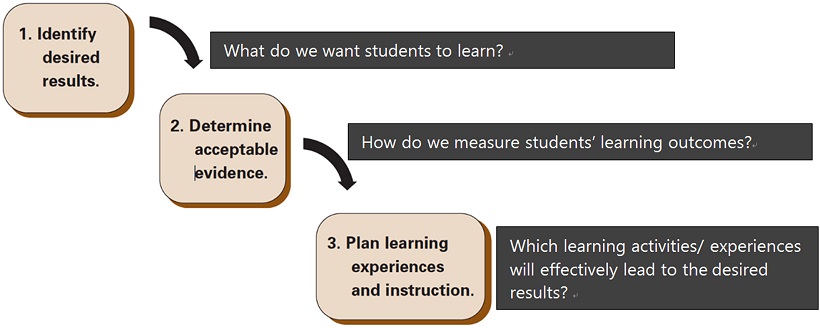
Stages of Backward Design(Wiggins McTighe, 2005).
During the first stage, educators need to think about what they want students to accomplish; what they should know, understand, and be able to do(Wiggins & McTighe, 2005). Knowing and understanding are not quite the same. For example, one may know how to create a profit and loss statement, but may not understand what the profit and loss statement means to a business and how to use it to make strategic business decisions. If knowledge is about the facts, understanding is about the meaning of the facts. A person may know “a body of coherent facts,” or understand “the theory that provides coherence and meaning to those fact”(Wiggins & McTighe, 2005, p. 38).
Wiggins and McTighe(2005) discussed six facets of understanding: 1) explanation, 2) interpretation, 3) application, 4) perspective, 5) empathy, and(6) self-knowledge). See Table 1 for the definition of six facets of understanding and refer to Wiggins and McTighe(2005) for further details. Wiggins and McTighe's model of backward design is complementary to the widely adopted Bloom’s taxonomy(Sideeg, 2016).

Six facets of understanding
The three types of content knowledge as shown in Fig. 2 is a useful framework to conceptualize desired learning outcomes. First, enduring understanding means the big ideas that students retain and important overarching goals. Second, there are theories, concepts, and skills that are important to know and do. Third, there is the knowledge you want your students to be familiar with. Most information covered in a course falls into this category. The goal is to balance the three types of content knowledge for successful learning outcomes(Davis, 2012; Davis, 2013). When dealing with constant changes in the fashion industry, understanding different types of content is exceptionally instrumental to effective curricula design.
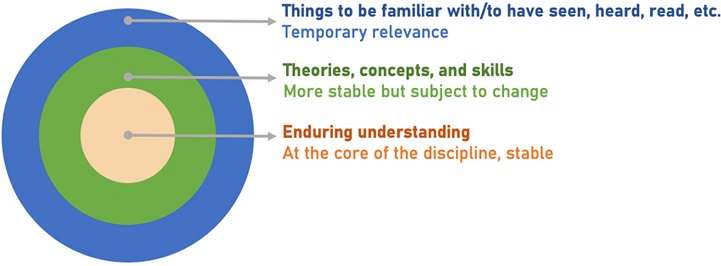
Three types of content knowledge (Davis, 2012; Davis, 2013; Wiggins & McTighe, 2005).
As compared to example(A) in Fig. 3 in which three types of knowledge are well-balanced, examples(B) and(C) in Figure 3 illustrate common issues that persist in college courses. Example(B) shows less emphasis on enduring understanding and important concepts as compared to content with temporary relevance. Example(C) shows the content-heavy course without adequately building enduring understanding and important theories/principles. Example(C) may give a false impression of intense learning because of extensive content. But they are mostly short-lived and quickly become irrelevant. Without deliberate and focused instructional design, it is challenging to balance three types of content(Wiggins & McTighe, 2005).
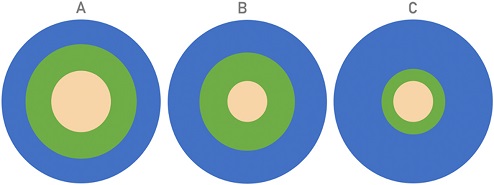
Different content structures(Davis, 2012; Davis, 2013).
During the second stage of backward design, educators determine how to assess students' learning progress and outcomes. At this stage, it is important to consider a wide range of assessment methods to create a 360 view of learning experiences and outcomes. Additionally, both formative assessment to monitor student learning progress and summative assessment to evaluate their learning outcomes should be considered. Quizzes and tests are often effective to measure learning of important theories/concepts/skills to know as well as things worth being familiar with. Performance tasks and projects are often more effective to assess students’ learning accomplishment of enduring understanding and important theories/concepts/skills(Wiggins & McTighe, 2005). Once educators have clearly identified learning goals and outcomes(stage 1) and appropriate evidence to assess how students achieve the desired results, educators are ready to plan learning experiences and instruction.
5. Curriculum Development Example: Digital Merchandising
In fall 2017, the author piloted a new course titled Digital Merchandising. The creation of this course was in response to the rapidly changing business world. Advancement in digital technologies not only improved business processes through automation, but also transformed the nature of the business operation(Harvard Business Review Press, 2019). In an omnichannel world, the traditional consumer decision-making model with linear progression from awareness to purchase was no longer relevant. The omnichannel customer journey is complex, dynamic, and unique to an individual or a shopping context(Bradley, 2019). There continue to be new emerging social media platforms, technology innovations such as blockchain, new shopping formats such as livestreaming, and so forth. Many emerging trends will be ephemeral. Yet it is hard to know which trends will last and which will perish. Students can learn the most effective social media strategies at the moment. Yet social media strategies are continuously changing with the rising new platforms and tools, and thus students’ knowledge will become quickly irrelevant. Students can learn the most widely used software programs in a class. Yet such tools are subject to change, and students may not have adequate skills for a job when they graduate. Therefore, a different approach was taken to develop a new course that can stay relevant and effectively prepare students for a volatile business environment.
5.1. Digital intelligence
Following the backward design model(Wiggins & McTighe, 2005), the desired learning outcome of the Digital Merchandising course was first identified; building digital intelligence. Facing industry 4.0, the growing importance of digital competency among college graduates is widely recognized(Jin & Shin, 2021; Merryman & Lu, 2021; Wang & Ha-Brookshire, 2018). Digital intelligence is defined as “the set of key capabilities needed to succeed in a world driven by technology and changing at breakneck speeds”(Harvard ManageMentor, 2021). Digital intelligence is not about having technology skills or gaining proficiency in the latest technology innovation. Rather, digital intelligence is a way of working and the ability to recognize the benefit offered by new digital tools and effectively utilize new tools. “With a digital mindset, you see technology as a means for innovating, solving problems, and creating efficiencies”(Harvard ManageMentor, 2021). With digital strategy or digital transformation, most often an emphasis is on “digital.” Westerman(2018) criticized the ill-guided focus on digital technologies per se. He argues that technology itself does not provide value(except for technology in products). Rather, the value of digital technology comes from what technology enables a business to do differently and better. For example, e-commerce is not about the Internet. It is about selling products differently by bringing a store to customers and keeping it open 24/7. Digital analytics is not about machine learning algorithms. Instead, it is about understanding customers better or improving business processes using better insights from machine learning. Westerman(2018) argues a strategic focus should not be on ‘digital.’ It is not “digital strategy” that is important. The focus should be on “a better strategy, enabled by digital.” Building digital intelligence is not about becoming a technology expert. However, with digital intelligence, students will recognize the ways technology can improve what they do and effectively utilize new digital tools(Westerman, 2018).
As illustrated in Fig. 4, there are four key practices to build digital intelligence(Harvard ManageMentor, 2021). Out of the four principles, embracing a digital mindset is the most integral to building digital intelligence. A digital mindset is “the ability to see and make the most of the opportunities that digital change offers”(Harvard ManageMentor, 2021). With a digital mindset, students will be excited to learn new things; will have a desire to use data to make decisions; will stay knowledgeable about emerging trends and technologies. As aforementioned, the ability to learn is the most essential skill that college graduates need to build(Chamorro-Premuzic & Frankiewicz, 2019; Selingo, 2015). With a digital mindset, students will be motivated to stay knowledgeable about up-and-coming digital trends and to expand their digital toolbox.
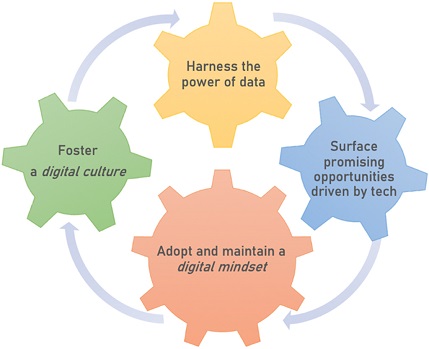
Four practices to build digital intelligence(Harvard ManageMentor, 2021).
With a clear idea of enduring understanding for the class(i.e., digital intelligence), the next step was to determine important knowledge(theories/principles/concepts) and skills(processes/strategies), and things with which to be familiar. Clarifying three types of content knowledge as illustrated in Fig. 5 is integral to designing a flexible curriculum. Based on these clear goals, learning experiences and instructions can be designed to build a flexible curriculum that is customizable, agile, and responsive to change(Davis, 2012, 2013). See Table 2 for an example of how to convert a traditional curriculum to a flexible curriculum(Davis, 2012; Davis, 2013).
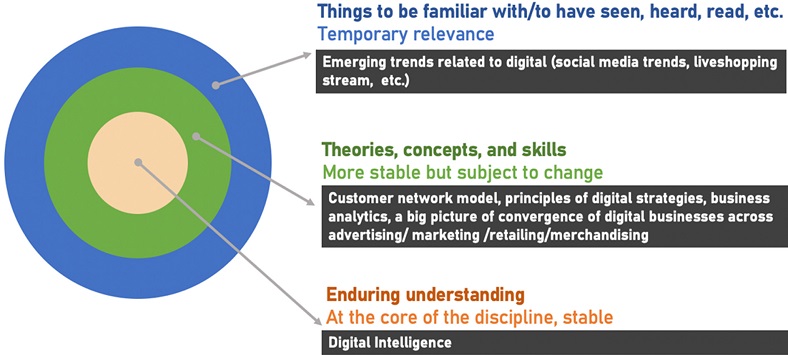
Example of three types of content knowledge for digital merchandising.
Traditional vs. flexible curricular
5.2. Visual course map
Fig. 6 is a visual course map of the Digital Merchandising course. This visual map not only shows the main topics/concepts/principles/tools of the course, but also offers a broad overview of how various concepts relate to one another. It is generally hard for students to see the big picture of what they are learning from a course. Often called a graphic syllabus, a course visual map allows students to understand their learning in a broader context(Nilson, 2007). To build digital intelligence, this course covers a wide variety of topics from digital advertising to site merchandising to business analytics to innovative digital strategies. Industry 4.0 characterized by a merger of physical assets and advanced digital technologies is expected to transform how we work and live(Deloitte Insights, 2020). With the growing omnichannel retailing, traditional boundaries of advertising, marketing, retailing, and merchandising have blurred. As a result, digital merchandising is a continually evolving area and cannot be limited by the boundary of traditional merchandising. This visual map is frequently used throughout the semester to help students connect dots across various topics/concepts/principles/tools.
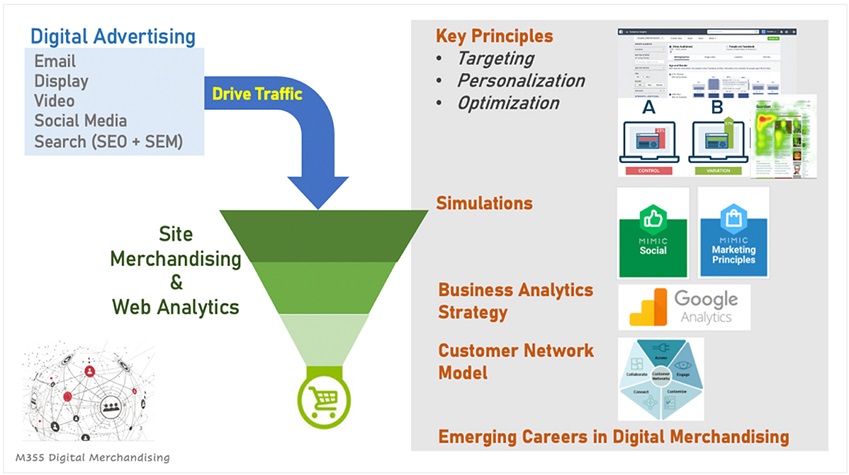
Visual course map of digital merchandising.
To further facilitate students’ understanding of the big picture of digital merchandising, students develop their own course map at the end of the semester. Fig. 7 shows the examples of students’ visual course maps that reflect how individual students make sense of different topics/concepts/principles/tools covered in the course. Students were asked not only to develop their own visual map, but also to explain their visual map. This process works as an elaborative rehearsal that promotes creating long-term memory by making associations(Goldstein, 2019). Additionally, this activity of developing a personal course visual map at the end of the semester aims to encourage reflection on personal growth in digital intelligence and promote enduring understanding.
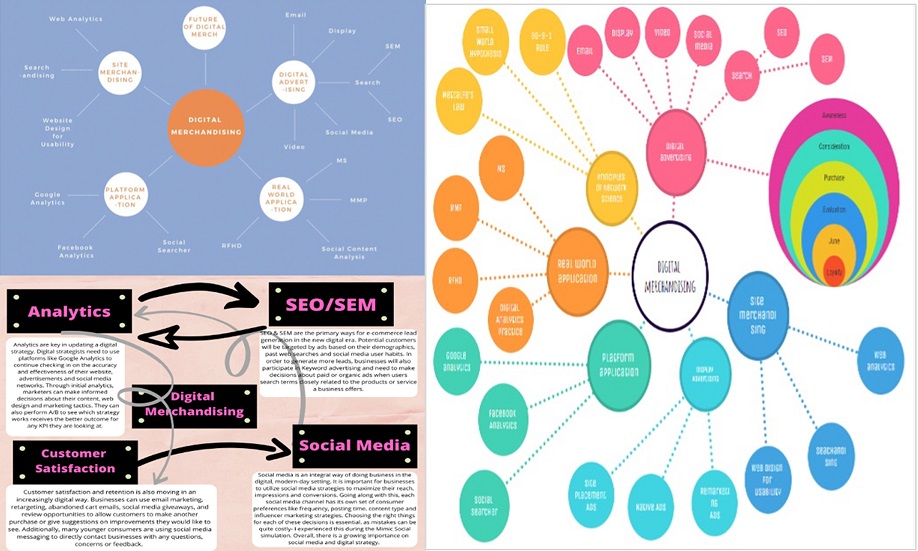
Examples of students’ visual maps.
5.3. Digital tools
To foster a digital culture, the Digital Merchandising course has utilized various digital tools for in-class and outside class collaborations. Digital tools include Google Jamboard(free), Miro boards(free educator account), Google Slides(free), Google Forms(free), and Padlet(paid). These digital whiteboards and other digital tools help all students participate in activities and more effectively collaborate with others both in and outside class. These tools are all relatively easy to use, and yet provide students with more opportunities to learn and use new tools. In particular, Miro boards are widely used in businesses for collaboration(Murray, 2020). These digital whiteboards allow students to see others’ responses, which further stimulate their thinking and give new inspirations. See Fig. 8 for examples of Google Jamboard and Fig. 9 Miro boards. These tools are regularly used during class to engage students.
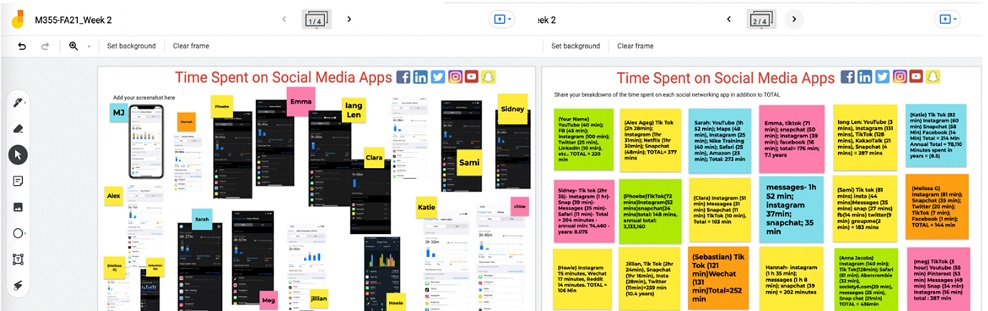
Examples of Google Jamboard(https://jamboard.google.com/).
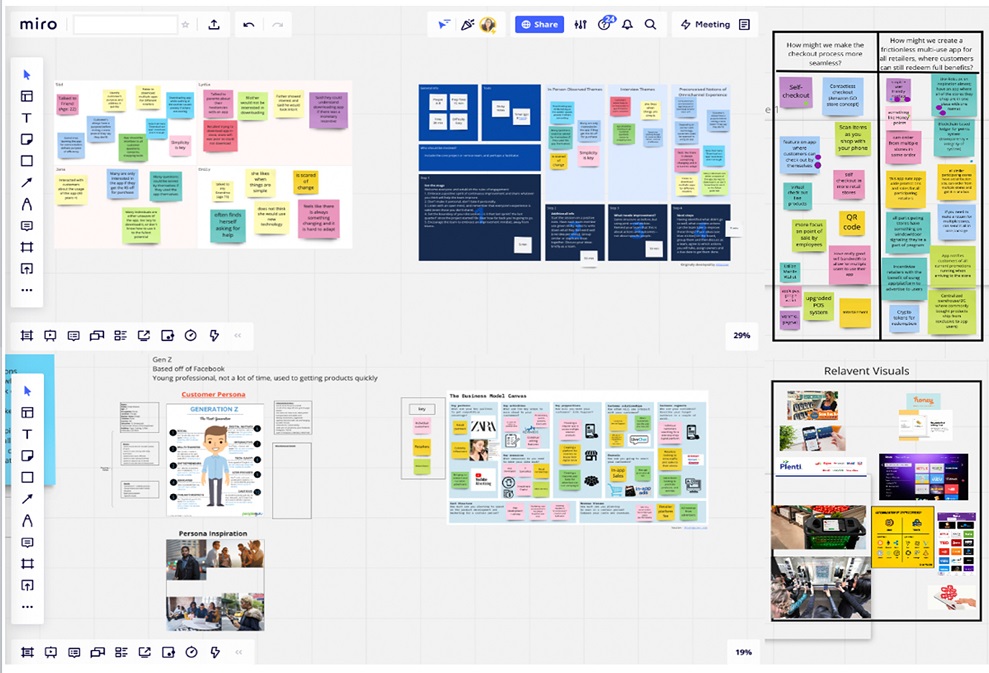
Examples of Miro boards(https://miro.com/).
In addition to learning the process of digital analytics in concepts, students practice using various digital analytics tools. Students are required to earn a certificate for Google Analytics for Beginners(https://analytics.google.com/analytics/academy/course/6) on their own and submit their certificate as a course requirement early in the semester. To further promote embracing a digital mindset and practicing using various analytics tools, students complete three digital analytics practice assignments:(1) Google Analytics for Google Merchandise store(https://support.google.com/analytics/answer/6367342?hl=en#zippy=%2Cin-this-article),(2) Social Searcher(https://www.social-searcher.com) for social listening and(3) SEMRush(https://www.semrush.com/) for social media audits and keyword searches. After a short introduction about these web-based tools during class, students take an active role in navigating and learning tools and utilize these digital tools to draw insights using the questions. This is done as an assignment outside class. Instructions are comprehensive ‘how to guide’ with relevant screenshots to encourage students to learn “how to learn” new digital tools. Relevant YouTube videos are suggested if available. Google Analytics and Social Searcher are free. For SEMrush, students access the site during a free trial period. Facebook and Instagram used to have demo accounts and analytics accounts, which became unavailable as of June 2021. See Fig. 10 for examples of social searcher websites and Fig. 11 for the SEMrush website. Additionally, students explore various free social media monitoring tools such as TweetDeck, MentionApp, Google Alerts, Google Trends, Hootsuite, etc. Little class time is devoted to these tools. Students are expected to do these assignments on their own and reach out to the instructor if needing individual help. This approach not only facilitates student learning of how to learn and ask for help when needed, but also opens class time for other content that benefits from community learning in class.

Social searcher.com(https://www.social-searcher.com/)
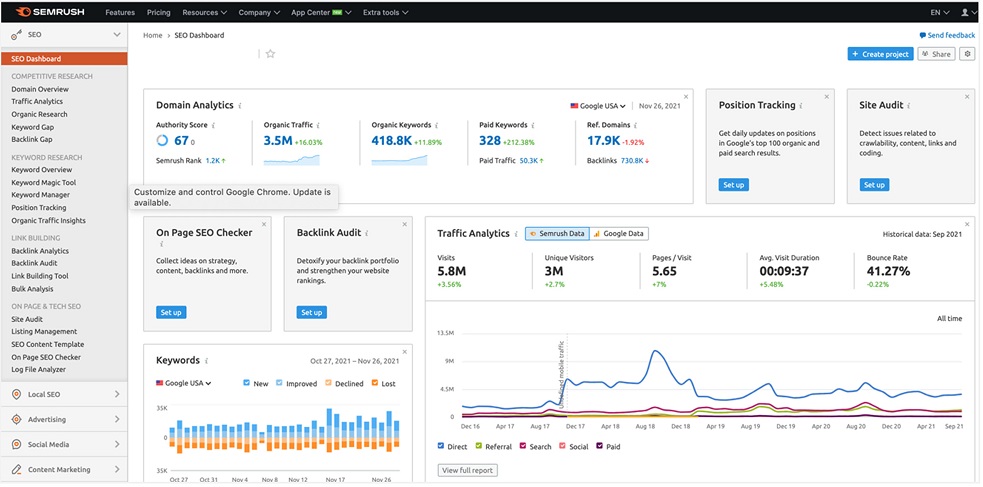
SEMrush(https://www.semrush.com/)
5.4. Simulations
One of the key emerging digital business strategies is the rise of social commerce(Perez, 2021). Instagram has become a digital shopping mall with endless assortments of products(Johnson, 2021). In the article in QUARTZ, Kozlowska(2019) poses a question “Why go to the mall when you can look at Instagram?” Influencer marketing is further reshaping the world of marketing. According to the recent eMarketer report(2021b), 67.9% of US marketers are using influencer marketing, and this figure is predicted to increase to 72.5% in 2022. Additionally, spending on influencer marketing is rising. The role of influencers in marketing is constantly evolving from an influencer as media to as a content producer, and now as a customer experience influencer(Skinner, 2020). The rise of social commerce and influencer marketing parallels the growth of career opportunities in social media management for fashion brands. Thus, social media management was considered one of the important topics of the course.
Rather than teaching major social media platforms and their effective social media strategies, a series of learning activities were designed following flexible curricula design approaches. The learning outcomes for students were to be able to run effective social media campaigns and to successfully work with social media influencers. Toward these goals, first students conducted a content analysis of social media postings from Herschel’s Facebook and Instagram(a competitor to a fictitious e-commerce company Buhi from simulation) for a one-month period using the Excel template that records different types of postings, the schedules(day and time), impressions(e.g., # of views), engagement(# of likes, shares, comments, etc.). After completing a content analysis, students used the data to draw insights about the relationships between types and schedules of social media posts and performance in terms of impressions and engagements. To help students further familiarize themselves with different social media ads and accompanying analytics, the second assignment was a social media audit. Instead of lectures, students were given guides about different types of social media postings across major social media platforms including Facebook, Instagram Snapchat, Pinterest, Twitter, etc. Students chose five social media ads across a minimum of three different platforms and qualitatively analyzed them using the structured questions.
After qualitative and exploratory approaches to social media strategies, students engaged in social media simulations using Stukent’s Mimic Social(https://www.stukent.com/higher-ed/mimic-social/). Simulation facilitates active learning and helps students develop real-world skills through hands-on learning experiences(Lateef, 2010; Rogmans, 2019). Mimic Social is an online social media marketing simulation, which includes both social media campaigns and influencer marketing for a fictitious e-commerce company called Buhi. With the current version(a new beta version came out in 2021), students can run up to 24 rounds(12 simulations + 12 analyses). The process needs to be scaffolded so that students can gradually build the competency of running successful simulations. Running effective social media campaigns is time-intensive. Thus not all 24 rounds are required but encouraged as a way to improve their overall performance and earn a Stukent certificate.
Learning how to use a web-based Mimic Social program is relatively easy. Creating social media campaigns takes a comprehensive understanding, planning, and execution of content strategy. Students tend to struggle at the beginning, not because a program is difficult to use, but because they have to make the multitude of decisions from a brand voice, a target audience, image/video selections, captions, hashtags, budgets for promotions, social media platform selections for each post, etc. Students are given $5,000 weekly budgets to run campaigns, and their performance is evaluated on impressions, engagement, clicks, conversions, and revenues. After each simulation, an analysis round helps students understand social media analytics based on their performance and use the data to inform their strategy for the next simulation. This simulation also includes rounds with influencer marketing strategies. As illustrated in Fig. 12, 15 influencers from mega(> 1 million followers) to micro-influencers(10,000 – 50,000 followers) with specialization in different platforms, product categories, follower demographics, etc. are available for partnering. The simulation is built in a way for students to make an offer and go through two rounds of negotiation in terms of influencer marketing strategy and payment. If no agreement is reached, the deal is off, and the influencer in negotiation will no longer be available to a student for that specific simulation. There are other influencers available to begin new negotiations. Simulation performance evaluations are built in. Students can see their class ranking based on revenues throughout the process. The evaluation rubric that instructors can customize is also available. First adopted in 2017, this simulation has been an excellent experiential learning opportunity for students. Feedback from both students and employers has been overwhelmingly positive.
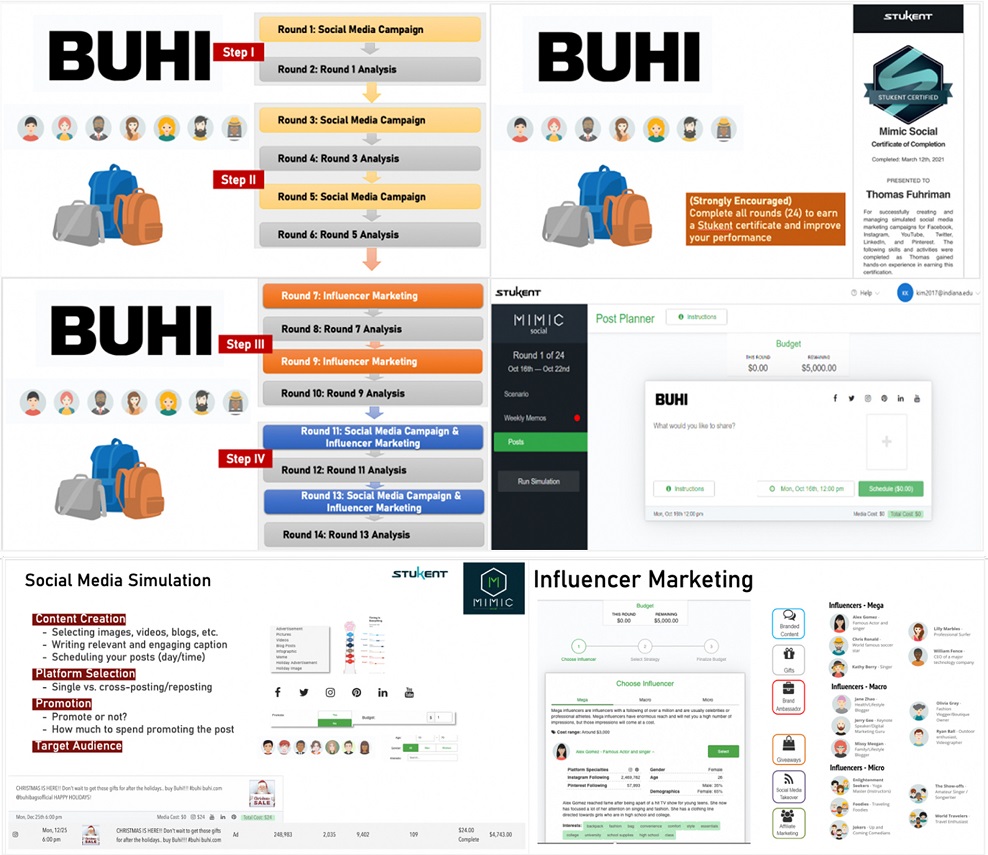
Introduction for Mimic Social simulation.
With the excellent learning outcomes from the Mimic Social simulation, another simulation program, Mimic Marketing Principles simulation, was adopted in 2020. See Fig. 13. This is a far less time-intensive and easier simulation than Mimic Social. This Mimic Marketing Principles simulation was incorporated into the early part of the semester to get students to become familiar with simulation and the same fictitious e-commerce company, Buhi as Mimic Social simulation. With this simulation, students conduct market research and make a series of essential marketing decisions(product, price, promotion, and distribution). One key feature of this simulation is immediate feedback and an opportunity to revise strategy during the next round. Evaluation of simulation performance for this simulation is completely built in. No grading by an instructor is necessary.
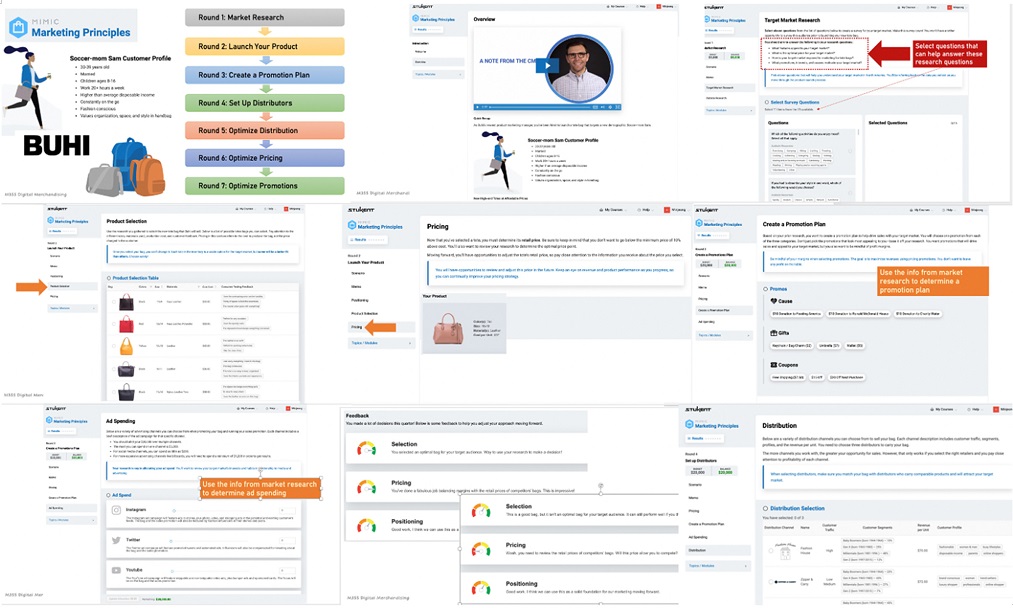
Introduction for Mimic Marketing Principles simulation.
Mimic Marketing Principles simulation has been complimentary to Mimic Social Media simulation and allowed students to ease into the more intensive Mimic Social simulation. Each simulation costs US$59.99. For both programs, a bundle price of $99 was offered. Students pay and register directly to Stukent.com. See Figure 13 for example screens of the Mimic Marketing Principles simulation.
5.5. Five core customer behavior model and innovative digital strategy development
To synthesize diverse concepts/topics/principles learned in the course and apply them to a real-life setting, students engage in project-based learning(Harvard Business Publishing Education, 2021) and develop innovative digital strategies in a collaborative team environment. Students worked with locally owned businesses that generally lack financial and human resources for developing effective digital strategies unlike large retail companies. To develop innovative digital strategies, students learn about the Five Core Customer Behavior model by Rogers(2012) rather than solely focusing on current successful digital strategies. The Five Core Customer Behavior model based on human motivations(See Fig. 14) and the five-step process of building innovative business strategies(See Fig. 15) are enduring concepts and processes that can be applied to changing business environments. This comprehensive project facilitates a deeper understanding of the concepts/theories/principles through applying them to a real-life business setting.
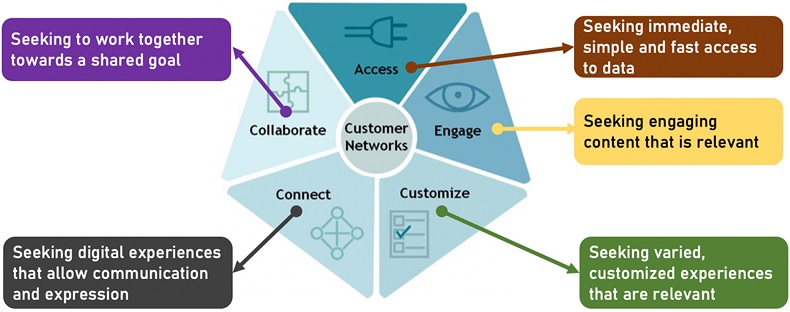
Five core customer behavior model(Rogers, 2012).
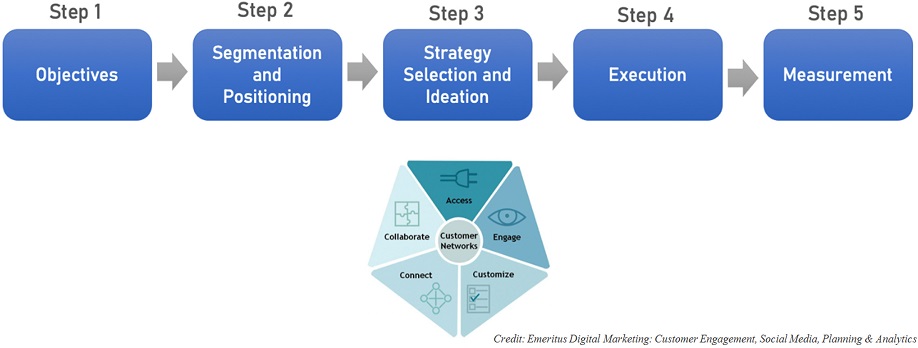
Five-step process to develop innovative digital strategies.
5.6. Ripped from the Headlines(RFHD)
In addition to learning important knowledge(theories/principles/concepts) and skills(processes/strategies), students also need to keep abreast of emerging digital trends and tools(i.e., things worth being familiar with). To help students build information literacy(Association of College & Research Libraries, 2016) while staying current with emerging trends, the Ripped from the Headlines(RFHD) assignment was used. Fashion educators have used the RFHD mini-lectures to demonstrate the relevance of textiles and apparel topics in the volatile business environment and help students stay informed of the current topics(Kim et al., 2007). This teaching approach by Kim et al.(2007) was adapted to provide an active learning opportunity for students. As an individual assignment, each student presents the RFHD with topics they identify as noteworthy and facilitates class discussions. After the general announcement, each class starts with an RFHD presentation and discussion led by a student. RFHD assignment is evaluated based on the following criteria: relevance of the topic(‘digital’), the effectiveness of presentation, quality of slide decks, depth of discussion questions, and effort to lead engaging discussions. See Fig. 16 for examples of students’ RFHD presentations.
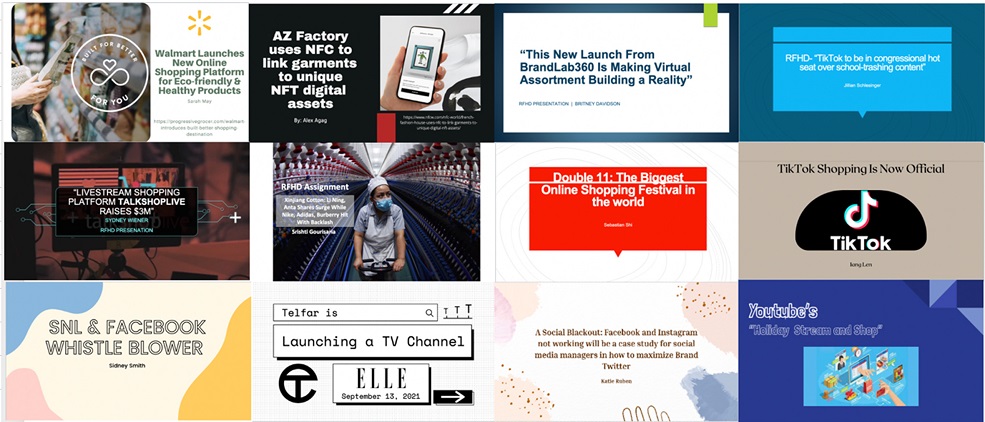
Examples of RFHD student presentations.
6. Feedback
Students complete both pre-assessment at the beginning of the semester and post-assessment at the end of the semester on various knowledge and skills. As part of the university-required course evaluation, the following questions were added to capture students’ self-assessment on the course learning outcomes. As shown in Table 3, students’ self-assessment on digital intelligence, social media competency, and digital mindsets of learning new tools on a 5-point scale has been consistently high.
Students’ Self-assessment
The Digital Merchandising course has been presented to the school’s industry advisory council that consists of 16-20 retail and merchandising executives representing a wide range of firms(Google, Kohl’s, Belk, Express, Finish Line, Burlington Stores, Vans, Sightline Retail, twelveNYC, WindowsWear, etc.). Responses have been overwhelmingly positive and enthusiastic about students’ learning outcomes. Students have been hired directly from the course.
As anecdotal evidence of the course, the following are quotes from former students who sent unsolicited feedback about the course.
Aubri L. stated that…
“…I wanted to reach out to tell you how grateful I am to have taken your classes during my time at IU. Admittedly, I was a bit unsure about the career path I wanted to take after graduating. I thought buying was the thing for me, but after taking digital merchandising, I found out how much I really loved data and analytics in a way that reached beyond my attachment to the retail industry.
Currently, I work as a content strategy specialist for ZergNet. It's an internet company that specializes in 'content recommendation', or the promotion and optimization of digital content for the purpose of increasing online traffic to both our own sites and our partner sites. I work with impressions, click-through rates, search engine optimization, pages per view, and more; these are all concepts I first learned in your class.
I can, without a doubt, say that I would not have this position without your courses. They equipped me with the knowledge and skills I needed to attain the role and succeed as I have thus far. I just wanted to thank you and let you know what an impact your work at IU has had on me…”
Elle H. stated that…
“…I just want to reach out and tell you how applicable the content of your course has been in my interviewing for multiple internships for this summer. Recruiters from a marketing firm, start-up apparel company and wealth management firm(marketing department) were wildly impressed with my knowledge of social media analytics and my experience with Stukent. I was able to talk in depth about what we learned from the simulations which demonstrated my knowledge of metrics in the omnichannel space and my ability to analyze them. Additionally in my interview for an internship with a marketing agency, he noted that being certified in Google Analytics(along with Google Garage) was something he looked for on resumes when interviewing for entry-level positions.
As a result of my experience in Google Analytics, Stukent and analyzing and developing marketing strategies for a small business, I was offered all three internships I interviewed for. I want to thank you for not only teaching us relevant skills, but focusing on and dedicating yourself to our development of these skills. I wish Digital Merchandising was a required course for apparel merchandising majors and minors because of its relevance to many industries…”
Expanding the success of the Digital Merchandising course, the author’s program has now developed a “Digital Merchandising concentration” available to students in the program. Currently, the Digital Merchandising concentration has three required courses: Omnichannel Innovation, Digital Merchandising, and Advanced Digital Merchandising.
7. Conclusion
Industry 4.0 is here. Digital transformation will continue to challenge both the industry and higher education to innovate and adapt(Iansiti & Lakhani, 2020; Philbeck & Davis, 2019; Levine & Pelt, 2021). The 21st-century career landscape is uncertain and unpredictable. Some college graduates may get jobs that did not exist when they started college. New digital-related careers are emerging and evolving, while some of the existing jobs might disappear, which means some people may lose their jobs by the middle of their careers(Blank, 2011). Mismatches between current and future job requirements will inevitably increase(Rüßmann et al., 2015). As a result, higher education is at an importation junction to re-examine its traditional educational model(Levine & Pelt, 2021). Some education leaders predict that traditional models of higher education will be dismantled(Christensen, 2009; Selingo, 2013). One clear message is that successful career preparation is paramount to the vitality of higher education(Mintz, 2020).
Fashion businesses face substantial digital disruptions, especially in retail and merchandising businesses(IMD, 2016). Fashion businesses are becoming more data-driven and technology-oriented(Moore, 2019; Silva et al., 2019; Vicario & Coleman, 2019). Consequently, an increasing number of positions in the fashion industry are positions related to digital or data science(Wang & Ha-Brookshire, 2018). Emerging fashion businesses(Stitch Fix, Rent the Runaway, Amazon, etc.) are built on technology as their core competency. When core competencies of fashion businesses become more technology-oriented and data-driven, what does this mean for the future of fashion programs? Should more technology-oriented and data science courses be offered in the fashion programs? How might fashion educators effectively and efficiently address a widening gap between the traditional fashion curriculum and the evolving fashion businesses?
The primary objective of this paper presenting a teaching case is to spark conversations with fellow educators about how we collectively and collaboratively innovate fashion education for the 21st century. The main premise of this paper is that fashion curriculum can be designed to cultivate the ability to learn(Chamorro-Premuzic & Frankiewicz, 2019; Selingo, 2015), while building an enduring understanding of the discipline(Davis, 2012; Davis, 2013; Wiggins & McTighe, 2005). For the Digital Merchandising course presented in this paper, building digital intelligence was considered the most central learning goal to accomplish. To develop innovative business strategies, the learning focus was on understanding the five core customer behavior model, not current digital strategies. Emerging digital trends were considered things to be familiar with, and students led the learning of emerging digital trends through the RFHD assignment.
Another important goal of the sample course was to gain a broad understanding of the convergence of digital advertising/marketing/retailing/merchandising. The rise of digital technologies and social platforms has blurred traditional disciplinary boundaries. For example, to manage fashion e-commerce businesses, students not only need to know how to merchandise and retail fashion products on websites(digital merchandising/retailing), but also need to know how to drive traffic to the site(digital advertising/marketing). Digital merchandisers may not be responsible for driving traffics to e-commerce sites, yet understanding different paths(e.g., paid social media, organic search, direct, etc.) that brought customers to specific websites is important to know to develop effective site merchandising strategies. Reflecting this convergence, social media-related courses are offered in four different schools(business, media, informatics, and merchandising) at the author’s institution. This also indicates a widening gap between the existing structures of higher education and the diverging and converging trends of the industries.
The Digital Merchandising course presented as a teaching case in this paper is neither perfect nor complete in its development. Nonetheless, the purpose of presenting the course that continues to undergo revision is to share educational resources and tools that may be helpful to fellow fashion educators. The current course is also the result of multiple iterations from its inception in 2017. It is my genuine hope that the information shared in this paper may be useful to some fashion educators. Fashion educators are encouraged to consider backward design and three types of content knowledge as complementary tools to widely used Bloom’s taxonomy(1956). Additionally, the flexible curricula design guides by Davis(2012, 2013) offer a useful way to think about course development.
The 21st-century business world demands employees to be cross-functional, agile, resilient(Blank, 2011). Drawing on its interdisciplinary nature from the textiles and clothing discipline, fashion students are well poised to expand their knowledge and skillsets. As suggested by Merryman and Lu(2021), there are multiple paths to support the integration of a new core competency(e.g., data science) into fashion students’ education. It is a time for fashion educators to come together and collaborate in visioning for the future of fashion education. Perhaps Professional organizations like the Society of Fashion & Textile Industry may consider building a sharable repository of teaching resources for a community of fashion educators.
References
-
Agarwal, V. (2018). Sustainable fashion education in changing world scenario. European Journal of Sustainable Development, 7(1), 365-373.
[https://doi.org/10.14207/ejsd.2018.v7n1p365]

- ‘Amazon announces new shopping experience, luxury stores’. (2020, September 15). Amazon Press Release. Retrieved September 15, 2020, from https://press.aboutamazon.com/news-releases/news-release-details/amazon-announces-new-shopping-experience-luxury-stores
- ‘Framework for information literacy for higher education.’ (2016). Association of College & Research Libraries. Retrieved October 1, 2021, from https://www.ala.org/acrl/sites/ala.org.acrl/files/content/issues/infolit/framework1.pdf
- Beer, J. (2019, April 25). Patagonia’s fight to save the planet continues with new film on wild fish, launching at Tribeca. Fastcompany. Retrieved October 15, 2020, from https://www.fastcompany.com/90340240/patagonias-fight-to-save-the-planet-continues-with-new-film-on-wild-fish-launching-at-tribeca
- Begley, S., Hancock, B., Kilroy, T., & Kohli, S. (2019, May 23). Automation in retail - An executive overview of getting ready. McKinsey & Company. Retrieved August 5, 2021, from https://www.mckinsey.com/industries/retail/our-insights/automation-in-retail-an-executive-overview-for-getting-ready
- Blank, S. (2011, February 16). College and business will never be the same. Fast Company. Retrieved January 9, 2014, from https://www.fastcompany.com/1728253/college-and-business-will-never-be-same
- Bloom, B. S. (1956). Taxonomy of educational objectives. New York, NY: McKay.
- Bradley, S. (2019, June). Think beyond the buy - Shopping is an omnichannel journey. Think with Google. Retrieved September 1, 2020, from https://www.thinkwithgoogle.com/consumer-insights/consumer-journey/omnichannel-shopping-journey/
- Bremner, P. A. M. (2017). From fourth year to the outside world: are we making our fashion graduates ‘work ready’ - Are their skills transferable into the workplace?. Worktribe.com. Retrieved October 1, 2021, from https://rgu-repository.worktribe.com/output/246767
- Busteed, B. (2019, April 30). This will be the biggest disruption in higher education. Forbes. Retrieved September 5, 2021, from https://www.forbes.com/sites/brandonbusteed/2019/04/30/this-will-be-the-biggest-disruption-in-higher-education/?sh=34d2659608a2
- Chamorro-Premuzic, T. & Frankiewicz, B. (2019). 6 reasons why higher education needs to be disrupted. Harvard Business Review Digital Articles, 2-6.
- Christensen, C. (2009). How to manage the disruption of higher education. Forum for the Future of Higher Education. Retrieved October 22, 2021, from http://forum.mit.edu/articles/how-to-manage-the-disruption-of-higher-education/
- ‘Coupang - The art of obsession.’ (2021). The Generalist. Retrieved November 2, 2021, from https://www.readthegeneralist.com/briefing/coupang
- Danziger, P. (2020, January 28). Amazon, already the nation’s top fashion retailer, is positioned to grab even more market share. Forbes. Retrieved January 30, 2021, from https://www.forbes.com/sites/pamdanziger/2020/01/28/amazon-is-readying-major-disruption-for-the-fashion-industry/?sh=2c11ea6367f3
- Daugherty, P. R., Wilson, H. J., & Michelman, P. (2019). Revisiting the jobs artificial intelligence will create. MIT Sloan Management Review, 60(4), 1-8.
- Davis, M. (2012). Designing flexible curricula. AIGA Design Educators Community. Retrieved October 10, 2013, from https://educators.aiga.org/wp-content/uploads/2012/01/Designing-Flexible-Curricula.pdf
- Davis, M. (2013). Curriculum workshop. School of Design and Human Environment, Oregon State University.
- Deloitte Insights. (2020). The fourth industrial revolution - At the intersection of readiness and responsibility. Retrieved January 10, 2021, from https://www2.deloitte.com/content/dam/insights/us/articles/us32959-industry-4-0/DI_Industry4.0.pdf
-
Dubreuil, M., & Lu, S. (2020). Traditional vs. Big-data fashion trend forecasting - An examination using WGSN and EDITED. International Journal of Fashion Design, Technology and Education, 13(1), 68-77.
[https://doi.org/10.1080/17543266.2020.1732482]
- eMarketer. (2021a). Top 10 retailers in South Korea, ranked by retail sales, 2019 & 2020 (billions). Retrieved November 1, 2021, from https://chart-na1.emarketer.com/248379/top-10-retailers-south-korea-ranked-by-retail-sales-2018-2019-billions
- eMarketer. (2021b). Creators are becoming a serious business for brands. Retrieved June 30, 2021, from https://www.emarketer.com/content/creators-becoming-serious-business-brands
- eMarketer. (2021c). US retail sales, by product category. Retrieved September 30, 2021, from https://forecasts-na1.emarketer.com/5c5dba5b8920aa0508d0645c/5c5cb5a78920aa0508d0641c
- Gebeloff, R., & Russell, K. (2017, July 6). How the growth of e-commerce is shifting retail jobs. The New York Times. Retrieved July 6, 2017, from https://www.nytimes.com/interactive/2017/07/06/business/ecommerce-retail-jobs.html
- Ghosh, P. (2021, March 17). Amazon Is now America’s biggest apparel retailer, here's why Walmart can't keep up. Forbes. Retrieved March 17, 2021, from https://www.forbes.com/sites/palashghosh/2021/03/17/amazon-is-now-americas-biggest-apparel-retailer-heres-why-walmart-cant-keep-up/?sh=24a2f9c931ce
- Goldstein, E. B. (2019). Cognitive psychology: Connecting mind, research, and everyday experience. (5th ed.). Boston, MA: Cengage Learning.
-
Ha-Brookshire, J. E., & Hawley, J. M. (2012). Envisioning the clothing and textile-related discipline for the 21st century its scientific nature and domain from the global supply chain perspective. Clothing and Textiles Research Journal, 31(1), 17–31.
[https://doi.org/10.1177/0887302X12470024]
- Harvard ManageMentor (2021). Digital intelligence. Harvard Business Publishing. Retrieved January 30, 2021, from https://myhbp.org/hmm12/content/digital_intelligence/landingpage.html
- Harvard Business Publishing Education. (2021). Readying students for their careers through project-based learning. Retrieved November 11, 2021, from https://hbsp.harvard.edu/inspiring-minds/readying-students-for-their-careers-through-project-based-learning
- Harvard Business Review Press. (2019). HBR’s 10 must reads on AI, analytics, and the new machine age. Boston, MA: Harvard Business Review Press.
-
Hodges, N., & Karpova, E. (2009). Making a major decision - An exploration of why students enroll in fashion programmes. International Journal of Fashion Design, Technology and Education, 2(2-3), 47-57.
[https://doi.org/10.1080/17543260903183596]
- ‘How ecommerce is transforming the retail employment landscape.’ (2020). Scalefast. Retrieved October 22, 2021, from https://www.scalefast.com/blog/retail-employment/
- Iansiti, M. & Lakhani, K. R. (2020). Competing in the age of AI - Strategy and leadership when algorithms and networks run the world. Boston, MA: Harvard Business Review Press.
- International Institute for Management Development. (2016). Strategies for responding to digital disruption. Retrieved November 5, 2020, from https://www.imd.org/contentassets/993ae1961034444e9fee7158102e4d16/59---responding-to-digital-disruption-dbt-center-insightsimd-31-05-16.pdf
-
Jin, B. E., & Shin, D. C. (2021). The power of 4th industrial revolution in the fashion industry - what, why, and how has the industry changed? Fashion and Textiles, 8, 31.
[https://doi.org/10.1186/s40691-021-00259-4]
- Johnson, E. (2019, July 24). In 10 years, every “relevant” company will be a tech company, Stitch Fix CEO Katrina Lake says. Vox. Retrieved February 1, 2020, from https://www.vox.com/recode/2019/7/24/20707751/katrina-lake-stitch-fix-retail-fashion-clothing-data-kara-swisher-recode-decode-podcast-interview
- Johnson, T. (2021). 12 innovative retail trends to watch in 2022. Tinuiti. Retrieved September 22, 2021, from https://tinuiti.com/blog/ecommerce/retail-trends-emerging/
- Kim, M., Lennon, S.J., & Rudd, N.A. (2007). Ripped from the headlines: demonstrating that textiles and apparel subject matter is relevant in the workplace and the retail environment. Proceedings of the International Textiles and Apparel Association, Annual Conference, Los Angeles, CA, USA.
- Kopka, U., Little, E., Moulton, J., Schmutzler, R., & Simon, P. (2020). What got us here won’t get us there: A new model for the consumer goods industry. McKinsey & Company. Retrieved May 15, 2021, from https://www.mckinsey.com/industries/consumer-packaged-goods/our-insights/what-got-us-here-wont-get-us-there-a-new-model-for-the-consumer-goods-industry
- Kozlowska, H. (2019, August 25). Why go to the mall when you can look at Instagram?. Quartz. Retrieved August 20, 2020, from https://qz.com/1694212/instagram-has-turned-into-a-gigantic-shopping-mall/
-
Lateef F. (2010). Simulation-based learning: Just like the real thing. Journal of emergencies, trauma, and shock, 3(4), 348–352.
[https://doi.org/10.4103/0974-2700.70743]
- Levine, A., & Pelt, S. (2021, October 4). Higher education should prepare for five new realities. Insider Higher Edu. Retrieved October 5, 2021, from https://www.insidehighered.com/print/views/2021/10/04/higher-education-should-prepare-five-new-realities-opinion
- Linn, A. (2014, July 30). A grim long-term outlook for retail ... workers. CNBC.com. Retrieved October 5, 2021, from https://www.cnbc.com/2014/07/30/a-grim-long-term-outlook-for-retail-workers.html
- McKay, S. (2021, March 20). Analysts: Walmart drops in rankings. Arkansas Democrat Gazette. Retrieved May 15, 2021, from https://www.arkansasonline.com/news/2021/mar/20/analysts-walmart-drops-in-rankings/
-
Merryman, L., & Lu, S. (2021). Are fashion majors ready for the era of data science? A study on the fashion undergraduate curriculum in U.S. institutions. International Journal of Fashion Design, Technology and Education, 14(2), 139-150.
[https://doi.org/10.1080/17543266.2021.1884752]
- Milner, D. (2020, July 21). Fashion jobs that are in demand now. The Business of Fashion. Retrieved July 15m 2021, from https://www.businessoffashion.com/articles/intelligence/fashion-jobs-future-coronavirus-pandemic-digital-virtual-design-sustainability?utm_source=instagram
- Mintz, S. (2020). The disruptions higher education needs. Inside Higher Ed. Retrieved August 1, 2021, from https://www.insidehighered.com/blogs/higher-ed-gamma/disruptions-higher-education-needs
- Moon, Y., Desai, M., & Oberholzer-Gee, F. (2021, February 17). Companies we’re watching: Affirm, Patagonia, Clubhouse, and more! (Season 4, No. 8) [Audio podcast episode]. In After hours. HBR. Retrieved February 17, 2021, from https://hbr.org/podcast/2021/02/companies-were-watching-affirm-patagonia-clubhouse-and-more
- Moore, G. (2019, September 25). Data science: the impact of big data on the fashion industry. The ID Factory. Retrieved September 13, 2021, from https://www.theidfactory.com/blog/data-science-the-impact-ofbig-data-on-the-fashion-industry/
- Murray, C. (2020). How digital whiteboards became the design tool of 2021. Bresslergroup. Retrieved March 1, 2021, from https://www.bresslergroup.com/blog/how-digital-whiteboards-became-the-design-tool-of-2020/
- Nilson, L. B. (2007). The graphic syllabus and the outcomes map: Communicating your course. San Francisco, CA: Jossey-Bass.
- Perez, S. (2021). Facebook debuts ‘Live Shopping Fridays’ featuring beauty, fashion and skincare brands. Techcrunch. Retrieved August 13, 2021, from https://techcrunch.com/2021/05/18/facebook-debuts-live-shopping-fridays-featuring-beauty-fashion-and-skincare-brands/
-
Pasricha, A., & Kadolph, S. J. (2009). Millennial generation and fashion education - A discussion on agents of change. International Journal of Fashion Design, Technology and Education, 2(2-3), 119-126.
[https://doi.org/10.1080/17543260903390183]
- Philbeck, T., & Davis, N. (2019). The Fourth Industrial Revolution - Shaping a new era. Journal of International Affairs, 72(1), 17-22.
- Pink, D. H. (2005). A whole new mind: moving from the information age to the conceptual age. New York, NY: Riverhead Books.
- ‘Re-Imagining education in the 21st Century.’ (2019). Times Higher Education. Retrieved October 12, 2020, from https://www.timeshighereducation.com/hub/salesforceorg/p/re-imagining-education-21st-century
- Rogers, D. L. (2010). The network is your customer - Five strategies to thrive in a digital age. New Haven, CT: Yale University Press.
- Rogmans, T. (2019). Brief, play, debrief: An action plan for using business simulations in your classroom. Harvard Business Publishing Education. Retrieved March 12, 2020, from https://hbsp.harvard.edu/inspiring-minds/an-action-plan-for-using-business-simulations-in-your-classroom
- Rüßmann, M., Lorenz, M., Gerbert, P., Waldner, M., Justus, J., Engel, P., & Harnisch, M. (2015). Industry 4.0 - The future of productivity and growth in manufacturing industries. Boston Consulting Group, 9(1), 54-89.
- Schwab, K. (2016). The fourth industrial revolution. World Economic Forum. Retrieved April 30, 2019, from https://luminariaz.files.wordpress.com/2017/11/the-fourth-industrial-revolution-2016-21.pdf
- Selingo, J. J. (2013). College (un)bound: the future of higher education and what it means for students. Las Vegas, NV: Amazon Publishing.
- Selingo, J. J. (2015, January 26). Why are so many college students failing to gain job skills before graduation? The Washington Post. Retrieved June 9, 2020, from https://www.washingtonpost.com/news/grade-point/wp/2015/01/26/why-are-so-many-college-students-failing-to-gain-job-skills-before-graduation/
- Selingo, J. J. (2016). Two-thirds of college grads struggle to launch their careers. Harvard Business Review Digital Articles, 2-5.
- Skinner, R. (2020). Forrester Influencer partnerships -Landscape, strategies, prospects, and predictions. Webinar.
-
Sideeg, A. (2016). Bloom’s taxonomy, backward design, and Vygotsky’s zone of proximal development in crafting learning outcomes. International Journal of Linguistics, 8(2), 159-186.
[https://doi.org/10.5296/ijl.v8i2.9252]
-
Silva, E. S., Hassani, H., & Madsen, D. Ø. (2019). Big data in fashion - Transforming the retail sector. Journal of Business Strategy, 41(4), 21–27.
[https://doi.org/10.1108/JBS-04-2019-0062]
- Singh, A. (2012, July 18). Driving innovation - Patagonia's 'sustainable salmon jerky' and naked pizza's 'healthy fast food.' Forbes. Retrieved February 17, 2021, from https://www.forbes.com/sites/csr/2012/07/18/driving-innovation-patagonias-sustainable-salmon-jerky-and-naked-pizzas-healthy-fast-food/?sh=3d9e7b9e4493
- Solis, B. (2017, June 15). AI sets the stage for a new round of retail innovation. Forbes. Retrieved March 10, 2018, from https://www.forbes.com/sites/briansolis/2017/06/15/ai-sets-the-stage-for-a-new-round-of-retail-innovation/?sh=1404e5191d69
- Soltes, F. (2020). Kohl's CEO Michelle Gass looks back - and ahead. National Retail Federation. Retrieved January 15, 2020, from https://nrf.com/blog/kohls-ceo-michelle-gass-looks-back-and-ahead
- Statista. (2021). Clothing and clothing accessories store sales in the United States from 1992 to 2020. Retrieved November 2, 2021, from https://www-statista-com.proxyiub.uits.iu.edu/statistics/197640/annual-clothing-store-sales-in-the-us-since-1992/
- The Economist. (2020). Can Amazon keep growing like a youthful startup?. Retrieved November 2, 2021, from https://www.economist.com/briefing/2020/06/18/can-amazon-keep-growing-like-a-youthful-startup
-
Vicario, G., & Coleman, S. (2019). A review of data science in business and industry and a future view. Applied Stochastic Models in Business and Industry. 36(1), 6-18.
[https://doi.org/10.1002/asmb.2488]
-
Wang, B., & Ha-Brookshire, J. (2018). Exploration of digital competency requirements within the fashion supply chain with an anticipation of industry 4.0. International Journal of Fashion Design, Technology and Education, 11(3), 333-342.
[https://doi.org/10.1080/17543266.2018.1448459]
- Weinswig, D. (2018, June 20). Slicing and dicing data on Amazon's private-label offering: Top four takeaways. Forbes. Retrieved May 15, 2020, from https://www.forbes.com/sites/deborahweinswig/2018/06/20/slicing-and-dicing-data-on-amazons-private-label-offering-our-top-four-takeaways/?sh=194b141458f3
- Westerman, G. (2018). Your company doesn’t need a digital strategy. MIT Sloan Management Review, 59(3), 14-15.
- White, M. C. (2013). The real reason new college grads can’t get hired. Time. Retrieved May 1, 2014, from https://business.time.com/2013/11/10/the-real-reason-new-college-grads-cant-get-hired/
- Wiggins, G., & McTighe, J. (2005). Understanding by design (2nd ed.). Alexander, VA: Association for Supervision and Curriculum Development.
- Yahoo Finance Video. (2021, October 25). Stitch Fix CEO - ‘Data science and algorithms are at the core’ of the company. Yahoo!news. Retrieved October 30, 2021, from https://malaysia.news.yahoo.com/stitch-fix-ceo-data-science-205012261.html?soc_src=social-sh&soc_trk=ma
- Yoo, H. S. (2020). Research on the names of colleges and departments affiliated with the department of clothing & textiles and analysis of curriculum. Fashion & Textiles Research Journal, 22(2), 158-169.