Measurement of Drape Appearance Similarity between Real and Digital Stretch Fabric

© 2021 Fashion and Textile Research Journal (FTRJ). This is an open access journal. Articles are distributed under the terms of the Creative Commons Attribution Non-Commercial License (http://creativecommons.org/licenses/by-nc/4.0), which permits unrestricted use, distribution, and reproduction in any medium, provided the original work is properly cited.
Abstract
This study aimed to visually compare the implementation of digital virtual fabrics for stretch fabrics mainly used in clothing that closely touch the body, using CLO. A digital fabric was used in CLO after measuring the weight, thickness, bending, and tensile force of five adhering clothing fabrics using a CLO fabric kit. The visual similarity of draftability was compared by measuring the area of the bending angle and the shape of the wrinkles of the real and digital fabric. A comparison of the bending angles showed that Fabric A was −0.75° and Fabric D was −2.5°, showing slightly lower drape properties than the real fabric. Meanwhile, Fabric B was 2.75°, Fabric C was 2.13°, and Fabric E was 1.375°, showing slightly higher drape properties in the vertical direction than the real fabric. Comparing the widths of the drape shapes, Fabric A was 0.77%, Fabric B was 1.27%, Fabric C was 0.06%, and Fabric E was 1.48%, which showed a slight difference. Fabric D showed a difference of 3.17% and was implemented where the digital fabric spread a little wider. As a result, the stretch fabric was visually expressed similarly to the real fabric as a whole in CLO. For 3D virtual clothing technology to be used widely in the close clothing industry in the future, more research on real clothing is needed.
Keywords:
stretch fabric, virtual clothing system, digital fabric, bending angles, drape shapes1. Introduction
As the Fourth Industrial Revolution became a topic of conversation in each field in the world, work digitalization and cutting-edge technology trends have been carried out through ICT convergence within the industrial sector. In the clothing industry, pattern manufacturing, grading, and apparel CAD work fields used in a mannequin in the production stage are being expanded to the 3D virtual clothing simulation area(Kwak, 2016). The adoption of the 3D virtual clothing system is changing the overall clothing industry system significantly. Currently, all processes ranging from garment planning to production and sales are becoming digitalized(Kim et al., 2014b), and the utilization area of 3D virtual clothing technology is continuously growing(Lee, 2010). From the existing method in which design is made using illustration and reference photos, real samples are made, and the revision process is repeated several times. The final sample is decided in a method where design using 3D virtual wearing software is made, communication is carried out with each department with the completed virtual clothes, and revision is replaced with 3D virtual garment before a real sample is produced. In Korea, the 3D apparel CAD system started to be widely used, centered on the Korean clothes vendors in the garment product development process mainly through vendors communicating with overseas buyers(Oh & Ryu, 2015), and the system adoption and settlement are carried out very fast. Among the Korean vendors, approximately 50 vendors, including Hansea, Sae-A Trading, Ubase, Nobrand, Shinsung Tongsang, and Wooin, have adopted the 3D apparel CAD system. Temporal and economic losses are reduced due to sample production by dressing apparel to Avatar in the virtual space with just pattern manufacture in the sample-making stage before mass production(Kwak, 2016). The 3D virtual garment is manufactured with computer graphics, and therefore it is convenient to develop design variations, which can be sent online. Moreover, this process plays a role in leading online communication between buyers and vendors(Choi, 2021).
As for the combination of 3D and digital technology, a connection with order sheets and BOM or utilization on a vendor’s cloud is attempted by partially substituting display clothes in lookbook and on the Internet shopping mall with 3D virtual garment or by converging with the firm’s internal product life cycle management( PLM). Through the data accumulation of digitalized sample information, a direction to maximize efficiency, including the semi-automation of 3D virtual garment manufacturing and extensive data analysis, and sales promotion, is pursued(Choi, 2018).
Recently, the 3D virtual clothing technology has been used in the garment production process within the industrial sector, while the era in which changes throughout people’s lives, including consumers’, has been embraced in line with the trend and post-COVID-19 era. Further expansion and development of IT technology use area in the changing fashion market due to COVID-19 that threatens humans in the world have become an obligation, not a choice(Song, 2021). The core of the 4th Industrial Revolution is intellectualization led by data suitable for individual situations. Namely, it identifies and analyzes consumers’ context, that is, intention or context, and responds appropriately(Park, 2018). The production method is changing from the past producer-centered mass production system to the customer-oriented mass customization and unique customization method(Lee, 2010). Indirect experiences as if one wore clothes can be offered by creating a 3D character similar to one’s body type and dressing clothes selected by the person to the character(Oh, 2011). Attempts of using 3D virtual clothing technology to help consumers decide to purchase including FX mirror, by which wearing the apparel selected through a unique screen in a store, and a fitting preview technology by which offering Avatar suitable for consumer’s body size online and dressing the Avatar continue to be made(Kim, 2019).
When interest in and demand for consumer customization increase, a design modeling in which consumers combine and select clothes’ design factors and then produce customized clothes gains attention(“ICT Convergence Personalized”, 2021).
3D virtual clothing technology from the consumer perspective is diversely used. As contactless consumption activities on garments increase, the importance of realistic implementation on virtual apparel has been enhanced. The material’s characteristics are key factors composing apparel, and the need for a study on virtual materials and real materials increases for the development of the 3D virtual garment system(Lee, 2011). Because there are various sizes and colors in apparel such as swimsuits, leggings, rash guards, yoga clothes, and many designs using graphics, it is suitable to apply the 3D virtual clothing technology. However, the 3D virtual clothing technology is not widely used for clothes closely attached to the body compared to other clothes(Ju & Jeong, 2016).
This study aims to provide baseline data on whether CLO is suitable for the field of clothes closely attached to the human body by comparing the appearance similarity of real stretch fabric mainly used for clothes closely attached to the body and digital fabric using CLO.
2. Literature Review
When looking at previous studies using digital fabric and virtual wearing software, the studies on the clothes composition field using 3D virtual clothing system released in the domestic scholarly journals can be divided into two categories. First, studies aiming to check the program characteristics and utility of the 3D virtual clothing system include a human modeling study using body data obtained through 3D scanning, a study analyzing the characteristics of a program after manufacturing a virtual garment, and a study manufacturing and comparing virtual reality garment and real garment. Second, studies evaluating fit using only a virtual wearing system without real manufacturing of apparel and proposing optimal patterns, namely, the studies replacing the evaluation of wearing with virtual garment instead of real garment mainly aim at pattern development(Oh & Ryu, 2015).
In a study on the expressivity of virtual clothing made of a 3D virtual clothing system according to the physical properties of fabric(Oh & Ryu, 2015), the accuracy and utility on the expressivity of real clothes based on a material’s physical properties by OptiTex Runway 12.0, one of the 3D virtual wearing software, were researched through a study comparing real clothes with virtual clothes by digitalizing real fabric with OptiTex fabric editor.
In a study by Lee(2020), a pattern revision method according to women’s tailored jacket fabric thickness was compared between real clothes and 3D virtual garments using CLO. In a study by Kim et al.(2014a), an evaluation on the perspectives and appearance of real clothes and 3D virtual garments on men’s slim pants was implemented, and clothing pressure when the virtual model was standing and walking was measured and analyzed using the stress distribution function of CLO.
Although there were studies on drape appearance, appearance, and fit of the 3D virtual garment using a woven fabric, the studies on 3D virtual garment closely attached to the body using fabric with high stretchiness are lacking.
The most crucial factor companies and consumers demand to use the 3D virtual clothing technology is whether implementation is visually conducted realistically. Therefore, reliable verification of the similarity of 3D digital and real fabrics should continue to be carried out. To this end, there is a need to present a method to objectively measure the appearance similarity between digital fabric s and real fabrics. The clothing types with which the 3D virtual clothing system is the most actively used in the clothing industry are casual and outdoor wear. The 3D virtual software’s practicality is diversely tested and researched for the clothing types. However, studies on the method to implement various supplementary materials are still insufficient for clothes closely attached to the body, such as yoga clothes and swimsuits. In addition, some technical limitations exist in that they are clothes greatly affected by a margin to seam, sewing thread, and the frictional force of fitting body, so the use scope is limited compared to other clothing types.
In this regard, this study analyzed the drape appearance and the appearance of real stretchable fabric used for clothes closely attached to the body and digital fabric as a first step to verify and improve the practicality of the 3D virtual clothing system on those clothes.
3. Methodology
3.1. Selection of method to measure target fabrics and physical properties
For the 3D virtual wearing software and equipment, CLO and fabric kit developed by CLO virtual fashion(Fig. 1), which has been the most widely used in Korean fashion companies and education institutions, were used. The items measured by the CLO fabric kit were weight, thickness, bending stiffness, stretch stiffness, weft, warp, and fabric samples with 22cm·3cm in size cut in the bias direction. Bending stiffness is measured in a method in which the fabric sample is naturally hanging down from the corner-end through gravity, and the location in which the end of the fabric sample makes contact with the floor is measured. For stretch stiffness, force responding to the length pulled by fixing the fabric sample at both ends is measured in five steps. The measured values are entered in the emulator within the CLO and digitalized.
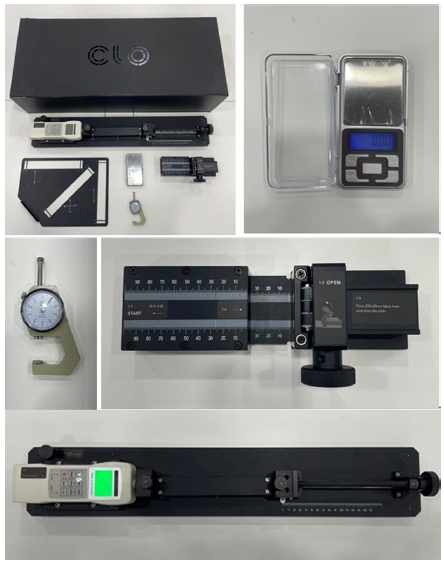
CLO fabric kit components.
The measured values entered in the emulator are indicated as attribute values corresponding to stretch stiffness-weft, stretch stiffness-warp, shear, bending stiffness-weft, bending stiffness-warp, bending stiffness-bias, thickness, and density. Shear corresponds to the measured value of stretch stiffness of the fabric sample cut in the bias direction. Density refers to the weight per unit weight, and it is indicated in a way that measured weight value is converted. The other attribute value is buckling. Buckling is an item to reflect a characteristic of bending if over a particular force is given, while the fabric maintains its shape when an external force is given. This item is not measured, but the buckling values are fixed depending on the four types of fabric: woven, leather, silk, and synthetic silk.
To check whether similarity difference occurs between digital fabric and real fabric depending on stretch fabric’s stretch stiffness or bending stiffness, this study selected five fabrics with differences in stretchiness or bending stiffness among the stretch fabrics used for clothes closely attached to the body. Regarding fiber mixing ratio, the natural materials of yoga clothes can be divided into bamboo, a natural material extracted from bamboo, and nylon, polyester, and spandex(Kim, 2017). According to a study by Kang et al.(2021), the mixing ratio of 177 products targeting new aqua wear products in Korea’s three leggings brands, Xexymix, Andar, and Mulawear, was as follows: nylon −7~74%, polyester −72~89%, polyurethan −4~33%, polyester −72~79%, and spandex −21%. The fabrics were selected in the scope of adjacent to the mixing ratio. Each fabric’s fiber mixing ratio is presented as follows: Fabric A – Polyester: 90%, spandex: 10%; Fabric B – Polyester: 93%, spandex: 7%; Fabric C – Nylon: 75%, spandex: 25%; Fabric D – Nylon: 85%, spandex: 15%; Fabric E – Polyester: 92%, spandex: 8%.
3.2. Comparison criteria and method of real fabrics and digital fabrics
For the comparison method of appearance between real fabrics and digital fabrics, “System and method of measuring the material of fabric” pending patent number 10-2093450 applied by D3D Co., Ltd. was used(Korea Patent No. 10-2093450, 2020).
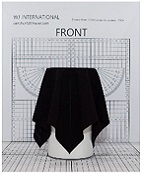
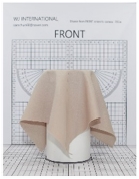
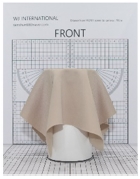
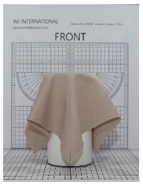
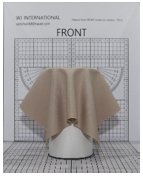
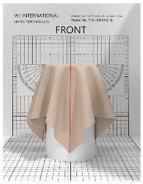
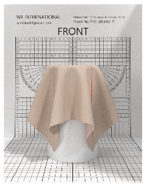
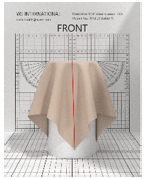
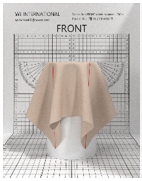
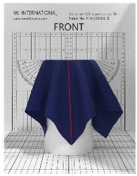
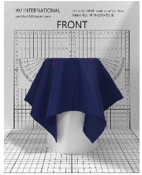
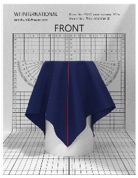
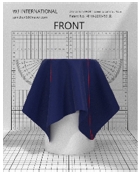
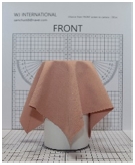
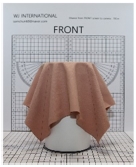
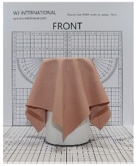
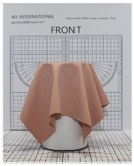
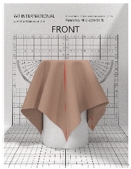
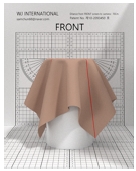
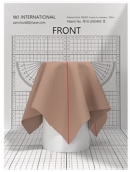
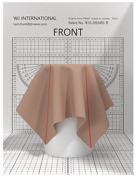
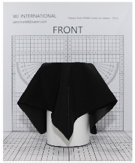
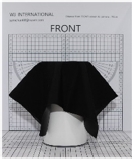
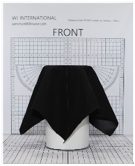
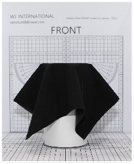
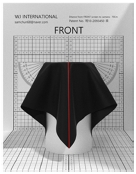
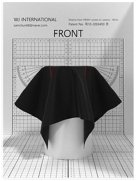
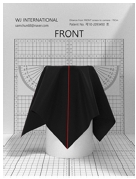
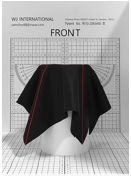
The measuring tool consists of measuring plate 1 that can measure bending angle with angles and gradation marked on the cylinder with 10 cm in diameter and 18cm in height, which is a holder for the measurement target fabric, and the measuring plate 2 that can measure the area, circumference, and the number of wrinkles of the fabric placed at the lower part of the holder(Fig. 2). After naturally hanging down the fabric with the size of 30 cm·30 cm on the cylinder in line with the center, the drape shape of the fabric is measured(Fig. 3). Unlike the existing method that has subjectively evaluated the visual drape shape of the fabric, this method was used in this study for more objective evaluation because this method can measure numerically.
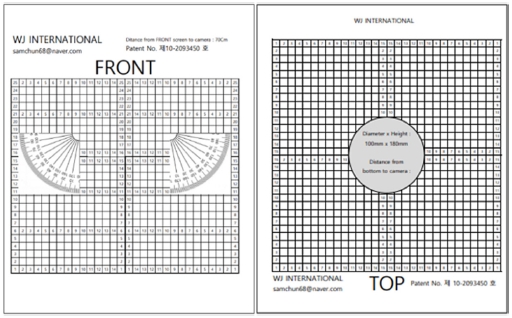
“System and method of measuring the material of fabric” pending patent number 10-2093450.
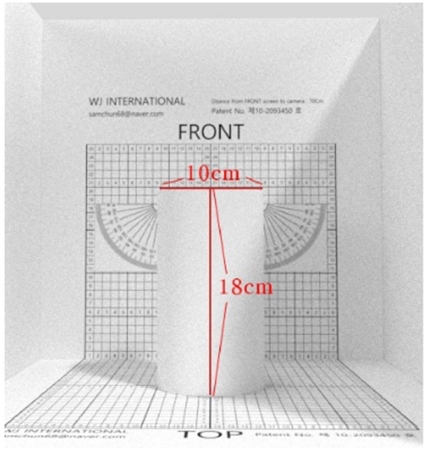
Measuring equipment and cylinder setting method.
The comparison criteria are as follows: First, the fabric's bending angle was naturally bent and fell at the corner-end by gravity. From the front, the vertex of the square fabric sample was located at the central line, the state where grain direction was placed in the bias direction was set as 0°, and the sample was set to rotate by 45° sequentially. In this way, bending angles were measured at four angles, 0°, 45°, 90°, and 135°(Fig. 4).
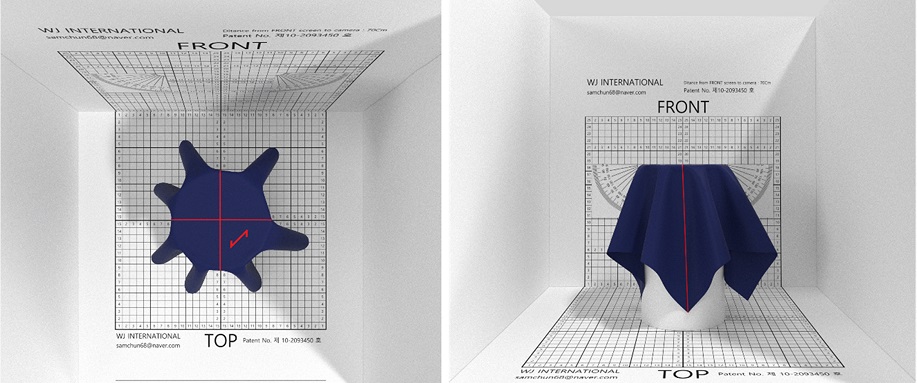
The drape shape measurement method of the fabric and the reference of 0°.
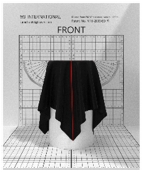
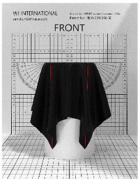
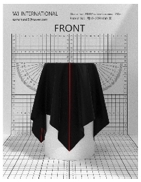
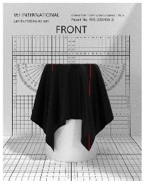
Because the cylinder's left and right bending angles can be observed asymmetrically depending on the physical properties of the fabric, a comparison was made with the mean bending angle at both sides. Second, the wrinkle shape occurred when the fabric was naturally hanging down on the cylinder(Fig. 5). Since the wrinkle shape differed depending on the placement state of the fabric mobility, the area that the silhouette took and indicated from the direction of looking at the fabric from above was measured and then compared.
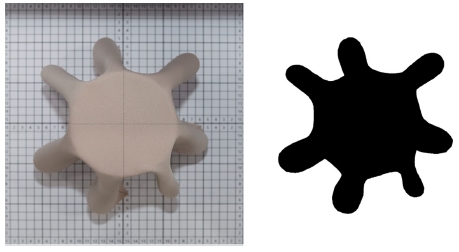
The draped shape of the fabric from above.
4. Results and Discussions
4.1. Digitalization results through fabric measurement and emulator
As a result of measurement, Fabric D’s 5.8 g was the heaviest, Fabric C’s 4.35 g was the second heaviest, followed by Fabric A’s 4.15 g, Fabric E’s 3.28 g, and Fabric C’s 3.04 g, which was the lightest.
As for thickness, Fabric B’s thickness was 0.8mm, the thickest, and Fabric D’s was 0.7 mm. Fabric A’s thickness was 0.6 mm, and Fabrics C’s and E’s were 0.4mm each, the thinnest. As the bending stiffness value became higher, fabric bent down naturally from the corner-end by gravity, and the distance to the floor was far. This means that the fabric’s bending stiffness was high. The weft of Fabrics B and D was measured as 10 mm, the highest, followed by Fabric E’s 8 mm, Fabric C’s 7 mm, and Fabric A’s 22 mm, which was the lowest. Fabric D’s warp was measured as 21 mm, the highest. As for the warp’s bending stiffness, Fabric C’s 12 mm was the second-highest, followed by Fabric B’s 7 mm and Fabric E’s 4 mm. Fabric A’s 3 mm was the lowest. Concerning bias, Fabric D’s was 25 mm, the highest, and therefore Fabric D showed the highest bending stiffness in the weft, warp, and bias, followed by Fabric C with 10 mm, Fabric E with 5 mm, and Fabric B with 3 mm. Fabric A showed 1 mm and was the lowest in weft, warp, and bias, so bending stiffness was the weakest.
If the measured values in Table 1 are entered in the order of the CLO emulator, they are calculated by CLO’s unique calculation method. The stretch test calculates the stretch stiffness among the CLO fabrics’ attribute values, the bending stiffness is calculated by a bending test, and density is calculated by weight and thickness.

The measurement of five stretch fabrics by CLO fabric kit
Table 2 shows the values of physical properties calculated after digitalization by entering each fabric’s measured values in the emulator.
The physical properties of five stretch fabrics in CLO.
As regards the stretch values of fabrics through Table 2, the stretch stiffness in the warp direction of Fabric B was 41649 g/s2 and Fabric A 27587 g/s2, whereas the stretchiness of Fabric B was the best with a slight difference. In the weft and shear, Fabric A was 27587 g/s2 and 8901 g/s2, and stretchiness was the best. Fabric C showed lower values with 191101 g/s2, 109865 g/s2, and 173475 g/s2 in weft, warp, and shear, respectively. Fabrics E and D, whose stretch stiffness was lower, showed 144730 g/s2 and 149610 g/s2, with Fabric E's stretchiness being better. However, Fabrics and D and E showed 192176 g/s2, 43551 g/s2, and 214781 g/s2, 221989 g/s2, respectively, in warp and shear, and the stretchiness of Fabric D was better.
Concerning the result of bending stiffness values, Fabric D’s were 1983 g·mm2/s2 rad, 457 g·mm2/s2 rad, and 779 g·mm2/s2 rad in the order of weft, warp, and shear, and its bending-stiffness was the highest in all directions. The second highest was Fabric B with 447 g·mm2/s2rad, Fabric E with 365 g·mm2/s2 rad, and Fabric C with 131 g·mm2/s2 rad. Regarding shear, Fabrics E, C, and B were high in the order of 321 g·mm2/s2 rad, 241 g·mm2/s2 rad, and 60 g·mm2/s2 rad. The fabric whose bending stiffness was the weakest in all directions was Fabric A with 43 g·mm2/s2 rad, 79 g·mm2/s2 rad, and 24 g·mm2/s2 rad in weft, warp, and shear, respectively.
Fabric D’s density was the highest with 282.89 g/m2, followed by Fabric B’s 219.7 g/m2 and Fabric A’s 209.6 g/m2. As for bending stiffness, Fabric C was the highest with 181.31 g/m2, and Fabric C was the lowest with 153.53 g/m2.
4.2. Comparison of the bending angle between real fabrics and digital fabrics
The comparison result of bending angles between real fabrics and digital fabrics is shown in Table 3.
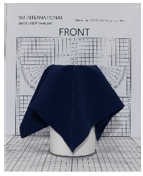
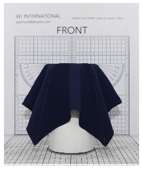
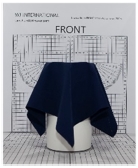
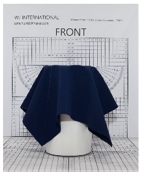
Comparison of drape shape appearance of real fabric and digital fabric
When the fabric is naturally hanging down on the cylinder in line with the center, if the visual difference of each fabric’s bending angle is compared to each fabric’s physical properties, the order of the highest bending stiffness among the digital fabric physical properties is D>E>C>B>A, but the actual order of the highest bending angle is E>D>C>B>A. Although the bending angle becomes higher as the bending stiffness gets higher, it was confirmed that the bending angle might be lower as the fabric hangs down in the vertical direction if density and stretchiness are higher.
In a visual comparison of the real and digital fabrics, the number of wrinkles corresponded, and the wrinkle type and thickness were similar. The visual comparison and numerical values were compared by measuring bending angles for the objectification of the comparison result.
Table 4 shows the comparison result between the real fabrics and digital fabrics.
Comparison of means of bending angle between real fabric and digital fabric
As for Fabric A, the mean of bending stiffness at both sides of the cylinder at 0° was 18.5° for the real fabric, and it was 19° for the digital fabric. At 45°, the real fabric showed 21.5° and digital fabric 22.5°. At 90°, the real fabric and digital fabric showed 19° and 19.5°, respectively. At 135°, the real and digital fabrics showed 21.5° and 22.5°, respectively. The bending angle of the real fabric was 0.75° on average and slightly more hanging down; thus, an almost similar drape appearance of the real and digital fabrics was displayed. As for Fabric B, the real fabric showed 22° and the digital fabric 26.5° at 0°. At 45°, the real and digital fabrics showed the same value at 28.5°. At 90°, the real fabric showed 29.5° and digital fabric showed 26°. At 135°, the real and digital fabrics’ bending angles were 39.5° and 27.5°, respectively. At 45°, they were measured as the same, but at 135°, the hanging down angle showed a 12° difference, so a similar degree of difference was depending on angles. However, the real fabric was less hanging down by 2.75° on average and can be similar from the aspect of the overall evaluation. Concerning Fabric C, the real and digital fabrics showed 33.5° and 31.5°, respectively, at 0°. At 45°, the real and digital fabrics showed 36.5° and 21.5°, respectively. At 90°, the real and digital fabrics showed 25.5° and 23.5°, each. At 135°, the real and 3D fabrics displayed 35° and 31°, respectively. Therefore, the real fabric was less hanging down by 2.13°, so almost a similar implementation was carried out. As for Fabric D, the real and digital fabrics showed 32.5° and 30.5° at 0°, respectively. At 45°, the real and digital fabrics showed 33° and 34°, respectively. At 90°, the real and digital fabrics displayed 25° and 28°, respectively. At 135°, the real and digital fabrics displayed 28° and 36°, each. Therefore, the real fabric was hanging down by 2.5° on average, so almost a similar implementation was performed. Regarding Fabric E, the real and digital fabrics showed 37.5° and 34° at 0°, respectively. At 45°, the real and digital fabrics showed 45° and 36.5°, each. At 90°, the real and digital fabrics showed 27° and 32°, respectively. At 135°, the real and digital fabrics showed 42.5° and 44°, respectively. On average, the real fabric was less hanging down by 1.375°, so almost a similar implementation was performed.
Tables 5 and 6 show the silhouette in which drape shapes are made flat in each angle seen from above and the measured area result.
Drape shape of the physical fabric and digital fabric
Drape area of the physical fabric and digital fabric
In Table 6, regarding the area ratio of the real fabric and digital fabric in terms of the entire 900 cm2, the real fabric, and the digital fabric showed 21.51% and 20.74% in Fabric A, and just a slight difference of 0.77% was revealed, and thus an almost similar drape shape was shown. In Fabric B, the real and digital fabrics showed 25.93% and 27.2%, each, and 1.27% difference was displayed; therefore, a similar drape shape was actualized. In Fabric C, the real and digital fabrics showed 25.46% and 28.63%, respectively, and only a minimal difference of 0.06% was revealed, so an almost similar drape shape was actualized. In Fabric D, the real and digital fabrics showed 25.46% and 28.63%, respectively, so 3.17% of the difference was revealed, and the digital fabric was actualized as a shape spreading a bit wider. In the analysis of Fabric D’s bending angle measurement result, the digital fabric’s drape appearance was slightly lower in Fabric D, the real and digital fabrics showed 32.91% and 31.43% in Fabric E, and 1.48% of the difference was revealed, so a similar drape shape was actualized.
As a result of comparing bending angles and drape shapes, the fabric digitalized and actualized/implemented with CLO was made very similar to the real fabric.
5. Conclusion
The stretch fabrics mainly used for clothes closely attached to the body were digitalized with CLO and were implemented in 3D. By measuring the bending angle and drape area of the real fabric and digital fabric, the similarity of appearance was comparatively analyzed in this study.
The bending angle of the real fabrics and digital fabrics showed slight visible differences in some angles of Fabrics B, D, and E. However, they were all measured similarly on average. As for the silhouette area of the real fabric and digital fabric depending on drape shape, the most significant error was found in Fabric D, but only slight differences occurred overall, and therefore all were measured similarly. Comparatively evaluating the visual shapes of the five stretch fabrics through simulation with digital fabrics via the CLO fabric kit and emulator confirmed that almost similar actualization/implementation is possible with a slight difference. Consequently, it is judged that the digital fabrics of stretch fabrics are suitable for visual use.
Based on this study confirming the similarity of stretch fabrics, the 3D virtual clothing technology’s utilization possibility is expected in the industry of clothes closely attached to the human body through implementing the 3D virtual garment and reliable appearance similarity evaluation.
References
- Choi, Y. J. (2018, Nov 16). 패션과 디지털이 만나면? ‘디자이너는 3D, 스타일리스트는 AI!’. [When fashion and digital meet? ‘Designer is 3D, stylist is AI!’]. Ministry of Science and ICT. June 10, 2021, Retrieved from https://blog.naver.com/with_msip/221399805500
-
Choi, Y. L. (2021). A qualitative study on 3D designer jobs in fashion vendors. Fashion & Textile Research Journal, 11(3), 504-514.
[https://doi.org/10.5805/SFTI.2021.23.4.504]

- Ha, J. T. & Kwak, J. S. & Chun, K. S. (2020). System for measuring property of matter for fabric and method of the same, Korea Patent No. 10-2093450. Daejeon: Korean Intellectual Property Office.
- ICT convergence personalized clothing store ‘within 24 - All studios’. (2021, Sep 21). The International Textile Fashion News. Retrieved June 10, 2021, from, http://www.itnk.co.kr/news/articleView.html?idxno=65175
- Ju, K. S., & Jeong, Y. H. (2016). Usage & education of the CLO 3D virtual clothing program in the development office & academic. Fashion Information and Technology, 13, 51-59.
- Kang, H. Y., & Kang, H. J., & Kim, C. Y. (2021). Aqua leggings production status survey according to the status of domestic leggings brands, Journal of Korea Multimedia Society, 24(7), 966-978.
- Kim, C. S. (2017, Oct 31). 요가복 선택 시 가장 중요한 요소는? 소재. [What's the most important factor when choosing yoga clothes? Fabric.]. The Digital Times. Retrieved July 14, 2021, from http://www.dt.co.kr/contents.html?article_no=2017103102109923811021&ref=naver
-
Kim, K. A & Hong, E. H., & Uh, M. K. (2014a). Comparative analysis of men’s slim pants patterns - Using a 3D CLO virtual garment system. The Research Journal of the Costume Culture, 22(4), 605-618.
[https://doi.org/10.7741/rjcc.2014.22.4.605]
- Kim, S. K. (2019, Sep 20). ‘패션이 디지털과 만났다’…. 3D 가상 피팅 매장 [Fashion meets digital.. 3D virtual fitting store.]. KNN. Retrieved June 10, 2021, from http://www.knn.co.kr/192781
-
Kim, Y. S. & Yin, S. & Song, H. K. (2014b). A comparison of fit and appearance between real pants with 3D virtual pants. The Journal of Convergence on Culture Technology, 16(6), 961-970.
[https://doi.org/10.5805/SFTI.2014.16.6.961]
-
Kwak, Y. S. (2016). A study on the 3D simulation system improvement through comparing visual images between the real garment and the 3D garment simulation of women's jacket. The Journal of Convergence on Culture Technology, 2(3), 15-22.
[https://doi.org/10.17703/JCCT.2016.2.3.15]
- Lee, N. R. (2020). Comparative analysis of the effect of fabric thickness on the fit of real and virtual clothing. The graduate school, Seoul National University, Seoul.
- Lee, S. Y. (2010). A study on applicability of custom-tailored clothing of 3D virtual clothing system - Focused on middle-aged women. Unpublished master’s thesis, Sangmyung University, Seoul.
- Lee, Y. J. (2011). A study on the drape profile analysis of the apparel textiles and 3D virtual textiles using a 3D digital clothing software. Journal of Fashion Business. 15(5), 103-114.
-
Oh, S. Y., & Ryu, E. J. (2015). A study on expressivity of virtual clothing made of 3D spparel CAD System according to the physical properties of fabric. Fashion & Textile Research Journal, 17(4), 613-625.
[https://doi.org/10.5805/SFTI.2015.17.4.613]
- Oh, Y. S. (2011). Development of a jacket pattern for plus-size women using by visual effect - Focusing on comparison between real clothing and virtual clothing. Unpublished doctoral dissertation, Pusan National University, Busan.
- Park, C. G. (2018). 4차 산업혁명 시대 콘텐츠가 왕이라면 컨텍스트는 신이다. [In the era of the 4th industrial revolution, if content is king, the context is god.] Seoul: Cloudninebooks, pp. 251
-
Song, E. Y. (2021). Perceptions and trends of digital fashion technology - A big data analysis. Fashion & Textile Research Journal, 23(3), 380-389.
[https://doi.org/10.5805/SFTI.2021.23.3.380]