How Textual Sources Affect Fashion Design Ideation and Developing Process

© 2021 (by) the authors. This article is an open access article distributed under the terms and conditions of the Creative Commons Attribution license (http://creativecommons.org/licenses/by/3.0/), which permits unrestricted use, distribution, and reproduction in any medium, provided the original work is properly cited.
Abstract
The research expects that textual sources such as reading texts with additional information in the form of texts can be effective inspiration sources for fashion design ideation and development process. This research analyzes how efficiently textual sources work along with individual internal sources, such as sociocultural influence, design fixation, and during the design process. Six fashion design graduate students shared 2 inspirational experiences under 2 different studies (4 experiences in total); in addition, in-depth interviews were conducted based on individual design sketches. The result shows that textual sources provided a positive effect on all 6 participants with different intensities based on various backgrounds and individual tastes. This result demonstrates individual ‘influence’ (their sociocultural capital such as personal preferences, likings, habits, and past experiences) and ‘inspiration’ mutually work together to make an effect on fashion designers’ ideation and development process for the design, sometimes one working more than the other (or vice versa), respectively. This paper makes important practical contributions by identifying and discussing the design behavior performed (especially in fashion design) by fashion design students during the design process with new sources of inspiration provided such as textual sources. The research revealed how textual sources can be an effective inspiration for fashion design students and provide insight to fashion design educators and professional fashion designers.
Keywords:
textual sources, creative design, fashion design process, sociocultural influence, design fixation1. Introduction
Whenever designers are confronted with problems that demand innovative ideas, there are multiple sources to handle the situation with creativity. In terms of creativity, designers are nowadays required to focus on both ‘how to think’ and ‘what to think about’. Fashion design, especially, can be seen more problematic than any other design industries, as interactions between design elements and principles, material properties, adaptation and modification of design inspiration are complex (Crilly & Cardos, 2017). Moreover, a fashion industry is a highly competitive industry where too many brands release too many garments every season, which are at least 4 times a year. From every season, it is very easy to see similar designs although they are from different brands. It is not easy to survive in the industry without its own originality. Although designing a garment is a complicated process and takes a lot of time, fashion industry has no choice but to work at a fast pace to prepare for each season, which does not allow designers enough time to fully develop their ideas. Due to this feature of fashion industry, it is becoming more important to study ‘how’ designers can expand their free ideas more efficiently and effectively to survive and successfully pursue creative design. Moreover, it is important to provide appropriate and efficient guideline to fashion design students in order for them to develop their design well, who need training to become professional designers in this fast pace field.
The creative ideation process in design is extremely complex and highly individual. To analyse the process, it is important to understand the related roles, influence and inspiration, and how these make an effect on the process. Strickfaden et al.(2015) defined that ‘influence’ shapes the context for creative ideas and ‘inspiration’ originates the content in the creative process; she argued that these two types of source are subsequently transformed into collections. Many previous studies argued that sources of inspiration play a crucial role throughout the whole design process (Eckert & Stacey, 2003; Gonçalves et al., 2012; Mete. F., 2006). However from these studies, it is vague to tell what type of inspiration sources is more efficient for designers’ ideation and developing process. Furthermore, previous research limited the form of stimuli to just visual source, but not many designers use only one source of inspiration (Gonçalves et al., 2012; Lee, 2017; Mete, 2006). This study is highly significant in that it will help fashion design students and designers to find which type of inspiration sources support their creative ideation process efficiently. Providing textual sources, including movie script and/or transcribed oral information by a docent regarding artist’s background knowledge, cultural environment or design history beyond simple visual inspiration sources might be able to elevate a designer’s capacity and help their design ideation process. This research addresses the question whether design ideation and developing approaches can be differentiated by with or without textual sources, and also if these design approaches can be improved with the help of textual sources on top of other given forms of visual sources for inspiration.
Many empirical studies on design creativity have investigated the role of ‘inspiration’ as external sources during idea generation. However, Strickfaden and Heylighen (2010) have come up with another important concept, which is ‘influence’; it refers to a designer’s sociocultural capital, which is the body of knowledge and experience that a designer accumulates during his or her entire life. Besides, it has been found that while external stimuli may unlock the designers’ imagination and boost the generation of ideas, they can also constrain designers’ exploration of more innovative ideas by ‘fixing’ them to blindly adhere to a limited familiar set of ideas only, an effect described as design fixation. Designers need to utilize both internal and external sources efficiently in order to expand their creativity and maximize their design ability. Although design fixations can have a negative impact on design process by limiting the space of solutions (Moreno et al., 2015), textual sources, as a fresh novel form of inspiration, can further stimulate either external or internal or both sources to expand one’s creativity.
Indeed, textual sources are expected to have a positive effect on creativity as a source of inspiration by interacting with intrinsic elements of individual designers. This research focuses on how textual sources can affect and enhance one’s ideation and creativity. It has significance in that it analyses the interaction between intrinsic and extrinsic elements, rather than the simple fragmentary approach of analysing the design ideation and developing process either in the aspect of only the external factor, inspiration, or the intrinsic factor of individual designers. Furthermore, to the best knowledge of the authors, there is not yet a study, which explores how valuable textual information can be as a novel form of inspiration for designers in the field of fashion design. This research ultimately aims to provide an effective and efficient guideline to all levels of students majoring in fashion design, from beginners to more experienced ones, who will potentially grow up to be professional designers, by analysing how textual sources can help to stimulate one’s internal and external sources to develop their own creative designs.
2. Literature review
The focus of the work presented in this paper is to see the effect of textual sources on fashion design students’ ideation and design developing process, thus, it is important to define first what exactly are textual sources. It is necessary to have a discussion on textual sources, as a new novel form of inspiration for designers. Secondly, this section provides an overview of ideation methods to support the analysis of how textual sources affects participants’ ideation process. Finally, we also need to pay attention to internal sources embodied in designers themselves. It presents socio-cultural capacity (one’s sociocultural ‘influence’), and design fixation as internal sources that students use, whether consciously or unconsciously, during their ideation and design development.
2.1. Textual sources
Multiple researchers have demonstrated that designers’ creative process is influenced by formerly acquired knowledge (Perttula & Liikkanen, 2006). Purcell and Gero (1991) defined that designers’ acquired knowledge arises from two main sources; knowledge resulting from everyday encounters, and knowledge from intentional learning on specific and structured domain. Both types of acquired knowledge play an important role in the design process. During the process, designer go through continuous interactions between imprecise mental images and external visualizations. Different forms of stimuli can influence the way one receives inspiration in different manner, and alter their design process, because the exposure of different stimuli before or during the initial idea generation stage has the potential to prompt access to different past memory associations and exploration of creative ideas.
Whilst an in-depth use of visual representations as a source of inspiration in design has been proven, it is unclear whether or not equivalent textual sources counterparts might also have an effect on design ideation and developing processes. Designers tend to prefer using visual representations for stimuli over textual sources (Gonçalves et al., 2012). It is understandable that designers choose to explore visual stimuli as an inspiration source since they commonly work as visualizers and are typically extremely competent with the use of visual sources, in comparison with textual sources (Mednick, 1962). Textual sources, such as keywords, context, and background information, rather than being inspirational, are usually thought to be a restrictive frame of reference that can block creative associations and explorations. Textual sources, that is to say, textual stimuli, are typically forgotten by designers as a possible inspiration source.
Nagai and Noguchi (2002) examined the role of keywords in a furniture design process to generate visual images for design solutions. According to their study, drawings are used to portray feelings or unutterable concepts, and considered as low-level information, while abstract keywords are considered as high-level information. In order to produce visual information from textual input, a higher level of abstraction may be required, which might take a longer time. This may explain why so many designers prefer to work with visual stimuli instead of textual ones when they are to generate ideas in the shortest amount of time, with the least hard effort. However, many studies have proved the potential usefulness of textual stimuli and thus, this type of stimuli as an inspiration source should not be overlooked by designers. Chiu and Shu (2007, 2012) have shown that written textual information enables the exploration of larger design solution space for novel idea generation in the field of engineering. The ambiguity of interpretation that textual stimuli can offer has the potential to stimulate creative results. This is because when designers work with incomplete information, it enables them to make certain creative leaps, assumptions, and novel decisions that can be revisited and reviewed. Goldschmidt and Sever (2011) have also shown the positive influence that textual sources can have when used as some stimuli for industrial design students during their idea generation. They found that groups exposed to textual stimuli exhibited higher originality and innovative ratings, when compared with the control group. These results suggest that the utilization of textual sources, can be potentially beneficial for inspiration when generating novel ideas for creative design. Table 1 shows textual sources utilized in previous studied to investigate if textual sources are an effective form of inspiration in design process.

Textual sources from previous studies
It is important to consider that any potential stimuli consist of two important elements crucial to the creation of an appropriate and effective stimulation: content - what the stimulus conveys; and representation - how the stimulus is shown (Sarkar & Chakrabarti, 2008). Therefore, textual sources as external stimuli have both the potential to stimulate generation of new ideas, as well as to further develop one’s reasoning process in overcoming existing solutions. Furthermore, it is necessary to distinguish between typography from pop-art, graffiti or brands’ logo and textual stimuli as a source of inspiration. Multiple studies have discussed about how graffiti or logo can be a significant source of inspiration in fashion design (Kim, 2020; Kim & Yoo, 2015; Ryu, 2011). However, according to these studies, typography is utilized and embraced as visual stimuli instead of textual stimuli. It is necessary to investigate the possible impact of textual sources on design idea generation among fashion designers, which has not yet been dealt in previous literature.
2.2 Mind mapping as an ideation method
Fashion designers usually get inspired by their surroundings either consciously or unconsciously. It is necessary for designers to find out the problems from their surroundings and acquaint themselves with the solutions. Ideation, called ‘idea generation’, is an essential component of creativity and problem solving, defined as ideas or concepts which strikes a designer’s mind from the inspirations. According to Brown (2008), there should be three stages in design projects to pass through. The first stage is ‘inspiration’ which the circumstances look for the solutions. ‘Ideation’, the second stage, is the process of generating, developing, and testing ideas that could find solutions. The last stage, ‘implementation’, is charting towards the market. However, ideation methods offer significant solution ways for satisfactory results for fashion designers while considering different possible concepts or solutions. Therefore, fashion designers can be more creative and express their ideas more professionally with ideation process methods.
Several ideation methods have been introduced from previous researches (Gerstenblatt, 2013; Hernandez et al., 2010; Osborn, 1957; Rawlinson, 1986) and these might be able to suggest various means for designers to develop or generate their ideas. To demonstrate which methods are utilized by fashion designers, in this paper, we will focus on mind mapping method to examine how and why designers prefer this method. Mind mapping is used to create, visualize, design and classify thoughts within education, organization, problem-solving and decision-making processes (Biktimirov & Nilson, 2006). Mind mapping comprises a network of connected and related concepts. However, in mind mapping, any idea can be connected to any other. Free-form, spontaneous thinking is required when creating a mind map, and mind mapping aims to find creative associations between ideas (Davies, 2011).
As the fashion industry requires designers to be more creative and innovative, it is important for designers to search for original inspirations and express or develop their ideas more efficiently with utilizing ideation method. Furthermore, it would be meaningful in this research to examine which ideation method is selected or applied by fashion designers into their design process.
2.3. Influence of sociocultural capital & design fixation
Importantly, it is not only specific inspiration sources, such as exhibitions, movies, and textual sources, that have an effect on fashion designers’ creative design process and their idea generation, but also their socio-cultural capital (i.e., socio-cultural references) plays a key role as ‘influences’. Goldschmidt (1998) elaborated on the nature of a designer’s socio-cultural references, emphasizing that such references must carry a meaning for the designer, whether consciously or unconsciously; they relate to concerns that are on the designer’s agenda, which may undergo changes during their lives. These references are therefore a rather personal matter and pertain to individual designers and their situated culture, such as the influence of their design school where they have been educated. Indeed, designers with their creative ideas inevitably reflect on varying degrees the structure of culture in which they live and work, revealing its technological, social and ideological aspects (Hamilton, 1987; Hwang, 2013). Thus, influence and inspiration are distinguishable through whether references are generally or specifically used by designers respectively when creating a design; influence is a consequence of what the designer already knows before encountering an inspiration, generally to produce overall impressions or basic ideas during the creative process (Strickfaden et al., 2015).
The concept of one’s socio-cultural capital is based on the work of Bourdieu (1986). For Bourdieu, social capital involves social connectedness related to membership in a group (“the possession of a durable network of more or less institutionalized relationships of mutual acquaintance and recognition”, Bourdieu, 1986). Bourdieu’s cultural capital covers or can exist in three forms, in the embodied state (“long-lasting dispositions of the mind and body”), the objectified state (through “cultural goods such as books, pictures, instruments, machines”) and the institutionalized state (such as one’s “educational qualifications”) (Bourdieu, 1986). These are all seen as one’s resources, which undoubtedly make influences on one’s creative workings and idea thinking processes.
Another important concept that Bourdieu introduced relating to his idea of socio-cultural capital is habitus. The notion of habitus ‘recognizes the structuring influences of the social world on the one hand, and the agency of the individuals who make choices’ as to what to design on the other (Entwistle, 2000). The agency of individuals includes their fashion/design tastes and habits, although these are also to an extent shaped by the culture that they live and work in (Shin, 2012).
Taken together, a designer’s socio-cultural capital, as ‘influences’, will be an important moderator when textual source as an ‘inspiration’ affects each individual designer’s creative ideation and design developing process. One key question to address in this paper is how much will one’s socio-cultural ‘influences’ play a role in this process, especially when a textual source as an inspiration is given.
Secondly, another important factor to investigate is when and how an inspirational source and a designer’s socio-cultural references work together to bring about a ‘design fixation’. Design fixation refers to a blind, and sometimes counterproductive, adherence to a limited set of ideas in the design process, ‘an obstacle’ often self-imposed by the problem-solver (Hester & Cunningham, 2007; Jansson & Smith, 1991).
Indeed, existing knowledge can influence the generation of new ideas and this process is referred as ‘structured imagination’; the fact that when people use their imagination to develop new ideas, those ideas could already ‘be heavily structured in predictable ways by the properties of existing categories and concepts’ (Ward, 1995). It is thus the inability to solve design problems by employing only a familiar method, ignoring better ones, self-imposing constraints and/or limiting the space of solutions by means of developing variants.
A number of causes can contribute to fixation such as depending on personality types (Toh et al., 2012); a designer’s unfamiliarity with principles of a discipline or domain knowledge (Cross, 2004); unawareness of technological advances, or conformity due to proficiency in the methods and supporting skills or functions of an existing solution (Luchins, 1959; Moreno et al., 2014). As Jansson and Smith (1991) have also suggested, it is possible that design experiences from years of educational and/or professional experience can contribute towards fixations, having detrimental results on the effectiveness of conceptual design because experienced designers might already have set goals, target consumers and/or functions in mind. Therefore, it will be interesting to see how and how much one’s socio-cultural capital of fashion design experiences has an effect on design fixation, when being faced with various new forms of inspiration including textual sources.
Another type of fixation is called ‘mental set’ and refers to a situationally-induced obstacle to problem-solving (Jansson & Smith, 1991). This means relying constantly on one similar thinking process or method, which follows a previously laid-out similar or same pattern that one has used before, because of the given situation of the design problem. Based on this, it could be suggested that due to the pressing atmosphere of when these design assignments and experiments were carried out in our study, it is likely that many of the participant designers used only the most familiar method for design idea generation, thus could have possibly contributed towards bringing a fixation. Overall, investigating on design fixation is crucial due to its impact on design outcomes and potentials, if mitigated, to improve designers’ abilities to generate more innovative ideas.
3. Research Methods
The purpose of this paper is to identify how textual sources affect fashion design student’s design ideation process through 2 different studies. It will also examine how ones' internal sources such as their individual sociocultural capital and their tendency towards design fixation affect their design developing process. Looking into their design processes thoroughly, this research conducted in-depth interview to learn more about one’s journey of design ideation and developing phases. Therefore, this research aims to reveal how textual sources, as a new inspiration form, positively affect design ideation and developing process in much more novel ways to enhance the creativity of fashion design students and designers. Accordingly, the following research questions are as below.
- • Research Question (1)
- (1)-1. Examine how fashion design students are inspired when textual sources are given externally as a source of inspiration and how that inspiration is applied to their designs.
- (1)-2. Examine the effects on fashion design students’ ideation and design development process when textual sources are additionally provided on top of given visual sources.
- • Research Question (2)
- (2). Examine how internal sources of fashion design students, such as their sociocultural references and tendency towards design fixation, influence different stages of their ideation process and design development.
3.1. Participants
A total of six students majoring in fashion design with different backgrounds participated in this study. According to previous studies (Chiu & Shu, 2007; Gerstenblatt, 2013; Lee, 2017), similar in-depth interviews were conducted with the size of participants from 1 to 9. Therefore, 6 participants for this study is an appropriate number to follow their design ideation and developing journey profoundly and thoroughly. Since the research is focused on fashion design ideation and developing process, it was necessary for participants to have a background related in fashion. Each participant had been chosen specifically so that they have a different background of work and study experience in design which has contributed towards the diversification of data (e.g. different choices of design working tools, different design styles, etc.). For more detail, Participant6 is a part-time graduate student working as a dancewear designer with her own line. The other five are all full-time graduate students studying for master’s degree. Participant1 is the only one who is a Ph.D. candidate in fashion design. The participants are all women, with an average age of 26.5 years and having spent an average of 6years in education related to fashion design. Only three of them had previous professional experiences related to fashion industry (Table 2).
Participant profile
3.2. Study Design
For Research Question (1)-1, a script of a movie was selected as a textual source. Two movies, from the list of 10 movies nominated for the Academy Award for Best Costume Design from 2010 to 2019, Mary Poppins Returns (2016) and The Danish girl (2015), were selected through voting by participants which are assumed most likely to inspire them. Participants were asked to vote two movies from the list. Both Mary Poppins Returns (2016) and The Danish girl (2015) were selected by 4 out of 6 participants. The participants were randomly divided into two groups for the study1 with these movies. This was done to compare the difference between the groups, whether just reading the script (limiting the external inspiration source to textual sources only) or simply watching the movie had an effect on their design ideation and development. In addition, in order to investigate individual differences among the participants, which means, to examine how one reacts differently to the movie and the script, each participant then changed the group to try the different form of inspiration source to the one that they had tried previously. The groups set up for this experiment had the following conditions.
- (i) ‘Unlimited’ condition group (n = 3). Participants watched the movie directly, including both hearing the sound and watching the video, and were allowed to pursue any research through the internet for additional images and information about the movie before or after watching the movie.
- (ii) ‘Limited’ condition group (n = 3). Participants only read the script of the movie in a separate space and were not allowed to pursue research for anything directly related to the images from the movie.
Firstly, from 9 am on April 9, 2019, the ‘Unlimited’ condition group watched Mary Poppins Returns on a 3000 × 2400 mm screen at the room B106 (a small theatre room with 79 seats in an area of 204.16 m2), building No. 222, Seoul National University. The participants in this group were able to freely select their seat. Others were restricted from entering the room during the movie show time, in order for the participants to be immersed deeply in the movie. At the same time, the participants in the ‘Limited’ condition group were requested to read the script in the room No. 216 of the same building and others were restricted from access to this room. After a 15-minute break, the participants of the ‘Limited’ condition group switched into a new ‘Unlimited’ condition group and watched The Danish girl in B106, building No. 222, and the other three participants switched into a new 'Limited' condition group and read the script of the movie.
For Research Question (1)-2, apart from the objects displayed in exhibitions, all other information such as labels, posters, pamphlets and a transcribed docent’s explanation were defined and set as textual sources. Unlike movies and movie scripts from study1, an exhibition would let participants to have more multi-dimensional stimuli, not only visually but also olfactorily, auditorily and interactively with atmosphere of a gallery. So that, from study2, we are expecting to see how participants reacted differently with multidimensional stimuli.
For the study2, two exhibitions were selected by the participants to provide design inspiration for the participants. To select two exhibitions, a list of available exhibitions with a docent’s explanation was provided and the two were selected out of this list through voting by the participants. The participants visited the exhibitions [Jasper Morrison: THINGNESS], held at Piknic in Jung-gu, Seoul and [I draw: There's nothing better than drawing], held at the D museum in Yongsan-gu, Seoul. The 6 participants were randomly divided into two groups, and they were switched at each exhibition in order to observe how individuals get influenced differently when inspiration sources are given with or without additional textual sources. This was done to compare the difference shown in fashion design ideation and developing process, depending on when textual sources are additionally given and when it is not. Also, in order to avoid familiarity, the members of each group were randomly mixed and arranged differently from the study1.
- (i) ‘Unlimited’ condition group (n = 3). The participants participated in the docent tour to see the exhibition and were allowed to collect all the additional information about the exhibition, such as labels of the works displayed, pamphlets and catalogues for the exhibition. The participants transcribed the docent’s explanation to have it as a textual source. In addition, before and after the exhibition, they were allowed to search for additional images and information about the exhibition and the artist.
- (ii) ‘Limited’ condition group (n = 3). The participants could only see the exhibited works without participating in the docent tour. They neither had access to any other information; they were not allowed to look at labels of the displayed works, pamphlets, nor catalogues of the exhibition and to search for anything related to the exhibition.
First, from 10 am on March 19, 2019, both groups went to visit the exhibition, [Jasper Morrison: THINGNESS], and each group followed their conditions. One week later, from 10:00 am on March 26, participants who had been in the 'Limited' condition group became the new ‘Unlimited’ condition group and participants who had been in in the ‘Unlimited’ condition group became the new 'Limited' condition group to see the exhibition [I draw: There's nothing better than drawing].
3.3. Procedure
All participants were asked to sketch designs based on the four experiences from both Study 1 and 2. Each participants was able to go through their own ideas freely since, design methods and tools, number of design sketches, amount of time taken and places used to carry out their ideation and design developing process were not limited at all. This is because under controlled environment and condition, it is difficult to investigate one’s design ideation and developing process. However, participants were requested to record their working process, such as through personal notes, to be able to remember and explain their conception and development process for in-depth interviews later. As Mete. F.(2006) argued that additional research related to the inspirational source is key to ease one’s design process, participants in limited condition group were asked to not to do additional research, only using provided inspirational source strictly. Until the in-depth interviews, ideas, sketches and working processes were not allowed to be shared in order to minimize the influences made upon each other during the studies. Flow of two studies is presented as below in Fig. 1.
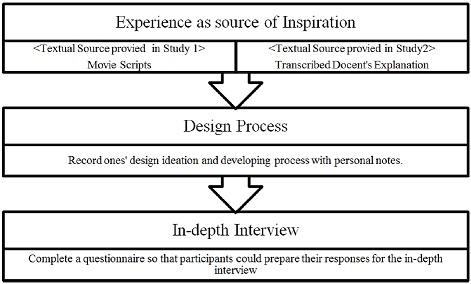
Flow of Study 1 and 2.
After all the ideation and design developing process were carried out, they were asked to complete a questionnaire so that they could prepare and organize their responses for the in-depth interview. The questionnaire consisted of questions related to the participants’ personal background, sources of inspiration that they regarded most importantly from the studies, and their ideation and design developing processes (e.g. their ideation and design developing methods, tools, etc.) Based on this, in-depth interviews were conducted to examine and analyse the meanings based on the experiences of each participants along with their design sketches, as the result of the experiments. A researcher leaded the group interview focused on each participant while others (who are not the one focused interviewee) were also able to ask any questions related to design ideation and developing process. The interview for each participant took an average of twenty-six minutes and sixteen seconds, and all interviews were recorded and transcribed in order to analyse the results (Table 3).
Design result analytics
3.4. Analysis method
This paper adopted the phenomenological research method of Giorgi (1970) for analysing and comparing data, since this qualitative method most effectively captures and sheds light on various experiences and mindsets of human beings. Giorgi's research method focuses on uncovering the meaning of experiences through in-depth interview of the participants and using their language to identify themes that best represent their experiences. Therefore, this method makes it possible to explain in detail the individual characteristics of the participants, having well reflected their situations and backgrounds. At the same time, the method can also organize the contents of interview data into categories by deriving common themes from all participants.
In addition, the phenomenological research method of Van Kaam (1969), further defined by Spiegelberg (1976), has also partly been used. This method has a quantitative character in that it presents the common themes from interview data in the order of their frequency (the number of times mentioned by participants). This method will allow the authors of this paper to see which common themes are regarded most important by the participants.
4. Results and discussions from study 1 and 2
This section presents the results from the analysis of the group interview from study1 and 2. Firstly, the results from both study 1 and 2 provide an overview of how each participant reacted to the different forms of stimulus, i.e. the movies and the exhibitions. Secondly, the results also reveal how textual sources affected each participant at each stage of ideation and design development process. Finally, after analysing data from each study, there a discussion about results for each study.
Table 4 serves as an example of the phenomenological research method of Giorgi (1970) to categorize the data with participant1’s own words, and Van Kaam (1969) to extract the frequency of meaningful statements for analysing the data.
Example of coded data of participant 1
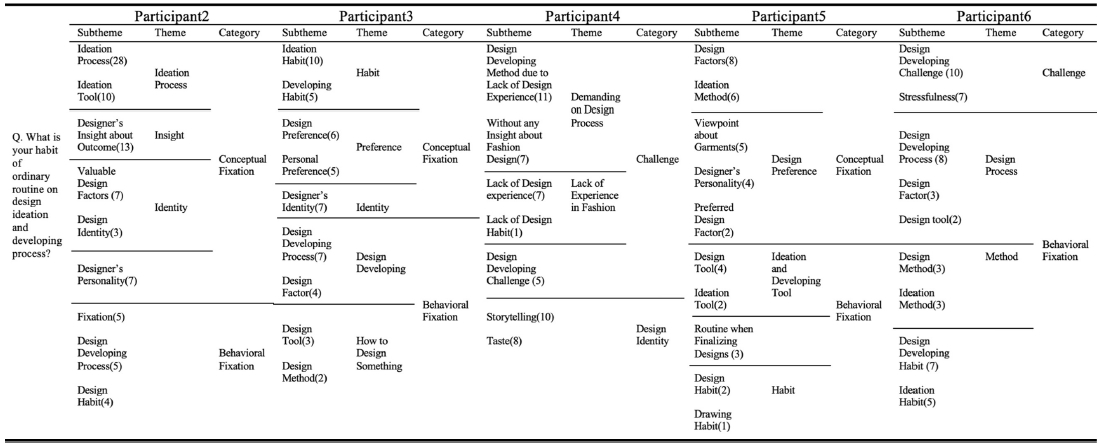
The ‘Significant Statement’ contains meaningful words from Participant 1’s interview. The number in the brackets stands for frequency of the subtheme mentioned (Table 4) Table 5 demonstrates how participants’ interviewed data has been categorized and analyzed. Since Participant 1’s data can be found in Table 4., Table 5 carries data of the other 5 participants, Participant 2 to 6. All participants, except for Participant 4 who had a background with an exceedingly small amount of education and experience in fashion design, turned out to have their own fixation in the fashion design process. Information extracted from the Participant 6’s interview showed a different category titled ‘Challenge’. This may be because Participant 6 is the only one who ran her own busy fashion brand so that she was already stressed out to go through another whole process of design ideation and developing under pressure. Participant 4, as a novice fashion design student, mentioned design ideation and developing process is “challenging” since she is lacking with experience in fashion design, so one big category from Participant 4’s interviewed data is also ‘Challenge’.
Categorized data from paricipant 2 to 6
4.1. Study 1: how does reading a movie script as a textual source affect design ideation and design developing process?
The Danish Girl (2015) and Mary Poppins Returns (2018) were the two selected movies for this experiment. The Danish Girl (2015) is based on the 2000 novel of the same name by David Ebershoff, and also roughly inspired by the actual life of the Danish painter, Einar (Lili). The movie depicts the story of Einar (Lili) who struggled with his gender identity. Since the story unfolds in a very serious tone and is based on a profound plot, Participants 5 and 6 claimed that they had a hard time to read or watch this genre of film. On the other hand, Participants 1 and 3 commented the movie was inspiring and touching enough for them to make an emotional connection with Einar (Lili). The remaining two participants, Participant 2 and 4, did not show any like or dislike about the movie.
The second movie, Mary Poppins Returns (2018) is a sequel to the original 1964 movie, Mary Poppins and brings back a sense of nostalgia from the original movie. Since it is a musical fantasy film, the movie is filled with lively songs and colourful costumes. Participants 3,4 and 5, were a huge fan of Mary Poppins (1964). Although Participant 4 and 5 only read the script of the movie without looking at any visual stimuli, they still found it very inspiring. Participant 1 also liked the story of the movie itself but felt that the movie had too much visual impact on her, and thus she felt burdened by the countless visual images and found them not inspiring to develop her collection. The remaining two participants did not show any like or dislike about the movie.
Overall, there were positive effects on the participants at their design ideation stage when using a script text as a textual source, apart from one person, Participant 6. During the design developing stage, half of the participants (Participant 1,3 and 5) found that textual source is useful. Firstly, during the ideation process, textual source has been able to provide more opportunities and chances to designers in making links with “meaningful narratives” or “storytelling” for their design ideas; in “encouraging further research” and in “being able to immerse in their work with fascination since working with a new form of inspirational source”. Moreover, during the design developing process, textual source has been able to give designers more room “for one’s own imagination” and “for personal intervention in terms of deciding design intentions or factors” regarding their sketches.
Participants 1 and 4 each commented more than 15 times, how the use of the script as an inspiration source enabled them to “build up my own meaningful narratives” and “storytelling”, as they were enticed to think further from the text and make lots of new associations. With texts of the script, there are relatively more information to develop many associations at one’s own pace compared with when just watching a movie, which allowed Participant 4 to write down more ideas on her mind mapping for her collection. Moreover, Participant 1 commented more than 10 times that the script triggered her to expand her creativity by making her keep on “thinking about the mood, colours, materials and silhouette of the collection looks”.
Participant 5 also found the script very inspiring; she places the utmost importance on “expressing emphatic emotions” (mentioned 25times) inspired from a source in her ideation and she found the text much more comfortable to work with as she could freely imagine, associate, interpret and empathize with each scene and characters while reading the text. From the interview, Participant 5 described herself as “Picasso”, as she mentioned, “Others said the way I design and draw seems like Picasso. I love to express my design in abstract concepts.” Figure 2. demonstrates how she interprets her idea from textual sources, to generate them into an abstract outcome. As can be seen from Figure 2., she freely scribbled her idea on the script whenever ideas popped up in her brain and then she applied these ideas to garments with her own abstract expressions. Furthermore, Participant 3 purposefully did not search any images after reading the script, as she just wanted to explore this fascinating new source of text alone, encouraging her to come up with silhouette designs purely based on her imagination. Participant 2 underlined how given ideas about different colours depicted in the script made her take time and contemplate over what the actual colour palette would be. Thus, she undertook further research for images to use them as sources of colours and fabrics for her designs.
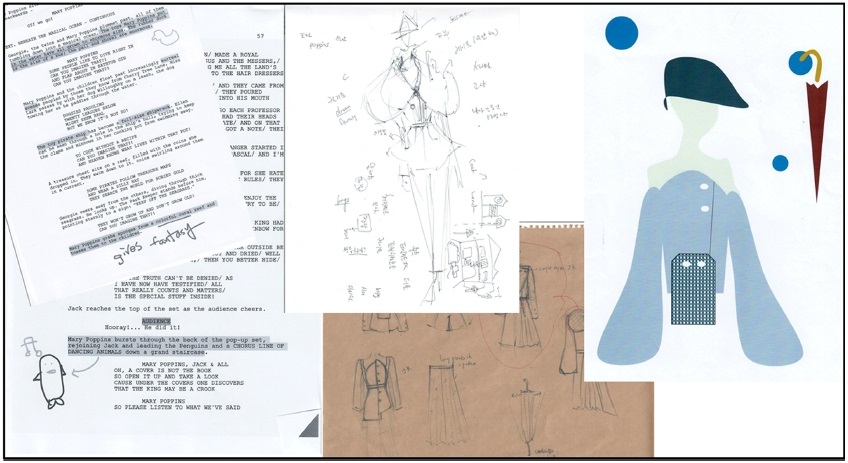
Participant 5/Mary Poppins Returns/group: with textual sources.
Participant 6 was the only one who claimed that she was adversely affected by the textual sources, i.e. the script text, during her ideation process. She is currently working also as a designer, and she normally begins with visual colour images to get inspired from, and then starts her ideation process for her collection. However, since there are not any visual colour sources in the script, this inevitably made her feel burdened and difficult to start off her ideation process.
In terms of ideation methods, interestingly, Participant 3 and 4 tried extra or different ideation tools and methods during the ideation process for exploring the new form of inspiration, the script. Figure 3. illustrates that Participant 4 used an image board and collage, in addition to mind mapping, in order to overcome her difficulty of not having any visual source for reference, as a novice fashion designer. Participant 3, as shown on Figure 4., did not deliberately adopt her usual ideation method of online image searching and collage. Instead, she purely relied on the text for exploring ideas and then taking her own photos for colour ideas inspired by the script. This allowed her to develop the collection based on her own imagination which let her step out of her comfort zone.
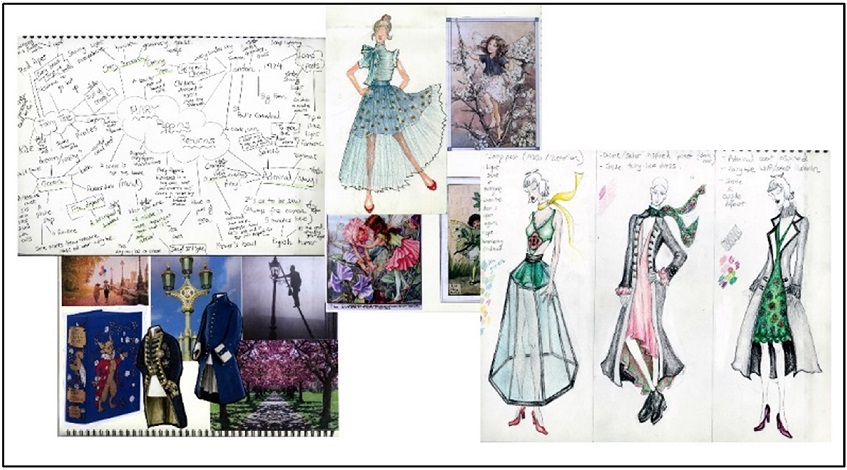
Participant 4/Mary Poppins Returns/group: with textual sources.
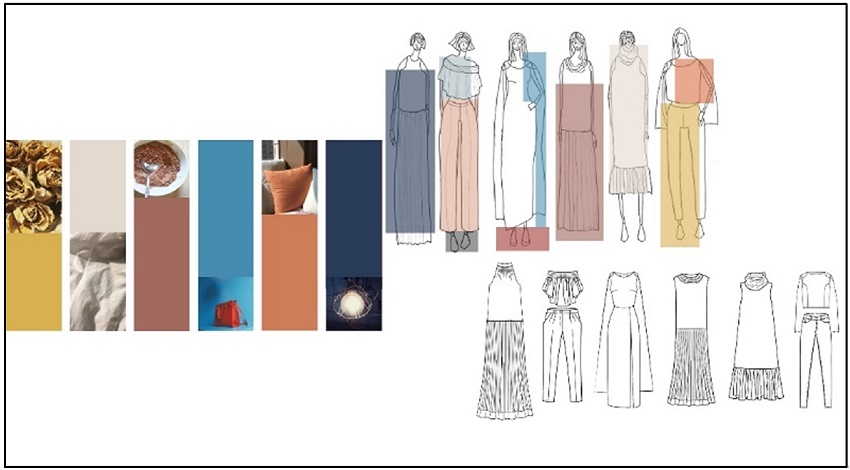
Participant 3/ The Danish Girl/group: with textual sources.
However, the other 3 designers, Participants 1,2 and 6, who have the top three longest design experiences (at least more than 6 years) out of the 6 participants, used almost the same ideation tools that they are most familiar with such as keywords extraction and memo, regardless of whether being inspired by reading the script or watching the movie.
As we can see from Participant 6, having no visual source in the script can indeed act as a drawback when sketching during the design developing process. It was especially true for Participant 4, who hardly had any fashion design experience beforehand and this was her first time developing her own collection in practice. Participant 3 who has 4 years of design experience in total, also commented that the script took longer and was slightly more difficult to produce visual ideas to directly apply to her designs for her collection. They both said that additional image searching and taking photos for colour helped them to trigger their design developing process after being inspired from the script, which created synergy effects.
However, for others, such as Participant 1, 2 and 5, who have relatively longer experiences in fashion design field and have been design students most of their lives, they already have accumulated a variety of different visual sources in themselves. Hence, they have the capacity to lead and develop their own collection just by using the script and taking their imagination to its maximum potential. In fact, Participant 1 emphasized that the script, especially being the first time to try a text as a new inspirational source form, triggered off her ideas most explosively, thus she was able to develop her design sketches the fastest for this collection in comparison to all the collections she has designed so far. Moreover, Participant 2 strongly agreed that she was able to have more space to expand her imagination and creativity when she sketched without any visual image but when she only had textual sources at her hand. Participant 5, also commented textual source was “way more interesting and exciting” (mentioned 4 times) to explore her design development.
There was a difference between participants dealing with their design ideation depending on their work experience and design education background. Participant 3,4 and 5 who relatively have less experiences in the fashion design field, tended to use at least more than 2 ideation methods, such as image boards, mind mapping and/or key words extraction to develop their ideas and originality. In particular, Participant 4 with less than a year experience in fashion design education, tried the most various kinds of ideation method like mind mapping, collage, key words extraction and memo to find a “meaningful narrative” for her collection.
With diverse and long design experiences and education backgrounds, Participant 1,2 and 6 commented more than 10 times that they relied on their habit to proceed with their design ideation, regardless of whether being inspired by reading the script or watching the movie. This is likely because of their already rooted habit of their own ideation process from their long design experiences and education. These can induce a form of fixation, especially when designers continuously adhere only to a familiar tool or skill of an existing solution method to a design problem (Moreno et al, 2014). It would be better to encourage designers to use diverse ideation methods like combining collage with mind mapping for example, according to different types of inspiration source forms.
All 6 participants’ design developing process interestingly revealed that they used at least one or more method(s) of transforming inspirational sources to their design sketches in the form of a) literal adaptation; b) conscious simplification; c) abstraction; d) modification to source and e) association and deviation (5 methods identified by Eckert and Stacey, 2003). When watching the movie, they all commented how they had the tendency to simply rely on using literal adaptation of visual images from the movie, to directly apply them to their design, as this was the easiest method out of the five methods identified by Eckert and Stacey (2003).
For example, Participant 4, as a beginner, was afraid to modify any shapes or colours from the movie’s costumes after having watched it; Participant 1 and 3 stressed how they both consciously and unconsciously copied the images and used them simply as “references” (mentioned more than 10 times for both) rather than as inspirations. They literally applied the silhouettes, items and/or colour palette from the movie Mary Poppins Returns (2019). Especially, Participant 1 emphasized how the countless quick running images from the movie made her “suffocate with too many visual sources”, and thus found it hard to “build up a meaningful story” which hindered her to expand her ideation and developing process. Participant 2 said watching the movie made her think and apply the design factors “intuitively and more easily” and Participant 5 literally applied revealing clothes from the movie The Danish Girl (2015) to her designs even though she usually feels uncomfortable with such items. Again, simply using this literal adaptation method in design developing process, can become a design fixation, since hardly any ideation is needed.
Study 1: How textual source (movie script) influenced participants’ design process
In contrast, the participants’ design sketches when using the movie script as an inspirational source revealed that they used much less or no literal adaptation. They instead exploited other various transformation methods such as conscious simplification (Participant 3, 4), abstraction (Participant 5) and association and deviation (all 6 participants) to obtain ideas and transform them to visual elements for more original application in their designs. Especially Participant 1 with more than 10 years of design education background claimed that she is in strong favour of exploiting textual sources, i.e. the script. She emphasized how textual sources as a new form of inspiration source was “refreshing” (mentioned 6 times) for her, making her come out of her comfort zone where she simply used to get inspiration from visual sources such as fine art objects or images from films and online search. As we can see from this experienced participant, it can be demonstrated that there is a possibility of preventing one’s design fixation when having textual sources as a new form of inspiration source to a designer. This demonstrates that an unfamiliar form of inspiration source such as movie scripts can encourage designers to use different or extra ideation tools and methods, which can elicit more creativity from them.
4.2 Study 2: How does viewing an exhibition with a docent’s explanation as an additional information source affect designers’ ideation and design developing process?
For the study 2, the participants visited the two exhibitions, ‘Jasper Morrison: Thingness’ and ‘I Draw’. In terms of the Jasper Morrison exhibition, the explanation from the docent was mostly about how Jasper Morrison developed his work from the scratch; from where and how he found his inspirations, and how his cultural and personal background played a role in his design ideation and development. This additional information about the designer from the docent helped Participant 3 and 4 to become more inspired from the exhibition. However, Participant 5 had a difficult time to develop her design sketches, since too much information limited her creativity. Although, Participant 2 viewed the exhibition without the additional docent’s explanation, she found it was inspiring enough since the content suited her taste. The other two, Participant 1 and 6, commented that it was hard to find any inspiring element from the exhibition.
Unlike ‘Jasper Morrison: Thingness’ which was an exhibition based on just one artist, ‘I Draw’ was an exhibition created with 16 different artists. A docent explained about how the curator to the ‘I draw’ exhibition had installed walls with different textures and colours as well as different incense diffusers for each space of the artist to well reflect their mood. Also, she gave detailed information about each of the 16 different artists, how they developed their work, what kind of techniques they used, what their work spaces look like and so on. All 6 participants found the exhibition itself inspiring, regardless of whether they had or not had the explanation from the docent. In particular, 3 participants viewed the exhibition with the docent’s explanation more helpful since they were able to get more information about the exhibition itself and the artists, which encouraged them to do further research for more ideas to develop and expand their creativity.
It revealed that the participants generally found positive effects for their design ideation and developing process when the transcribed docent’s explanation was additionally given as textual sources. Also, multi-dimensional stimuli from the exhibitions enhanced participants’ design ideation and developing process. Five out of the six participants have directly stated the usefulness of the information in terms of getting to know more about the background of the artists and their works, and using the information for their follow-up research on the themes by which they have been inspired from the exhibition. However, the other remaining participant, Participant 5 had difficulty in getting inspired from the exhibition with the docent’s explanation and preferred the other exhibition without the explanation.
Participant 3 highlighted that she is usually inspired by human figures or characters and their fashion, and then from there on she builds up her ideas and designs. Since there were hardly any figures in the exhibition ‘Jasper Morrison: Thingness’ (the only figure being Morrison himself), she did not find the exhibition and the objects displayed in it much inspiring. However, she was thankful for the docent’s explanation, which gave details on the designer figure, Morrison. Consequently, she felt at least a little more sense of intimacy with the designer after having heard and read the explanation, and thus tried to imagine what would be in the wardrobe of Morrison from where she started her ideation process.
For Participant 4, who is a novice fashion designer, the additional textual source was beneficial in helping with her ideation process for her collection. She learnt through the information how Jasper Morrison tried to put meaningful values on his furniture designs such as hidden considerations and functional aspects for the comfort of users. Therefore, she was able to associate this with her own experiences of discomfort in clothing when she had a difficult time during her treatment in a hospital. The participant was able to “build up a meaningful narrative” (mentioned 11times) from the docent’s explanation, which further developed and enhanced her creativity.
Participant 6, who viewed the ‘I Draw’ exhibition with additional information, was grateful for the docent’s explanation to find out that each space of the artists had a different scent to reflect their mood, which she would not have realized had she not heard the explanation. The other three participants who had not heard the explanation, did not realize there was a different fragrance to each space. Therefore, Participant 6 used this olfactory information together with visual images from online research to decide the mood of her collection. Figure 5. shows the given additional information from the docent encouraged her to do further research about one of the artists who started his career based on Instagram. The fact that the artist posted his work on the social media was interesting for her, so that she looked up the artist’s account and ended up being fascinated by his work and colour. Since she is used to working with colours first normally for her designs, the explanation from the docent helped her to find colour references easier to make her ideation process smoother.
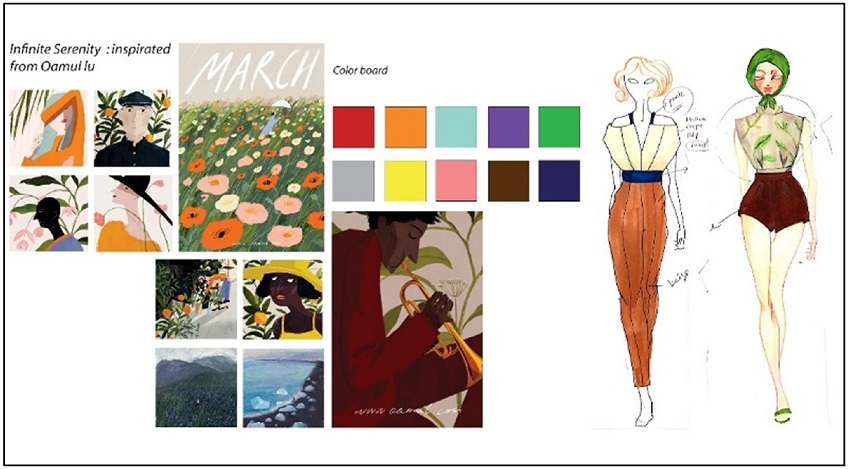
Participant 6/ I Draw/group: with textual sources.
Since the exhibition, ‘I Draw’ displayed works by many different artists, it was inspiring enough for Participant 1 to gain a variety of visual sources from their works. Figure 6. shows how textual sources encouraged Participant 1 to work on her ideation process with collage of tickets from the exhibition, pictures taken from the exhibition and fabric swatches with colors extracted from the theme of the exhibition. With the explanation from the docent, the participant was able to find out lots of behind stories about each artwork and how an artist created one’s own technique or style. These additional textual sources stimulated her to further expand her ideas, not simply stopping at the ones gained from the visual sources. She commented 5 times that “the docent was helpful” enough for her to generate some forms of “storytelling” for her collection.
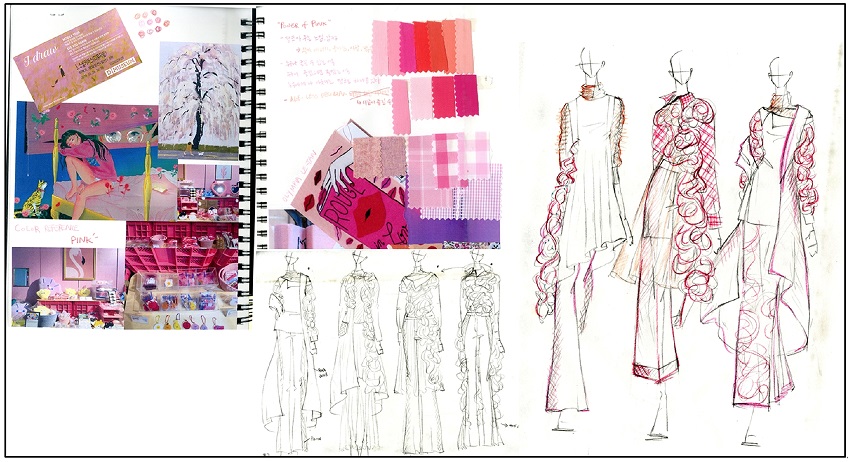
Participant 1/I Draw/group: with textual sources.
Participant 5, as mentioned, has a strong liking for abstract concepts and emotions (“like Picasso” as mentioned from the interview) inspired from artworks and artists. She has a disposition to personally interpret these concepts and emotions through empathy and expresses these ideas in her designs. However, since she felt that the Jasper Morrison exhibition only talked about functionality of modern industrial designs and hardly contained any emotional story, she was not able to make any emotional connection with the exhibition. Furthermore, she deemed the docent explanation as too factual for her, thus she felt that she was “trapped in the vast sea of such objective information both from the exhibition display and the additional explanation given by the docent”. Therefore, the additional information from the docent hindered this participant’s ideation process.
As Figure 7. shows, Participant 2 said that the docent explanation was not really used directly during her design developing and sketching process, as she already had fixed design habits and preferable design elements that she wanted to reflect in her project more. Consequently, she mentioned that the exhibition experience was not really helpful but her own habit, which can be called design fixation, was dominant in her design ideation process.
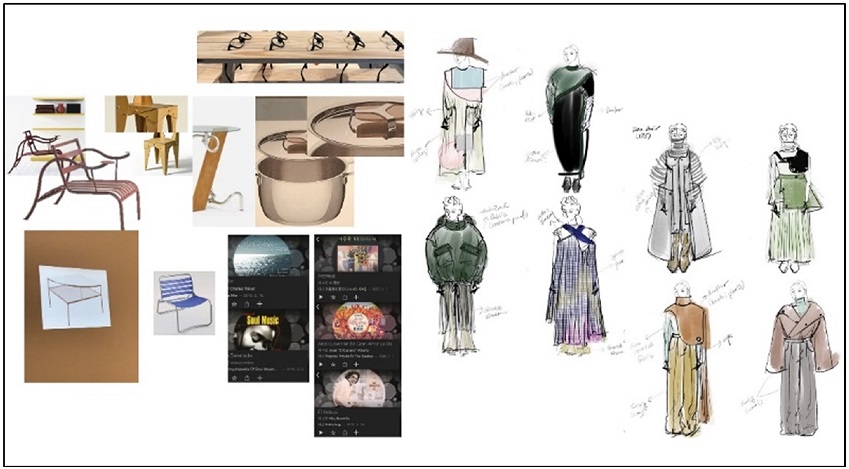
Participant 2/jasper morrison: Thingness/group: without textual sources.
Participant 1 strongly agreed that she felt more comfortable with the additional information on the artists and their works in being able to expand her thoughts and ideas. It was especially helpful for her in that she was able to get ideas about design details and fabric manipulation for her garments, as the docent often explained the methods and tools adopted by the artists. She was able to learn about the working process of the artists, which is not usually possible to know by simply looking at finished works of artists, as was the case for her in ‘Jasper Morrison’ exhibition. For the ‘I Draw’ exhibition (with the docent explanation), she commented more than 10 times on specific techniques of the artists, and she associated some of these with her ideas for fabric manipulation (e.g. one artist used the cross-stitching technique and from this she gained the idea to use tulle fabric and apply the technique on her garment).
Moreover, Participant 4 was encouraged by the docent’s explanation to put in “meaningful narratives” and hidden considerations for the future wearer of her designs; she mentioned over 10 times how inspiring it was to be able to learn the hidden values and intentions of Morrison through the docent’s explanation. She claimed that she would have found it difficult to come up with meaningful narratives and her target group, had she not known about these values and intentions of the designer. Even though she already had enough visual sources to come up with her designs from different forms of furniture, kitchen utensils and so on, the additional information helped her more to develop depth and profundity for her designs, as she mentioned.
However, both Participants 2 and 6 said that the docent explanation was not really used directly during their design developing and sketching process, as they already had fixed design habits and preferable design elements that they wanted to reflect in their project more. These two participants most reflected their personal design tastes and habits (i.e. their sociocultural capital and its influence) in addition to using the inspiration source (although making this fit into their usual design preference) in their design development, almost regardless of the 4 different stimuli used in this research.
Participant 5 commented on how it would have been better for her to just see the exhibition or simply read the transcribed docent’s explanation separately, which would have let her imagination flow more freely and smoothly, without having too much information all at once at her hand. However, she stressed that if the additional textual source from the docent had been to her liking and taste (i.e. information that mainly conveys emotions of people), it then would have helped her with design ideation and development for her collection.
Overall, the study2 has shown that additional textual sources in the form of transcribed docent’s explanations can be well exploited by design students to find out more about the works displayed and the artist(s) in an exhibition. This information can be about the background, values, meanings endowed by artists to their work and also about their working processes and techniques hidden behind finished works. They can use these many ideas for follow-up research, finding the next reference points, being encouraged to also impart meaningful stories to their own design ideas, as well as applying the techniques in more detail to their design developments. The participants also strongly agreed that if the exhibition is particularly to their liking, then the additional docent’s explanation works well together with the artworks to give positive synergy effects, in providing comprehensive information for many more inspirational ideas.
For example, Participants 3 and 5 both claimed that the first exhibition, ‘Jasper Morrison: Thingness’, did not rather suit their taste, whereas the second one, ‘I Draw’, was much more exciting and suited much to their taste and interest. Therefore, it was easier for them to build up their collection inspired from the exhibition which suited their taste, regardless of whether there were additional textual sources from the docent or not.
Interestingly, the analysis of the interview data of all 6 participants revealed that the participants spent more time on research and/or employed a more variety of ideation tools for design ideas inspired by the exhibition that they preferred or liked more, compared to the other one. Participant 6 enthusiastically did more follow-up research for the ‘I Draw’ exhibition; she even went on the Instagram of one of the artists that she was deeply moved by to get a further understanding of the artist’s mood and then made a colour board based on this mood. For Participant 5, the number of times she mentioned anything that could be categorized under “empathy with stimulus” was much higher for the ‘I Draw’ exhibition. She went on to even personify the fashion that she has designed based on this stimulus by putting her inspired emotions more passionately in it for their expression.
Study 2: How textual source (transcribed docent’s explanation) influenced participants’ design process
Participants 1 and 3 also tried to come up with more original ideas through making lots of associations with the inspirational sources from the ‘I Draw’ exhibition, which they preferred, and pondered more over methods of construction for their designs such as fabric manipulation. On the other hand, Participant 2 thought that the Jasper Morrison exhibition (without the docent’s explanation) was more interesting; she was even captivated by the music from the exhibition and was thus encouraged to do further research and discover the mood for her collection. Lastly, Participant 4 said that because she was so mesmerized by the values of the designer that she had learnt through the exhibition and the docent’s explanation, she re-read the transcribed docent’s explanation many times in order to understand it thoroughly for further research.
5. Conclusion
Textual sources not only helped to develop experienced design students’ creativity and productivity, but also affected a novice design student in a positive way. These studies overall demonstrate how textual sources can generate beneficial effects during the ideation and design developing process of fashion design students. They can also help to diminish the influence of one’s design fixations and the use of only few restricted methods or tools. The results from this research’s studies can be evidence to and explain the reason for why groups exposed to textual stimuli exhibited higher originality ratings in Goldschmidt and Sever’s study (2011). Therefore, it is important that in the field of fashion design education, instructors should teach and enhearten their students to practice a variety of different ideation methods to become familiar with them, and to learn which one to select depending on different forms of inspiration, not just teaching one or two tools preferred habitually by the instructor.
As we can see from study2, it can be said that when design students are stimulated by sources which they have a liking for, these sources can really generate positive synergy effects with the additional textual sources given, for their more original and thoughtful design ideation and developing process. All 6 participants’ interview and design sketches demonstrated that when a stimulus is forced upon a designer or design student which really does not suit his/her taste, they generally had a tendency to simply reflect more of their design habits and usual style, or just literally adapt the sources to their work.
This was regardless of whether additional textual sources were given or not. These show forms of design fixation and thus, it is important to respect individual preferences for inspirations when trying to explore their original ideation and design development process, in order to avoid such fixations. It is therefore necessary to emphasize voluntary inspiration selection by designers and students actively, unless for other special reasons, in general.
To conclude, textual sources overall has a positive effect on participants’ ideation and design developing process with different intensity based on their various backgrounds and own taste. Participants with much longer design-related education and work experience, who can be called as ‘experienced’ designers, tend to utilize textual sources efficiently so that it fits into what they value for their design, and their own design aesthetics. Interestingly, textual sources helped ‘experienced’ designers to relieve their design fixation, giving them opportunities to develop their idea with a new form of inspiration such as texts and additional transcribed explanation about stimuli. Moreover, for novice design students, textual sources gave potential to expand their originality by building a meaningful narrative based on their sociocultural influences, which helped them to form a stronger bond and intimacy with their collection in the end.
Ultimately, what these results demonstrate is that one’s ‘influence’ (i.e. their sociocultural capital such as personal preferences, likings, habits, past experiences, etc.) and ‘inspiration’ mutually work together always to make an effect on fashion designers’ ideation and development process for their design, sometimes one working more than the other (or vice versa), for each person and for each stimulus.
As fashion industry requires fashion designers to be more creative and innovative, it is important for designers and design students to search for more original inspirations and express or develop their ideas more effectively by utilizing diverse ideation methods. Overall, this paper makes important practical contributions by identifying and discussing the designing behaviours performed by fashion design students during their ideation and design developing process with given new sources of inspiration, textual information. The experiments were performed in the context of fashion design, yet many of the results may be useful for all design-related activities that include using textual sources as inspiration source for design.
Challenges of design fixations often involve repeating same habitual design techniques during the ideation and design development process. A great deal of research and experimentation with this issue of design fixation is occurring in other fields such as in the sciences, arts, and design. On this basis, future research should deal with designers’ creativity, not only in the phases of ideation process, but in the early information gathering and inspirational phases as well. This will provide a better understanding of source materials for designers, and help them broaden their creativity further. At the same time, it will give better idea to design-related educators encouraging design students to break out of their habits and fixations, which is just as important as instructing basic technical design skills. In this research, perhaps 6 participants may too small to generalize the result, still, 6 participants consisted with graduate students only may be able to give fresh insight to fashion design educators. Therefore, future research with bigger size of participants with various backgrounds will enrich the discussion on how textual sources enhance one’s creativity and expand one’s design process.
Acknowledgments
This work was supported by BK21 Plus Project of the National Research Foundation of Korea Grant funded by the Korean Government.
References
- Biktimirov, E. N., & Nilson, L. B. (2006). Show them the money - Using mind mapping in the introductory finance course. Journal of Financial Education, 32, 72-86.
- Bourdieu, P. (1986). The forms of capital. J. Richardson (Ed.) Handbook of theory and research for the sociology of education içinde (ss. 241-258). New York: Greenwood Press.
- Brown, T. (2008). Design thinking. Harvard business review, 86(6), 84-92.
- Cardoso, C., Gonçalves, M., & Badke-Schaub, P. (2012). Searching for inspiration during idea generation - Pictures or words?. In DS 70: Proceedings of DESIGN 2012, the 12th International Design Conference, Dubrovnik, Croatia. pp.1831-1840.
-
Chiu, I., & Shu, L. H. (2007). Using language as related stimuli for concept generation. Artificial Intelligence Engineering Design, Analysis and Manufacturing, 21(2), 103-121.
[https://doi.org/10.1017/S0890060407070175]

-
Chiu, I., & Shu, L. H. (2012). Investigating effects of oppositely related semantic stimuli on design concept creativity. Journal of Engineering Design, 23(4), 271-296.
[https://doi.org/10.1080/09544828.2011.603298]
-
Crilly, N., & Cardoso, C. (2017). Where next for research on fixation, inspiration and creativity in design?. Design Studies, 50, 1-38.
[https://doi.org/10.1016/j.destud.2017.02.001]
-
Cross, N. (2004). Expertise in design: an overview, Design studies, 25(5), 427-441.
[https://doi.org/10.1016/j.destud.2004.06.002]
-
Hester, K., & Cunningham, C. (2007). Engineering Is Elementary - An Engineering And Technology Curriculum For Children. Paper presented at 2007 Annual Conference & Exposition, Honolulu, Hawaii, June 24, pp.12.639.1.
[https://doi.org/10.18260/1-2--1469]
-
Davies, M. (2011). Concept mapping, mind mapping and argument mapping: what are the differences and do they matter?. Higher education, 62(3), 279-301.
[https://doi.org/10.1007/s10734-010-9387-6]
-
Eckert, C., & Stacey, M. (2003). Adaptation of sources of inspiration in knitwear design. Creativity Research Journal, 15(4), 355-384.
[https://doi.org/10.1207/S15326934CRJ1504_5]
- Entwistle, J. (2000). The Fashioned Body - Fashion, dress, and modern social theory. Cambridge: Polity Press.
-
Gerstenblatt, P. (2013). Collage portraits as a method of analysis in qualitative research. International Journal of Qualitative Methods, 12(1), 294-309.
[https://doi.org/10.1177/160940691301200114]
- Giorgi, A. (1970). Psychology as a human science. New York: Harper and Row.
- Goldschmidt, G. (1998). Creative architectural design - Reference versus precedence. Journal of Architectural and Planning Research, 15(3), 258-270.
-
Goldschmidt, G., & Sever, A. L. (2011). Inspiring design ideas with texts. Design Studies, 32(2), 139-155.
[https://doi.org/10.1016/j.destud.2010.09.006]
-
Hamilton, J. A. (1987). Dress as a cultural sub-system - A unifying meta theory for clothing and textiles. Clothing and Textiles Research Journal, 6(1), 1-7.
[https://doi.org/10.1177/0887302X8700600101]
-
Hernandez, N. V., Shah, J. J., & Smith, S. M. (2010). Understanding design ideation mechanisms through multilevel aligned empirical studies. Design Studies, 31(4), 382-410.
[https://doi.org/10.1016/j.destud.2010.04.001]
- Hwang, J. Y. (2013). Fashion designers' decision-making process: The influence of cultural values and personal experience in the creative design process. Unpublished doctoral dissertation, Iowa State University, Seoul.
-
Jansson, D. G., & Smith, S. M. (1991). Design fixation. Design studies, 12(1), 3-11.
[https://doi.org/10.1016/0142-694X(91)90003-F]
-
Kim, S. Y. (2020). Expressive types and meaning of design using the logo in contemporary fashion - Focusing on collections from 2017 S/S to 2019 F/W. Korean Journal of Human Ecology , 29(2), 217-230.
[https://doi.org/10.5934/kjhe.2020.29.2.217]
-
Kim, T. H. & Yoo, Y. S. (2015). A study on the characteristics of digital graffiti and expression in fashion. Journal of the Korean Society of Costume, 65(8), 50-63.
[https://doi.org/10.7233/jksc.2015.65.8.050]
- Lee, J. S. (2017). The role of sketches in fashion design - Focus on a case study of a professional designers process. Journal of Fashion Business, 21(3), 58-66.
- Luchins, A. S., & Luchins, E. H. (1959). Rigidity of behaviour - A variational approach to the effect of Einstellun, Univer: Oregon Press.
-
Mednick, S. (1962). The associative basis of the creative process. Psychological review, 69(3), 220.
[https://doi.org/10.1037/h0048850]
-
Mete, F. (2006). The creative role of sources of inspiration in clothing design. International journal of clothing science and technology, 18(4), 278-293.
[https://doi.org/10.1108/09556220610668509]
-
Moreno, D. P., Hernandez, A. A., Yang, M. C., Otto, K. N., Hölttä-Otto, K., Linsey, J. S., Wood, K. L. & Linden, A. (2014). Fundamental studies in design-by-analogy - A focus on domain-knowledge experts and applications to transactional design problems. Design Studies, 35(3), pp.232-272.
[https://doi.org/10.1016/j.destud.2013.11.002]
-
Moreno, D. P., Yang, M. C., Hernández, A. A., Linsey, J. S., & Wood, K. L. (2015). A step beyond to overcome design fixation - A design-by-analogy approach. Design Computing and Cognition'14, Springer, Cham, pp.607-624.
[https://doi.org/10.1007/978-3-319-14956-1_34]
-
Nagai, Y., & Noguchi, H. (2002). How designers transform keywords into visual images. In Proceedings of the 4th conference on Creativity and Cognition, Association for Computing Machinery, pp.118-125.
[https://doi.org/10.1145/581710.581729]
- Osborn, A. F. (1957). Applied Imagination-Principles and Procedures of Creative Writing. New York : Scribner.
-
Perttula, M. K., & Liikkanen, L. A. (2006). Structural tendencies and exposure effects in design idea generation. In American Society of Mechanical Engineers 2006 International Design Engineering Technical Conferences and Computers and Information in Engineering Conference, American Society of Mechanical Engineers Digital Collection, pp.199-210.
[https://doi.org/10.1115/DETC2006-99123]
-
Purcell, A. T., & Gero, J. S. (1991). The effects of examples on the results of a design activity. In Artificial Intelligence in Design'91, Butterworth-Heinemann, pp.525-542.
[https://doi.org/10.1016/B978-0-7506-1188-6.50031-4]
- Rawlinson, J. G. (1986). Creative thinking and brainstorming. Abingdon: Routledge.
- Ryu, H. J. (2011). Formative characteristics of graffiti in fashion since 2000. Journal of the Korea Fashion and Costume Design Association, 13(1), 159-167
-
Sarkar, P., & Chakrabarti, A. (2008). The effect of representation of triggers on design outcomes. Artificial intelligence for engineering design, analysis and manufacturing, 22(2), 101-116.
[https://doi.org/10.1017/S0890060408000073]
-
Shin, K. (2012). Incubating practice-based fashion design research. International Journal of Fashion Design, 5(2), 79.
[https://doi.org/10.1080/17543266.2012.697288]
- Spiegelberg, H. (1976). The phenomenological movement (Vols. I±II). The Hague: Martinus Nijhoff.
-
Strickfaden, M., & Heylighen, A. (2010). Cultural capital - A thesaurus for teaching design. International Journal of Art & Design Education, 29(2), 121-133.
[https://doi.org/10.1111/j.1476-8070.2010.01653.x]
-
Strickfaden, M., Stafiniak, L., & Terzin, T. (2015). Inspired and inspiring textile designers - Understanding creativity through influence and inspiration, Clothing and Textiles Research Journal, 33(3), 213-228.
[https://doi.org/10.1177/0887302X15578263]
- Toh, C., Miller, S., & Kremer, G. (2012). Increasing novelty through product dissection activities in engineering design. In International Design Engineering Technical Conferences, American Society of Mechanical Engineers, Chicago, Illinois.
- Van Kaam, A. (1969). Existential Foundations of Psychology. New York: Image Books.
- Ward, T. B. (1995). What’s old about new ideas?. In S. M. Smith, T.B. Ward, & R.A. Finke(Eds.), The creative cognition approach(pp. 157-178). The MIT Press.