Analysis of 3D Facial Shapes of Female Adult to Improve Face Mask Fit
© 2020 (by) the authors. This article is an open access article distributed under the terms and conditions of the Creative Commons Attribution license (http://creativecommons.org/licenses/by/3.0/), which permits unrestricted use, distribution, and reproduction in any medium, provided the original work is properly cited.
Abstract
When it is necessary to wear masks for long periods, such as during the current COVID-19 pandemic, the essential function of masks to prevent contamination (or transmission to others) as well as comfortableness are important. For this study, we used three-dimensional (3D) facial measurements of adult women to compile basic face shape data for designing comfortable and effective masks. This study analyzed the 3D facial data of 127 subjects in their 20s to 30s of the 6th Size Korea. Factor analysis of the survey data produced seven factors that formed the composition of adult female faces. These factors combined to produce three facial types: square (long face and a large lower middle face), oval (smallest central and lower body in the middle), and triangle (short face with a small central and lower large nose). These types reflect that the facial types of adult women show the differences in the nose angle, nose length, bitragion-subnasal arc, bitragion-menton arc. Therefore, properly fitting masks for fine dust particle filtration require 3D customization of a mask’s breathing apparatus to fit differently shaped central and lower face parts that interfere with mask fit.
Keywords:
face mask, 3D facial dimensions, 3D facial features1. Introduction
Fine particle air pollution comes from vehicle emissions, coal-burning power plants, industrial emissions, and many other human and natural sources. While exposures to larger airborne particles can also be harmful, studies have shown that exposure to high average concentrations of PM2.5 over the course of several years is the most consistent and robust predictor of mortality from cardiovascular, respiratory, and other types of diseases. In 2017, 92% of the world’s population lived in areas that exceeded the WHO guideline for PM2.5 exposure (“State of global air”, 2019).
The sources responsible for PM2.5 pollution vary within and between countries and regions. Combustion from vehicle engines, industry, fires, and coal burning represents the most common man-made sources, while sandstorms, agriculture, and chemicals reacting in the atmosphere represent the most common natural sources. Countries and regions in East Asia, Southeast Asia, and South Asia suffer from the highest annual average PM2.5 concentrations weighted by population. South Korea ranks highest among OECD countries for average annual PM2.5 exposure; on a city level, 61 of the 100 most polluted cities in OECD countries are located in South Korea (“IQAir AirVisual”, 2019). To protect against the damaging health effects from fine particulate contamination, the Ministry of Environment in Korea recommends wearing masks on days with high fine dust levels (“Guidelines on the specification”, 2019). However, in addition to protecting against fine particulate matter, masks have become necessary during the COVID-19 pandemic for wear by the general public to protect against transmission of the novel coronavirus. Under these circu-mstances, when masks must be worn for long periods of time, it is important not only that masks perform their essential function of blocking transmission of contaminants but also that they be comfortable to wear.
Internationally, Hughes and Lomaev(1972) measured facial dimensions of Australian men to develop appropriate respiratory protection, and McConville and Alexander(1975) developed programs to design masks for American airmen. Yatapanage and Post(1992) also designed a three-to-one digitizer that would provide the most comfortable masks for a different Australian population.
For maximum protection from inhaling harmful substances, masks should adhere well to the face, which requires well-fitting masks(Han & Rhi, 2004). The face consists of more curved parts than many other parts of the human body, and the close contact of masks with the curved areas of the face requires that masks be designed to fit these curves. Traditional anthropometric methods have shown limitations in measuring the distances between marking points or the sizes of arcs(Kim et al., 2003), and recent researchers have come to prefer three-dimensional(3D) over direct measure-ments for analyzing face dimensions both domestically in Korea and abroad.
Song and Yang(2010) used 3D head measurement data from Size Korea to devise a methodology for producing medium-sized masks suitable for Korean faces. Eom and Lee(2016) purchased a cold-air three types mask sold on the market and conducted pattern analysis and wearability assessment, including 3D analysis of changes in skin extension and face shape according to vowel pronunciation when wearing the mask, to produce a prototype for masks for Korean faces. Overseas, Lin and Chen(2017) conducted a human body measurement survey on teenagers in central Taiwan to characterize the head and face dimensions that are key to respirator fit test pane(RFTP) for application to small and medium-sized facial features. Participants were tested for fit on three N95 masks of different facial designs, and Lin and Chen(2017) analyzed the impacts of facial characteristics on respiratory fit compared with the facial size distribution. Lee(2019) have also used 3D scanners and 3D printing technology to customize masks for individual users’ faces.
Despite of adult face sizes, shapes, and growth rates also differ significantly by race and gender(Agbolade et al., 2020; Da Silva et al., 2017; Kim et al., 2003), and these differences also require different mask shapes and sizes. Overseas manufacturers can produce masks of the same model in different sizes(small, medium, large, and combinations), but in Korea, nearly all companies only produce size medium masks(Han & Don, 2004). Kang(2016) applied a half-sized mask by pressing the nose supporter according to the face contour and adjusting the length of the rubber band on the ear to ensure facial adhesion, but with these masks, fine dust-containing outdoor air and structural steam escaped through lenses during breathing. In fact, Kang et al.(2015) determined that multiple types of yellow dust masks on the market leaked fine dust inflows from the face owing to different face shapes.
Currently, it is believed that 3D face shape data require 3D analysis to ensure tighter–fitting but comfortable masks that seal out fine dust particulate matter while accommodating different face shapes and that such masks are necessary now that COVID–19 requires daily all-day mask wearing. The aim of this study is to devise a classification of face shapes for use in fine dust mask design with a basic 3D face shape data for adult Korean women in their 20s and 30s.
2. Methods
2.1. Subjects of study and measurement items
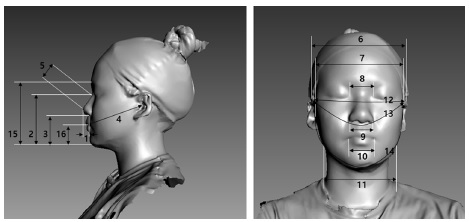
For this study, we used Size Korea(2010) Human Body Dimension data, which included 3D measurements of the facial features of 127 adult women in their 20s and 30s. The sixteen items from the 6th Size Korea were analyzed for calculation including five items for height and length, six for breadth, three for arc, menton-glabella length and menton-stomion length (Table 1).

Analysis Front and side items by the 6th Size Korea
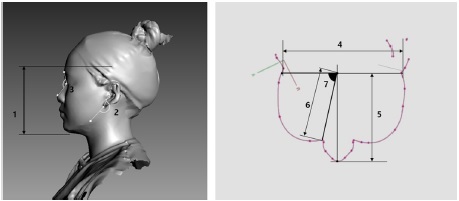
For the 3D measurement items, the area was selected with respect to the fine free space on the top nose of the mask, referring to prior studies (Choi et al, 2009; Han & Lee, 2004; Kang, 2016; Lee et al., 2013). Measurement reference points were set to euryon-right and left, inferior auricle, menton, and gonial angle-right and left according to the 6th Size Korea 3D measurement criteria. The seven measurement items were menton-euryon length, nose depth, nose breadth, sellion cross length, sellion cross-nose length, sellion cross-side nose length, and sellion cross-side nose angle, and the measurement methods are shown in Table 2.
Measurement items of 3D scanned by the 6th Size Korea
2.2. Facial shape analyses
We performed statistical analysis of the measurement data using SPSS Statistics ver. 23, obtaining the average, standard deviation, and maximum and minimum for each measurement item. We used factor analysis and cluster analysis to classify the women’s facial features.
With the factor analysis, we aimed to compress and summarize the measurement data as minimal factors. Specifically, we used a correlation matrix to analyze the main components for all measurement items and adopted all factors with oil value of 1.00 or higher. We used varimax orthogonal rotation to extract factors.
We then performed cluster analysis of the facial feature data based on the factor analysis results. The clusters were grouped based on the morphological features, appearance rates and distribution status of facial features, and we performed ANOVA and the Duncan test to examine the differences in the classified facial features.
3. Results
3.1. Measurement 3D facial features
Table 3 displays the minimums, maximums, and standard deviations (SD) for the 3D feature measurement data from 127 adult women in their 20s and 30s in Size Korea. The seven items showed standard deviations of more than 10 mm. In particular, all arc items had such large deviations, with the largest, 17.0 mm, for the bitragion-menton arc. The angle items also showed large standard deviations of 15.8 mm for the chine angle and 12.7 mm for the nose angle. In the cross section, the sellion cross-nose length was 15.2 mm, showing a large difference. We considered that this measurement in particular differed greatly depending on the 3D shapes of the parts of the nose and chin.
Measurements values of 3D facial features of Korean women(unit: mm)
3.2. Facial features variables
As we noted above, we conducted factor analysis to compress and summarize the measurement data for the facial features into minimal factors. We used a total of 23 items to analyze the main components and adopted the Kaiser factors as the basis for determining the number of factors ; varimax rotation extracted seven factors that explained 72.4% of the total variance. These results are shown in Tables 4 and 5.
Seven extracted factors
Factor analysis of women's facial
The measurements by factor were as follows: Factor 1 comprised inter-otobasion superius breadth, bitragion-subnasal arc, tragion to stomion, bitragion-menton arc, bitragion-sellion arc, inter-gonial angle breadth and intertrgion breadth. This factor showed the characteristics of volume from tragion to gonia angle which we summarized as the shape of the middle and lower face. The eigenvalue was 5.32, and Factor 1 explained 23.15% of the variance. Factor 2 comprised menton-subnasale length, breadth, face length, menton-stomion length, menton-glabella length. This factor shows the characteristics length of glabella lower face and we called this factor the length of the middle part of the face. The eigenvalue was 3.58, and Factor 2 described 15.57% of the total variation. Factor 3 sellion cross-side nose length, sellion cross-nose length and sellion cross-side nose angle. The thickness of the pronasale section characterized the length and angle of the protruding part of the face among the measured items based on the pronasale. The eigenvalue was 2.02, and Factor 3 explained 8.80% of the total variance. Factor 4, nose area length, comprised the nose length and height, had an eigenvalue of 1.79, and explained 7.76% of the total variance. Factor 5, the mouth area width, consisted interocular breadth and lip length, Its eigenvalue was 1.37, and it explained 5.96% of the total variance. Factor 6, the total size of the outer face, comprised the chin angle, menton-euryon length, and sellion cross length; the eigenvalue for the factor was 1.37, and it described 5.95% of the total variance. Factor 7, the nose area shape, comprised the nose angle and nasal breadth. The factor’s eigenvalue was 1.20, and the factor explained 5.24% of the total variance. Factor 7 can be thought of as a component of nose shape that is distinct from the nose length in Factor 3.
3.3. Classification of the facial features of women
The measured Size Korea items that we used to classify facial types among adult Korean women could be summarized into seven factors, and we classified these factors into three women’s facial expressions by conducting hierarchical clustering analysis of independent variables. Fig. 1 and Table 6 present and display the cluster analysis results according to factor analysis of the women’s facial expression features.
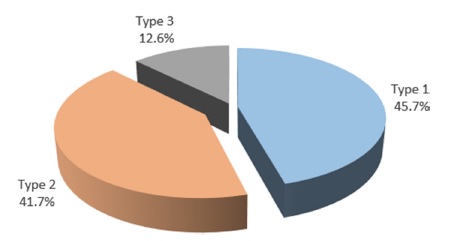
Distribution of facial type.
ANOVA results for factor scores according to face type
Cluster analysis identified that two to four clusters allowed for evenly distributing the face types into groups for custom designing masks to prevent fine dust infiltration. For this study, three clusters could accurately account for the different characteristics of adult Korean women’s face types. By cluster, there were 58 women in face type 1(45.7%), 53 in type 2 (41.7%), and 33 in type 3 (12.6%).
Face type 1 showed a high loading on factor 2, reflecting a long length of the middle part of the face, with a square shape and a large, long, wide nose (factors 5 and 7). The women with this face type have long lowed nose and chin points and large middle and lower faces, and a wide range of respiratory protection is available for this face type. Type 2 presents an oval shape with a moderate vertical length, factor 2, but with a small overall factor value. On factor 7, the nose angle was the largest item and the nose length is short, and on factor 5, Interocula breadth is short. The women with this face type had the smallest nose and face bodies, and this group has a limited range of comfortable and effective respiratory protection. Face type 3 shows triangle and small facial length down the middle with a wide outer mouth in the nose area. This face type had short noses and faces and small nose angles, severe angles in the 3D nose, and short lengths of the nose under the face and the jaw end point, so that the lower part of the face was small. This face type had the largest noses and thus required masks with a close fit around the nose.
A number of measurement items in the seven factor categories showed significant differences by face type: bitragion-subnasal arc, menton-subnasale length, face length, menton-stomion length, menton-glabella length, interocular breadth, and nose angle (all p <0.001) as well as bitragion-menton arc, sellion cross-side nose length, and nose length(p <0.01). The tragion to stomion, sellion cross-side nose angle, menton-euryon length shows differences that were significant at p <0.05.
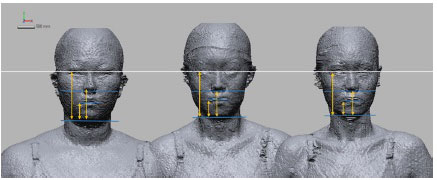
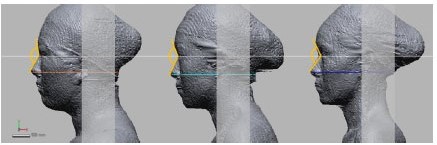
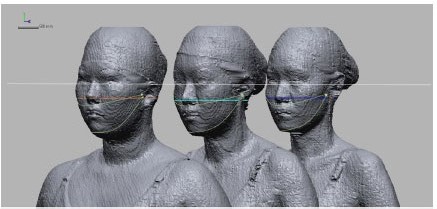
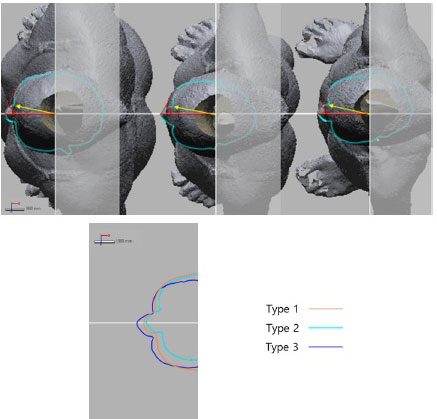
These face type differences highlight the importance of designing masks according to specific facial characteristics to ensure the best fit for proper filtration of particles. Table 7 shows the differences between the measured items by face type, and Table 8 presents the 3D shapes and the polymerizations of the cross-sections, also by face type.
ANOVA results for measurement items by face type(unit: mm)
Characteristics of facial clusters
4. Conclusions
For this study, we analyzed the facial features of adult Korean women in their 20s and 30s using 3D measurement data from the 6th Size Korea human dimension survey. Factor analysis extracted seven relevant factors: shape of the middle and lower part of the face, length of middle part of the face, thickness of the nose end point section, nose area length, mouth area width, nose area shape, and total size of the outer face. Classifying the adult female facial features resulted in three types. Face type 1 had a long face in the middle part with a large square shape. Type 2 had an egg shaped face of moderate length with the smallest middle and lower eyes. Type 3 had a small triangular shape with a wide outer mouth and nose.
Among the adult women’s face types, we identified particular differences in bitragion-subnasal arc, interocular breadth, nose angle, and nose length; this is where the 3D appearance is the most prominent and the part of the respiratory tract that has the greatest influence on breathing and activity when a person is wearing a mask. Even for adult women in their 20s and 30s, a mask’s degree of adhesion can vary by face type, so it is considered necessary to design masks that accommodate different face types and sizes.
Based on our findings, we consider that mask patterns need to vary in the widths of the nose supports, based on 3D measurements, to accommodate crinkling of the face so that there is no minute clearance at the upper part of the mask across the nose or under the chin. We also consider that designs based on 3D data need to strive to eliminate the discomfort caused by pulling due to close contact between the nose and mouth area, which moves the most when people are breathing and talking while wearing a mask.
Our aim with this study is for future scientists to use our face shape classification method to further refine 3D masks design by expanding available age and gender parameters to enable developing functional masks with high adhesion to protect the respiratory tract.
References
-
Agbolade, O., Nazri, A., Yaakob, R., Ghani, A. A., & Cheah, Y. K. (2020). Morphometric approach to 3D soft-tissue craniofacial analysis and classification of ethnicity, sex, and age. Plos one, 15(4),
[https://doi.org/10.1371/journal.pone.0228402]

- Choi, Y. L., Kim, J. S., & Nam, Y. J. (2009). Classification of head shape and 3-dimensional analysis for Korean women. Fashion & Textile Research Journal, 11(5), 779-787.
-
da Silva, A. M. B. R., Magri, L. V., Andrade, L. M., & da Silva, M. A. M. R. (2017). Three-dimensional analysis of facial morphology in Brazilian population with Caucasian, Asian, and Black ethnicity. Journal of Oral Research and Review, 9(1), 1-7.
[https://doi.org/10.4103/2249-4987.201405]
-
Eom, R, I., & Lee, Y. J. (2016). Three dimensional analyses of common masks and facial shapes for development of cold protection masks. Korean Journal of Human Ecology, 25(6), 737-748.
[https://doi.org/10.5934/kjhe.2016.25.6.737]
- ‘Guidelines on the specification of standard on the dust mask’. (2019, March 6). Ministry of Food and Drug Safety. Retrieved July 14, 2020, from https://www.mfds.go.kr/brd/m_99/view.do?seq=43296
- Han, D. H., & Choi, K. L. (2002). Development of half - masks well - fitting for Korean faces (1) - Facial dimensions and predictors of fit for half – mask, Journal of Korean Society of Occupational and Environmental Hygiene, 12(1), 46-54.
- Han, D. H., & Lee, J. M. (2004), Development of half-masks well-fitting for Koeran faces(2)-pilot study, Journal of Korean Society of Occupational and Environmental Hygiene, 14(8), 8-17.
-
Hughes, J. G., & Lomaev, O. (1972). An anthropometric survey of Australian male facial sizes. American Industrial Hygiene Association Journal, 33(2), 71-78.
[https://doi.org/10.1080/0002889728506611]
- IQAir AirVisual (2019). World air quality report region & city P.M2.5 ranking. IQAir. Retrieved July 14, 2020, from https://www.iqair.com/world-most-polluted-cities/world-air-quality-report-2019-en.pdf
- Kang, S. H., Yu, H .S., Lim, J. S., Park J. Y., Ahn, H. G., Ahn, H. R., & Shin, D. H. (2015). Customized 3D functional mask for yellow dust with reusability, Proceedings of the Korean Society of Mechanical Engineers, Spring Conference, Korea, pp.749-752.
- Kang, Y. S. (2016). The Research of the lifestyle facial masks characteristics and consumer`s wearing attitude. Journal of the Korean Society of Fashion Design, 15(3), 1-20. doi:10.5850/JKSCT. 2016.40.1.114
-
Kim, H. W., Han, D. H., Roh, Y. M., Kim, K. Y., & Park, Y. G. (2003). Facial anthropometric dimensions of Koreans and their associations with fit of quarter-mask respirators. Industrial Health, 41(1), 8-18. doi:10.2486/indhealth.41.8
[https://doi.org/10.2486/indhealth.41.8]
-
Kim, H., Seo, H., Myong, J. P., Yoon, J. S., Song, Y., & Kim, C. (2016). Developing yellow dust and fine particulate masks for children. Journal of Korean Society of Occupational and Environmental Hygiene, 26(3), 350-366. doi:10.15269/JKSOEH.2016.26.3.350
[https://doi.org/10.15269/JKSOEH.2016.26.3.350]
- Korean Agency for Technology and Standards. (2010). The 6th Size Korea 3D scan & measurement technology report. Seoul: Government Printing Office.
-
Lee, W. S., Jeong, J. G., Park, J. W., Jeon, E. J., Kim, H. E., Jung, D. H., Park, S. W., & You, H. C. (2013). Analysis of the facial measurements of Korean Air Force pilots for oxygen mask design. Ergonomics, 56(9), 1451–1464.
[https://doi.org/10.1080/00140139.2013.816376]
-
Lin, Y. C., & Chen, C. P. (2017). Characterization of small-to-medium head-and-face dimensions for developing respirator fit test panels and evaluating fit of filtering face piece respirators with different face seal design. PLOS one, 12(11),
[https://doi.org/10.1371/journal.pone.0188638]
- McConville, J. T., & Alexander, M.(1975). Anthropometric sizing program for oral nasal oxygen masks based on 1967 U.S Air Force surveys data. Aviation, Space, and Environmental Medicine, 46(11), 1383-1389.
- Song, Y. W., & Yang, W. H. (2010). Half-mask interface prototype design using Korean face anthropometric data. Journal of the Korea Safety Management and Science, 12(4), 87-92.
- ‘State of global air’. (2019). Health Effects Institute. Retrieved July 14, 2020, from https://www.stateofglobalair.org/sites/default/files/soga_2019_report.pdf
-
Yatapanage, K. G., & Post, K. (1992). Measurement of 3-D facial contours for the design of half-face respirators. American Industrial Hygiene Association Journal, 53(1), 19-26.
[https://doi.org/10.1080/15298669291359258]