Application Two-Dimensional Pattern Development of Cycling Tights based on the Three-Dimensional Body Scan Data of High School Male Cyclist

© 2020 (by) the authors. This article is an open access article distributed under the terms and conditions of the Creative Commons Attribution license (http://creativecommons.org/licenses/by/3.0/), which permits unrestricted use, distribution, and reproduction in any medium, provided the original work is properly cited.
Abstract
This study develops an optimal two-dimensional (2D) pattern from three-dimensional human scan data by considering the cycling posture and dermatome of high school male cyclists. By analyzing the body surface change in the cycling posture and considering the dermatome of the lower limbs, the optimal cutting line setting and the development of cycling tights for individual cyclists were presented to provide data that could be used in the clothing industry. We designed three cycling tights to solve the size unsuitability. 3D design 1 is a non-extension design based on the analysis of the 3D human body scan data, in which parts were connected diagonally from the front of the knee to the back of the knee. 3D design 2 removed both the front and back to reduce air resistance during cycling. 3D design 3 did not have a cutting line on the front panel because of the air resistance during cycling in the front area. We analyzed the garment pressure for 8 points of lower body and performed a subjective evaluation of the 3D designed tights and the current cycling tights. The 3D design 1 in this study was well received in the omphalion, thigh, and hip area, while 3D design 3 was well received in the omphalion, thigh, hip, and bottom bands. Therefore, the LoNE of 3D design 1 was applied to the front, and the hip cutting line of 3D design 3 was applied to the back.
Keywords:
3D human scan data, 2D clothing pattern, cycling posture, cycling tights, dermatome1. Introduction
With the increasing popularity of bicycles for use in public transportation, the general popularity of bicycling as a sport has increased, and the number of professional elite athletes has also been increasing. The globalization of cycling has progressed at a significant pace in recent years with a record number of events and teams registered. Elite athletes come from a growing range of countries around the world. In just four years, there has been an increase of more than 50 registered UCI Continental teams: from 122 in 2010 to 177 in 2014. The global popularization of cycling is diversifying the professional peloton with more than 70 different nations represented in 2013(Union Cycliste Internationable, n. d.).
Cycling requires a bent posture during exercise, and movement of the lower limbs requires speed and endurance(Park, 2018). The comfortable fit of the cycling wear worn during cycling is an important index for the quality evaluation of sportswear. It affects not only athletes’ health, but also their performance during sports(Bartels, 2005). Any tension or folding on the surface of the clothing should be avoided as much as possible for those who need a record in racing or have a special body form(Jeong et al., 2006). Compression athletic wear, such as tights and elastic shorts, has become increasingly popular among power based sports for better fit, enhancing performance and recovery in muscle fatigue(Manshahia & Das, 2014). Previously, many researchers concluded that fabric performance is the most important factor of functional clothes. However, the optimization of garment patterns in a dynamic state is an effective way to improve the comfort and functionality(Liu et al., 2016a) of sportswear. Most of the patterns have been developed in a static state without considering the dynamic state. This is one of the reasons why it is difficult for consumers to choose the right clothing and why there are problems with clothing fit. Therefore, it is necessary to study skin deformation in cycling to design high-performance sportswear, such as compression cycling tights.
A dermatome is an area of skin that is mainly supplied by afferent nerve fibers from a single dorsal root of a spinal nerve which forms an area of a spinal nerve(Fig. 7). Along the thorax and abdomen, the dermatomes resemble a stack of discs forming a human, each supplied by a different spinal nerve(Dermatome, n. d). Dermatomes are regularly arranged on the body surface in each neuromere, along with the distribution of sensory and motor nerves (Kim, 2008). Iberall(1970) developed a method of mapping a nonstretching line on the body surface to create a variable pressure suit. This line of non-extension(LoNE) does not increase and keeps the appropriate pressure, but does not restrain the human body. In studies involving dermatomes, Kim(2008), in a basic research to develop functional clothing, analyzed the change of a dermatome according to dynamic posture and suggested a method for establishing construction lines of functional clothing. Choi and Hong (2015) provided a practical guide line for LoNE that depends on the length of the pants, and the LoNE of the lower body were investigated extensively. Quantification of deformation along the various curvature directions on the body surface is helpful for functional design lines and their fabrication using seams. One of the key variables affecting the performance and comfort of compression suits is the location and quality of the seams that join and assemble the pattern panels together(Choi & Hong, 2015). In recent years, the clothing industry has been paying more attention to user-customized clothing design in which computer-aided design(CAD) technologies speed up the design procedure and shorten the time taken from designing to fabricating, and 3D body scanning has become a revolutionary technology that is changing many aspects of the clothing industry(Zang et al., 2014). Three-to two-dimensional(2D) deployment is often used to make tight-fitting clothes. However, most of these designs are based on the static state, without considering the dynamic state. Pattern manufacturing has focused on a standard body type for most clothing patterns without providing a proper fit for each individual body shape. To enhance the fit of clothing, it is necessary to incorporate the subtle features of body shape and posture in clothing patterns(Choi & Nam, 2009). In a study that reflects dynamic posture in relation to cycling wear, Luo et al.(2017) obtained the lower body skin deformation map using the gel rubbing method. The study proposed a reliable and convenient method to procure skin deformation for active body postures. The results provide primary data for pattern designers to determine suitable ease distribution, reasonable divisions of clothing patterns and matching elastic fabric for each division of cycling shorts. Liu et al.(2016b) used 3D-to-2D flattening technology to develop patterns of a jersey T-shirt. A novel pressure measuring method was proposed to test the clothing pressures in static and dynamic states in a virtual environment. Park and Kim(2019) analyzed the changes in body surface by road bike driving motion through 3D human body scanning. The standard pattern was modified by consideration of body surface change analysis and motion suitability, and the final pattern was suggested through electroencephalogram(EEG) analysis. However, these studies were not aid at the development of automatic pattern-making systems or the improvement of athletic performance of professional athletes. There are many problems in applying these studies to cyclists because the difference in garment pressure between the static and dynamic states were studied using the pattern of the static state. Our body dimensions and shapes change as we move. The dimensions measured during dynamic states provide information regarding adjustments that can be made to clothing to facilitate ease of motion(Shin & Chun, 2013). Additionally, even for garments made of the same material, there is a difference in fit depending on the cutting line, which is determined in the design construction of the clothing. Thus far, there has been no exploration of skin deformation of the lower limbs in the cycling posture for cyclists. Therefore, we aim to develop compression cycling tights, observe changes in the body surface for cycling dynamic posture, and apply the dermatome to improve athletic performance. Customers’ demand for better fitting clothing is increasing in today’s clothing market, and clothing companies are increasingly interested in providing customized clothing as a new and unique way to market their clothes. Accordingly, if more efficient and automated methods for making individually customized patterns are developed, this may facilitate the provision of individual customization of clothes(Han et al., 2014).
The goal of this study is to develop an optimal 2D pattern from 3D human scan data by considering the cycling posture and dermatome for high school male cyclist. By analyzing the body surface change in the cycling posture and considering the dermatome of the lower limbs, the optimal cutting line setting and the development of cycling tights for individual cyclists are presented to provide data that can be used in the clothing industry.
2. Methods
2.1. Subjects
In our previous study(Park & Do, 2015a), we visited the National Junior Cycling Race organized by the Korea Cycle Federation, which is a member of the Korean Sport & Olympic Committee. It was launched with the purpose of distributing cycles to cultivate excellent athletes and leaders. We measured 50 items of the human body of high school male cyclists from first to third grade. In this study, we selected the subject closest to the average of a total of 111 participants.
2.2. Testing
The body scan was conducted with an Artec Eva device, which is a contactless hand scanner, that can scan either by moving the object to be scanned or by rotating the scanner 360° around the target. The data scanned from multiple angles can be obtained automatically and in real time at the same time as scanning. The specifications of the scanner are listed in Table 1.

Artec Eva specifications
A 3D human body scan was performed on the subject in cycling and standing postures to develop the cycling tights for the cyclist by considering the cycling exercise using 3D human body scan data. In the case of the lower limbs during cycling, the maximum and minimum ranges are extremely wide and the their postures of various angles are formed by the bending of the upper body and the rotation of the lower limbs. Finally, as depicted in Fig. 1, the cycling posture was determined to be 145° at the waist and 90° at the knee.
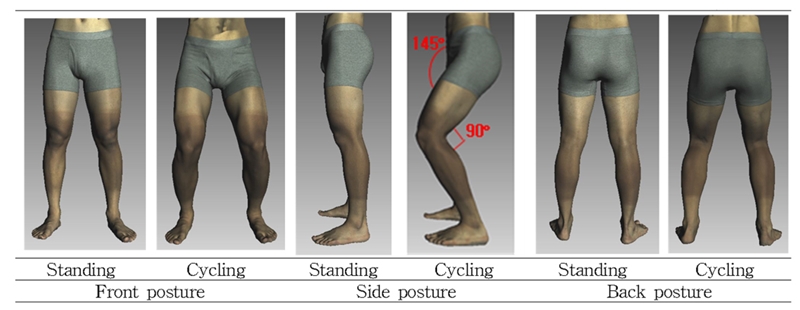
3D body scan posture.
The scan data were aligned and synthesized using the program Artec Studio 11 Professional. The missing areas can be mesh prepared by hole filling and healing defects, missing area reconstruction, remeshing and rewrapping, and surface smoothing with the program Design-X(Fig. 2).
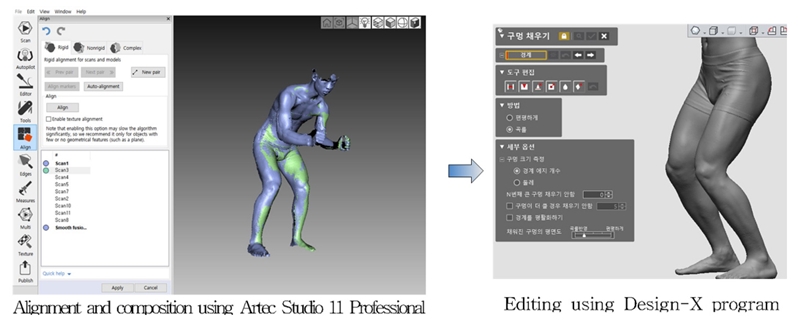
Editing process.
2.3. 2D pattern development using 3D body scan data
The Optitex program was used to develop the 2D pattern from the 3D human body scan data to develop the athlete’s cycling tights. Optitex is a 3D virtual program, but it is possible to produce a 2D pattern in the program so that the pattern can be modified immediately after seeing the wearing state. The 3D human body scan data can be used as a model in the program. Additionally, the 3D human body scanned shape stored as an obj file can be used as a model in the program, and various shapes can be applied. By using the flattening tool, we can see the mesh of the saved model and draw the desired design on the body shape so that the pattern is immediately compatible(Fig. 3).
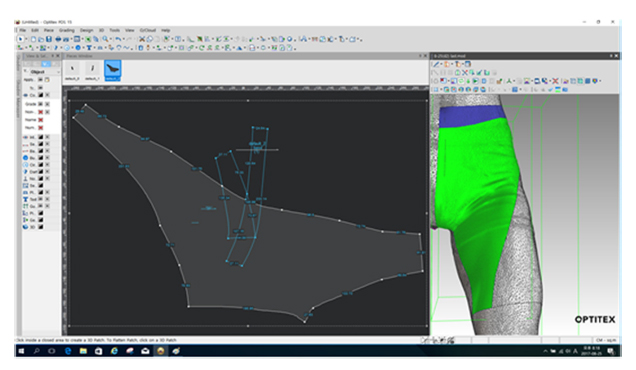
Flattening.
2.4. 3D design of cycling tights
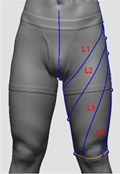
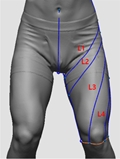
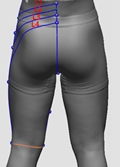
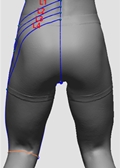
To develop the cycling tights using the 3D body scan data of the subject in a cycling posture, body surface changes according to the standing and cycling postures were analyzed in Design-X. In reference to the previous study(Choi, 2016; Kim, 2008) analyzing the deformation characteristics of the skin according to the exercise posture, only L1–L4 are generated in the direction similar to the dermatomes according to the mesh to determine the non-extension. We generated curves according to the cycling posture and analyzed the changes. Finally, in this study, the design cutting line that is most suitable for the cycling tights for high school male cyclists was established. Three cycling tights were developed, designed by non-extension, without cutting lines, and using dermatomes, respectively(Fig. 4). Cycling tights were made by 2ndwind, a Korean cycling wear company, using the material most frequently used for cycling tights. The material properties are listed in Table 2.
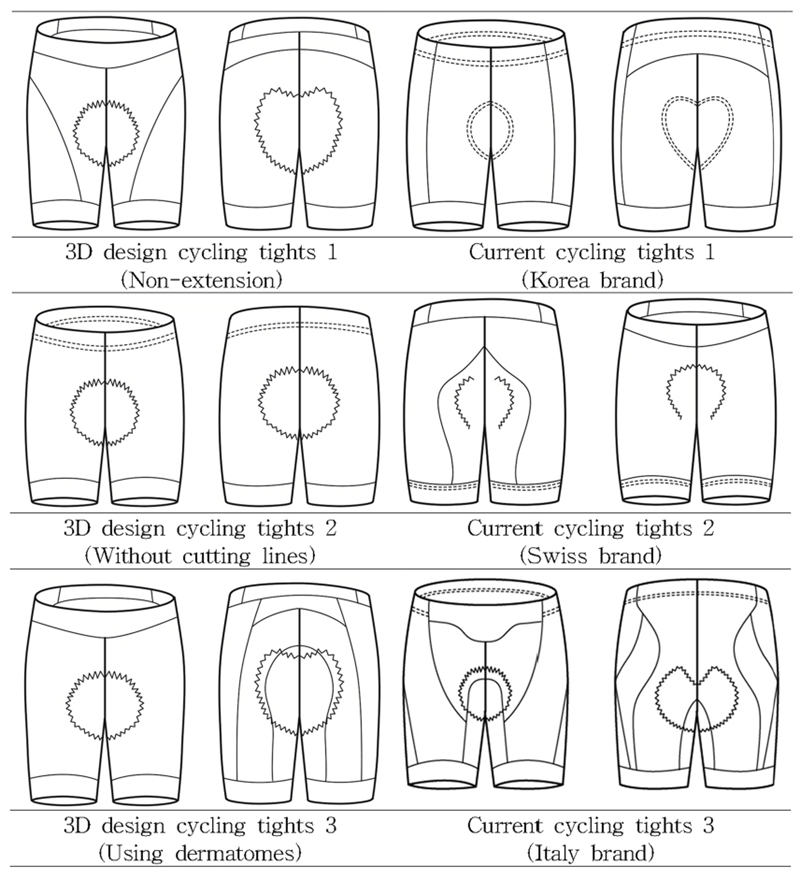
3D design and current cycling tights.
Properties of experimental material and KES
2.5. Garment pressure and subjective evaluation of cycling tights
We analyzed the garment pressure and performed a subjective evaluation of the 3D designed tights and current cycling tights. Schematics of the 3D design of this study and the current cycling tights are illustrated in Fig. 4. For the current cycling tights, we selected a Korea brand with common cutting lines, a Swiss brand with the cutting line only at the hip, and an Italian brand with the largest cutting lines.
The garment pressure measurement was performed using a TNL-AMI 3037-10 air-injection garment pressure sensor, and the garment pressure measurement sensor was used to inject air into a non-woven air pack. The measured pressure was stored in a .txt file for 1min at 1s intervals via Agilent’s data collector. The garment pressure device is depicted in Fig. 5.
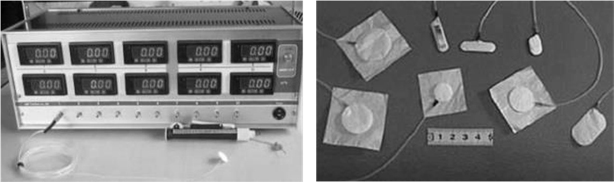
Garment pressure measuring device. www.technox.co.kr.
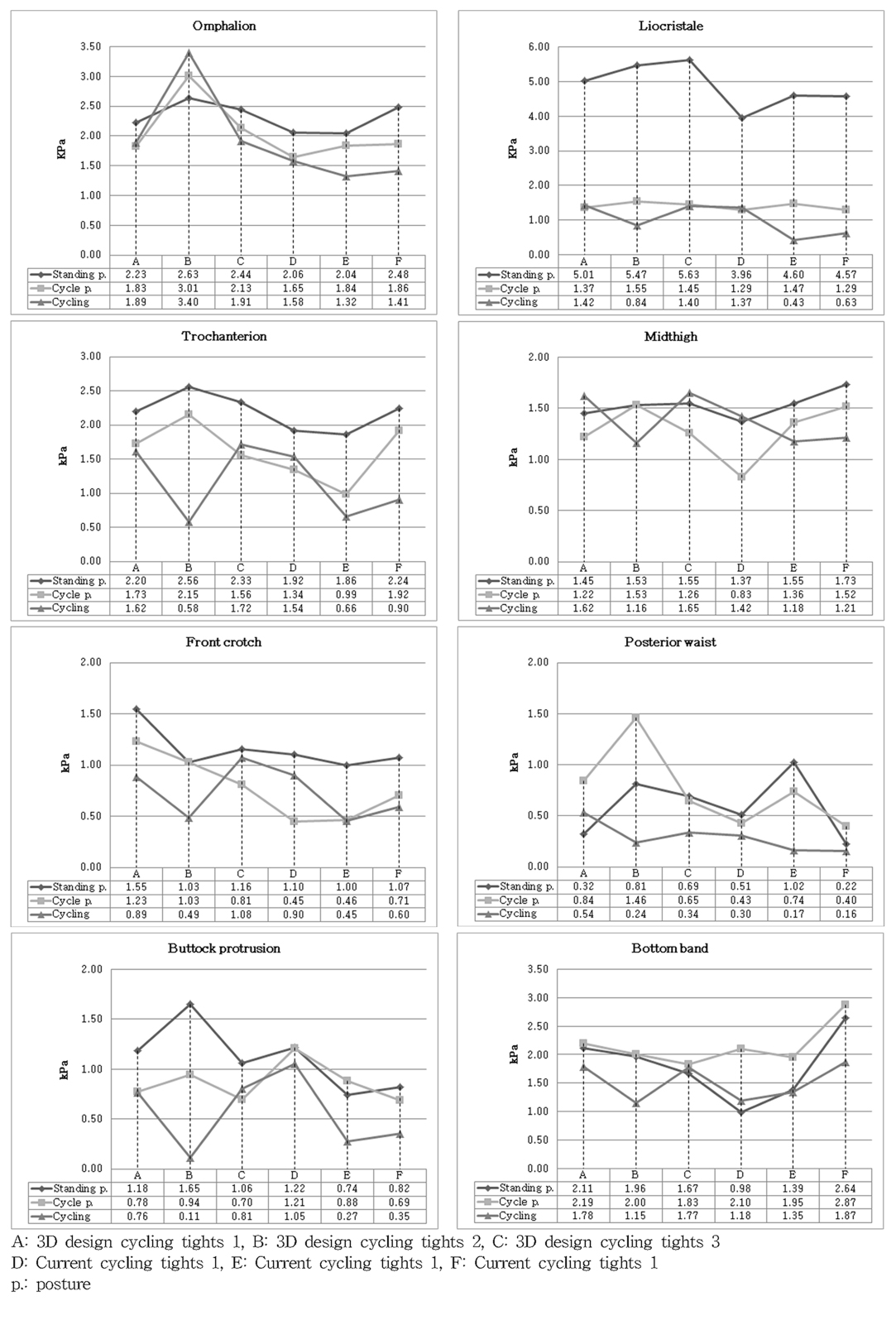
The subject of this experiment was a high school male cyclist on whom a 3D human body scan was conducted(Fig. 6). To measure garment pressure, garment pressure sensors were attached to the following measuring points: ① omphalion, ② liocristale, ③ trochanterion, ④ midthigh, ⑤ front crotch, ⑥ posterior waist, ⑦ buttock protrusion, and ⑧ bottom band.
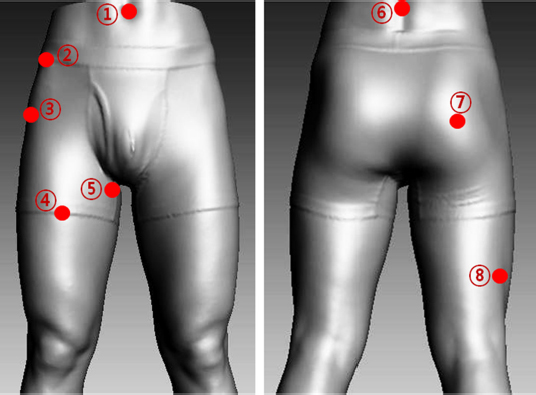
Garment pressure measurement points.
Three types of garment pressures were measured: for 1 min in a standing posture and a sitting posture with the legs bent before cycling, and while cycling at 50 km/h for 5 min. Subjective evaluation was assessed by adding five high school male cyclists of similar size to the subject of garment pressure measuring. Six tights were randomly selected and worn before cycling and for 5 min at 50 km/h. Evaluation of the pressure at the eight areas of the garment was categorized as ‘very weak’, ‘weak’, ‘moderate’, ‘strong’, and ‘very strong’. We asked about the cyclists to choose between feelings of “unpleasant” and “pleasant” and asked them how they would like to change the garment pressure if their answer was “unpleasant”.
3. Results and Discussion
We analyzed the body surface length of 3D human body scan data according to dermatomes to develop cycling tights for high school male cyclist considering the cycling posture. Additionally, according to the selected design, a total of three tights were produced by developing a 2D pattern.
3.1. 3D human body scan data analysis and cycling tights development using dermatomes
To develop cycling tights for high school male cyclist, we attempted to identify the construction lines of clothing by applying dermatomes, as depicted in Fig. 7. Dermatomes refer to the skin area where the spinal nerves are distributed, and all the skeletal muscles to which the motor nerves derived from these dermatomes are distributed, the sensory nerves to the skeletal muscles, and the skin areas where the sensory nerves are distributed. Nakazawa(1999) attempted to utilize dermatomes as construction lines of clothing by considering the anatomy of the human body. When the skin is stretched, the haunches axial line of the control area of the lumbar nerve and the sacral nerve, the stretched area, were used as the construction line of the slacks. In a previous study, Kim(2008) predicted that disturbing the passage of nerves would slow the responsiveness to exercise; thus, it would interfere with exercise if the dermatomes were not considered. The optimal dermatome, L4, was selected so that the cutting line of the functional tight-fitting clothing did not interfere with the dermatome. Choi(2016) constructed a performance cutting line and designed tight-fitting clothing based on the LoNE and the constitutive cutting line where the change in body surface was relatively small. Therefore, if the dermatome of the human body is applied as a clothing construction line, the athletic performance is expected to improve without restraint on the human body.
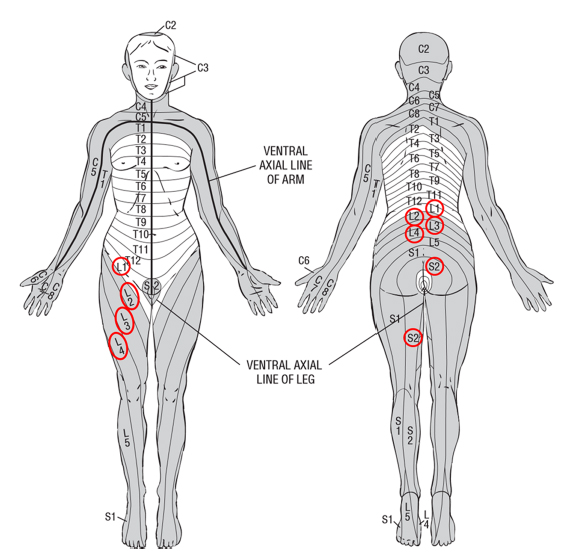
Dermatomes. (Greenberg(2003). “The history of dermatome mapping”. Archieves of Neurology.)
In this study, the major measurement points of the 3D body scan data were landmarked using Design-X to analyze the changes in the human body surface according to the standing and cycling postures. The purpose of this study was to develop the five-length tights. The front and back center line was drawn on the body shape, the inseam was formed along the crotch area, and the knee circumference was marked based on the knee point. By referring to the previous study, curves were generated according to the mesh in a direction similar to the dermatome lines corresponding to L1–L4 in the body shape in the standing and cycling postures(Table 3). Consequently, the length of L1 and L2 decreased in the cycling posture comparison with that in the standing posture, whereas L3 and L4 increased in length during cycling. Analyzing the change in the length of the body surface in the standing and cycling postures, revealed that the value between L2 and L3 changed from negative to positive. It is assumed that there is a 0 value between L2 and L3, and the LoNE is set to the area closer to L3 based on the rate of change. Although the cutting lines are designed in a variety of ways in clothing design, seams along the cutting lines of tight-fitting clothing, such as cycling wear, can restrain the human body and further affect athletic performance. Therefore, the cutting lines in majority of the cycling wear interfere with the cycling exercise; thus, the non-extension lines of the body shape need to be used as the cutting line of clothing to enhance the fit. In this study, a line close to L3 was applied to the design of the cycling tights.
Length of the body surface according to dermatomes
3.2. 3D design of cycling tights
We designed three tights by considering the cycling posture in Optitex(Fig. 8). 3D design 1 is a non-extension design based on the analysis of the 3D human body scan data, in which parts were connected diagonally from the front of the knee to the back of the knee. A rubber band was inserted at the back of the waist, and the front area was made without the rubber band so as not to encumber breathing. The width of the bottom bands were 7 cm in all. 3D design 2 reflected the dissatisfaction with the feeling of seam in the current cycle wear satisfaction survey of the previous study(Park & Do, 2015b), and the cutting lines were from removed both the front and back to reduce air resistance during cycling. In the case of 3D design 1, abdominal breathing was important, and the front area did not use the band. According to the cycling wear manufacturer, if the band is not inserted, the abdomen may be folded during cycling. Consequently, 3D design 2 was made by inserting a rubber band all around the waist. 3D design 3 did not have a cutting line on the front panel because there of the air resistance during cycling in the front area. The S2 line of the dermatome was selected and applied to the design of the hip pad. Nakazawa(1999) suggested that the S-segment of the dermatome should be considered for wearing comfort in the structure of slacks, including the perineal area that is most drooped by the exercise of the lower limb, and the adductor magnus and posterior gluteal area. However, it is difficult to sew pads because there is no cutting line other than at the hip, based on consultation with the cycling wear manufacturer, cutting lines were added on both side lines and the waist line to facilitate sewing the pads. Additionally, because the hip is an area where the feeling of thickness is felt from the pad, it was judged that the seam there is not significantly felt.
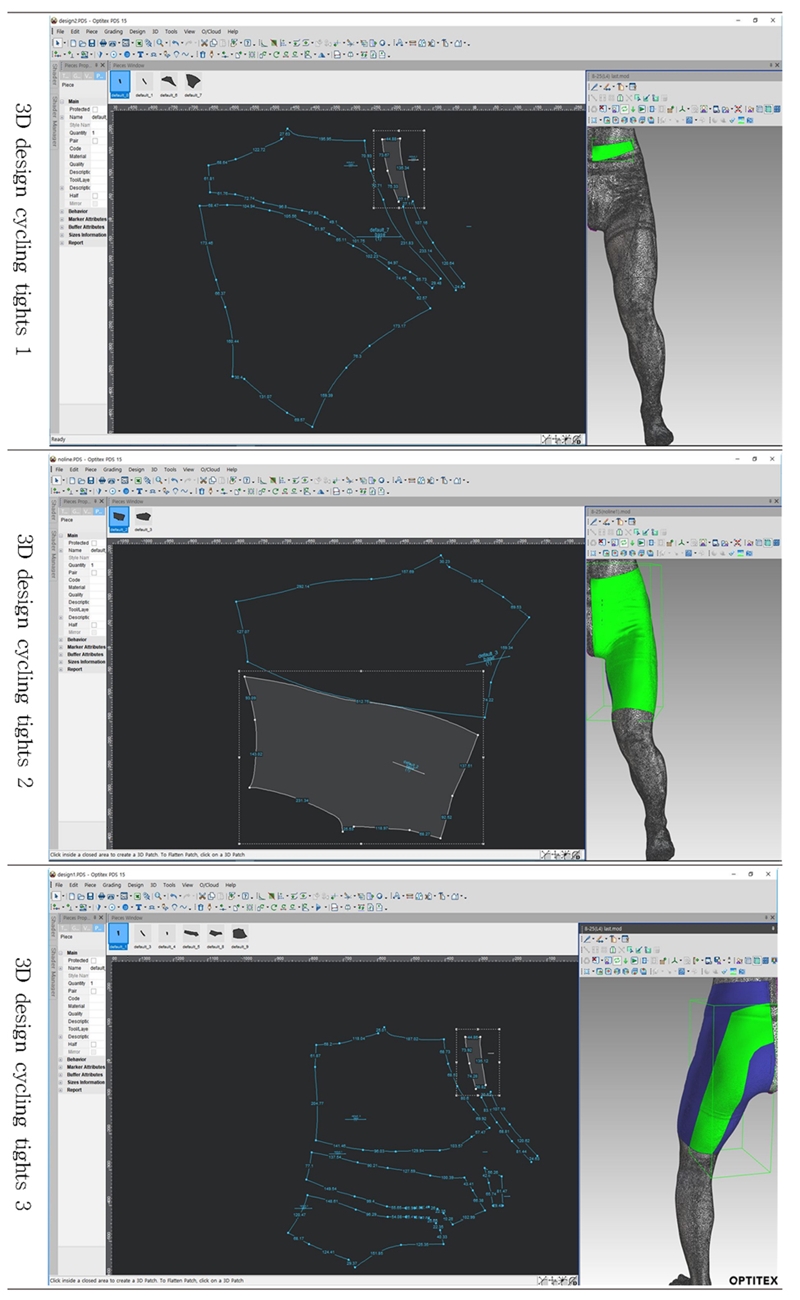
Pattern development of 3D design cycling tights.
Because cycling tights are made of stretchable material, the pattern was completed by applying a reduction ratio to the developed pattern. This is a pattern reflecting the cycling exercise by flattening the cycling posture of the 3D human body scan data. The lines of the deployed pattern have been modified to complete the pattern depicted in Fig. 9, and the wearing conditions of the subject are depicted in Fig. 10.
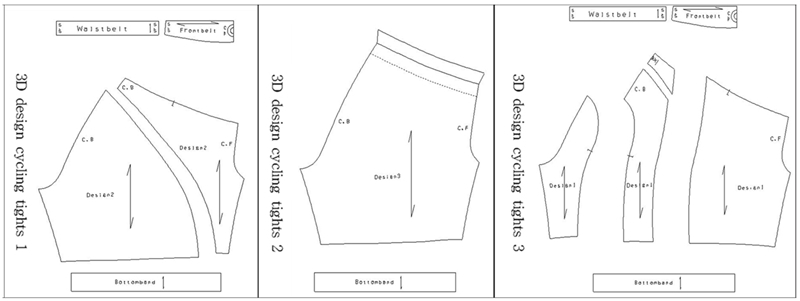
Patterns of 3D design cycling tights.
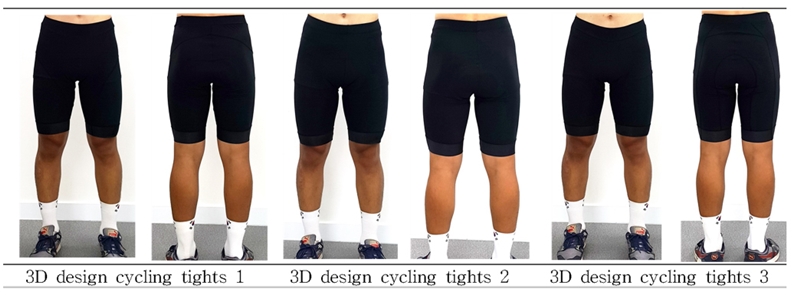
Wearing conditions of 3D designs.
3.3. Results of cycling tights garment pressure and subjective evaluation
Garment pressure measurements of the 3D design tights and current cycling tights are presented Table 4 and the results of the subjective evaluation are depicted in Fig. 11. Additionally, the optimal garment pressure was suggested, as given in Table 5, to influence performance improvement during cycling. Garment pressure was found to be most sensitive in the omphalion and bottom bands, and the 3D designs reflecting cycling posture were found to be close to human body. From an analysis of each garment pressure measurement point, it was found that the garment pressure at the omphalion point is an important area for improving the cyclist’s athletic performance because of breathing. 3D designs 1 and 3, which did not have a rubber band at the front, received a good evaluation. Appropriate garment pressure in this area was suggested at 2.23-2.44 kPa for standing postures and 1.83-2.13 kPa for cycling postures. The garment pressure of the liocristale point was measured on the bone; thus, the pressure value was higher than that of other areas. In particular, the garment pressure of the 3D designs reflecting cycling posture was 5.01-5.63 kPa, which was higher than other garment pressures; however, the subjects did not feel the garment pressure strongly according to the subjective evaluation. Although the garment pressure is high owing to the tightness on the body when wearing tights, it is considered that the garment pressure is lowered by the elasticity of the material during cycling and does not interfere with exercise. The trochanterion point is an area that undergoes a considerable amount of movement during cycling, and various garment pressures were measured; however, the pressures were generally appropriate based on the subjective evaluation before and after cycling. The subjective evaluation of the midthigh varied for each subject for the same tights; this is considered to result from the different movements and muscle masses caused by the cycling exercise. 3D designs 1 and 3 exhibited slightly higher garment pressures during cycling than when the subject was in a standing posture; however, these were deemed mostly adequate from the subjective evaluation average. Current tights 2 was also found to be appropriate based on the subjective evaluation average. Appropriate garment pressure of midthigh was suggested at 1.45-1.55 kPa for standing posture and 1.22-1.26 kPa for a cycling posture. In the tight-fitting performance sportswear study of Kim(2008), the garment pressure of the three femurs was 0.73-1.32 kPa, and the mean garment pressure was 0.23 kPa, indicating that the garment pressure of our study was higher. This demonstrates that cycling tights require some degree of pressure for cycling. The front crotch area showed that the cycling pad had a greater effect on garment pressure and the subjective evaluation than the tightness of the clothing itself. The posterior waist point pressure was generally low because of the lack of pressure on the back waist from the bending posture of the cyclist. 3D designs 1 and 3 do not have a rubber band at the front area and the pressure in the area is appropriate based on the subjective evaluation average before and after cycling. The buttock protrusion area showed the highest garment pressure in the standing posture in 3D design 2; however, it was rapidly lowered during cycling, and hence, did not support the muscles. Current cycling tights 3 was felt to show the highest garment pressure in subjective evaluation in comparison with the measured garment pressure. Therefore, 3D design 2 without cutting lines was weak in muscle support, and current cycling tights 3 with many cutting lines seemed to make the subjects feel more subjective garment pressure while restraining the human body. Garment pressure of the bottom band is the most important area for cycling exercise, and appropriate garment pressure in that area is crucial because it affects athletic performance. Therefore, the band of 3D design 3, which supports the thigh area with a similar garment pressure in all postures, received the best evaluation. Appropriate garment pressure in this area was suggested at 1.37 kPa for the standing posture and 1.83 kPa for the cycling posture. In summary, it was found that 3D design 1 in this study was well received in the omphalion, thigh, and hip area, while 3D design 3 was well received in the omphalion, thigh, hip, and bottom bands. Consequently, using a design with the application of the dermatome as a cutting line of clothing, will benefit the development of tight-fitting clothing that does not constrain the human body. Therefore, the LoNE of 3D design 1 was applied to the front, and the hip cutting line of 3D design 3 was applied to the back. The 3D virtual try-on system using Optitex is illustrated in Fig. 12.
Variation of garment pressure at the measuring points
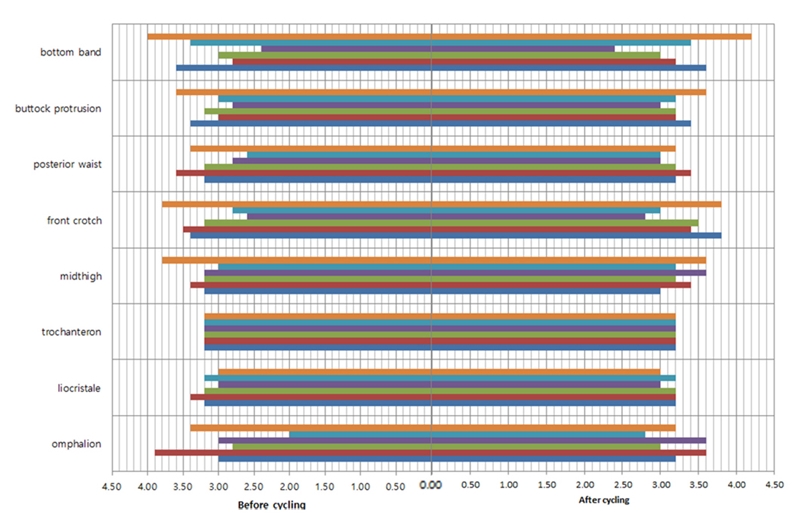
Mean values of subjective evaluation before and after cycling.
Appropriate garment pressure(Unit: kPa)
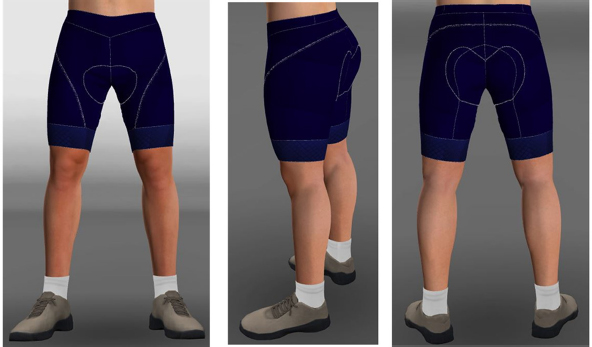
3D virtual try-on of prototype using Optitex.
4. Conclusions
The goal of this study was to develop a 2D tight-fitting pattern for cycling tights with the appropriate garment pressure from 3D human body scan data by considering the cycling posture. By analyzing the dermatome of the lower limb, the optimal cutting line setting and the cycling tights were developed for individual cyclists. We were designed three cycling tights to solve the size unsuitability of adolescents. 3D design 1 is a non-extension design based on the analysis of the 3D human body scan data, in which parts were connected diagonally from the front of the knee to the back of the knee. 3D design 2 reflected the dissatisfaction with the feeling of seam in the current cycle wear satisfaction survey of the previous study(Park & Do, 2015b), and the cutting lines were from removed both the front and back to reduce air resistance during cycling. 3D design 3 did not have a cutting line on the front panel because there of the air resistance during cycling in the front area. The S2 line of the dermatome was selected and applied to the design of the hip pad. We analyzed the garment pressure for 8 points of lower body and performed a subjective evaluation of the 3D designed tights and the current cycling tights. As a results, garment pressure was found to be most sensitive in the omphalion and bottom bands, and the 3D designs reflecting cycling posture were found to be close to human body. Garment pressure of the bottom band is the most important area for cycling exercise, and appropriate garment pressure in that area is crucial because it affects athletic performance. 3D design 2 without cutting lines was weak in muscle support, and current cycling tights 3 with many cutting lines seemed to make the subjects feel more subjective garment pressure while restraining the human body. In summary, it was found that 3D design 1 in this study was well received in the omphalion, thigh, and hip area, while 3D design 3 was well received in the omphalion, thigh, hip, and bottom bands. In this study, subjects perceived different levels of garment pressure due to a variety such as selvage, sewing methods and movement according to the body curves. Consequently, using a design with the application of the dermatome as a cutting line of clothing, will benefit the development of tight-fitting clothing that does not constrain the human body. Therefore, the LoNE of 3D design 1 was applied to the front, and the hip cutting line of 3D design 3 was applied to the back. Additionally, we suggested that the technique of deploying 3D body types to 2D patterns can be utilized in the clothing industry, opening up the possibility of designing optimal athletic tights for each athlete. The results of this study are expected to be utilized in clothing production to increase the efficiency of individual garment production in the future.
References
-
Bartels, V. T. (2005). Physiological comfort of sportswear. Textiles in Sport, 177-203.
[https://doi.org/10.1533/9781845690885.3.177]

- Choi, J. Y. (2016). 3D skin length deformation of lower body for guidelines on 3D non-uniform compression suits and performance evaluations of compression suits with isokinetic muscular function, cardiopulmonary ability and wear comfort. Unpublished doctoral dissertation, Chungnam National University, Daejeon.
-
Choi, J. Y., & Hong, K. H. (2015). 3D skin length deformation of lower body during knee joint flexion for the practical application of functional sportswear. Applied Ergonomics, 48, 186-201.
[https://doi.org/10.1016/j.apergo.2014.11.016]
-
Choi, Y. L., & Nam, Y. J. (2009). Surface pattern comparison among lateral body types flattening 3D figure data. Fibers and Polymers, 10(6), 837-846.
[https://doi.org/10.1007/s12221-009-0837-7]
-
Greenberg, S. A. (2003). The history of dermatome mapping. Archives of Neurology, 60(1), 126-131.
[https://doi.org/10.1001/archneur.60.1.126]
-
Han, H. S., Kim, J. Y., Kim, S. M., Lim, H. S., & Park, C. K. (2014). The development of an automatic pattern-making system for made-to-measure clothing. Fibers and Polymers, 15(2), 422-425.
[https://doi.org/10.1007/s12221-014-0422-6]
-
Iberall, A. S. (1970). The experimental design of a mobile pressure suit. Journal of Basic Engineering, 92(2), 251-264.
[https://doi.org/10.1115/1.3424984]
-
Jeong, Y. H., Hong, K. H., & Kim, S. J. (2006). 3D pattern construction and its application to tight-fitting garments for comfortable pressure sensation. Fibers and Polymers, 7(2), 195-202.
[https://doi.org/10.1007/BF02908267]
- Kim, S. Y. (2008). Engineering design process of tight-fit performance sportswear using 3D information of dermatomes and skin deformation in dynamic posture. Unpublished doctoral dissertation, Chungnam National University, Daejeon.
-
Liu, K., Kamalha, E., Wang, J., & Agrawal, T. K. (2016a). Optimization design of cycling clothes’ patterns based on digital clothing pressures. Fibers and Polymers, 17(9), 1522-1529.
[https://doi.org/10.1007/s12221-016-6402-2]
-
Liu, K., Wang, J., Zhu, C., & Hong, Y. (2016b). Development of upper cycling clothes using 3D-to-2D flattening technology and evaluation of dynamic wear comfort from the aspect of clothing pressure. International Journal of Clothing Science and Technology, 28(6), 736-749.
[https://doi.org/10.1108/IJCST-02-2016-0016]
-
Luo, S., Wang, J., Yao, X., & Zhang, L. (2017). A novel method for determining skin deformation of lower limb in cycling. The Journal of The Textile Institute, 108(9), 1600-1608.
[https://doi.org/10.1080/00405000.2016.1269403]
-
Manshahia, M., & Das, A. (2014). Effect of fiber and fabric constructional parameters on dynamic behavior of compression athletic wear. Fibers and Polymers, 15(2), 414-421.
[https://doi.org/10.1007/s12221-014-0414-6]
- Nakazawa. (1999). Garment and body type. Seoul: Yehaksa.
- Park, H. J. (2018). Development of tight-fit tights and sizing system of cycle wear for male highschool cyclist. Unpublished doctoral dissertation, Chonnam National University, Gwangju.
-
Park, H. J., & Do, W. H. (2015a). A comparative study for anthropometric measurements of highschool boys and highschool boys cyclist. Fashion & Textile Research Journal, 17(2), 258-264.
[https://doi.org/10.5805/SFTI.2015.17.2.258]
-
Park, H. J., & Do, W. H. (2015b). A research on the actual wearing condition of cycle wear for athletes - Focusing on male cyclist in domestic highschool. Fashion & Textile Research Journal, 17(4), 597-603.
[https://doi.org/10.5805/SFTI.2015.17.4.597]
-
Park, S. Y., & Kim, K. H. (2019). A study on the patterns of roadbike pants through 3D body scanning analysis and evaluation of movement. Journal of Korean Traditional Costume, 22(3), 41-55.
[https://doi.org/10.16885/jktc.2019.09.22.3.41]
-
Shin, S. M., & Chun, J. S. (2013). Changes in back body surface measurements for dynamic postures in the form of baseball batting motion with a 3D body scanning. International Journal of Human Ecology, 14(1), 41-55.
[https://doi.org/10.6115/ijhe.2013.14.1.41]
- Union Cycliste Inetrnationale. (n. d.). Cycling, a global activity. Retrieved from https://www.uci.org/world-cycling-centre/development/cycling-global-activity, .
- Dermatome. (n. d.). Wikipedia. Retrieved from https://en.wikipedia.org/wiki/Dermatome_(anatomy)
-
Zhang, D. L., Wang, J., & Yang, Y. P. (2014). Design 3D garments for scanned human bodies. Journal of Mechanical Science and Technology, 28(7), 2479-2487.
[https://doi.org/10.1007/s12206-014-0605-5]