
Comparison of Plantar Pressure and Contact Time on Gait between the Korean Young and the Elderly Women

© 2017 (by) the authors. This article is an open access article distributed under the terms and conditions of the Creative Commons Attribution license (http://creativecommons.org/licenses/by/3.0/), which permits unrestricted use, distribution, and reproduction in any medium, provided the original work is properly cited.
Abstract
This study was undertaken to compare the gait characteristics between the Korean elderly and young adults, we measured the plantar pressure and contact time of gait with barefoot along a walkway at their preferred walking speed. The results indicate that older people exhibited significantly less plantar pressure than young adult in all 3 regions (FF, MF and RF) and significantly less time % on the initial contact phase (ICP), forefoot push-off phase (FFPOP) and significantly more % forefoot contact phase (FFCP) and foot flat phase (FFP). The converted plantar pressure value to percentage, it showed more pressure in forefoot (FF) in the elderly person than the young adults. It could be explained that the forward shifting in plantar pressure are associated with a more flexed posture of elderly such as actual stabilizing fearrelated adaptations. Longer total foot contact time in the elderly means that the old people show the decreased gait velocity. In other words, lower velocity was found to be associated with pre-existing fear of falling. With longer contact time and slower stepping movement, the elderly become more unstable. With these findings, it could be confirmed that there were significant changes in foot characteristics which contribute to alter the plantar pressure and contact time during gait with advancing age. Further research is required to establish possible links to risk of falling and development of footwear in the elderly adults.
Keywords:
gait, plantar pressure, contact time, Korean young and the elderly, footwear1. Introduction
For the elderly people, it is very important to maintain good walking ability for good quality of life. As life expectancy and the aging population increase, it is becoming increasingly important to understand the effects of aging on walking. Considering the already known sensorial deficits and structural changes of foot related to the aging, it is important to understand how gait characteristics change and how this information can be helpful to manage injuries commonly related to walking in the elderly (Machado et al., 2016). Since aging is associated both with progressive degeneration of the central nervous system and peripheral nerves (Anguera & Gazzaley, 2012).
In previous studies (Eils et al., 2002; Kim et al., 2014), they revealed that a decrease in foot function affects non-uniform distribution of weight throughout the foot, which leads to a decrease of balance control. The elderly experience functional changes in foot as getting older with overall decline in functional ability such as a decrease in muscle power and flexibility. Because of the reduced balance ability, the risk of falling is increasing, and it causes limitation of outdoor activities and a decrease in quality of life of the elderly (Kim & Hwangbo, 2015). The inability to perform basic activities of daily living such as gait increases the elderly individual’s tendency for nursing home care. This increase presents a considerable financial concern to our health-care system as well as our society (Kernozek & LaMott, 1995). In particular, falls among the elderly are a serious threat to their functional mobility in activities of daily living. Kilby et al.(2014) insisted that it is necessary to understand what mechanisms and processes of gait cause falls in the elderly. Therefore, addressing gait characteristics such as contact time and plantar pressure in the elderly would be able to provide important clinical information.
In the recent years, the plantar pressure and contact time of gait phase have widely been accepted as a vital biomechanical parameter to evaluate human walking. The distribution and magnitude of plantar pressure and contact time can provide useful information to diagnose the abnormal foot and present objective measures to track disease progression (Rai & Aggarwal, 2006). Chiu et al. (2013) revealed that increased gait changes resulted from aging factors such as nervous and musculoskeletal deterioration and sensory, perceptual and cognitive degeneration. The gait performance of the elderly is typically characterized by variations in slower walking speed, shorter steps, increased step width, decreased muscle strength and reduced range of motion. While several studies (Burnfield et al., 2004; Kilby et al., 2014; Kimmeskamp & Hennig, 2001; Rai & Aggarwai, 2006) consider the gaits in patients or injured people, but there is few research addressing the gaits especially plantar pressure and contact time of phase in Korean independent healthy elderly and young adults.
The purpose of this study was to examine the gait characteristics, we evaluated the plantar pressure and contact time of gait between the Korean elderly and young adults. This information can be extended to footwear design area for control the walking of the elderly and extended to help from the risks such as falling
2. Method
2.1. Participants
Fifty eight elderly women and fifty eight young women were participated in this study. The elderly participants had an average age of 71.1(SD=3.61) years, weight of 57.0 (SD=3.61) kg and the young participants had an average age of 21.6 (SD=1.72) years, weight of 52.6 (SD=6.3) kg. Participants were volunteers who signed informed consent forms containing the experimental process, requirements and measurements. This study was approved by the ethics committee of the university. Participants were asked to walk barefoot along a walkway at their preferred walking speed. Prior to gait measurement, they were instructed to become familiar with the test procedures. They were asked to walk at the normal pace along the walkway and asked to look straight at the foot pressure system while walking.
2.2. Assessment of gait
The dynamic pressure measurement system (RS scan Ltd., Germany) was used to record the maximal pressure (max P) of plantar pressure and contact time of phase during gait. The plantar pressure distribution and contact time of each phase were measured by walking along a track with a pressure sensor plate (415×675 mm) which was placed in the last part of the walking track. The size of the pressure plate was small enough to touch only one foot, several times of walking steps were performed to adapt the experimental environment. After gait practice, it was measured once each right foot and left foot pressure values individually. All data were recorded and processed using scientific foot scan software (RSscan Ltd., Germany). Fig. 1 shows the RS-scan system and gait measurement.
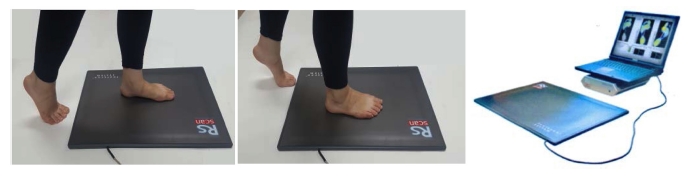
RS-scan system and gait measurement.
Plantar pressure was analyzed for different three foot regions defined as forefoot (FF), midfoot (MF) and rearfoot (RF) (Machado et al., 2016). Fig. 2 shows three regions of foot for plantar pressure. The contact phase of gait was divided into four phases (Fig. 3) according to the foot scan software. Every gait has 5 contact steps and 4 contact phases. The first contact is the initial contact phase (ICP), defined as the period from the first foot contact until first metatarsal contact. The second sub-phase is the forefoot contact phase (FFCP), which is the period immediately following the ICP, until all metatarsals contact with the floor. The third sub-step is the foot flat phase (FFP), follows FFCP and ends when the heel is off the floor. The fourth sub-step is the forefoot push-off phase (FFPOP), which starts when the heel is off the floor and ends when the foot is off the floor.
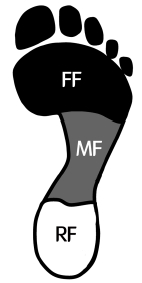
Three plantar regions. FF, forefoot; MF, midfoot; RF, rearfoot.
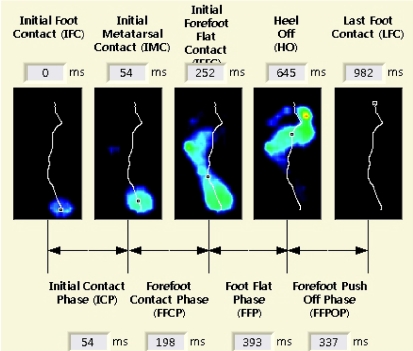
Gait measurement soft ware and four contact phase (ICP, FFCP, FFP, FFPOP).
2.3. Statistical Analysis
Data were taken as the average value of the right and left barefoot from the healthy independent elderly and the young adults. Analysis of variance (ANOVA) was performed to examine the age effect on plantar pressure distribution and contact time of gait. Statistical analyses were performed using SPSS version 20.0, and the level of significance of all statistical tests was set as p<0.05.
3. Results and Discussion
3.1. Plantar pressure
The participants’ plantar pressure by the contact areas of the forefoot (FF), midfoot (MF), and rearfoot (RF) across all two groups were summarized in Table 1. There was a slight difference in the values of left and right but no significant differences were found. In the comparison of average values in two groups, the elderly showed significantly less plantar pressure than young adult in every region but no asymmetry in plantar pressure, in other words, it could be interpreted that there was a tendency similar to that of young people in each region. In two groups, forefoot pressure showed the highest pressure, followed by rearfoot and midfoot midfoot . In table 1, we can find out that plantar pressure value itself in FF region is low in the elderly compare to young adults, but if you convert the plantar pressure value into percentage, it is rather high in the elderly. Especially, significant test results were getting better in MF region. Fig. 4 will help you to understand these results.

Plantar pressure by the contact areas(N/cm2)
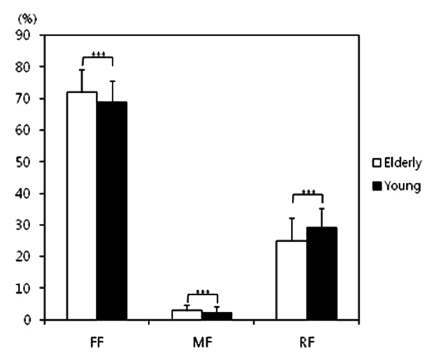
Plantar pressure value in percentage. FF, forefoot; MF, midfoot; RF, rearfoot. ***p<.001.
A major finding of this study was that during gait the elderly had increased plantar pressure towards forefoot when compared to the young group. In previous study (Machado et al., 2016), the elderly adults showed a clear change in foot sensitivity in parallel with the shift in plantar pressure. It could be explained that the forward shift in plantar pressure is related to a more stooped posture of elderly. When older individuals were asked to adopt a stooped posture, the center of pressure moves anteriorly, reaching values similar to those observed in elderly with Parkinson disease (Termoz et al., 2008). In these previous studies mentioned above, it is surprising that the elderly participants showed a clear change in plantar pressure in parallel with the shift in foot sensitivity. Although in this study, we did not measured sensitivity, it could be expected that sensitivity at the heel was reduced. Presumably, the young do depend less on foot sensitivity to control body sway, as measured by center of pressure displacements (Billot et al., 2015).
The previous research (Hills et al., 2001) about the plantar pressure between the two groups with a weight difference of 30kg or more, obese subjects showed increased forefoot width and higher plantar pressures during standing and walking compared to a nonobese group. This difference may be the result of reduced strength of the ligaments of the foot in obese women. These findings have implications for pain and discomfort in the lower extremity in the obese, the choice of footwear and predisposition to participation in activities of daily living such as walking. In the case of a person with normal weight, the change in the gait could be attributed to factors depending on age.
When crossing the obstacles, the elderly have decreased power to move forward because they have problem in maintaining dynamic balance control due to decreased load bearing capacity in lower extremity joint and muscle strength. However, stronger forward momentum due to increase in muscle strength and flexibility raised pressure in frontal part of the foot (Hahn & Chou, 2004; Kimmeskamp & Hennig, 2001). From the study of Kim & Hwangbo (2015), increased foot pressure after crossing the obstacle interpreted that ankle movement and weight bearing were more effectively controlled due to increased force against balance disturbance and forward momentum when crossing the obstacle.
This kind of measuring method of foot pressure is most widely used when examining such changes in mechanism or functional decline of foot. Movements that control equilibrium can be identified by measuring plantar pressure against ground with these highly reliable methods (Ahroni et al., 1998; Błaszczyk & Michalski, 2006).
3.2. Contact time
Table 2 shows foot contact time of initial contact phase (ICP), forefoot contact phase (FFCP), foot flat phase (FFP), forefoot pushoff phase (FFPOP) and total foot contact time respectively. There was a slight difference in the values of left and right but no significant differences were found. In the comparison of average values in two groups, the forefoot contact phase (FFCP), foot flat phase (FFP), and total foot contact time are significantly longer in the elderly than the young people (p<0.001). In forefoot push-off phase (FFPOP), the elderly shows less time than the young with significance (p<0.001). Longer total foot contact time in the elderly means that the old people show the decreased gait velocity.
Comparison of contact time on each gait phase between young and the elderly(ms)
Time percentage of each contact phase to total contact is plotted in Fig. 5. When we look at the ratio of each contact time to total contact, we can see that elderly adults have relatively more time % on the FFCP (p<.001) and FFP (p<.05), and significantly less time % on the ICP (p<.05) and FFPOP (p<.001) than young adults. These are displayed in the box in accordance with the walking sequence, and the schematic progression of center of pressure is marked with a line. These results imply that elderly and young adults have different temporal pressure progression during walking.
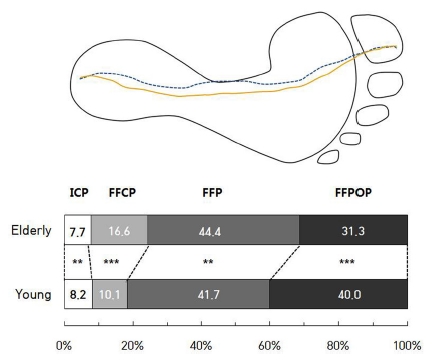
Time percentage of each contact phase and schematic progression of center of pressure. ICP, initial contact phase; FFCP, forefoot contact phase; FFP, foot flat phase; FFPOP, forefoot push-off phase.
Similarly, the research of Chiu et al. (2013) showed that age effect influences significantly time % during FFCP, FFP and FFPOP (p<.001). They explained that the elderly have a slower preferred walking speed than younger and walking at preferred speeds might reflect a movement strategy intended to enhance stability and adaptability. In Maki’s research (1997), he also reported decreased gait speed and stride length in the elderly. These changes of gait in the elderly may be stabilizing adaptation related to fear of falling.
With these results in mind, generally the elderly experience decreased dynamic stability while walking and need much more time during movement that requires balance control than young adults. Particularly, the elderly become more unstable when stance phase in one foot moves to the other accompanied with longer contact time and slower stepping. In turn, they explained that decreased total contact time also indicated increased dynamic stability and control ability (Hollman et al., 2011; Kilby et al., 2014; Kim & Hwangbo, 2015).
4. Conclusion
The aim of this study was to examine the gait characteristics between the Korean elderly and young adults. We evaluated the plantar pressure and contact time of gait between elderly subjects and young subjects. The main results were that the elderly showed significantly less plantar pressure than young adult in every region and significantly less time % on the initial contact phase (ICP),forefoot push-off phase (FFPOP) and significantly more % forefoot contact phase (FFCP) and foot flat phase (FFP).
A first major finding of the present study was that during walking the elderly had decreased plantar pressure in all 3 regions (FF, MF and RF) when compared to the young adults. Our result confirms the previous researches of Kim and Hwangbo (2015) and- Termoz et al. (2008). They reported that the elderly have decreased power to move forward when crossing the obstacles because they have problem in maintaining dynamic balance control due to decreased load bearing capacity in lower extremity joint and muscle strength. But the pressure value of converted to percentage, it showed more plantar pressure in forefoot (FF). We could explain that the forward shifting in plantar pressure are associated with a more flexed posture of elderly such as forward displacement of center of mass. With regard to forward shifting changes, Maki (1997) asserted that it would seem more likely actual stabilizing fear-related adaptations, rather than risk factors that increase the likelihood of falling. And also Machado et al. (2016) expressed that such shift toward forefoot could bean ongoing process in the independent elderly. It should be noted however that plantar pressure changes might also depend on other factors in elderly. Particularly there may be a deterioration of central processing of sensory input leading to changes in postural control.
In general, reductions of muscle strength and range of motion may cause abnormal foot posture and these changes may later contribute to the situation causing the foot pain and impaired balance and gait performance, in the elderly person (Mohd Said et al., 2016). Nevertheless, this gait change could be regarded not a risk factor that actually increases the likelihood of falls, but rather a stable adaptation from the fear of the fall.
A second major finding of present study was that the total foot contact time is significantly longer in the elderly than the young people. Longer total foot contact time in the elderly means that the old people show the decreased gait velocity. The results of this study appear to support the hypothesis of Maki (1997) that gait variability in spatial-temporal gait parameters would be an independent predictor of the likelihood of experiencing future falls. In other words, shorter stride length and lower velocity were found to be associated with pre-existing fear of falling.
The elderly also showed significantly less time % on the initial contact phase (ICP), forefoot push-off phase (FFPOP) and significantly more % forefoot contact phase (FFCP), foot flat phase (FFP), and total foot contact time.
Generally, the elderly experience decreased dynamic stability while walking and need much more time during movement that requires balance control than young adults. With longer contact time and slower stepping movement, the elderly become more unstable. Decreased total contact time indicates increased dynamic stability, increased control ability and increased confidence in movement, which in turn, decreased movement performance time. It should be consistent with the findings of Scott et al. (2007) that ageing is associated with significant changes in foot characteristics which contribute to altered plantar pressure and contact time during gait. Measuring the variability of plantar pressure and contact time of gait may also be useful in evaluating or monitoring interventions aimed at improving balance and walking. Finally, it should be mentioned that the future work should look into in more detail, to reveal which subareas are primarily associated with the contributions of receptors for plantar pressure and contact time of phase to understand the factors responsible for the gait variability with ageing. Further research is required to establish possible links to risk of falling, balance training and development of footwear in the elderly adults. As the pressure on the forefoot side of the elderly person increases, the sole of the footwear should be made softer. The forelimb part on the footwear should use a resilient structure and material for the next walking step. It is recommended the proper placement of metatarsal pad and the apex of rocker bottom sole. Any change in this pattern could be helpful if applied clinically or in everyday life.
Acknowledgments
This research was supported by Kyungpook National University Bokhyeon Research Fund, 2015.
References
-
Ahroni, J. H., Boyko, E. J., & Forsberg, R., (1998), Reliability of F-scan in-shoe measure-ments of plantar pressure, Foot & Ankle International, 19(10), p668-673.
[https://doi.org/10.1177/107110079801901004]

-
Anguera, J. A., & Gazzaley, A., (2012), Dissociation of motor and sensory inhibition processes in normal aging, Clincal Neurophysiology, 123(4), p730-740.
[https://doi.org/10.1016/j.clinph.2011.08.024]
-
Billot, M., Handrigan, G. A., Simoneau, M., & Teasdale, N., (2015), Reduced plantar sole sensitivity induces balance control modifications to compensate ankle tendon vibration and vision deprivation, Journal of Electromyography and Kinesiology, 25(1), p155-160.
[https://doi.org/10.1016/j.jelekin.2014.06.003]
- Blaszczyk, J. W., & Michalski, A., (2006), Ageing and postural stability, Studies in Physical Culture and Tourism, 13, p11-14.
-
Burnfield, J. M., Few, C. D., Mohamed., O. S., & Perry, J., (2004), The influence of walking speed and footwear on plantar pressures in older adults, Clinical Biomechnics, 19(1), p78-84.
[https://doi.org/10.1016/j.clinbiomech.2003.09.007]
-
Chiu, M. C., Wu, H. C., Chang, L. Y., & Wu, M. H., (2013), Center of pressure progression characteristics under the plantar region for elderly adults, Gait & Posture, 37(3), p408-412.
[https://doi.org/10.1016/j.gaitpost.2012.08.010]
-
Eils, E., Nolte, S., Tewes, M., Thorwesten, L., Völker, K., & Rosenbaum, D., (2002), Modified pressure distribution patterns in walking following reduction of plantar sensation, Journal of Biomechanics, 35(10), p1307-1313.
[https://doi.org/10.1016/s0021-9290(02)00168-9]
-
Hahn, M. E., & Chou, L. S., (2004), Age-related reduction in sagittal plane center of mass motion during obstacle crossing, Journal of Biomechanics, 37(6), p837-844.
[https://doi.org/10.1016/j.jbiomech.2003.11.010]
-
Hills, A. P., Hennig, E. M., McDonald, M., & Bar-Or, O., (2001), Plantar pressure differences between obese and nonobese adults: a biomechanical analysis, International Journal of Obesity, 25, p1674-1679.
[https://doi.org/10.1038/sj.ijo.0801785]
-
Hollman, J. H., McDade, E. M., & Petersen, R. C., (2011), Normative spatiotemporal gait parameters in older adults, Gait & Posture, 34(1), p111-118.
[https://doi.org/10.1016/j.gaitpost.2011.03.024]
-
Kernozek, T. W., & LaMott, E. E., (1995), Comparisons of plantar pressures between the elderly and young adults, Gait & Posture, 3(3), p143-148.
[https://doi.org/10.1016/0966-6362(95)99064-R]
-
Kilby, M. C., Slobounov, S. M., & Newell, K. M., (2014), Postural instability detection: Aging and the complexity of spatial-temporal distributional patterns for virtually contacting the stability boundary in human stance, Postural Instability Detection in Aging, 9(10), p1-12.
[https://doi.org/10.1371/journal.pone.0108905]
-
Kimmeskamp, S., & Hennig, E. M., (2001), Heel to toe motion characteristics in Parkinson patients during free walking, Clinical Biomechanics, 16(9), p806-812.
[https://doi.org/10.1016/s0268-0033(01)00069-9]
-
Kim, S. G., & Hwangbo, G., (2015), The effect of obstacle gait training on the plantar pressure and contact time of elderly women, Archives of Gerontology and Geriatrics, 60(3), p401-404.
[https://doi.org/10.1016/j.archger.2015.02.007]
-
Kim, S. G., Nam, C. W., & Yong, M. S., (2014), The effect of increase in baggage weight on elderly women’s lower extremity muscle activation during gait, Archives of Gerontology and Geriatrics, 59(3), p574-576.
[https://doi.org/10.1016/j.archger.2014.07.015]
-
Machado, A. S., Bombach, G. D., Duysens, J., & Carpes, F. P., (2016), Differences in foot sensitivity and plantar pressure between young adults and elderly, Archives of Gerontology and Geriatrics, 63, p67-71.
[https://doi.org/10.1016/j.archger.2015.11.005]
-
Maki, B. E., (1997), Gait changes in older adults: Predictors of falls or indicators of fear?, Journal of the American Geriatrics Society, 45(3), p313-320.
[https://doi.org/10.1111/j.1532-5415.1997.tb00946.x]
-
Mohd Said, A., Justine, M., & Manaf, H., (2016), Plantar pressure distribution among older persons with different types of foot and its correlation with functional reach distance, Scientifica, 2016, p8564020.
[https://doi.org/10.1155/2016/8564020]
- Rai, D. V., & Aggarwal, L. M., (2006), The study of plantar pressure distribution in normal and pathological foot, Polish Journal of Medical Physics and Engineering, 12(1), p25-34.
-
Scott, G., Menz, H. B., & Newcombe, L., (2007), Age-related differences in foot structure and function, Gait & Posture, 26(1), p68-75.
[https://doi.org/10.1016/j.gaitpost.2006.07.009]
-
Termoz, N., Halliday, S. E., Winter, D. A., Frank, J. S., Patla, A. E., & Prince, F., (2008), The control of upright stance in young, elderly and persons with Parkinson’s disease, Gait and Posture, 27(3), p463-47.
[https://doi.org/10.1016/j.gaitpost.2007.05.015]